
Results
-
 £33.62
Miserere mei, Deus (Brass Band) Gregorio Allegri arr. Espen Haukas
Miserere mei, Deus was composed by the Italian composer Gregorio Allegri (1582-1652) during the 1630s for use in the Sistine Chapel during matins, as part of the exclusive Tenebrae service on Wednesday and Friday of the Holy Week. The Miserere is written for two choirs, one of five and one of four voices, and is generally accepted to be one of the finest examples of Renaissance polyphony to survive to the present day. Tutti choirs sing a simple version of the original Miserere chant; one voice then, spatially separated, sings an ornamented "commentary" on this. The comment-part is left out in this arrangement due to its meaning with text, though monotonous in tune. The introduction is added by the arranger to set the right atmosphere before the original chant is played. The brass choirs are meant to be placed opposite each other in a church or large hall. To view a video of Norges Nasjonale Brassband performing the piece please visit www.youtube.com/watch?v=YrJU3lwYD9U PDF download includes score and parts. Sheet music available from: UK - www.brassband.co.uk USA - www.solidbrassmusic.com Difficulty Level: 4th Section + Instrumentation: Brass Choir 1: Solo Cornets (incl. Repiano) Horn in Eb Tenor Trombones in Bb Euphoniums Basses in Bb Timpani Brass Choir 2: Soprano Cornet in Eb 2nd Cornets in Bb 3rd Cornets in Bb Flugelhorn Horns in Eb Baritones Bass Trombone Basses in Eb
In Stock: Estimated dispatch 1-3 working days
-
Postman Pat - Bryan Daly - Len Jenkins
The original music for the phenomenally successful Postman Pat series was composed by Bryan Daly (who sadly died in January 2012) and included not only the well-known theme tune "Postman Pat & His Black and White Cat", but also the tuba solo "Walking in Greendale", both of which are now available, arranged for brass, from Wobbleco Music. The theme tune was originally sung by Ken Barrie and was released as a single in the UK where it reached number 44 in the charts in July 1982. The Postman Pat TV series and the later Postman Pat SDS TV series continue to delight and entertain children not least because of the instantly recognizable theme tune. What is less well known is that Bryan was also one of the most sought-after session-musician guitar players of the 1960's and 1970's, a first-call studio musician for the likes of Burt Bacharach, and his performances grace numerous classic hit recordings that have remained radio staples to this day. This "twin-pack" contains 2 arrangements: one of which follows faithfully the original theme and is generally A4 in size, and another which is a march/fete edition and is slightly easier to play. They are printed back-to-back and by folding the parts in half, the march/fete edition becomes lyre-ready.
-
 £55.00
The Millionaire Waltz
ABOUT THIS PIECE: Bring the theatrical brilliance of Queen to your brass band with this dazzling arrangement of The Millionaire Waltz. Written by Freddie Mercury and featured on the band's 1976 album A Day at the Races, this whimsical and dynamic piece showcases Mercury's love for classical and operatic influences, blending waltz rhythms with rock elements in a truly unique style. Renowned for its intricate structure and playful shifts in mood and tempo, The Millionaire Waltz is a standout example of Queen's innovative approach to songwriting. This arrangement captures the piece's exuberance and charm, offering a delightful addition to your brass band's repertoire. "The Millionaire Waltz is quite outlandish, really. It's the kind of track I like to put on every album. Something way outside Queen's format." Freddie Mercury; Circus magazine, 31 January 1977 ENSEMBLE: Standard British Brass Band WHEN YOU BUY THIS PRODUCT, YOU GET: High-quality printed score and parts LEVEL: 3 - 4 LISTEN: DURATION: 5-minutes EXAMPLE SCORE: Click here LEVEL GUIDE: Level 1- Accessible to all Level 2 - c. UK third section and higher Level 3 - c. UK second section and higher Level 4 - c. UK first section and higher Level 5 - c. UK championship section level
Estimated dispatch 5-7 working days
-
 £94.99
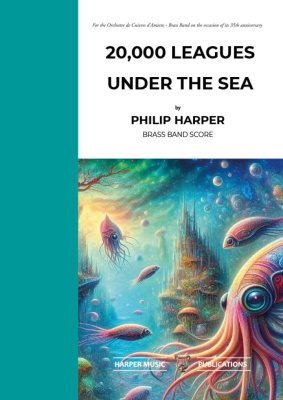
20,000 Leagues Under the Sea (Brass Band - Score and Parts)
Frenchman Jules Verne was a pioneer in science fiction during the late 19th Century, penning some classic stories such as Journey to the Centre of the Earth and Around the World in 80 Days - both of which have already been the subject of brass band test-pieces. It was therefore natural for me to choose Verne's 1869 watery magnum opus as the subject for this piece to which there are five sections, as well as an introduction and a finale.THE NAUTILUS. After a mysterious introduction we are introduced to The Nautilus - a fantastical submarine.THE CORAL KINGDOM. We visit awe-inspiring underwater coral formations.SQUID ATTACK. The Nautilus is attacked by a school of giant squid, or 'devilfish'.CAPTAIN NEMO. Captain Nemo is a loner and an eccentric. Some say he is a madman. Soloists of the band help to uncover the character of this enigmatic but powerful figure.MAELSTROM. The Nautilus is dragged into the ocean's deadliest whirlpool but Captain Nemo lives to fight another day.Duration: 12.30
Estimated dispatch 7-14 working days
-
£43.99
20,000 Leagues Under the Sea (Brass Band - Score only)
Frenchman Jules Verne was a pioneer in science fiction during the late 19th Century, penning some classic stories such as Journey to the Centre of the Earth and Around the World in 80 Days - both of which have already been the subject of brass band test-pieces. It was therefore natural for me to choose Verne's 1869 watery magnum opus as the subject for this piece to which there are five sections, as well as an introduction and a finale.THE NAUTILUS. After a mysterious introduction we are introduced to The Nautilus - a fantastical submarine.THE CORAL KINGDOM. We visit awe-inspiring underwater coral formations.SQUID ATTACK. The Nautilus is attacked by a school of giant squid, or 'devilfish'.CAPTAIN NEMO. Captain Nemo is a loner and an eccentric. Some say he is a madman. Soloists of the band help to uncover the character of this enigmatic but powerful figure.MAELSTROM. The Nautilus is dragged into the ocean's deadliest whirlpool but Captain Nemo lives to fight another day.Duration: 12.30
Estimated dispatch 7-14 working days
-
 £40.00
Losgaintir. For solo Baritone/Euphonium and brass band composed by Andrew Duncan
Recommended - Championship to 2nd Section Written for Katrina Marzella and the Black Dyke band, Losgaintir (or Luskentyre in English) is one of my favourite places in Scotland. Losgaintir is on the west coast of the isle of Harris in the Outer Hebrides and has an outstanding beach widely regarded as one of the most beautiful in the world. Losgaintir is a wonderful place to be on warm sunny days with its long stretch of white sands, aqua marine seas, the incredible mountain backdrop of south Lewis and the uninhabited island of Taransaigh in view. The weather in Harris is notorious for changing very quickly and this piece tries to reflect this. Although idyllic on a calm, sunny days, on stormy days Losgaintir's character becomes dark and foreboding, with low dark clouds and sweeping winds from the Atlantic creating a dark, brooding atmosphere. The opening melody (written modally like a traditional Scottish Gaelic air) depicts the calm serenity of Losgaintir on a beautiful summer's day. The character of the fast section that follows portrays winter in Losgaintir during a tempestuous storm with bracing winds. Includes score & parts Also see: Losgaintir for Solo Baritone/Euphonium & Piano
-
 £18.00
Es ist ein Ros Entsprungen
DescriptionEs ist ein Ros Entsprungen is sometimes sung to the English words "A Great and Mighty Wonder". This tune to the reformation era German carol first appeared in the Speyer Hymnal in Cologne in 1599. This harmonisation of the tune by Michael Praetorius in 1609, one of his earliest publications. Praetorius was, along with his slightly younger contemporary Heinrich Schutz, the foremost German composer of the day, and became famous for his choral music. Much of this was written for multiple groups positioned around the church and conducted by a central conductor, giving a multi-phonic effect similar to the Venetian music of Gabrieli. Today his most famous music is Terpsichore, a collection of over 300 secular dances.You can follow the preview video of the score below.PercussionPercussion required are timpani and clash cymbals only; if clash cymbals are not available this part should be omitted (rather than played on a suspended cymbal).Mutes2 x solo cornets, second cornets and all trombones will require cup mutes
Estimated dispatch 7-14 working days
-
 £45.00
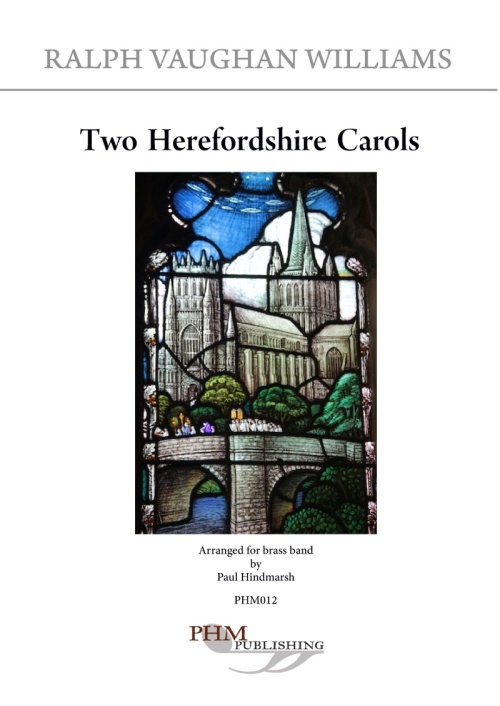
Two Herefordshire Carols (Brass Band - Score and Parts)
The two traditional tunes that comprise this straightforward setting were sung to Ralph Vaughan Williams (1872-1958) by Mrs. Esther Smith of Dilwyn, near Hereford, during one of the great composer's folk song collecting tours of England in the early years of the twentieth century. They were included in Twelve Traditional Carols from Herefordshire, edited by E.M. Leather and Vaughan Williams. The words to which Mrs. Smith sung the first tune were probably drawn from eighteenth century evangelical sources. The editors replaced these with six of the 16 verses of a traditional seventeenth century carol text, Joseph and Mary.The second melody, which appears as the centre piece of this arrangement, was sung to a carol that tells of a farmer who ploughed on Christmas Day. It is in fact a translation of a German traditional carol Gelobet seist du Jesu Christ that was published in Goodly Psalmes and Spiritualle Songes (1546) translated by Miles Coverdale. Vaughan Williams used the title Coverdale's Carol.The brass band settings follow the settings made by Vaughan Williams in 1920 for the Oxford Book of Carols. Since his simple harmonic approach is similar in both settings, three verses of his haunting version of Coverdale's Carol have been folded inside four verses of the slightly more animated treatment of Joseph and Mary. The harmonisations of Vaughan Williams have been given some brass band colour, with some verses taken by soloists from the ensemble. The accompaniment figuration that embellishes the second verse of Joseph and Mary has been used to open and close this arrangement and to bind the verses together.- Paul HindmarshDuration: 5.00
Estimated dispatch 7-14 working days
-
 £74.95
Platform to the Heavens (Brass Band - Score and Parts)
The piece takes its inspiration from the mountain ranges from one of my favourite countries, Switzerland.I have visited the Swiss Alps on many occasions and I am still taken back by its sheer awesome beauty with every visit. This commission gave me the opportunity to pay homage to this wonderful landscape and paint my own musical picture of it.The piece opens with what I imagine daybreak would be like at one of its many peaks. With the sun growing behind the mountain range, the piece builds from a single note to a huge climatic chord revealing Mother Nature's creation.Then at rehearsal figure 'C' the tempo changes dramatically as we fly through the many slopes of the mountains as if on a manic skiing expedition, revealing the many dangers within the Swiss Alps.The twists, turns and climaxes begin to die away as we enter rehearsal figure 'M' - nightfall over the mountains. As the sun disappears, the sky darkens to reveal the beautiful starlit sky above the mountain range. This middle section starts with the various cadenzas that serve as echoes around the Alps. It then leads to a lyrical solo at rehearsal figure 'O' as the moonlight illuminates the icy mountain peaks. A final cadenza to conclude this section highlights the end of nightfall as the sun starts to rise again.This recapitulation from the opening, signals a new dawn as the sun rises above the snowy peaks once again. The music at this point in its slightly altered state highlights the dawn of a new day in the Alps. The fast manic ski ride follows which takes the piece to its grand finale conclusion.The idea behind the title of this piece is that the Swiss Alps are so beautiful and vast; I can only imagine that they could be a platform connecting the earth to the heavens above.Paul Lovatt-Cooper
Estimated dispatch 7-14 working days
-
£69.95
STARMAKER (Brass Band Set) - Ray Steadman-Allen
Described by the composer as one of his more ambitious works for brass band, this work is in three movements. Although each movement is capable of standing alone, the composer's own concept is totality with the three movements forming a composite whole. Starmaker presents in music the concept of God's creation of the universe. The frantic and sometimes harsh music of the first movement portrays the chaos from which the immortal and invisible wisdom of God created the order and structure of the heavens, with the stars and planets in their ordered places. An exquisite second movement, based on the benediction 'Now the day is over', brings a calm and ordered peace to the universe, also reminding listeners of the night sky, when God's amazing work is best viewed in all its awesome wonder. The final movement is celebratory in nature, with fragments of melodies like 'Praise to the Lord, the Almighty, the King of creation' appearing in various guises.
Estimated dispatch 7-14 working days