
Results
-
 £77.00
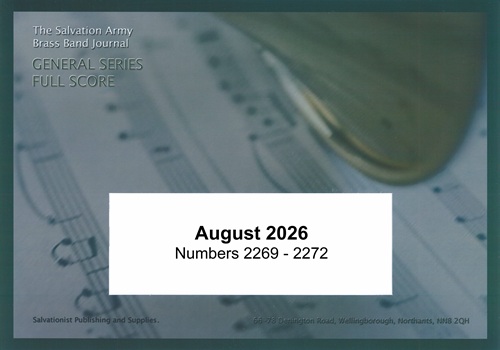
General Series Brass Band Journal, Numbers 2269 - 2272, August 2026
2269: Intrada - Christians Awake (Stephen Gibson)This intrada heralds the happy morning when Christians celebrate the birth of Jesus. Fanfares surround the traditional Christmas Day hymn, Christians Awake (C.C. 20), where we are encouraged to 'awake, salute the happy morn'. Written in a processional style, this music was composed as a concert opener to be performed in a large church setting.2270: Jesus loves me (Stanley Kelley)Jesus loves me! (S.A.S.B. 807) is a song many church-goers learn as children. While written for children, its message is for everyone. John 15:9 says, 'As the Father has loved me, so have I loved you.'2271: Prelude on 'Deep Harmony' (Geoffrey Nobes)This piece was written for the Blendworth Band of Hampshire. The hymn tune, by Handel Parker, is one of the most beautiful and iconic melodies ever written, with lovely harmony supporting the rise and fall of a simple but perfect melodic line.2272: To the hills (Paul Sharman)The inspiration for this arrangement came during a walking holiday in the Lake District. Looking towards the hills brought to mind the words of Psalm 121 and Ernest Rance's setting of that passage, I Lift Up My Eyes (S.A.S.B. 208), with its lovely tune Ochills. This arrangement was written shortly after the composer's return home.
Estimated dispatch 7-14 working days
-
 £44.95
Judd: Daystar
The title of this work is taken from 2 Peter 1:19 which refers to the word of prophecy about 'the light that shineth in a dark place, until the day dawn, and the day star arise in your hearts'.The beautiful hymn tune Ascalon is the main focal point while the composer also makes use of the less well-known melody My Saviour suffered on the tree.
Estimated dispatch 7-14 working days
-
 £19.95
Mythical Tales (Brass Quintet)
Mythical Tales (2012) is a ten minute work in three movements which represents three of the most popular folk stories or indeed in the case of the first movement, true stories, in Welsh culture.I. Owain GlyndwrOwain Glyn Dwr was born around the 1350s into an Anglo-Welsh gentry family. His estates provided him with a modest power base in north-east Wales. After a number of disputes, he proclaimed himself prince of Wales in September 1400.Glyn Dwr led several battles with the English, although he was never captured. Over the next few years punitive measures were enacted to keep control of Wales, but these were matched by many acts of Welsh rebellion - among them the capture of Conwy Castle in April 1401. In June 1402, at the Battle of Pilleth on Bryn Glas Hill, Glyn Dwr led his troops to victory over an English army. By now Glyn Dwr was leading a national revolt. In 1404, he led a march towards Wocester, but failed, with the English capturing parts of Wales. He died defending his country.II. MyfanwyMyfanwy was the most beautiful woman in Powys, but she was vain and liked nothing better than to be told how beautiful she was. Many handsome men would court her, but she would not show interest because they couldn't sing and play to her, reflecting her true beauty.Luckily, a penniless bard, Hywel ap Einion was in love with Myfanwy, and one day plucked up the courage to climb up the hill to the castle with his harp, to sing and play to her. He's allowed in to play for her, and while he's playing and complimenting her on her beauty she can neither listen nor look at any other man. Because of this Hywel believes that she has fallen in love with him. But his hopes are dashed when a richer, more handsome and more eloquent lover comes along. The music of the second movement portrays the despair and upset that Hywel must have felt.III. Battle of the DragonsMany centuries ago when dragons roamed the land, a white ice dragon descended on a small village and decided to live there, not knowing that a red fire dragon was already living nearby.Six months later the red dragon awoke to find a huge white dragon wrapped around his village that he cared for. He could tell that his people were ill from the cold. The Land was bare; nothing was able to grow not even the pesky dandelions. The people were starving. The people longed for the red dragon to free them from the icy misery, so that their life and land could return to the sunny and warm climate that it was once before.The red fire dragon challenged the white ice dragon to a single combat fight at the top of the cliff the next day. The people of the village watched in terror awaiting their fate. The red dragon beat the white dragon, and the crowd cheered with joy as the red dragon roared with triumph. The mayor of the village declared that the land should always fly a flag with the symbol of a Red dragon on it. The flag's background should be half green and half white; the green to represent the lush green grass of the land and the white to represent the ice. This way no one would ever forget what happened.
Estimated dispatch 7-14 working days
-
£44.95
DAYSTAR (Brass Band Set) - Ray Steadman-Allen
The title of this work is taken from 2 Peter 1:19 which refers to the word of prophecy about 'the light that shineth in a dark place, until the day dawn, and the day star arise in your hearts'. The beautiful hymn tune Ascalon is the main focal point while the composer also makes use of the less well-known melody My Saviour suffered on the tree.
Estimated dispatch 7-14 working days
-
 £33.62
Bagatelle No.25 in A Minor - Fur Elise (Brass Band) Beethoven arr. Olaf Ritman
Perhaps the most well-known piano piece by Ludwig van Beethoven, Bagatelle No. 25 in A Minor (written around 1810) is better known under its subtitle 'Fur Elise'. Even to this day it is still unknown who Elise was, with at least four theories claiming to tell the story. It might have been one of Beethoven's students or Therese Malfatti, a young lady who got much attention from him. The theory is that Beethoven's autograph Ludwig Nohl could not decipher his handwriting and might have read Elise instead of Therese. Nevertheless the piece has become extremely popular over the last two centuries and is often the very first real classical piece a beginner pianist goes to. Many classical pieces have been transcribed in contemporary fashion for brass bands in recent times, with Toccata in D Minor by J.S. Bach arranged by Ray Farr being the most popular and more recently Vivaldi's first part of Winter from The Four Seasons arranged by Philip Harper. This arrangement of Fur Elise fits in this series perfectly and seeks to bring a smile to its listeners. The last two bars are a direct tribute to Ray Farr's aforementioned arrangement of Toccata. To view a video of the Amsterdam Staff Band performing the work please visit https://www.youtube.com/watch?v=sdLI7U-aplw Duration: 3.15 minutes approx. Difficulty Level: 2nd Section + PDF download includes parts and score. Sheet music available from www.brassband.co.uk Instrumentation: Soprano Cornet Eb Solo Cornet Bb Repiano Cornet Bb 2nd Cornet Bb 3rd Cornet Bb Flugel Horn Bb Solo Horn Eb 1st Horn Eb 2nd Horn Eb 1st Baritone Bb 2nd Baritone Bb 1st Trombone Bb 2nd Trombone Bb Bass Trombone Euphonium Bb Bass Eb Bass BbTimpani Percussion 1-3
In Stock: Estimated dispatch 1-3 working days
-
 £44.83
City of David (Brass Band) Philip Rayment
This engaging major Christmas work features three carols or songs associated with the place of Christ's birth: Once In Royal David's City, O Little Town of Bethlehem (Forest Green) and How Far Is It To Bethlehem? During Old Testament times, the city of Jerusalem had been considered the 'City of David', as the political and spiritual capital of Israel. However, after Christ's birth, that name was given to the town of Bethlehem - a quiet farming village in the countryside. This new designation is first mentioned in the Gospel of Luke: ''For unto you is born this day in the City of David a Saviour, which is Christ the Lord.' (Luke 2:11) A variety of moods are used to express:- The crowds of people arriving in Bethlehem to be taxed, overtaking the town, leaving no room for a young, pregnant Mary and her husband.- The stillness of the countryside on the eve of Christ's birth.- The excitement of worshippers celebrating the birth of a Saviour. To view performances of the work please visit: Canadian Staff Band: www.youtube.com/watch?v=0UC-j9jBsx4 Five Lakes Silver Band: www.youtube.com/watch?v=aCn4JjQCe9A Duration: 7.30 minutes approx. Difficulty Level: 2nd Section + PDF download includes parts and score. Sheet music available here. Instrumentation: Soprano Cornet Eb Solo Cornet Bb 1st Cornet Bb 2nd Cornet Bb Flugel Horn Bb Solo Horn Eb 1st Horn Eb 2nd Horn Eb 1st Baritone Bb 2nd Baritone Bb 1st Trombone Bb 2nd Trombone Bb Bass Trombone Euphonium Bb Bass Eb Bass BbTimpani Percussion 1-3
In Stock: Estimated dispatch 1-3 working days
-
 £33.62
E lucevan le stelle (Cornet/Euphonium Duet with Brass Band) Puccini arr.Bushnell
Tosca is an opera in three acts by the Italian composer Giacomo Puccini. The opera is set in June 1800 in Rome, and tells the story of the Kingdom of Naples and the threat to its control of Rome by Napoleon's invasion of Italy. Some of Puccini's best-known arias can be found in Tosca. The opera is based on Victorien Sardou's dramatic play of the same name (La Tosca). Puccini saw the play at least twice in 1889 and begged his publisher, Giulio Ricordi, to obtain the rights to turn it into an opera, which were secured in 1891 - although Puccini relinquished the rights to Alberto Franchetti before being recommissioned in 1895. Puccini wrote "I see in this Tosca the opera I need, with no overblown proportions, no elaborate spectacle, nor will it call for the usual excessive amount of music." It took four years to write, with Puccini arguing with his librettists (Luigi Illica and Giuseppe Giacosa) and his publisher. Although the first performance was delayed by a day due to the unrest in Rome at the time, the opera was premiered on 14 January 1900 at the Teatro Costanzi in Rome. The critics reviews were indifferent, but it was an immediate success with the public. The opera is through-composed, with the different musical elements weaved from piece to piece. Puccini used the Wagner's leitmotif concept to identity different parts of the opera. Taken from Act 3, E lucevan le stelle is sung by Cavaradossi, a painter, who has fallen for the singer Tosca. The corrupt Chief of Police, Baron Scarpia, longs for Tosca himself and, upon suspecting Cavaradossi of helping a political prisoner escape, he takes the opportunity to get rid of Cavaradossi and blackmail Tosca into being with him. The guards lead Cavaradossi to the roof of Castel Sant'Angelo, where he is told he has 1 hour to live before being executed. He asks to write a letter to Tosca, overcome by memories, he sings E lucevan le stelle (And the stars shone). It was selected by the tenor Wynne Evans as one of the most romantic songs for his top ten arias for Classic FM. He described it as "another tenor classic, both tragic and beautiful." This arrangement (for cornet and euphonium duet with brass band) includes alternative parts for horns in F and lower brass in bass clef. A recording of the original song can be found here: www.youtube.com/watch?v=EAqHQMX7GHY
In Stock: Estimated dispatch 1-3 working days
" frameborder="0" allowfullscreen> -
 £55.00
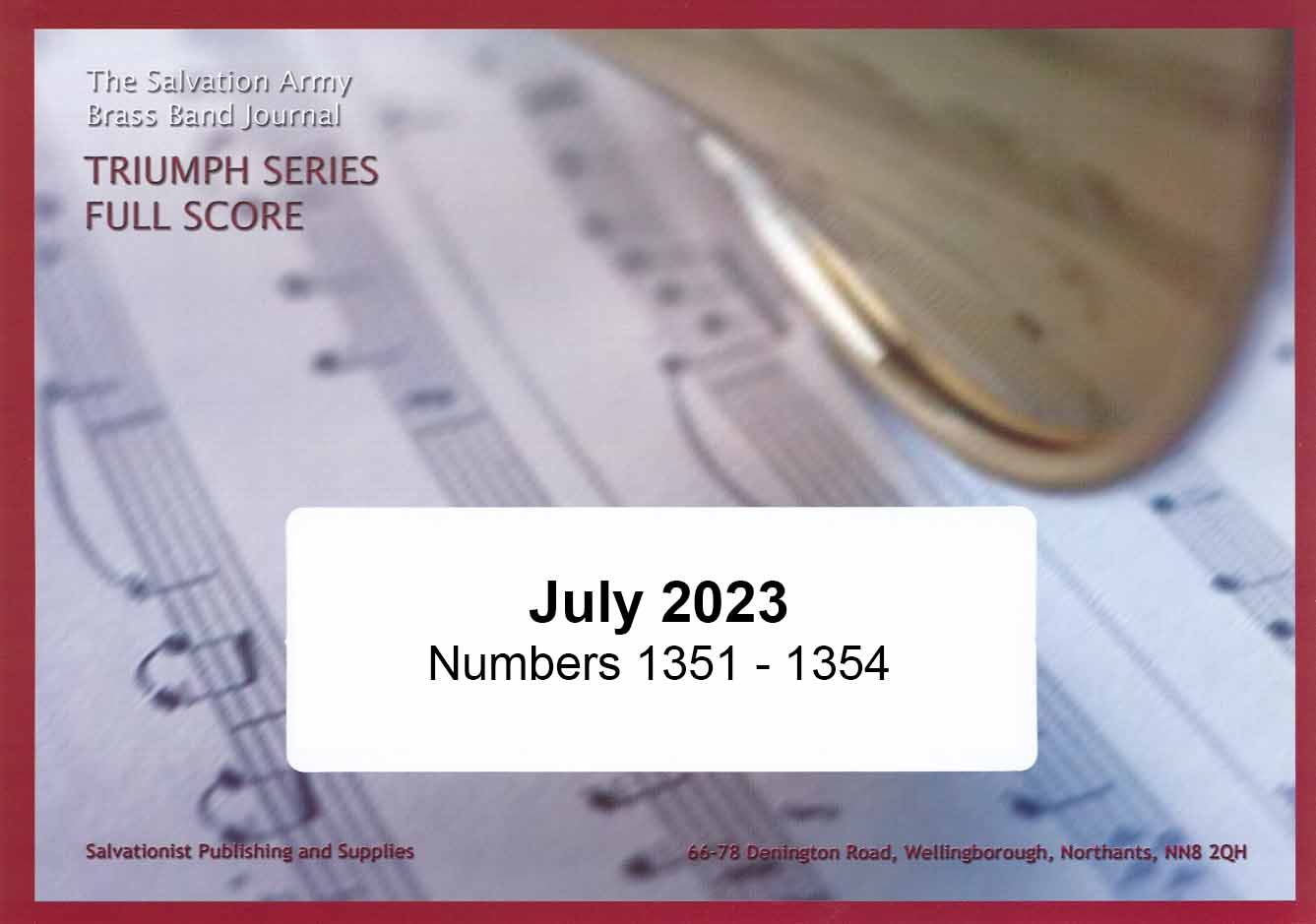
Triumph Series Brass Band Journal, Numbers 1351 - 1354, July 2023
1351: The anointed King (Marcus Venables)This piece was originally written as a massed band item for the Ontario Central-East Divisional Music Day in 2019. The updated version includes two songs, King of kings, majesty (S.A.S.B. 376) and O worship the King (S.A.S.B. 52) to a rhythmic setting of the tune Laudate Dominum (T.B. 481). Both songs present the contrasting characteristics of God; the powerful King and gentle, loving Saviour.1352: A suite of English Christmas carols (Kenneth Downie)This suite is the result of a request for a piece of music featuring exclusively English Christmas carols.The first movement features The holly and the ivy (C.C. 87). In sharp contrast, the second movement calls for a broad, sensitive, song-like approach. Using The cherry tree carol (C.C. 85), a much slower tempo than is normally applied to encourage the listener to see this beautiful tune in a new light. The rumbustious arrival of the finale is based on I saw three ships come sailing in (C.C. 44) with the festive mood prevailing until the end.1353: Nothing but thy blood (Norman Bearcroft)This two-verse setting of Richard Slater's much-loved hymn Nothing but thy blood (S.A.S.B. 769) appears straight-forward in nature, but requires a careful sense of the musical line across all parts.1354: Meditation - Reflections on Advent (Andrew Blyth)Two well-known carols, Away in a manger (C.C. 12) and Silent Night! (C.C. 77) are featured alongside original material. The piece attempts to convey a sense of reflection and meditation on the wonderful and awe-inspiring Advent story.
Estimated dispatch 7-14 working days
-
 £50.00
Judd: Beulah Land
Wilfred Heaton began to assemble material for 'Beulah Land' in the early 1990s following a request from the Amsterdam Staff Band for a new work. Despite reminding himself on the manuscript that he should either complete or destroy the work before his death, ultimately he did not manage either. This edition was subsequently realised in 2003 for the tour of the USA Western States by the Amsterdam Staff Band. 'Beulah Land' is Heaton's vision of the joy that awaits the Christian in Heaven and, according to his family, is reminiscent of the kind of music he often improvised at the piano. The three movements are as follows; 1. Better World; a waltz sequence on the tune 'Zealley' to which the words 'There is a better world, they say' are sung.2. Heavenly Home; an elegiac cortege using the tunes 'My home is in Heaven', 'I have a home that is fairer than day' and 'The home over there'.3. Happy Land; Beginning in waltz rhythm this soon gives way to a sequence of free variations on the song 'There is a happy land, Far, far away'.
Estimated dispatch 7-14 working days
-
£59.95
BEULAH LAND (Brass Band Set) - Wilfred Heaton - Paul Hindmarsh
Wilfred Heaton began to assemble material for 'Beulah Land' in the early 1990s following a request from the Amsterdam Staff Band for a new work. Despite reminding himself on the manuscript that he should either complete or destroy the work before his death, ultimately he did not manage either. This edition was subsequently realised in 2003 for the tour of the USA Western States by the Amsterdam Staff Band.'Beulah Land' is Heaton's vision of the joy that awaits the Christian in Heaven and, according to his family, is reminiscent of the kind of music he often improvised at the piano. The three movements are as follows;1. Better World; a waltz sequence on the tune 'Zealley' to which the words 'There is a better world, they say' are sung.2. Heavenly Home; an elegiac cortege using the tunes 'My home is in Heaven', 'I have a home that is fairer than day' and 'The home over there'.3. Happy Land; Beginning in waltz rhythm this soon gives way to a sequence of free variations on the song 'There is a happy land, Far, far away'.
Estimated dispatch 7-14 working days