
Results
-
£72.99
Cinemania - Robert Finn
This music sounds as if it came straight off the cinema screen. However, there's no movie for this fantastic score! Just like EVERY good film score, this work also includes moving melodies, fast virtuoso passages and, last but not least, a romantic love theme. The instrumentation takes into account that a group may not be complete and this means that the piece can be played by practically every orchestra. Highly recommended for concerts and competitions.
Estimated dispatch 5-14 working days
-
 £76.99
Showtime ! - Sven Van Calster
In this piece, which consists of four contrasting sections in which doubling of parts make it suitable for a wide range of bands. The first part is a kind of musical appetizer which has a heavy disco beat while the second part is a romantic ballad. The third part is inspired by an Irish dance and the last part is a variation of the first part with a spectacular ending. This work makes an ideal challenge for dynamic and young bands.
Estimated dispatch 5-14 working days
-
 £76.99
Hymn To The Fallen (From Saving Private Ryan) - John Williams - Steven Verhaert
Hymn To The Fallen is the main theme from one of the most succesful movies of the last decade: Saving Private Ryan. Steven Verhaert especially arranged this heart-rending hymn for a wind orchestra.The melancholic atmosphere that flows out of this beautiful air characterizes the entire movie.
Estimated dispatch 5-14 working days
-
 £76.99
Oregon - Jacob de Haan
This fantasy tells the story of Oregon, one of Americas north-western states. Traveling by train on the Northern Pacific Railroad, the listener is taken through the fascinating Oregon landscape. Indians, cowboys, golddiggers and hooded wagons will file past on this adventurous journey. The piece has some similarities with a soundtrack of a movie. Various melodies, which could be the main themes of a movie, pass the review.The piece begins in a slow movement, introducing the first theme in minor. Then we hear in the following fast movement the trombones imitate the train, whistling the steam-flute. We hear the characteristic minor theme again, but now in differentvariants(also in major). The rythmic structure of 'western' stile and rock succeed each other. This is leading to the slow movement, where the signals of horns and trumpets introduce a wonderful vocal melody. After this characteristic melody, the fast movement appears shortly again, the trombones whistling the steam-flute again (now in major). We hear also some musical elements, that plays a part in the following Presto. Barchanges, jazzy chords, interesting rhytmic patterns (with bongo) and an original theme are the characteristics of this Presto. After this, the horns announce the last section of the piece. Interesting is the fact that we hear in this Allegro section a variant of the vocal melody in the slow movement. Also the Presto theme returns shortly, followed by the Allargando, which is a grand characteristic end of a soundtrack. The movie of our travelling fantasy has come to an end.
Estimated dispatch 5-14 working days
-
 £104.99
Slavia - Jan Van der Roost
Jan Van der Roost originally composed each and every note of 'Slavia' (as in case in 'Puszta', 'Rikudim' and 'A Highland Rhapsody'). Consequently, 'Slavia' does not contain any arrangement of existing tunes, but is an original composition 'in the style of...'. The introduction has an ABA structure and exposes a broad melodic line. Following a short cadenza, there is a second movement in a fast and fiery tempo. The tempi increase, gradually culminating in an exciting final climax, making this 'Slavonic Rhapsody' a spell-binding experience to the very last note.
Estimated dispatch 5-14 working days
-
 £60.99
Allein Gott in der Hoh' sei Ehr - Jacob de Haan
Jacob de Haan begins his arrangement of the well-known hymn Allein Gott in der Hoh' sei Ehr (All Glory Be to God on High) with a quotation from his own Missa Katharina, a mass for choir, soprano, and band. To this melody he sets the Latin text from the last part of the Gloria. The chorale is then heard after an interlude and can, at the director's discretion, be accompanied by the choir singing in either German or English. A perfect work for church concerts.
Estimated dispatch 5-14 working days
-
 £104.99
Musica Helvetica - Jan de Haan
Every year a competition for wind orchestras and brass bands takes place in Wallberg, Switzerland. Apart from a hymn and a solo piece, all orchestras also have a compulsory piece to play. The commission to create a compulsory piece for the 2012 competition fell to Jan de Haan. The composition is entitled Musica Helvetica. It takes the form of a three-part concert work, in which the last two parts flow directly from one to the other. The first part, Musica Prima, is a brisk virtuoso opening with jazz flavours woven in. The following section, Musica Sacra, offers a contrast with an extraordinarily colourful instrumentation for the gorgeous main theme. Thefinal part, Musica Alpina, is inspired by the great variety of scenery in Switzerland. With its witty humour it makes a worthy conclusion to this beautiful tryptich.
Estimated dispatch 5-14 working days
-
 £60.99
Fanfare La Perie - Paul Dukas - Peter Wain
In 1911 the Russian impresario Diaghilev commisioned Paul Dukas to compose music for the famous ballet fairy-tale 'La Perie'by Jean Coralli.Fokine was to make a new choreography, so that the Russian ballet company 'Ballet Russes' would be able to perform the piece in Paris that same year. Due to a quarrel between Diaghilev and Dukas about who should dance the title-part, however, the ballet was not performed by the 'Ballet Russes'but by another company in 1912.The ballet 'La Perie' is Dukas' last symphonic work. In 1911 gaf de Russische impresario Diaghilev Paul Dukas opdracht om muziek te componeren voor het beroemde ballet sprookje 'La Perie' van Jean Coralli. Fokine was gevraagd om een nieuwe choreografie te maken, zodat het Russische balletgezelschap 'Ballet Russes' in staat zou zijn om het stuk in Parijs op te voeren in datzelfde jaar. Door een ruzie tussen Diaghilev en Dukas over de vraag wie de hoofdrol mocht dansen, werd het ballet in 1912 echter niet uitgevoerd door het 'Ballet Russes' maar door een ander gezelschap. Het ballet 'La Perie' is het laatste symfonische werk van Dukas.
Estimated dispatch 5-14 working days
-
 £54.99
They are Coming - John Emerson Blackstone
There are people who are capable of planning well. They live their lives in a well-structured manner and know exactly what they have to do. On the other hand, there are also people who are the exact opposite: they want to do too many things at once and are often somewhat absent-minded, which occasionally results in frantic situations. The outcome of one such situation is 'They are coming'. John Emerson Blackstone had been working on a new composition for some time when he received a telephone call from his editor, who told him that the deadline was approaching rapidly, even worse, that it would expire at the end of that same day and that he would drop by in person to fetch thecomposition! Blackstone set to work in a frenzy and completed the last details. When his editor arrived, the piece was finished ..... and got its definitive title: 'They are coming'.
Estimated dispatch 5-14 working days
-
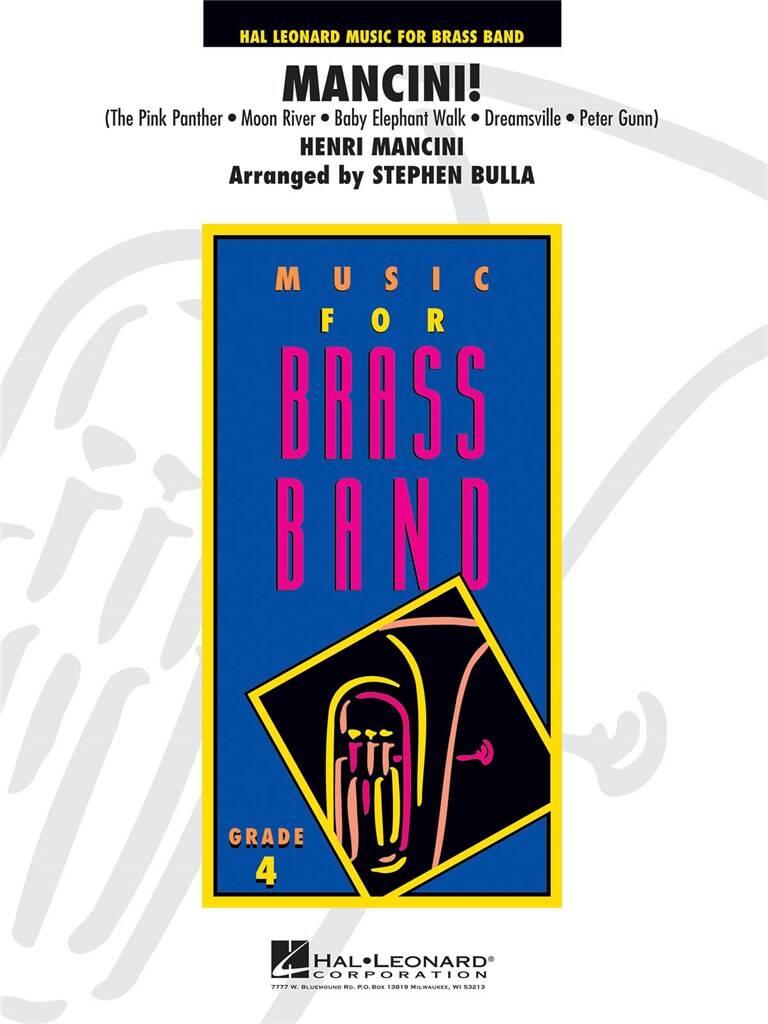 £67.50
Mancini! - Henry Mancini - Stephen Bulla
Some of the most recognisable themes from film and television over the years have come from the creative genius of Henry Mancini. Here is a symphonic showstopper featuring some of Mancini's biggest hits and most recognised melodies from the last four decades! Includes: The Pink Panther, Moon River, Baby Elephant Walk, Dreamsville, and Peter Gunn.
Estimated dispatch 5-14 working days
 View Music