
Results
-
 £45.00
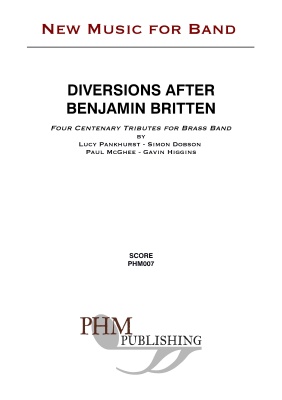
Diversions After Benjamin Britten (Brass Band - Score only)
Suite by Lucy Pankhurst, Simon Dobson, Paul McGhee and Gavin HigginsHaving devised a collective centenary tribute for Michael Tippett at the 2006 RNCM Festival of Brass (Variations on a Theme of Michael Tippett by five eminent composers of brass band music, PHM002), I commissioned this companion piece as a Benjamin Britten tribute for the 2013 festival. In the late 1970s, while researching a book about the English composer, and Britten's first teacher, Frank Bridge (1879 - 1941), I came across a copy of the printed score of Benjamin Britten's Variations on a Theme of Frank Bridge (Op.10) for string orchestra, in which Britten had written descriptive titles for each of the variations suggesting appropriate character traits of his much loved mentor and guide. The character variations are cast in march, song and dance forms.Taking inspiration from Britten's youthful tribute, I invited four award-winning composers, who have all made significant contributions to the brass band medium, to create their own personal reflections on four aspects of Britten's character and music, designed to form a suite of Diversions after Benjamin Britten, but which can also be played separately.Lucy Pankhurst's hauntingly lyrical Prelude: His Depth refers to the emotional and symbolic subtexts that underpin Britten's operas, taking its musical cue from Britten's many arrangements of folk songs. The flugel horn takes a prominent role throughout.Simon Dobson's breathless Scherzo: His Vitality reminds us with its rapid passage work and leaping bass 'groove' that Britten loved tennis and fast cars in his younger days.Paul McGhee's evocative interpretation of the March: His Sympathy represents Benjamin Britten's pacifism, as the composer writes: 'We view the music through the eyes of a pacifist. Whilst war and violence surround us, we do not engage in it and though it continues to happen around us. With the use of muted effects in most of the band throughout the piece, the flugel horn is the lone voice of reason, standing firm against the mechanical and destructive society in which it is forced to live. As the machine of war continues around the lone voice, the voice is gradually dismissed and mocked as the war machine rumbles on into the distance.'In an extended finale, entitled Toccata: His Skill, Gavin Higgins celebrates Benjamin Britten's consummate creativity. For the RNCM Festival of Brass premiere, the four contrasting movements were framed and connected by Britten's Fanfare for St. Edmundsbury for three trumpets, with the trumpet soloists spaced round the hall. I am grateful to the Britten Estate and publishers Boosey & Hawkes for giving permission for the elements of Britten's fanfare to be incorporated in the collective work.- Paul HindmarshDuration: 19.30
Estimated dispatch 7-14 working days
-
 £30.00
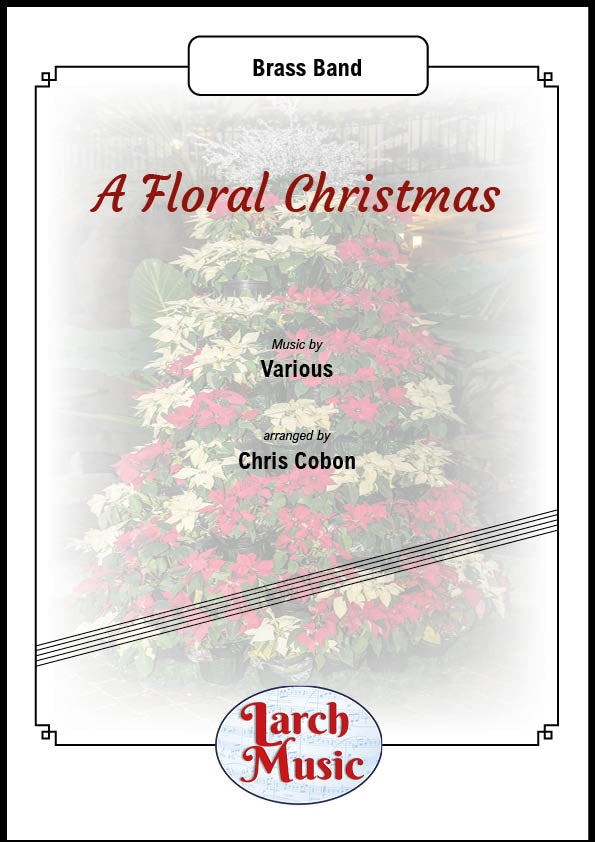
A Floral Christmas - Brass Band Sheet Music Full Score & Parts - LM264
COMPOSER: VariousARRANGER: Chris CobonISMN : 9790570002641A superb new collection of Christmas carols carefully crafted into a medley, with a hint of the Katy Moss classic "Floral Dance", ready for your Christmas concerts.Christmas Carols include :The Holly & The IvyJingle BellsHark!, The Herald Angels SingThe Twelve Days of ChristmasIt Came Upon A Midnight ClearDeck The HallsCarol of The BellsAway In A MangerSilent NightFloral DanceO Holy NightO Come, O Come EmmanuelThe Twelve Days of ChristmasJoy To The WorldO Come, All Ye FaithfulThe Twelve Days of ChristmasLM264 - ISMN : 9790570002641
In Stock: Estimated dispatch 3-5 working days
-
 £100.00
Handel in the Band (Brass Band - Score and Parts)
Handel in the Band is a virtuoso set of symphonic variations on one of Handel's best known keyboard dances, the Sarabande from his Suite in D minor, HWV 437, based on the Spanish traditional dance La Folia. Kenneth Downie's work was commissioned by Brass Band Treize Etoiles, for performance at the 2013 Swiss National Brass Band Championships, where it was conducted by James Gourlay. The title is a reference to Percy Grainger's popular Handel in the Strand, and is indicative of the witty and theatrical nature of the music, which is more playful than conventional competition pieces and as such offers different challenges to brass bands as well as being thoroughly entertaining for audiences.Kenneth Downie is one of the most respected and experienced brass band composers. His music has been widely performed and published throughout the brass band world since the 1960s.Handel in the Band was selected as the set work for the Championship Section final of the 2018 National Brass Band Championships of Great Britain, which took place at the Royal Albert Hall, London, on 6th October 2018.Duration: 15.00
Estimated dispatch 7-14 working days
-
£19.99
Handel in the Band (Brass Band - Score Only)
Handel in the Band is a virtuoso set of symphonic variations on one of Handel's best known keyboard dances, the Sarabande from his Suite in D minor, HWV 437, based on the Spanish traditional dance La Folia. Kenneth Downie's work was commissioned by Brass Band Treize Etoiles, for performance at the 2013 Swiss National Brass Band Championships, where it was conducted by James Gourlay. The title is a reference to Percy Grainger's popular Handel in the Strand, and is indicative of the witty and theatrical nature of the music, which is more playful than conventional competition pieces and as such offers different challenges to brass bands as well as being thoroughly entertaining for audiences.Kenneth Downie is one of the most respected and experienced brass band composers. His music has been widely performed and published throughout the brass band world since the 1960s.Handel in the Band was selected as the set work for the Championship Section final of the 2018 National Brass Band Championships of Great Britain, which took place at the Royal Albert Hall, London, on 6th October 2018.
Estimated dispatch 7-14 working days
-
 £59.77
Caprice (Euphonium Solo with Brass Band) Andrew Batterham
VIEW SCORE PDF Caprice was written for Matthew van Emmerik, to showcase his virtuosity in an engaging piece of concert music. The work is in theme and variation form, with the primary material being the theme from the last of Paganini's Ventiquattro Capricci per violino solo, a collection of 24 caprices for solo violin. This theme has been the inspiration for similar works by many composers since it was first published, including Liszt, Brahms, Rachmaninov, Benny Goodman and Andrew Lloyd Webber. In this work, the famous theme is treated to a more contemporary approach. The first variation, Capricious, relies on motor rhythms and jagged dialogues between the soloist and the band. It is couched in an organic scale reminiscent of the Phrygian mode. The second variation, Sad, is in direct contrast, acting as a traditional ballad and allowing the soloist to explore the expressive side of the instrument. The third variation, Energetic, is a micro set of variations in itself, designed to display the soloist's innovative technique and stamina. Each section is more challenging than the last, until the work concludes with a whirlwind dance at breakneck speed. Like all of Batterham's recent work, the musical language of Caprice draws upon classical, jazz, funk and ska elements to create a unique sound where anything can happen, and probably will. This arrangement was made possible through Matt's instigation and generosity. To view a video of Matthew van Emmerik performing the version with brass band please visit www.youtube.com/watch?v=D0hsvux_a5o To view a video of Fletcher Mitchell performing the version with piano please visit www.youtube.com/watch?v=NOZ6KRldDVo Sheet music available from: UK - www.brassband.co.uk USA - www.solidbrassmusic.com Instrumentation: Euphonium Soloist Soprano Cornet Eb Solo Cornet Bb Repiano Cornet Bb 2nd Cornet Bb 3rd Cornet Bb Flugel Horn Bb Solo Horn Eb 1st Horn Eb 2nd Horn Eb 1st Baritone Bb 2nd Baritone Bb 1st Trombone Bb 2nd Trombone Bb Bass Trombone Euphonium Bb Bass Eb Bass Bb Percussion 1-3
In Stock: Estimated dispatch 1-3 working days
-
 £29.88
Fanfare from La Peri(Brass Band) Dukas arr. Rob Bushnell
La Peri is a one-act ballet by the French composer Paul Dukas, best known for The Sorcerer's Apprentice (L'apprenti sorcier) as in the 1940 Disney film Fantasia. Dukas was commissioned to write La Peri by the Ballets Russes, producing a Poeme danse en un tableau ('dance poem in one scene') in 1911; this become his last published work. With Natalia Trouhanova due to play the Peri and Vaslav Nijinsky to play Iskender (the name of Alexander the Great in Persian, who is scouting around Iran in search of the Flower of Immortality), the production was ultimately cancelled because Serge Diaghilev feel Trouhanova was not a skilled enough dancer to be partnered to Nijinsky. Trouhanova later hired Ivan Clustine to choreograph the music, with the ballet premiering at the Theatre du Chatelet in Paris on 22 April 1912.The brilliant fanfare that precedes the ballet is often performed separately and is the arrangement available here. Arranged for British-style brass band, it has optional percussion parts as well as alternative parts for horns in F and bass-clef lower brass. The piece has been lowered by a tone compared to the original. A recording of the original composition can be found here: www.youtube.com/watch?v=7EDekMos1ok. Duration: Approx. 2 minutes Difficulty Level: 2nd Section + Duration: 4 or 5 minutes (depending on tempo and without any cuts) PDF download includes parts and score. Sheet music available at www.brassband.co.uk (UK) or https://satradecentral.org (USA) Instrumentation: Soprano Cornet Eb Solo Cornet Bb Repiano Cornet Bb 2nd Cornet Bb 3rd Cornet Bb Flugel Horn Bb Solo Horn Eb 1st Horn Eb 2nd Horn Eb 1st Baritone Bb 2nd Baritone Bb 1st Trombone Bb 2nd Trombone Bb Bass Trombone Euphonium Bb Bass Eb Bass Bb Timpani Percussion 1 - Snare Drum Percussion 2 - Bass Drum & Cymbal
In Stock: Estimated dispatch 1-3 working days
-
 £33.62
La Chica sin nombre (Trombone Solo with Brass Band) Rob Wiffin
A vibrant, rhythmic solo for trombone and band. La Chica sin Nombre was written in March 2020 at the request of Brett Baker, who wanted something in Latin style, resulting in a Mambo-type dance piece. For the right percussion sound, Conga drums and Mambo Bell/Timbales are recommended rather than a drum kit, and the piece should be played with an appropriate feel for Latin music. It should sound light and easy to play but has a few tricky moments - especially the cadenza-like sections from F to H. The virtuosic section at letter G can be cut if required. Audio demo: https://soundcloud.com/user-565396545/la-chica-sin-nombre-trombone Duration: Approx. 4.20 minutes Difficulty Level (Band): Medium Soloist: Advanced This PDF download includes the full score and parts. Sheet music available at www.brassband.co.uk (UK) or https://satradecentral.org (USA)
In Stock: Estimated dispatch 1-3 working days
-
 £89.66
Trumpet Concerto with Brass Band (Andrew Batterham)
Andrew Batterham's tour de force Trumpet Concerto showcases the incredible spectrum of emotions the trumpet can convey, in the hands of a dedicated performer. The music ranges from Classical to minimalism, ballads to fanfares, culminating in a wild dance full of stamina and energy. Commissioned by ABC Classic through the ABC Fresh Start Fund, Concerto was premiered by David Elton, Principal Trumpet with the Sydney Symphony Orchestra (previously with London Symphony Orchestra). This brass band version was premiered by David and Victoria Brass, conducted by Matt van Emmerik. It is also available with piano accompaniment here. To view a video of David Elton performing the work with Victoria Brass, please visit https://www.youtube.com/watch?v=zImGHAL9mIE PDF download includes score and parts. Sheet music available from: UK - www.brassband.co.uk USA - https://satradecentral.org Difficulty Level for Soloist: Advanced Difficulty Level for Band: 1st Section + Duration: approx. 19 minutes Instrumentation: Trumpet Soloist Bb Soprano Cornet Eb Solo Cornet Bb Repiano Cornet Bb 2nd Cornet Bb 3rd Cornet Bb Flugel Horn Bb Solo Horn Eb 1st Horn Eb 2nd Horn Eb 1st Baritone Bb 2nd Baritone Bb 1st Trombone Bb 2nd Trombone Bb Bass Trombone 1st Euphonium Bb 2nd Euphonium Bb Bass Eb Bass Bb Timpani Percussion 1-2
In Stock: Estimated dispatch 1-3 working days
-
 £79.99
Another World's Hell (Brass Band - Score and Parts)
Another Worlds Hell was commissioned in versions for brass, wind and fanfare bands by the Societe Cantonale des Musiques Vaudoises and the Association Cantonale des Musiques Neuchateloises for the 2013 Swiss Cantonales festivals. It is inspired by a passage in Aldous Huxleys classic 1932 science-fiction novel Brave New World, which describes in unusually close detail the music that is being played at a dance. This is Dobsons interpretation of the imagined future music that Huxley dreamed of. Suitable for 1st Section Bands and above. Duration: 13.00
Estimated dispatch 7-14 working days
-
 £37.35
Polonaise from 'Scenes de Ballet' (Brass Band) Glazunov arr. Rob Bushnell
Alexander Glazunov was a Russian composer who was a gifted musician from childhood. He was seen as the natural heir to the nationalist revolution that had started with the Mighty Handful. Despite quickly turning from this to absolute forms of music, taking a keen interest in ballet music, his compositions still alludes to Russian folk tunes. He wrote four dance compositions, of which Scenes de Ballet was the first in 1894. The suite Scenes de Ballet, opus 52 has eight movements and was dedicated to the orchestra of the Russian Opera, St Petersburg. First performed in 1895 at a concert of the Imperial Music Society with Glazunov conducting. This arrangement of the final movement is for the British-style brass band, with alternative parts for horns in F and bass-clef lower brass. A recording of the original composition can be found here: https://www.youtube.com/watch?v=BS-Yx-bmxPg Duration: approx. 5.20 minutes Difficulty Level: 2nd Section + PDF download includes parts and score. Sheet music available at www.brassband.co.uk (UK) or https://satradecentral.org (USA) Instrumentation: Soprano Cornet Eb Solo Cornet Bb Repiano Cornet Bb 2nd Cornet Bb 3rd Cornet Bb Flugel Horn Bb Solo Horn Eb 1st Horn Eb 2nd Horn Eb 1st Baritone Bb 2nd Baritone Bb 1st Trombone Bb 2nd Trombone Bb Bass Trombone Euphonium Bb Bass Eb Bass Bb Timpani Percussion 1 - Snare Percussion 2 - Triangle, Cymbal & Bass Drum
In Stock: Estimated dispatch 1-3 working days
