
Results
-
 £95.00
Tenor Horn Concerto 'Three Gods' (Tenor Horn Solo with Brass Band - Score and Parts)
Edward Gregson's Tenor Horn Concerto (Three Gods) was commissioned by the Belgian tenor horn soloist Tim de Maeseneer for a recording of commissioned works he made in 2024 with his own band, Brass Band Willebroek.The subtitle of 'Three Gods' refers to three mythological Greek Gods: Zeus, Hermes and Apollo. The idea for this came from Gregson's Viola Concerto, which he composed in 2023 and which was similarly subtitled 'Three Goddesses'. Indeed, the first movement of the horn concerto shares some common material with the viola concerto, although the other movements are newly composed.The concerto exploits the noble character of the horn, but the writing is also virtuosic in character as well as lyrical and melodic, demanding an extended playing range of nearly four octaves with a variety of colouration in its sonorities. The unifying motif of the whole concerto is the interval of a rising 5th, heard at the outset. The opening also has some other surprises (both seen and heard).The musical ideas, cast in three separate movements, take their starting point from the characters of the Three Gods in the title:Zeus, ruled as King of the Gods on Mount Olympus, and was the God of Thunder and Lightning and of War. His music is often threatening and violent, but also has a more tender side as portrayed in the lyrical second subject. However, the dominant mood is one of foreboding.Hermes was the great messenger to the Gods who could travel between realms on his winged sandals. Thus, his music is fast, fleet of foot, and mercurial - a dashing scherzo, but with lyrical and expressive moments.Apollo, the God of Music and Dance (and the Sun), symbolises virtue and beauty. This final movement, 'Hymn to Apollo', is mainly slow and hymn-like and cast in a continuous stream of melody passed between soloist and band. Brief fanfares herald a triumphant march, before the music returns to its quiet opening, gradually rising to a triumphant climax with glittering melodic percussion leading the way. The music ends in a blaze of glory!Duration: 17.00
Estimated dispatch 7-14 working days
-
 £64.95
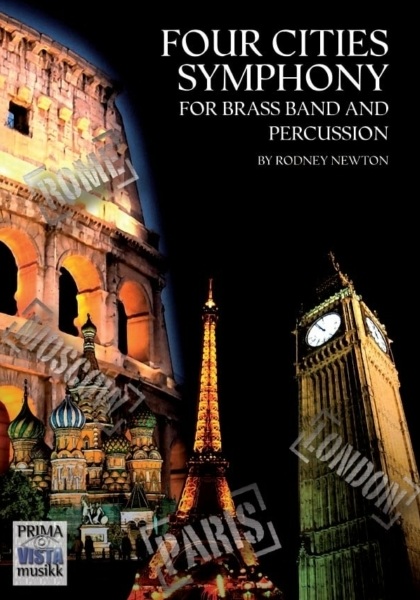
Four Cities Symphony (Brass Band - Score and Parts)
This piece was commissioned by the National Contesting Council as the 4th section test piece for the 2008 Regional Brass Band Championships of Great Britain.This symphony (the composer's 12th) has four movements played without a break. The first centres on two aspects of the city of London: its history and pageantry and its role as a busy modern metropolis.The second movement depicts Paris, its street cafes and boulevards and riverside walks, in the form of a romantic waltz.The third movement is constructed around the Gregorian chants of the Lord's Prayer (Pater noster, qui es in caelis) and the Creed (Credo in unum Deum) in an evocation of the city of Rome. After a powerful climax, mysterious tramping footsteps are heard as the ghosts or a Roman legion march through the city by night. The vision fades and the pater noster is heard once again before the movement is brought to a close with the ancient Ambrosian chant, Christus Vincit, Christus Regnet, Christus Imperat.The final movement is an evocation of the city of Moscow, with its great historic buildings, its turbulent history and its fiery traditional music. At the outset a rather dour folk-like melody is heard which is transformed into a lively Cossack dance.This work is dedicated to Howard Wilson, former principal euphonium of City of Coventry Band who, in 1972, introduced the composer to top section brass band contesting.Duration: 11.00
Estimated dispatch 7-14 working days
-
 £11.20
Trumpet Concerto with Brass Band (Andrew Batterham) Soloist Part in Bb
Andrew Batterham's tour de force Trumpet Concerto showcases the incredible spectrum of emotions the trumpet can convey, in the hands of a dedicated performer. The music ranges from Classical to minimalism, ballads to fanfares, culminating in a wild dance full of stamina and energy. Commissioned by ABC Classic through the ABC Fresh Start Fund, Concerto was premiered by David Elton, Principal Trumpet with the Sydney Symphony Orchestra (previously with London Symphony Orchestra). The brass band version was premiered by David and Victoria Brass, conducted by Matt van Emmerik. To view a video of David Elton performing the work with Victoria Brass, please visit www.youtube.com/watch?v=zImGHAL9mIE This PDF download includes soloist part in Bb. Brass band accompaniment version available here. Piano accompaniment version available here. Sheet music available from: UK - www.brassband.co.uk USA - https://satradecentral.org Difficulty Level for Soloist: Advanced Duration: approx. 19 minutes
In Stock: Estimated dispatch 1-3 working days
-
 £84.95
In League with Extraordinary Gentlemen (Euphonium Solo with Brass Band)
Concerto for EuphoniumIn League with Extraordinary Gentlemen combines two of composer Peter Graham's life interests - composition and 19th century popular fiction. Each of the concerto's three movements takes its musical inspiration from extraordinary characters who have transcended the original genre and have subsequently found mass audiences through film, television and comic book adaptations.The first movement follows a traditional sonata form outline with one slight modification. The order of themes in the recapitulation is reversed, mirroring a plot climax in the H.G. Wells novella The Time Machine (where the protagonist, known only as The Time Traveller, puts his machine into reverse bringing the story back full circle).The Adventure of the Final Problem is the title of a short story published in The Memoirs of Sherlock Holmes by Arthur Conan Doyle. This is an account of the great detective's final struggle with his long-time adversary Professor Moriarty at the Reichenbach Falls in Switzerland. The music takes the form of a slowed down lndler (a Swiss/Austrian folk dance) and various acoustic and electronic echo effects call to mind the alpine landscape. The final bars pose a question paralleling that of Conan Doyle in the story - have we really seen the last of Sherlock Holmes?The final movement, The Great Race, (available separately) follows Phileas Fogg on the last stage of his epic journey "Around the World in Eighty Days" (from the novel by Jules Verne). The moto perpetuo nature of the music gives full rein to the soloist's technical virtuosity. As the work draws to a conclusion, the frantic scramble by Fogg to meet his deadline at the Reform Club in Pall Mall, London, is echoed by the soloist's increasingly demanding ascending figuration, set against the background of Big Ben clock chimes.In League with Extraordinary Gentlemen was first performed in the brass band version by David Thornton and the Black Dyke Band, conductor Nicholas Childs, at the RNCM Concert Hall Manchester on January 30, 2009.
Estimated dispatch 7-14 working days
-
 £87.99
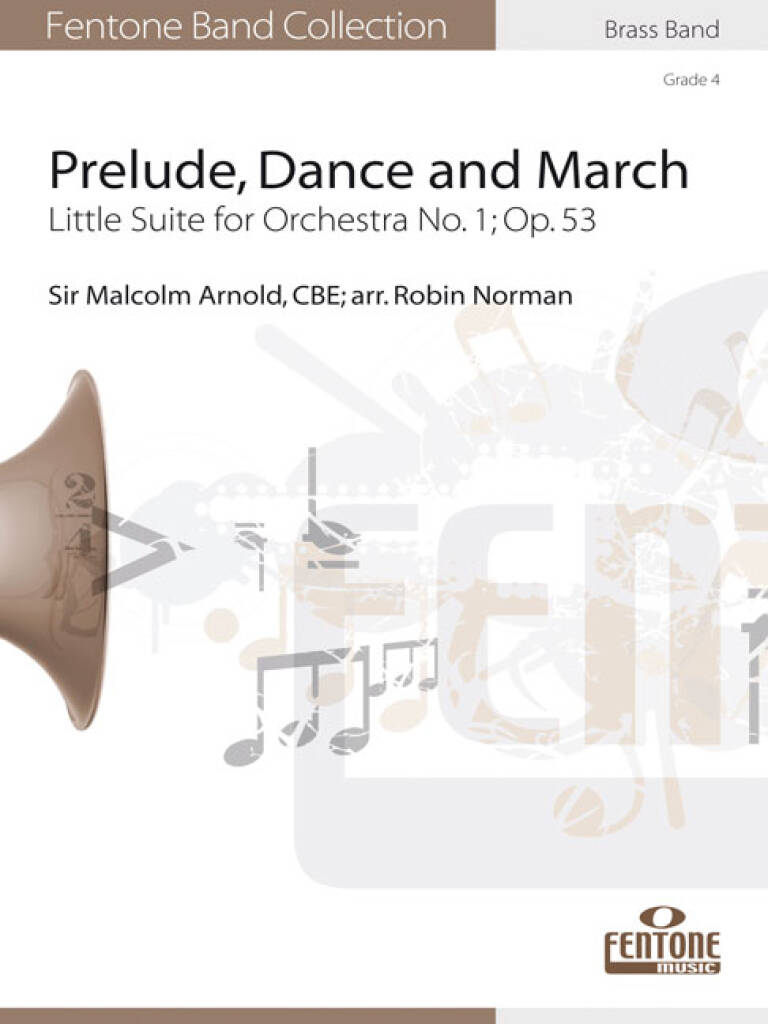
Prelude, Dance and March - Malcolm Arnold - Robin Norman
Malcolm Arnold is one Britain's best-loved composers. In 1948 he composed a very short suite for the National Youth Orchestra of Great Britain - entitled simply To Youth. Seven years later he took To Youth and made some fairly major revisions, including a complete new movement, and the Little Suite for Orchestra was born. The Little Suite for Orchestra follows a very similar pattern to the later suites for brass band, starting with a bold, strident Prelude, which strangely ends quietly before a lovely, lilting, Dance composed in 3/8 time. Finally a rollicking and militaristic March brings the suite to a conclusion. This arrangement for brass band by Robin Norman is sure tobecome a classic in the brass band repertoire.
Estimated dispatch 5-14 working days
-
 £64.95
Dance Spirit (Brass Band - Score and Parts) - Wiffin, Rob
Dance Spirit is a three movement suite of dances comprising Stomping Dance, Waltz Interlude and Duende linked by solo dancer cadenzas. It started life as the wind band piece Spirit of the Dance. In it I attempted to capture some of the elements of this most fundamental of human activities, the urge to move our bodies to the rhythm of the music. In re-working it for brass band I extended the duration of the Waltz Interlude and increased the technical level in some areas with the intention of making it a suitable test piece.Stomping Dance - The suite starts with perhaps the most basic dance feeling, the desire to stomp our feet to the music, unrefined, no knowledge of steps needed. The heavy stomp is not always present in the music here, and sometimes you can sense the dancers trying something a little more refined, but it is always lurking in the background, ready to draw us back to the elemental rhythm of the beat.Waltz Interlude - Of course, dance does not always have to have heat, it can be elegant and restrained, emphasising fluidity of line and movement. In the waltz it is occasionally suspended by the held poses before the motion starts again. Unlike the outer movements, the Waltz Interlude is cool, danced in moonlight rather than under the sun. The two dancers sometimes move as one and at other times the man provides a frame for the more intricate arabesques of his partner.Duende - During my time living in Spain I went to watch some flamenco dancing. I was expecting the normal tourist cliches but the dancers were serious students of Flamenco Nuevo y Viejo (new and old). They performed with passion to some pounding asymmetric rhythms and their performance was the inspiration for Duende. Duende as a term is hard to define. It is a spirit of performance - that moment when you are right in the middle of the creative spirit of the music. It is about soul and a heightened state of emotion. Federico Garcia Lorca wrote: I have heard an old maestro of the guitar say, The duende is not in the throat; the duende climbs up inside you, from the soles of the feet. Meaning this: it is not a question of ability, but of true, living style, of blood, of the most ancient culture, of spontaneous creation.- Rob WiffinDuration: 13.45
Estimated dispatch 7-14 working days
-
 £31.95
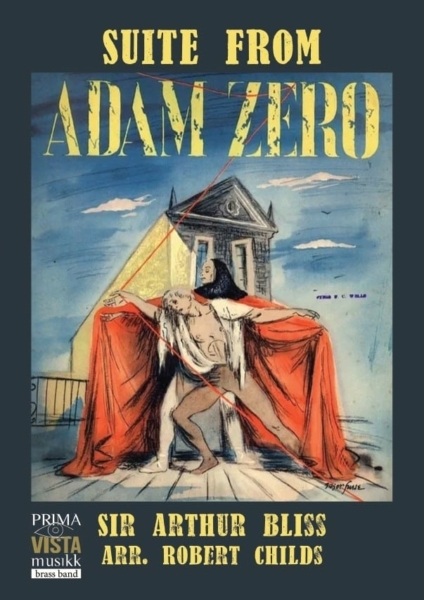
Adam Zero, Suite from (Brass Band - Score only) - Bliss, Arthur - Childs, Robert
Selected as the Section 2 test piece for the National Brass Band Championships of Great Britain 2025Following his ballet Checkmate, Bliss composed another score for the, by then, Sadler's Wells Ballet, Miracle in the Gorbals, which was choreographed by Robert Helpmann, to a scenario by Michael Benthall. Premired in 1944, the ballet made a considerable impact and was a box-office success. It was followed in turn by a further collaboration with Helpmann and Benthall, Adam Zero. This would serve Helpmann, in the eponymous role, as a vehicle in two respects: demonstrating his gifts as a dancer-actor and as a choreographer. First performed at the Royal Opera House, Covent Garden, on 8 April 1946, Adam Zero was conducted by Constant Lambert, the work's dedicatee. Bliss considered it 'his most varied and exciting ballet score'. Benthall provided a synopsis for the programme:There is a philosophy that life moves in an endless series of timeless cycles. As Nature passes through Spring, Summer, Autumn and Winter, so man is born, makes a success in his own particular sphere, loses his position to a younger generation, sees his world crumble before his eyes and only finds peace in death. This age-old story is told in terms of a Company creating a ballet and calling on the resources of the theatre to do so. Lighting, stage mechanism, dance conventions, musical forms and costumes and scenery of all periods are used to symbolize the world of 'Adam Zero'.Apart from Adam, as the Principal Dancer, other main roles included the Stage Director (representing Omnipotence), and Adam's Fates (Designer, Wardrobe Mistress, and Dresser). 'The Woman in this allegory', wrote Bliss, 'under the symbol of the Choreographer, was both the creator and destroyer of Adam: his first love, his wife, his mistress, and finally the figure of beneficent Death.' When the curtain rose, the 'audience saw the Covent Garden stage right back to the wall, completely empty except for the protagonists, 'the Company poised, still and expectant, as they await the birth of... Adam Zero.'Unfortunately, soon after the premire, Helpmann injured himself and had to withdraw from the remaining performances. Despite generally positive reviews, the ballet did not capture the imagination of audiences and, to Bliss's considerable disappointment, was not revived. Seventy years would elapse before its first major return to the stage, in 2016, performed by the ballet company of Stadttheater Bremerhaven with choreography by Sergei Vanaev.Bliss extracted a concert suite from the ballet, conducting its first performance with the City of Birmingham Symphony Orchestra on 28 October 1948. For his own suite, arranged for brass band in 2023, Dr Robert Childs chose three dances linked to the seasons, book-ending them with the ebullient 'Fanfare Overture' and 'Fanfare Coda'. After Adam has grown to manhood, his Fates clothe him in a costume synonymous with confident youth, appropriate for the virile, ardent 'Dance of Spring'. In the 'Approach of Autumn', Adam, now wearing a sombre costume, has grown older: his Fates have streaked grey in his hair and put lines on his face. But they had earlier raised Adam to the zenith of his power, and the 'Dance of Summer' depicts him in the prime of life, in music of sweeping grandeur. The 'Fanfare Coda' signals that the next cycle of life is about to begin.Duration: 10.30
Estimated dispatch 7-14 working days
-
£21.65
Adam Zero, Suite from (Brass Band - Study Score) - Bliss, Arthur - Childs, Robert
Selected as the Section 2 test piece for the National Brass Band Championships of Great Britain 2025Following his ballet Checkmate, Bliss composed another score for the, by then, Sadler's Wells Ballet, Miracle in the Gorbals, which was choreographed by Robert Helpmann, to a scenario by Michael Benthall. Premired in 1944, the ballet made a considerable impact and was a box-office success. It was followed in turn by a further collaboration with Helpmann and Benthall, Adam Zero. This would serve Helpmann, in the eponymous role, as a vehicle in two respects: demonstrating his gifts as a dancer-actor and as a choreographer. First performed at the Royal Opera House, Covent Garden, on 8 April 1946, Adam Zero was conducted by Constant Lambert, the work's dedicatee. Bliss considered it 'his most varied and exciting ballet score'. Benthall provided a synopsis for the programme:There is a philosophy that life moves in an endless series of timeless cycles. As Nature passes through Spring, Summer, Autumn and Winter, so man is born, makes a success in his own particular sphere, loses his position to a younger generation, sees his world crumble before his eyes and only finds peace in death. This age-old story is told in terms of a Company creating a ballet and calling on the resources of the theatre to do so. Lighting, stage mechanism, dance conventions, musical forms and costumes and scenery of all periods are used to symbolize the world of 'Adam Zero'.Apart from Adam, as the Principal Dancer, other main roles included the Stage Director (representing Omnipotence), and Adam's Fates (Designer, Wardrobe Mistress, and Dresser). 'The Woman in this allegory', wrote Bliss, 'under the symbol of the Choreographer, was both the creator and destroyer of Adam: his first love, his wife, his mistress, and finally the figure of beneficent Death.' When the curtain rose, the 'audience saw the Covent Garden stage right back to the wall, completely empty except for the protagonists, 'the Company poised, still and expectant, as they await the birth of... Adam Zero.'Unfortunately, soon after the premire, Helpmann injured himself and had to withdraw from the remaining performances. Despite generally positive reviews, the ballet did not capture the imagination of audiences and, to Bliss's considerable disappointment, was not revived. Seventy years would elapse before its first major return to the stage, in 2016, performed by the ballet company of Stadttheater Bremerhaven with choreography by Sergei Vanaev.Bliss extracted a concert suite from the ballet, conducting its first performance with the City of Birmingham Symphony Orchestra on 28 October 1948. For his own suite, arranged for brass band in 2023, Dr Robert Childs chose three dances linked to the seasons, book-ending them with the ebullient 'Fanfare Overture' and 'Fanfare Coda'. After Adam has grown to manhood, his Fates clothe him in a costume synonymous with confident youth, appropriate for the virile, ardent 'Dance of Spring'. In the 'Approach of Autumn', Adam, now wearing a sombre costume, has grown older: his Fates have streaked grey in his hair and put lines on his face. But they had earlier raised Adam to the zenith of his power, and the 'Dance of Summer' depicts him in the prime of life, in music of sweeping grandeur. The 'Fanfare Coda' signals that the next cycle of life is about to begin.Duration: 10.30
Estimated dispatch 7-14 working days
-
£74.95
Adam Zero, Suite from (Brass Band - Score and Parts) - Bliss, Arthur - Childs, Robert
Selected as the Section 2 test piece for the National Brass Band Championships of Great Britain 2025Following his ballet Checkmate, Bliss composed another score for the, by then, Sadler's Wells Ballet, Miracle in the Gorbals, which was choreographed by Robert Helpmann, to a scenario by Michael Benthall. Premired in 1944, the ballet made a considerable impact and was a box-office success. It was followed in turn by a further collaboration with Helpmann and Benthall, Adam Zero. This would serve Helpmann, in the eponymous role, as a vehicle in two respects: demonstrating his gifts as a dancer-actor and as a choreographer. First performed at the Royal Opera House, Covent Garden, on 8 April 1946, Adam Zero was conducted by Constant Lambert, the work's dedicatee. Bliss considered it 'his most varied and exciting ballet score'. Benthall provided a synopsis for the programme:There is a philosophy that life moves in an endless series of timeless cycles. As Nature passes through Spring, Summer, Autumn and Winter, so man is born, makes a success in his own particular sphere, loses his position to a younger generation, sees his world crumble before his eyes and only finds peace in death. This age-old story is told in terms of a Company creating a ballet and calling on the resources of the theatre to do so. Lighting, stage mechanism, dance conventions, musical forms and costumes and scenery of all periods are used to symbolize the world of 'Adam Zero'.Apart from Adam, as the Principal Dancer, other main roles included the Stage Director (representing Omnipotence), and Adam's Fates (Designer, Wardrobe Mistress, and Dresser). 'The Woman in this allegory', wrote Bliss, 'under the symbol of the Choreographer, was both the creator and destroyer of Adam: his first love, his wife, his mistress, and finally the figure of beneficent Death.' When the curtain rose, the 'audience saw the Covent Garden stage right back to the wall, completely empty except for the protagonists, 'the Company poised, still and expectant, as they await the birth of... Adam Zero.'Unfortunately, soon after the premire, Helpmann injured himself and had to withdraw from the remaining performances. Despite generally positive reviews, the ballet did not capture the imagination of audiences and, to Bliss's considerable disappointment, was not revived. Seventy years would elapse before its first major return to the stage, in 2016, performed by the ballet company of Stadttheater Bremerhaven with choreography by Sergei Vanaev.Bliss extracted a concert suite from the ballet, conducting its first performance with the City of Birmingham Symphony Orchestra on 28 October 1948. For his own suite, arranged for brass band in 2023, Dr Robert Childs chose three dances linked to the seasons, book-ending them with the ebullient 'Fanfare Overture' and 'Fanfare Coda'. After Adam has grown to manhood, his Fates clothe him in a costume synonymous with confident youth, appropriate for the virile, ardent 'Dance of Spring'. In the 'Approach of Autumn', Adam, now wearing a sombre costume, has grown older: his Fates have streaked grey in his hair and put lines on his face. But they had earlier raised Adam to the zenith of his power, and the 'Dance of Summer' depicts him in the prime of life, in music of sweeping grandeur. The 'Fanfare Coda' signals that the next cycle of life is about to begin.Duration: 10.30
Estimated dispatch 7-14 working days
-
 £75.00
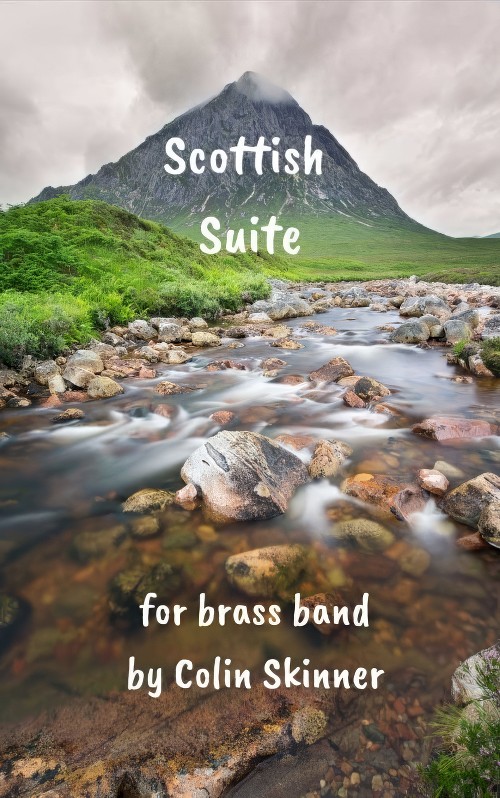
Scottish Suite (Brass Band - Score and Parts) - Skinner, Colin
A? four movement Gaelic suite for brass band. Includes: Simmer Dim (The night-long twilight in Orkney and Shetland in midsummer, when dusk runs more or less directly into dawn and it is never truly dark); Dance o' the Tattie-Bogles (Another name for scarecrows. We imagine them in the fields, one by one coming to life and joining in an extraordinary and chaotic dance); Sweetheart Abbey (Inspired by the ruined abbey near Dumfries founded by Dervorguilla of Galloway, in memory of her husband. After his death, she kept his embalmed heart with her for the rest of her life and it was buried alongside her when she died); Clanjamfrie (A drunken rabble meet in a remote Highland pub and proceed to talk nonsense and dance the night away). Duration: 11.15
Estimated dispatch 7-14 working days
 View Music