
Results
-
 £100.00
Handel in the Band (Brass Band - Score and Parts) - Downie, Kenneth
Handel in the Band is a virtuoso set of symphonic variations on one of Handel's best known keyboard dances, the Sarabande from his Suite in D minor, HWV 437, based on the Spanish traditional dance La Folia. Kenneth Downie's work was commissioned by Brass Band Treize Etoiles, for performance at the 2013 Swiss National Brass Band Championships, where it was conducted by James Gourlay. The title is a reference to Percy Grainger's popular Handel in the Strand, and is indicative of the witty and theatrical nature of the music, which is more playful than conventional competition pieces and as such offers different challenges to brass bands as well as being thoroughly entertaining for audiences.Kenneth Downie is one of the most respected and experienced brass band composers. His music has been widely performed and published throughout the brass band world since the 1960s.Handel in the Band was selected as the set work for the Championship Section final of the 2018 National Brass Band Championships of Great Britain, which took place at the Royal Albert Hall, London, on 6th October 2018.Duration: 15.00
Estimated dispatch 7-14 working days
-
£19.99
Handel in the Band (Brass Band - Score only) - Downie, Kenneth
Handel in the Band is a virtuoso set of symphonic variations on one of Handel's best known keyboard dances, the Sarabande from his Suite in D minor, HWV 437, based on the Spanish traditional dance La Folia. Kenneth Downie's work was commissioned by Brass Band Treize Etoiles, for performance at the 2013 Swiss National Brass Band Championships, where it was conducted by James Gourlay. The title is a reference to Percy Grainger's popular Handel in the Strand, and is indicative of the witty and theatrical nature of the music, which is more playful than conventional competition pieces and as such offers different challenges to brass bands as well as being thoroughly entertaining for audiences.Kenneth Downie is one of the most respected and experienced brass band composers. His music has been widely performed and published throughout the brass band world since the 1960s.Handel in the Band was selected as the set work for the Championship Section final of the 2018 National Brass Band Championships of Great Britain, which took place at the Royal Albert Hall, London, on 6th October 2018.
Estimated dispatch 7-14 working days
-
 £12.50
Of Distant Memories (Music in an Olden Style) (Brass Band - Study Score) - Gregson, Edward
2013 Finals of the National Brass Band Championships of Great Britain - Championship Section.Of Distant Memories pays homage to the brass band composers that form the backbone of the brass band repertoire, and their music, and in the process summons up a kind of subconscious memory bank of the musical languages, styles and forms used by them. The music is conceived in the form of a 'traditional' tone poem, reflecting certain aspects (e.g. melodic, harmonic, textural) of those early test pieces. Although fairly traditional concepts have been kept in planning the architecture of the work, certain aspects of the instrumentation, or scoring, are more contemporary in colouristic terms, as befits a composer writing in the 21st century. However, the percussion requirements are fairly modest, similar to those used in the works of that period. The brass band tradition owes much to the composers of that period, for through their music they established a truly homogenous 'British' brass band sound which has spread throughout many parts of the world. That tradition flourishes today and remains important for today's composers, even if their musical language is far removed from that of their predecessors. Of Distant Memories is the composers own way of repaying that gratitude.Duration: 15.00
Estimated dispatch 7-14 working days
-
 £89.95
Of Distant Memories (Music in an Olden Style) (Brass Band - Score and Parts) - Gregson, Edward
Of Distant Memories pays homage to the brass band composers that form the backbone of the brass band repertoire and their music, and in the process summons up a kind of subconscious memory bank of the musical languages, styles and forms used by them. The music is conceived in the form of a 'traditional' tone poem, reflecting certain aspects (e.g. melodic, harmonic, textural) of those early test pieces. Although fairly traditional concepts have been kept in planning the architecture of the work, certain aspects of the instrumentation, or scoring, are more contemporary in colouristic terms, as befits a composer writing in the 21st century. However, the percussion requirements are fairly modest, similar to those used in the works of that period. The brass band tradition owes much to the composers of that period, for through their music they established a truly homogenous 'British' brass band sound which has spread throughout many parts of the world. That tradition flourishes today and remains important for today's composers, even if their musical language is far removed from that of their predecessors. Of Distant Memories is the composers own way of repaying that gratitude.Duration: 15.00
Estimated dispatch 7-14 working days
-
 £44.95
Of Distant Memories (Music in an Olden Style) (Brass Band - Score only) - Gregson, Edward
Of Distant Memories pays homage to the brass band composers that form the backbone of the brass band repertoire, and their music, and in the process summons up a kind of subconscious memory bank of the musical languages, styles and forms used by them. The music is conceived in the form of a 'traditional' tone poem, reflecting certain aspects (e.g. melodic, harmonic, textural) of those early test pieces. Although fairly traditional concepts have been kept in planning the architecture of the work, certain aspects of the instrumentation, or scoring, are more contemporary in colouristic terms, as befits a composer writing in the 21st century. However, the percussion requirements are fairly modest, similar to those used in the works of that period. The brass band tradition owes much to the composers of that period, for through their music they established a truly homogenous 'British' brass band sound which has spread throughout many parts of the world. That tradition flourishes today and remains important for today's composers, even if their musical language is far removed from that of their predecessors. Of Distant Memories is the composers own way of repaying that gratitude.Duration: 15.00
Estimated dispatch 7-14 working days
-
 £60.99
Centennial Prelude (Brass Band - Score and Parts) - Van der Roost, Jan
This short opening music was composed on commission of the symphonic band of Jan Van der Roost's village (= Kontich near Antwerp / Belgium). In 1991, this community band celebrated its 100th anniversary. After composing commissioned pieces from different countries (even from Japan), this was the most 'near' commission he ever received indeed! It is a short but varied piece, featuring all sections of the band. After a short introduction, played by the brass instruments, a crisp rhythm starts and boxes the main theme. After a second theme, played by brass and percussion, a short melodical passage brings some 'rest'. At the end, the fanfare of the introduction reoccurs. Although this "Centennial Prelude" isn't a really demanding piece, it sounds colourful and energetic. It has been recorded on CD by the band of the 'Royal Dutch Airforce' and the 'Desford Colliery Brass band'.Duration: 3:30
Estimated dispatch 7-14 working days
-
 £40.00
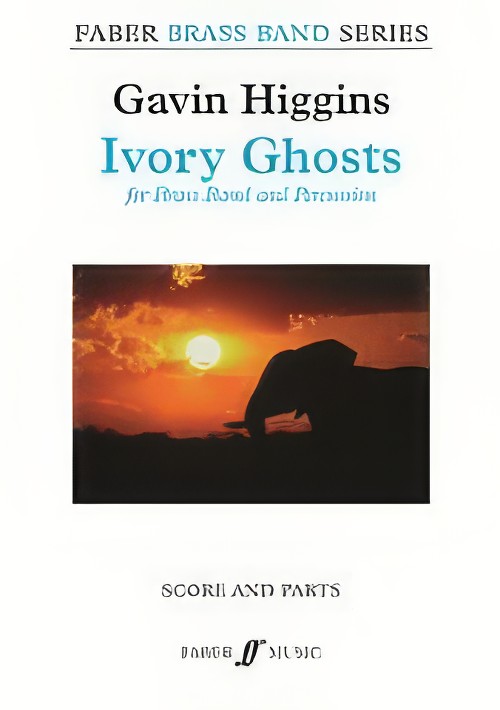
Ivory Ghosts (Brass Band - Score and Parts) - Higgins, Gavin
Gavin Higgins wrote Ivory Ghosts in 2006 for brass ensemble as one of a collection of short pieces composed in support of the charity Brass Band Aid. It is a haunting miniature created in response to the horrors of the illegal trade in African elephant ivory. This definitive version for brass band and percussion was prepared for the Tredegar Town Band.
Estimated dispatch 7-14 working days
-
 £37.95
The Four Elements (Euphonium Solo with Brass Band - Score only) - Ellerby, Martin
Partita for Solo Euphonium and Brass BandThe Four Elements was written for Gary Curtin and the Black Dyke Band as part of a recording project of Martin Ellerby's brass band music. The composer, having previously written a large scale concerto for the euphonium, decided to write something much more concise though still enabling the soloist to display flair and lyricism in equal measure. Each movement is approximately 2 minutes long, a set of miniatures, based on the four elements of earth, water, air and fire, and are given their Latin manes of terra, aqua, aer and ignis in the score. The term partita is used to indicate that the work is a collection, or suite, of pieces and in keeping with former examples, uses both song and dance forms to provide suitable musical structures.Duration: 8.00
Estimated dispatch 7-14 working days
-
 £89.95
The Four Elements (Euphonium Solo with Brass Band - Score and Parts) - Ellerby, Martin
Partita for Solo Euphonium and Brass BandThe Four Elements was written for Gary Curtin and the Black Dyke Band as part of a recording project of Martin Ellerby's brass band music. The composer, having previously written a large scale concerto for the euphonium, decided to write something much more concise though still enabling the soloist to display flair and lyricism in equal measure. Each movement is approximately 2 minutes long, a set of miniatures, based on the four elements of earth, water, air and fire, and are given their Latin manes of terra, aqua, aer and ignis in the score. The term partita is used to indicate that the work is a collection, or suite, of pieces and in keeping with former examples, uses both song and dance forms to provide suitable musical structures.Duration: 8.00
Estimated dispatch 7-14 working days
-
 £168.50
Music of the Spheres (Brass Band - Score and Parts) - Sparke, Philip
Music of the Spheres was commissioned by the Yorkshire Building Society Band and first performed by them at the European Brass Band Championships in Glasgow, May 2004. The piece reflects the composers fascination with the origins of the universe and deep space in general. The title comes from a theory, formulated by Pythagoras, that the cosmos was ruled by the same laws he had discovered that govern the ratios of note frequencies of the musical scale. ('Harmonia' in Ancient Greek, which means scale or tuning rather than harmony - Greek music was monophonic). He also believed that these ratios corresponded to the distances of the six known planets from the sun and thatthe planets each produced a musical note which combined to weave a continuous heavenly melody (which, unfortunately, we humans cannot hear). In this work, these six notes form the basis of the sections Music of the Spheres and Harmonia. The pieces opens with a horn solo called t = 0, a name given by some scientists to the moment of the Big Bang when time and space were created, and this is followed by a depiction of the Big Bang itself, as the entire universe bursts out from a single point. A slower section follows called The Lonely Planet which is a meditation on the incredible and unlikely set of circumstances which led to the creation of the Earth as a planet that can support life, and the constant search for other civilisations elsewhere in the universe. Asteroids and Shooting Stars depicts both the benign and dangerous objects that are flying through space and which constantly threaten our planet, and the piece ends with The Unknown, leaving in question whether our continually expanding exploration of the universe will eventually lead to enlightenment or destruction.Duration: 18:00
Estimated dispatch 7-14 working days
 View Music