
Results
-
 £34.95
Island Whirl (Brass Band - Score and Parts)
Island Whirl was commissioned by Margaret Milligan who wanted a brand new piece of music composed as a present for Ian, her husband for his 70th birthday. Ian Milligan is a keen and dedicated musician and he is the musical director of Callendar Brass, based in Callendar near Stirling in Scotland.Margaret contacted me about the possibility of composing a short lively piece which had a Scottish theme that would be ideal for Callendar Brass Band and any other ensemble to get their teeth into. This piece takes its inspiration from the traditional Scottish folk song 'An Eriskay Love Lilt' which is a particular favourite of both Margaret and Ian.With thunderous Celtic drums the piece opens in a whirlwind of sound with fanfare brass and an off-stage soloist that can perform using either the cornet or trumpet. After the exciting opening, the brass and drums die away to allow the off-stage soloist to air the traditional tune 'An Eriskay Love Lilt'.The beautiful haunting melody, keeping its originality throughout undergoes a series of changes in the accompanying harmonic material before dying away to allow the Celtic drums to return. The percussion whip the band into a frenzy as the piece gets faster and faster. Just prior to the final notes the band diminuendo to allow one last closing statement from the Eriskay Love Lilt lead by the off-stage soloist before the ensemble charge to a dramatic close.When performing this piece I would recommend the off-stage soloist taking a position somewhere in the audience, so they can almost feel part of the performance. In addition, with the two tom-tom parts that represent the Celtic drums, bands should make the most of showcasing them by getting the two drummers out to the front of the band to perform. The ideal stage position would be with the players set up in stereo with one player in front of the soprano cornet and the other in front of the solo trombone.With the various choreographed movements from both the off-stage soloist and the percussionists. This piece is a great addition to any concert repertoire and is an ideal showcase for bands who want to try something a little different.I wish Ian at 70 years young, all the very best with his music making in the many years to come and I hope this piece, composed especially for him and Callender Brass brings them many years of musical enjoyment.Paul Lovatt-Cooper
Estimated dispatch 7-14 working days
-
 £54.95
Wall of Sound (Brass Band - Score and Parts)
This piece was commissioned by Dr Nicholas Childs and Philip Biggs for the National Children's Band of Great Britain.As the commission was for a youth band, I wanted to compose a piece of music that alluded to the styles and genres of music that are abundant in the current popular music market. However, the National Children's Band isn't just any old youth band; they are some of the finest young musicians in Great Britain. So the challenge was to compose a piece that included many popular music styles whilst providing enough of a test to keep the music technically interesting to work on and perform.The driving force behind the whole piece is the percussion section and in particular, the drum kit which is constant throughout. From the start the music is rhythmic and repetitive, similar to many dance tracks. The music begins to slowly unfold and build in texture and at bar 24 the syncopated main theme appears. This theme reappears throughout the piece along with various other motifs and solo lines. The music uses the styles, rock, pop, latin, funk and dance within the score and has a real fun factor about it.There are lots of opportunities for soloists to play and it is marked in the score where to stand and soloists can come out to the front of the stage. I really enjoyed working on this piece and I'm sure performers and audience members will enjoy it too.Paul Lovatt-Cooper
Estimated dispatch 7-14 working days
-
 £38.00
Monteverdi Three Miniatures
ABOUT THIS PIECE: Monteverdi - Three Miniatures, is an engaging and educational brass band arrangement by Adam Taylor, originally composed for the British Open Youth Brass Band Contest at the Guild 2015. This piece masterfully reimagines themes from the works of Claudio Monteverdi, presenting them in a contemporary style that's both accessible and inspiring for modern brass ensembles. Ideal for youth bands and ensembles looking to explore early music in a fresh format, Monteverdi - Three Miniatures offers flexibility and creativity. The arrangement includes adaptable tempos to match your interpretation, a featured duet with parts available in both Bb and Eb, and written percussion parts that can be expanded with additional instruments or streamlined for smaller sections. Players are encouraged to add their own ornamentation, allowing for personal expression and an authentic touch to the music. With its nod to the grandeur of the late Renaissance and early Baroque periods, this piece serves not only as an excellent concert addition but also as a valuable educational tool, introducing young musicians to Monteverdi's timeless work. Dive into this vibrant arrangement and bring the essence of Monteverdi's genius to your next performance. ENSEMBLE: Standard British Brass Band (with adaptations) WHEN YOU BUY THIS PRODUCT, YOU GET: High-quality printed score and parts LEVEL: 1 LISTEN: Click here DURATION: 5-minutes, 30-secondsEXAMPLE SCORE: Click here LEVEL GUIDE: Level 1- Accessible to all Level 2 - c. UK third section and higher Level 3 - c. UK second section and higher Level 4 - c. UK first section and higher Level 5 - c. UK championship section level
Estimated dispatch 5-7 working days
-
.png) £34.95
£34.95Casper's Lament (for Brass Band) - Jonathan Bates
'Casper's Lament' was composed for the Foden's Band's appearance at the 2021 Brass in Concert Championships held at The Sage, gateshead. The music is inspired by the lesser known side to 'Casper the Friendly Ghost'; a "good ghost" who much to the annoyance of his uncles chooses to help people rather than scare them. Despite the uplifting and joyful narrative to the 'Casper' stories, there is a much more tragic back story of how he come to be. Casper's mother passed away during his birth leaving him to be raised solely by his extremely devoted father until the age of 12 when having begged his father for a sled to play in the snow Casper contracted pneumonia from playing out in the cold for too long and passed away shortly after. Throughout Casper's childhood years, the pair were inseparable. So much so, that after his tragically young death, Casper simply could not leave his father to be alone in the mortal world and as a result he stuck around as the ghost we love come to know and love through the many books, series and films over the years. . .
In Stock: Estimated dispatch 1-3 working days
-
 £38.95
Unity Series Band Journal - Numbers 530 - 533, June 2024
530: Carol Arrangement - God rest you merry, gentlemen (Noel Jones)This swing arrangement of the traditional English carol also features references to O come, all ye faithful (C.C. 61) and Jingle Bells (C.C. 121). Play with imagination and a sense of style!531: Go, tell it on the mountain! (Nathanael Watchorn)Historically, the passion of enslaved people in America for singing about the Gospel of Jesus is well documented, but it was men of three generations, each named John Wesley Work, who enabled spirituals to become more widely known. John Wesley Work Sr, a church choir director in Nashville, Tennessee, wrote and arranged music for the pioneering Fisk Jubilee Singers whose early repertoire consisted largely of spirituals. This passion and knowledge of spirituals was passed down through the generations. John Work III travelled hundreds of miles to collect songs by attending church services in remote areas. In 1940, he published a collection of 230 songs which included a setting of Go, tell it on the mountain! that is still performed today.Nathanael Watchorn, a Bandsman at Regent Hall Corps in London, is a new contributor to the journals. He originally wrote this as a vocal arrangement for the group FourHymn, subsequently transcribing it for the corps' Young People's Band, while he was Band Leader.532: Carol Arrangement - They all were looking for a king (Stephen Hull)At the North American Composers Forum, Major Len Ballantine challenged participants to find an unfamiliar song in the Salvation Army Song Book and try to write an arrangement of the listed tune. Stephen Hull happened across They all were looking for a king (S.A.S.B. 128) and the tune Childhood (T.B. 421) which lead to this arrangement.533: March - Washed and healed (Eiliv Herikstad)The Christian experience of many people will have been positively impacted by the life of the late Bandmaster Eiliv Herikstad, either personally or through his musical leadership and compositions. This march is the second publication from this well-known Salvation Army composer since his Promotion to Glory last year. This march is more traditional in style that many of his compositions but contains a strong Christian message and demonstrates his compositional expertise.
Estimated dispatch 7-14 working days
-
 £33.62
Bagatelle No.25 in A Minor - Fur Elise (Brass Band) Beethoven arr. Olaf Ritman
Perhaps the most well-known piano piece by Ludwig van Beethoven, Bagatelle No. 25 in A Minor (written around 1810) is better known under its subtitle 'Fur Elise'. Even to this day it is still unknown who Elise was, with at least four theories claiming to tell the story. It might have been one of Beethoven's students or Therese Malfatti, a young lady who got much attention from him. The theory is that Beethoven's autograph Ludwig Nohl could not decipher his handwriting and might have read Elise instead of Therese. Nevertheless the piece has become extremely popular over the last two centuries and is often the very first real classical piece a beginner pianist goes to. Many classical pieces have been transcribed in contemporary fashion for brass bands in recent times, with Toccata in D Minor by J.S. Bach arranged by Ray Farr being the most popular and more recently Vivaldi's first part of Winter from The Four Seasons arranged by Philip Harper. This arrangement of Fur Elise fits in this series perfectly and seeks to bring a smile to its listeners. The last two bars are a direct tribute to Ray Farr's aforementioned arrangement of Toccata. To view a video of the Amsterdam Staff Band performing the work please visit https://www.youtube.com/watch?v=sdLI7U-aplw Duration: 3.15 minutes approx. Difficulty Level: 2nd Section + PDF download includes parts and score. Sheet music available from www.brassband.co.uk Instrumentation: Soprano Cornet Eb Solo Cornet Bb Repiano Cornet Bb 2nd Cornet Bb 3rd Cornet Bb Flugel Horn Bb Solo Horn Eb 1st Horn Eb 2nd Horn Eb 1st Baritone Bb 2nd Baritone Bb 1st Trombone Bb 2nd Trombone Bb Bass Trombone Euphonium Bb Bass Eb Bass BbTimpani Percussion 1-3
In Stock: Estimated dispatch 1-3 working days
-
£44.00
Don't Sit Under the Apple Tree - Stept-Brown-Tobias - Bjorn Morten Kjaernes
"Don't Sit Under the Apple Tree (With Anyone Else but Me)" is a popular song that was made famous by Glenn Miller and by the Andrews Sisters during World War II. Its lyrics are the words of two young lovers who pledge their fidelity while one of them is away serving in the war. Originally titled "Anywhere the Bluebird Goes", the melody was written by Sam H. Stept as an updated version of the nineteenth-century English folk song "Long, Long Ago". Lew Brown and Charles Tobias wrote the lyrics and the song debuted in the 1939 Broadway musical Yokel Boy. After the United States entered the war in December 1941, Brown and Tobias modified the lyrics to their current form, with the chorus ending with "...'till I come marching home".In 1942 the song was featured in the film Private Buckaroo as a performance by the Andrews Sisters with the Harry James orchestra and featuring a tap dancing routine by The Jivin' Jacks and Jills. It was featured in the films Twelve O'Clock High (1949), With a Song in My Heart (1952), Kiss Them for Me (1957), A Carol for Another Christmas (1964), In Dreams (1999) and The Master (2012). It also featured in the mini-series The Pacific. You can use the song both on musical concerts, movie concerts or just as a happy jazz tune on your next concert. On the sections (like from bar 25), please work carefully to make a good balance with all parts, and that each chord is balanced. With 4-part harmonies sometimes you need to hold back certain notes to make the accord sound good. If you want to open up for a longer improvisation, you can repeat 65 to 81, but then change the part 2 in bar 80 from Eb to a D on the repeat. The accord will be an F6 instead of F7 (on beat 3 and 4 in bar 80) Have fun and enjoy!
Estimated dispatch 7-14 working days
-
 £38.95
Unity Series Band Journal - Numbers 534 - 537, October 2024
534: Boldly Going (Wycliffe Kortin)This arrangement is derived from a Kenyan Swahili gospel melody Simama Imara, which means 'to stand firm'. The song is an encouragement to Christians to stay strong in the Lord, even in times of difficulty. The piece has a lively rock feel which requires precision in articulation and a sense of drive throughout.535: Fill me anew (Mark Feltwell)The melody Fill me anew (T.B. 611) has always been a favourite of the composer and this composition was used at the Worchester Corps in their Pentecost services. It is a simple melody with a simple purpose and associated prayer that is the focus of the piece, 536: There's something about that name (William Gaither arr. Kingsley Layton)The chorus (S.A.S.B. 80) from which this piece takes its title was composed by Bill and Gloria Gaither. They wrote it in 1970, having watched their grandparents near the end of their lives and pass away. At the same time, they were, as a couple, embracing parenthood. It resonated with them how the young loved to say the name of Jesus as well as those that were nearing the end of their lives. The chorus reflects the peace and comfort which comes to us when we call on that name during both the good and challenging times in life. The Gaithers are a performing and songwriting couple who have become well-known within the Southern Gospel music genre.537: Selection - Singing Praises! (Noel Jones)A motif, based on the phrase 'Praise him!, Praise him!, Ever in joyful song', appears throughout the selection. Songs also featured include I love to sing of the Saviour (S.A.S.B. 845) and Singing glory, glory, Glory be to God on high (S.A.S.B. 840)
Estimated dispatch 7-14 working days
-
 £5.00
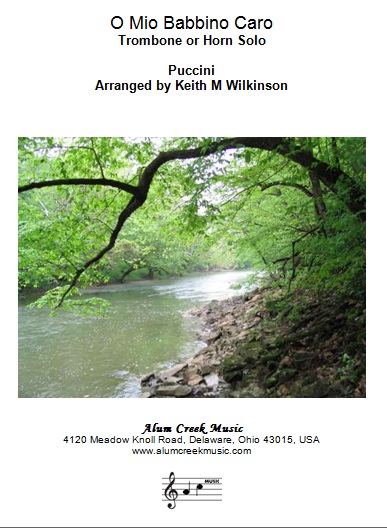
£5.00O Mio Babbino Caro (Trombone or Horn Solo and Piano Accompaniment)
This famous aria is from the opera Gianni Schicchi. Lauretta, daughter of Gianni Schicchi, has fallen in love with Rinuccio but there are huge tensions between their two families which threaten to keep the young couple apart. The rather discordant music which opens portrays these tensions before giving way to Lauretta's tender appeal to her father to allow her to marry the man she loves. A brass band arrangement of this aria was prepared at the request of Brett Baker to be performed with Brass Band Of The Western Reserve, musical director Dr Keith M Wilkinson, during his visit in May, 2011. This piano accompaniment version will make this beautiful music accessible to more soloists.Parts included for Trombone BC, Trombone TC, Eb Horn, F Horn and Piano Accompaniment
Estimated dispatch 7-14 working days
-
 £48.56
Perspectives from Gallipoli (Brass Band) Fendall Hill
This powerful and evocative work by Australian-New Zealand composer Fendall Hill pays tribute to the ANZAC soldiers who passed through Weymouth, Dorset during World War I. Inspired by first-hand accounts, the piece follows the emotional journey of a young soldier - from eager enlistment, through the harrowing Gallipoli campaign, to recovery and reflection in Weymouth. Structured in four movements, the music captures anticipation, fear, fierce resistance, and eventual healing, culminating in a moment of remembrance. The hymn tune Wareham -written by Dorset composer William Knapp - features prominently as a thematic thread, honouring the region's historical connection to the ANZAC legacy. A deeply moving addition to the brass band repertoire, this work is both a musical narrative and a heartfelt gesture of gratitude to the people of Dorset for their care and ongoing commemoration of the ANZACs. To view a performance of the work featuring ANZAC Brass please visit www.youtube.com/watch?v=diz9TRz7rwE Duration: approx. 8.00 minutes Difficulty Level: 1st Section + PDF download includes parts and score. Sheet music available at www.brassband.co.uk (UK) or https://satradecentral.org (USA) Instrumentation: Soprano Cornet Eb Solo Cornet Bb Repiano Cornet Bb 2nd Cornet Bb 3rd Cornet Bb Flugel Horn Bb Solo Horn Eb 1st Horn Eb 2nd Horn Eb 1st Baritone Bb 2nd Baritone Bb 1st Trombone Bb 2nd Trombone Bb Bass Trombone Euphonium Bb Bass Eb Bass Bb Timpani Percussion 1-3
In Stock: Estimated dispatch 1-3 working days