
Results
-
 £72.99
Little Clover (Cornet Solo with Brass Band - Score and Parts) - Crausaz, Etienne
Irish Fantasy for Cornet and Brass Band. Due to its rarity, the four-leaf clover is considered lucky in western culture. But the common three-leaf shamrock, also known as Little Clover, is one of the symbols of Ireland, whose traditional music greatly influenced the general aesthetics of this piece. The work is in three parts: the first, in 6/8, is very lively and virtuosic. After a short cadenza, the second part introduces a theme tinged with melancholy, while the last part is a dance in 2/2 that reprises the theme of the second part to conclude the piece.Duration: 6.30
Estimated dispatch 7-14 working days
-
 £29.95
Christmas Presence (Brass Band - Score and Parts) - Sharman, Paul
Written for Birmingham Citadel Band to play at their annual carol concert at Symphony Hall, Birmingham, this piece tells the story of the Nativity using the carols Who is He? and Calypso Carol. Brief appearances are made by the shepherds (While Shepherds Watched), the angels (Ding Dong! Merrily on High) and the wise men (The Kings' March and We Three Kings of Orient are). The music finishes with a majestic setting of the chorus of Who is He?, reminding us of baby Jesus.
Estimated dispatch 7-14 working days
-
 £154.99
A Road Less Travelled By (Brass Band - Score and Parts) - Sparke, Philip
A Road Less Travelled By was commissioned by Palangos Orkestras for the Championship Section of the 2020 European Brass Band Championships held in Palanga, Lithuania.The following was written by the composer, Philip Sparke:The title alludes to a poem by American author, Robert Frost, which appeared in his 1916 collection, Mountain Intervals: The Road Not Taken.In common with most of my larger works, this piece in not programmatic, but purely abstract; there is no extrinsic musical story. The choice of title shares my view of how composers can often develop. There can be no 'destination' in a composer's career, but rather a continuing journey to an unknown place. From piece to piece a composer needs to decide his or her next steps, never really knowing where they might lead. As Frost so eloquently describes, these sorts of instinctive decisions guide all our lives.Set in three movements, which play without a break, A Road Less Travelled By opens with a Moto Perpetuo firmly rooted in classical language, form and syntax. A continuous river of semiquavers, veering from melody to accompaniment and back again, adds drive, every and motion. The second movement, Nocturne, is in the form of a free fantasia; solos for vibraphone, flugel horn and euphonium set the stage for a central cornet solo, quietly echoed by the full band. A triumphal climax is reached before the movement dissolves into a Scherzo Finale. Mercurial and quixotic in nature, this third movement starts jovially until trios for trombones and horns darken the atmosphere. A change of mood and meter leads to a reprise of the opening and a return of the cornet melody, this time accompanied by figures derived from the scherzo theme. A brief coda based on earlier material drives the piece to a close.Duration: 15.30
Estimated dispatch 7-14 working days
-
£36.50
A Road Less Travelled By (Brass Band - Score only) - Sparke, Philip
A Road Less Travelled By was commissioned by Palangos Orkestras for the Championship Section of the 2020 European Brass Band Championships held in Palanga, Lithuania.The following was written by the composer, Philip Sparke:The title alludes to a poem by American author, Robert Frost, which appeared in his 1916 collection, Mountain Intervals: The Road Not Taken.In common with most of my larger works, this piece in not programmatic, but purely abstract; there is no extrinsic musical story. The choice of title shares my view of how composers can often develop. There can be no 'destination' in a composer's career, but rather a continuing journey to an unknown place. From piece to piece a composer needs to decide his or her next steps, never really knowing where they might lead. As Frost so eloquently describes, these sorts of instinctive decisions guide all our lives.Set in three movements, which play without a break, A Road Less Travelled By opens with a Moto Perpetuo firmly rooted in classical language, form and syntax. A continuous river of semiquavers, veering from melody to accompaniment and back again, adds drive, every and motion. The second movement, Nocturne, is in the form of a free fantasia; solos for vibraphone, flugel horn and euphonium set the stage for a central cornet solo, quietly echoed by the full band. A triumphal climax is reached before the movement dissolves into a Scherzo Finale. Mercurial and quixotic in nature, this third movement starts jovially until trios for trombones and horns darken the atmosphere. A change of mood and meter leads to a reprise of the opening and a return of the cornet melody, this time accompanied by figures derived from the scherzo theme. A brief coda based on earlier material drives the piece to a close.Duration: 15.30
Estimated dispatch 7-14 working days
-
 £40.00
Fanfare for a New Era (Brass Band - Score and Parts) - Gregson, Edward
Fanfare for a New Era is the most substantial of Edward Gregson's fanfares and was the result of a private commission by Lady Sheila Stoller to celebrate the opening in April 2017 of the Stoller Hall at Chetham's School of Music, Manchester. Gregson dedicated it to Sir Norman Stoller, who donated the funding for the new concert hall. The Fanfare was designed to fill the whole space, with separate brass choirs - trumpets, horns, trombones and tuba - playing their own music. A solo trumpeter playing 'on high' announces first the four horns and timpani, who enter with a stately measure. Next the herald trumpeter ushers in trombones, tuba and drums, with a faster dance. Finally, the remaining three trumpets amplify the peeling of bells. All four elements then come together, surrounding the audience with a 'joyful noise' of festive brass and percussion.Duration: 3.00
Estimated dispatch 7-14 working days
-
£14.00
Fanfare for a New Era (Brass Band - Score only) - Gregson, Edward
Fanfare for a New Era is the most substantial of Edward Gregson's fanfares and was the result of a private commission by Lady Sheila Stoller to celebrate the opening in April 2017 of the Stoller Hall at Chetham's School of Music, Manchester. Gregson dedicated it to Sir Norman Stoller, who donated the funding for the new concert hall. The Fanfare was designed to fill the whole space, with separate brass choirs - trumpets, horns, trombones and tuba - playing their own music. A solo trumpeter playing 'on high' announces first the four horns and timpani, who enter with a stately measure. Next the herald trumpeter ushers in trombones, tuba and drums, with a faster dance. Finally, the remaining three trumpets amplify the peeling of bells. All four elements then come together, surrounding the audience with a 'joyful noise' of festive brass and percussion.Duration: 3.00
Estimated dispatch 7-14 working days
-
 £12.00
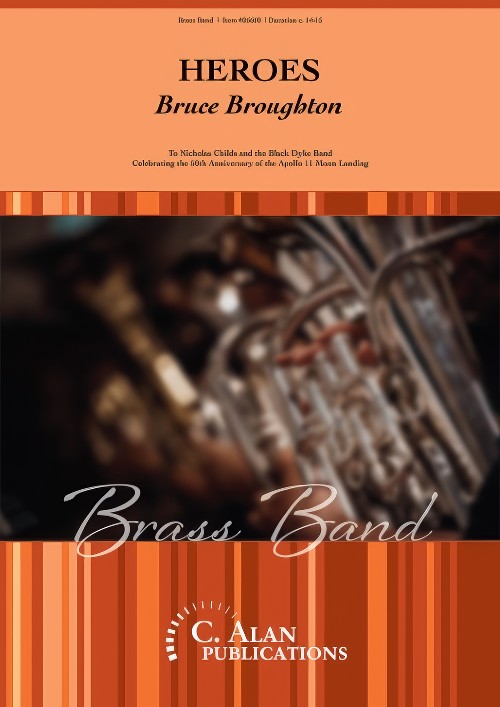
Heroes (Brass Band - Study Score) - Broughton, Bruce
Celebrating the 50th Anniversary of the Apollo 11 Moon Landing.Dedicated to Nicholas Childs and the Black Dyke Band, Heroes pays tribute to the 50th anniversary of the Apollo 11 moon landing and the incredible achievements of astronauts Neil Armstrong, Buzz Aldrin and Michael Collins.The piece is cast in three continuous sections:Ignition, which launches the work, propels us into orbit with dynamic rhythmic writing before transitioning into the second section...Tranquility, provides the soloists an opportunity to revel in a contrasting sound world, reflecting the remarkable quiet and stillness of The Sea of Tranquility.Return, the find section is a technical tour de force, developing material from the earlier sections before a reprise of the Tranquility theme brings the work to a resounding conclusion.
Estimated dispatch 7-14 working days
-
 £31.95
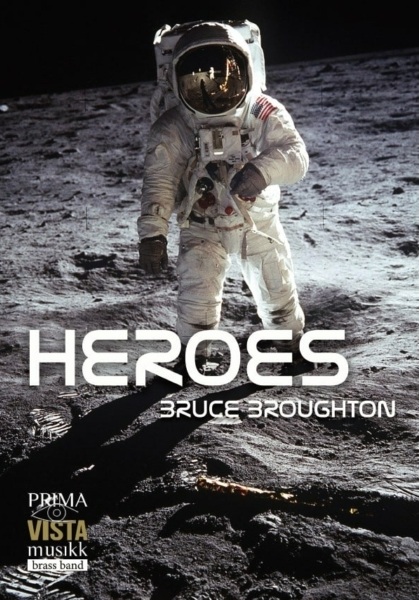
Heroes (Brass Band - Score only) - Broughton, Bruce
Celebrating the 50th Anniversary of the Apollo 11 Moon Landing.Dedicated to Nicholas Childs and the Black Dyke Band, Heroes pays tribute to the 50th anniversary of the Apollo 11 moon landing and the incredible achievements of astronauts Neil Armstrong, Buzz Aldrin and Michael Collins.The piece is cast in three continuous sections:Ignition, which launches the work, propels us into orbit with dynamic rhythmic writing before transitioning into the second section...Tranquility, provides the soloists an opportunity to revel in a contrasting sound world, reflecting the remarkable quiet and stillness of The Sea of Tranquility.Return, the find section is a technical tour de force, developing material from the earlier sections before a reprise of the Tranquility theme brings the work to a resounding conclusion.
Estimated dispatch 7-14 working days
-
 £94.95
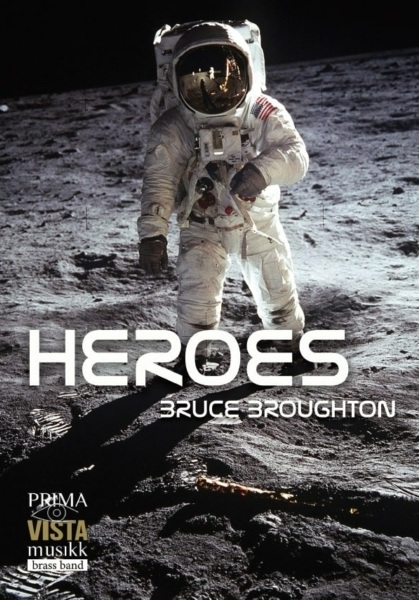
Heroes (Brass Band - Score and Parts) - Broughton, Bruce
Celebrating the 50th Anniversary of the Apollo 11 Moon Landing.Dedicated to Nicholas Childs and the Black Dyke Band, Heroes pays tribute to the 50th anniversary of the Apollo 11 moon landing and the incredible achievements of astronauts Neil Armstrong, Buzz Aldrin and Michael Collins.The piece is cast in three continuous sections:Ignition, which launches the work, propels us into orbit with dynamic rhythmic writing before transitioning into the second section...Tranquility, provides the soloists an opportunity to revel in a contrasting sound world, reflecting the remarkable quiet and stillness of The Sea of Tranquility.Return, the find section is a technical tour de force, developing material from the earlier sections before a reprise of the Tranquility theme brings the work to a resounding conclusion.
Estimated dispatch 7-14 working days
-
 £174.99
Tales and Legends (Brass Band - Score and Parts) - Crausaz, Etienne
This three-movement work by the Swiss composer Etienne Crausaz reflects three true stories and fascinating legends from the Middle Ages. The first movement tells the dramatic story of the 'witch' Catherine 'Catillon' Repond (1662-1731). She was the last woman ever to be executed for sorcery. In the second movement, the famous court jester Girard Chalamala occupies centre stage. This jester, the last one at the castle of Count Greyerz, could make everyone laugh. The third movement tells the story of Count Michael. He went down in history as a spendthrift bon-vivant. His burden of debt became so high that he did a moonlight flit and never came back! Duration: 21.00
Estimated dispatch 7-14 working days
 View Music