
Results
-
 £44.95
Harrison's Dream (Brass Band - Score only) - Graham, Peter
At 8.00pm on the 22nd of October 1707, the Association, flagship of the Royal Navy, struck rocks off the Scilly Isles with the loss of the entire crew. Throughout the rest of the evening the remaining three ships in the fleet suffered the same fate. Only 26 of the original 1,647 crew members survived. This disaster was a direct result of an inability to calculate longitude, the most pressing scientific problem of the time. It pushed the longitude question to the forefront of the national consciousness and precipitated the Longitude Act. Parliament funded a prize of �20,000 to anyone whose method or device would solve the dilemma.For carpenter and self-taught clockmaker John Harrison, this was the beginning of a 40 year obsession. To calculate longitude it is necessary to know the time aboard ship and at the home port or place of known longitude, at precisely the same moment. Harrison's dream was to build a clock so accurate that this calculation could be made, an audacious feat of engineering.This work reflects on aspects of this epic tale, brilliantly brought to life in Dava Sobel's book Longitude. Much of the music is mechanistic in tone and is constructed along precise mathematical and metrical lines. The heart of the work however is human - the attraction of the �20,000 prize is often cited as Harrison's motivation. However, the realisation that countless lives depended on a solution was one which haunted Harrison. The emotional core of the music reflects on this, and in particular the evening of 22ndOctober 1707.- Peter GrahamJuly 2000 Recorded on Polyphonic QPRL219D Master Brass (Volume Fifteen). Duration: 14'30"
Estimated dispatch 7-14 working days
-
 £50.00
CONCERTO FOR EUPHONIUM (Brass Band Parts) - Scott, Andy
Brass Band parts only, solo part not included - available separately. The 'Concerto for Euphonium' with Brass Band is scored in three movements: The Lure of the Red Jacket; Far Beyond the Stars; The Dragon's Den. The Lure of the Red Jacket responds musically to these ideas and attitudes; a non-relenting riff that signifies the hard slog of practice, scorings which find members of the band supporting the soloist, all the time the soloist putting together new riffs and ideas. Stylistically all this happens within a frame of minimalism and funk. Far Beyond the Stars is a simple folk-like melody that is stated by the soloist, which develops with different harmonic backdrops being introduced. The poignant words form the focus of the emotional intensity of this piece. The Dragon's Den is a fierce and fiery fusion of energy, virtuosic playing and intricate ensemble work, the finale of the Concerto for Euphonium draws upon the composers experience of big band and small group performance and writing. Dur: 15:00
Estimated dispatch 7-14 working days
-
£20.00
CONCERTO FOR EUPHONIUM (Brass Band Score) - Scott, Andy
Brass Band score only. The 'Concerto for Euphonium' with Brass Band is scored in three movements: The Lure of the Red Jacket; Far Beyond the Stars; The Dragon's Den. The Lure of the Red Jacket responds musically to these ideas and attitudes; a non-relenting riff that signifies the hard slog of practice, scorings which find members of the band supporting the soloist, all the time the soloist putting together new riffs and ideas. Stylistically all this happens within a frame of minimalism and funk. Far Beyond the Stars is a simple folk-like melody that is stated by the soloist, which develops with different harmonic backdrops being introduced. The poignant words form the focus of the emotional intensity of this piece. The Dragon's Den is a fierce and fiery fusion of energy, virtuosic playing and intricate ensemble work, the finale of the Concerto for Euphonium draws upon the composers experience of big band and small group performance and writing. Dur: 15:00
Estimated dispatch 7-14 working days
-
£12.50
CONCERTO FOR EUPHONIUM (Euphonium Solo part only) - Scott, Andy
Solo part only, Brass Band parts and score available separately. The 'Concerto for Euphonium' with Brass Band is scored in three movements: The Lure of the Red Jacket; Far Beyond the Stars; The Dragon's Den. The Lure of the Red Jacket responds musically to these ideas and attitudes; a non-relenting riff that signifies the hard slog of practice, scorings which find members of the band supporting the soloist, all the time the soloist putting together new riffs and ideas. Stylistically all this happens within a frame of minimalism and funk. Far Beyond the Stars is a simple folk-like melody that is stated by the soloist, which develops with different harmonic backdrops being introduced. The poignant words form the focus of the emotional intensity of this piece. The Dragon's Den is a fierce and fiery fusion of energy, virtuosic playing and intricate ensemble work, the finale of the Concerto for Euphonium draws upon the composers experience of big band and small group performance and writing. Dur: 15:00
Estimated dispatch 7-14 working days
-
 £84.95
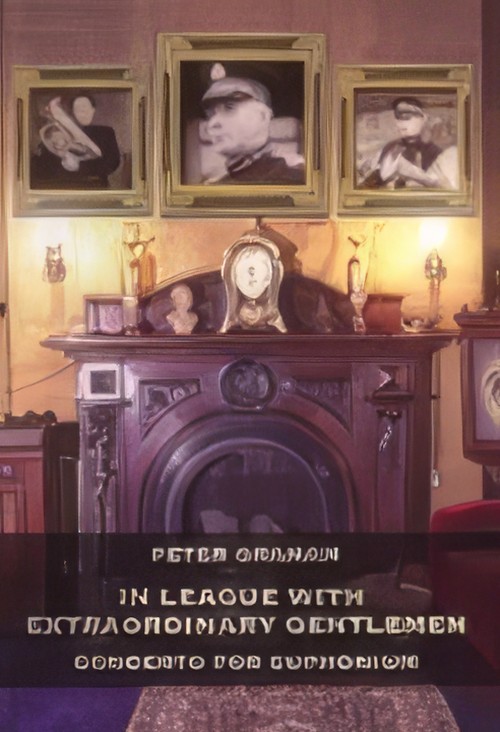
In League with Extraordinary Gentlemen (Euphonium Solo with Brass Band - Score and Parts) - Graham, Peter
Concerto for EuphoniumIn League with Extraordinary Gentlemen combines two of composer Peter Graham's life interests - composition and 19th century popular fiction. Each of the concerto's three movements takes its musical inspiration from extraordinary characters who have transcended the original genre and have subsequently found mass audiences through film, television and comic book adaptations.The first movement follows a traditional sonata form outline with one slight modification. The order of themes in the recapitulation is reversed, mirroring a plot climax in the H.G. Wells novella The Time Machine (where the protagonist, known only as The Time Traveller, puts his machine into reverse bringing the story back full circle).The Adventure of the Final Problem is the title of a short story published in The Memoirs of Sherlock Holmes by Arthur Conan Doyle. This is an account of the great detective's final struggle with his long-time adversary Professor Moriarty at the Reichenbach Falls in Switzerland. The music takes the form of a slowed down lndler (a Swiss/Austrian folk dance) and various acoustic and electronic echo effects call to mind the alpine landscape. The final bars pose a question paralleling that of Conan Doyle in the story - have we really seen the last of Sherlock Holmes?The final movement, The Great Race, (available separately) follows Phileas Fogg on the last stage of his epic journey "Around the World in Eighty Days" (from the novel by Jules Verne). The moto perpetuo nature of the music gives full rein to the soloist's technical virtuosity. As the work draws to a conclusion, the frantic scramble by Fogg to meet his deadline at the Reform Club in Pall Mall, London, is echoed by the soloist's increasingly demanding ascending figuration, set against the background of Big Ben clock chimes.In League with Extraordinary Gentlemen was first performed in the brass band version by David Thornton and the Black Dyke Band, conductor Nicholas Childs, at the RNCM Concert Hall Manchester on January 30, 2009.
Estimated dispatch 7-14 working days
-
 £74.95
Radio City (Trombone Solo with Brass Band - Score and Parts) - Graham, Peter
As youngsters growing up on the west coast of Scotland, my brother and I fell heir to an old valved radiogram which provided us with our first experiences of radio broadcasts. On the short wave signal, and through the static, we could pick up a whole range of programmes from across the Atlantic. I particularly recall the baseball games, the American accents of the announcers providing a window to a evocative world far removed from our small Ayrshire town. These memories form the basis of Radio City.The work is set in three movements, each introduced by a pastiche radio announcer narrative written by Philip Coutts. The first, City Noir, is a nod towards Raymond Chandler's eponymous private eye Philip Marlow and the dark cityscape of 1940s California.Movement two, Cafe Rouge, takes its title from the main restaurant in New York's famous Hotel Pennsylvania. Two of the most famous band leaders of the 1940s, trombonists Glenn Miller and Tommy Dorsey, broadcast live from the cafe on numerous occasions and the movement echoes with a collage of imagined sounds from the period.The finale, Two-Minute Mile, derives from an event dubbed in the USA as "the most exciting two minutes in sport", namely the Kentucky Derby. The virtuoso soloist figurations have their roots in Kentucky bluegrass fiddle music, with the galloping bluegrass clog-dancing rhythms providing the backdrop.- Peter Graham, Cheshire, January 2013
Estimated dispatch 7-14 working days
-
 £99.95
SEA PICTURES (Brass Band - Score and Parts) - Sparke, Philip
An atmospheric and descriptive work, Sea Pictures is in three sections. The quiet but very difficult opening describes the sea at dawn when all is still save for the cries of the early-morning gulls and deep movements of the sea itself. The sun rises and the next section pictures it glistening and sparkling on the waves. A school of playful dolphins passes. As they swim into the distance we are alone again with the sun and the waves. But there are distant rumblings; from far away a storm approaches. Cool breezes disturb the surface of the sea as it clouds over. And then the storm is upon us, turning the sea into the most awful force in all nature. Then, as suddenly as it had begun, it abates, leaving the sea once again serene in sunlight. All is calm but, as the work fades to a close, distant claps of thunder remind us that we are always at the mercy of the power and ficklesness of nature. Championship section. Duration 20:13
Estimated dispatch 7-14 working days
-
£57.95
SEA PICTURES (Brass Band - Score only) - Sparke, Philip
An atmospheric and descriptive work, Sea Pictures is in three sections. The quiet but very difficult opening describes the sea at dawn when all is still save for the cries of the early-morning gulls and deep movements of the sea itself. The sun rises and the next section pictures it glistening and sparkling on the waves. A school of playful dolphins passes. As they swim into the distance we are alone again with the sun and the waves. But there are distant rumblings; from far away a storm approaches. Cool breezes disturb the surface of the sea as it clouds over. And then the storm is upon us, turning the sea into the most awful force in all nature. Then, as suddenly as it had begun, it abates, leaving the sea once again serene in sunlight. All is calm but, as the work fades to a close, distant claps of thunder remind us that we are always at the mercy of the power and ficklesness of nature. Championship section. Duration 20:13
Estimated dispatch 7-14 working days
-
£89.95
TUBA CONCERTO (Gregson) (Tuba Solo with Brass Band - Score and Parts) - Gregson, Edward
This work was commissioned by the Besses o' th' Barn Band with funds provided by the Arts Council of Great Britain. It was written for, and is dedicated to, John Fletcher, who gave the first performance in Middleton Civic Hall, near Manchester, on 24 April, 1976, with Besses o' th' Barn Band conducted by the composer. Another interesting feature about the premire was that it was recorded by BBC Television for an Omnibus programme with Andr Previn as presenter. The concerto exists in four versions: with brass band (1976), orchestra (1978), wind band (1984) and piano reduction.The concerto is in three movements, following the usual, quick-slow-quick pattern: Allegro deciso,Lento e mesto, Allegro giocoso. The first movement has a sonata form shell with two contrasting themes, the first one being rhythmic in character, the second lyrical. There is a reference made in passing to the Vaughan Williams Tuba Concerto, but this merges into the other material in the development section.The second movement begins with a chorale, but after the entry of the tuba it leads to a cantabile theme, softly unfolded by the soloist. The opening chorale passage returns, this time briefly on muted brass, and leads to a middle section which is more chromatic in style and soon builds to a powerful climax, where the opening cantabile theme triumphantly returns. The music subsides, returning to the opening chorale and ending peacefully.The finale is light and breezy in style, and is cast in rondo form. After a brief introduction the tuba announces the main rondo theme, which is dance-like and a little jaunty. There are two episodes: the first a broad sweeping tune, the second a slowish waltz and a little jazz-like. After a virtuoso cadenza reference is made to the very opening of the concerto before the work ends with a triumphal flourish.The Tuba Concerto has established itself as one of the main works in the solo tuba repertoire. It has been performed and broadcast in over 40 countries all over the world. There are currently six commercial recordings of the concerto in its various versions.resolution in C major, pointed by a simple but expansive melody towards which the piece has been heading, and ending in a blaze of joyful colour.Duration: 18 mins
Estimated dispatch 7-14 working days
-
 £54.95
WORLD WITHIN, A (Brass Band Parts) - Scott, Andy
Brass Band parts only. 'A World Within' is a one-movement work that starts with a simple theme stated by the Soprano Cornet before an ostinato figure in 6/8 time emerges (Vibraphone, Horns and muted 2nd and 3rd Cornets) over which firstly Solo Cornet, and then both Solo Cornets (1 & 2), play a sustained melody. A shift between major and minor harmonies characterises the 'B' section, before making way for a virtuosic Flugel solo. When the Flugel leaves centre stage the front line Cornets take over, leading to a full bodied reprise of the 'B' section. The low brass bridge the gap between what is in effect the end of the first main section of the piece and the second section. The constant time shift between 3/4 and 6/8 that has been prevalent through-out 'A World Within', re-emerges towards the end of the 'slow, heavy blues' section, leading into an intricate almost fugue-like passage (Horn and Baritone leading the way). Out of this comes a short transitional bridge section that leads us back to the (transposed) original 6/8 time theme and feel, this time scored with a bold directness that leads to a powerful 2/4 time passage. The climax of 'A World Within' is heralded by one dark and dissonant chord that is repeated three times. A flashback moment occurs where the 'hymn' is stated (muted Cornets) in a bitonal harmonic world. A final statement emerges from the denseness of sound, a re-working of the initial theme (Solo Cornet), with the last work being left to Solo Eb Bass. Dur: 13:00
Estimated dispatch 7-14 working days
 View Music