
Results
-
 £80.00
The Unfortunate Traveller (Brass Band - Score and Parts)
Imogen Holst (1907-1984) submitted The Unfortunate Traveller (1929) as her final work as a student portfolio at the Royal College of Music, where her composition teacher was Gordon Jacob. The title was taken from Thomas Nashe's famous 1594 picaresque novel of the same title. The Suite was first performed on 12 February 1933 at her Majesty's Theatre, Carlisle, by the St. Stephen's Band, with the composer conducting. Te concert was given in memory of Holst's uncle, Dr. H.A. Lediard. Holst had been impressed with the band's performance of his A Moorside Suite at the 1928 National Brass Band Championships (The Crystal Palace, South London) and was keen to work with them. Writing in Imogen Holst, a life in music, Christopher Grogan indicates that it was Gustav Holst's suggestion to include his daughter's work in the programme, quoting Imogen Holst's remarks made in interview to The Daily Mail as follows: "....it is the first time, so far as I know, that a woman has conducted a brass band at a public concert....It has been a delight to rehearse the St. Stephen's Band. It was their performance at the Crystal Palace Festival that inspired me to write this Suite, which I have dedicated to them."Imogen Holst accompanied her father to the Crystal Palace in 1928 to hear the performances of A Moorside Suite, and was so excited by the played and, audibly, by her father's music that she decided to write a brass band piece for her final examination. Te result was The Unfortunate Traveller (1929). However, it was not possible for her to present a brass band work for examination. She arranged it for string orchestra so that it could be played before she left the RCM in July 1930. Following the premiere of the original in 1933, the manuscripts did not resurface until 1969 Imogen found them among her late mother's effects. Although she requested score and parts be destroyed, they ended up in the possession of Manchester composer John Golland, who marked up the score presumably with the intention of creating a new performing edition. The original scoring reveals a lack of experience with what can be a tricky medium.With the agreement of the Holst Foundation, a revised edition, with additional percussion, was prepared in 2011 since when the work has been fortunate to travel round the world as a concert and contest piece. The original includes drums in the March only. The title was taken from Tomas Nashe's famous 1594 picaresque novel of the same title. Several Morris Dance tunes are introduced during the course of the four short movements, including Bonnie Green Garters, Shepherd's Hey, The Rose and The Wind Blaws Cauld. Quirky twists and turns of harmony and spirited rhythms that remind us how much Imogen Holst loved tradition English dance music.In September 2025, I made a performing edition of the composer's arrangement for string orchestra. The manuscript lacks the final movement, which I arranged in a similar style, ie. without extending the upper ranges. Making this edition raised some issues regarding the accuracy of my band version and some of the solutions I used to smooth out the voicing. I have used the composer's second thoughts to refine my performing edition and to correct a textual errors.- Paul HindmarshDuration: 10.00
Estimated dispatch 7-14 working days
-
£40.00
The Unfortunate Traveller (Brass Band - Score only)
Imogen Holst (1907-1984) submitted The Unfortunate Traveller (1929) as her final work as a student portfolio at the Royal College of Music, where her composition teacher was Gordon Jacob. The title was taken from Thomas Nashe's famous 1594 picaresque novel of the same title. The Suite was first performed on 12 February 1933 at her Majesty's Theatre, Carlisle, by the St. Stephen's Band, with the composer conducting. Te concert was given in memory of Holst's uncle, Dr. H.A. Lediard. Holst had been impressed with the band's performance of his A Moorside Suite at the 1928 National Brass Band Championships (The Crystal Palace, South London) and was keen to work with them. Writing in Imogen Holst, a life in music, Christopher Grogan indicates that it was Gustav Holst's suggestion to include his daughter's work in the programme, quoting Imogen Holst's remarks made in interview to The Daily Mail as follows: "....it is the first time, so far as I know, that a woman has conducted a brass band at a public concert....It has been a delight to rehearse the St. Stephen's Band. It was their performance at the Crystal Palace Festival that inspired me to write this Suite, which I have dedicated to them."Imogen Holst accompanied her father to the Crystal Palace in 1928 to hear the performances of A Moorside Suite, and was so excited by the played and, audibly, by her father's music that she decided to write a brass band piece for her final examination. Te result was The Unfortunate Traveller (1929). However, it was not possible for her to present a brass band work for examination. She arranged it for string orchestra so that it could be played before she left the RCM in July 1930. Following the premiere of the original in 1933, the manuscripts did not resurface until 1969 Imogen found them among her late mother's effects. Although she requested score and parts be destroyed, they ended up in the possession of Manchester composer John Golland, who marked up the score presumably with the intention of creating a new performing edition. The original scoring reveals a lack of experience with what can be a tricky medium.With the agreement of the Holst Foundation, a revised edition, with additional percussion, was prepared in 2011 since when the work has been fortunate to travel round the world as a concert and contest piece. The original includes drums in the March only. The title was taken from Tomas Nashe's famous 1594 picaresque novel of the same title. Several Morris Dance tunes are introduced during the course of the four short movements, including Bonnie Green Garters, Shepherd's Hey, The Rose and The Wind Blaws Cauld. Quirky twists and turns of harmony and spirited rhythms that remind us how much Imogen Holst loved tradition English dance music.In September 2025, I made a performing edition of the composer's arrangement for string orchestra. The manuscript lacks the final movement, which I arranged in a similar style, ie. without extending the upper ranges. Making this edition raised some issues regarding the accuracy of my band version and some of the solutions I used to smooth out the voicing. I have used the composer's second thoughts to refine my performing edition and to correct a textual errors.- Paul HindmarshDuration: 10.00
Estimated dispatch 7-14 working days
-
 £99.95
Breath of Souls (Brass Band - Score and Parts)
Breath of Souls was commissioned by Weyland and Yvonne Roberts. It was composed especially for the 100th National Brass band Championships of Great Britain at the Royal Albert hall on October 15th 2011.Weyland has worked in science for many years and has always been fascinated by nature's capacity to grow and rebuild regardless of Mother Nature's catastrophic power. This is evident with the news of tsunami, forest fires, earthquakes and volcanic disasters around the world where animals, plant life and humans have overcome adversity and have demonstrated that unique regenerative quality.Speaking about the piece composer Paul Lovatt-Cooper commented: "With Breath of Souls I wanted to compose a piece of music that was a celebration of life. Not only that, but a piece of music that from the very first notes heard in the percussion and cornets, is bustling with activity, emulating that in life everything that is living has a soul and breathes - nothing stays still and everything keeps moving and growing.Just like life itself Breath of Souls also grows musically with each bar. You will hear many and various motifs and ideas grow and develop as the piece develops."
Estimated dispatch 7-14 working days
-
 £15.00
Breath of Souls (Brass Band - Study Score)
Breath of Souls was commissioned by Weyland and Yvonne Roberts. It was composed especially for the 100th National Brass band Championships of Great Britain at the Royal Albert hall on October 15th 2011.Weyland has worked in science for many years and has always been fascinated by nature's capacity to grow and rebuild regardless of Mother Nature's catastrophic power. This is evident with the news of tsunami, forest fires, earthquakes and volcanic disasters around the world where animals, plant life and humans have overcome adversity and have demonstrated that unique regenerative quality.Speaking about the piece composer Paul Lovatt-Cooper commented: "With Breath of Souls I wanted to compose a piece of music that was a celebration of life. Not only that, but a piece of music that from the very first notes heard in the percussion and cornets, is bustling with activity, emulating that in life everything that is living has a soul and breathes - nothing stays still and everything keeps moving and growing.Just like life itself Breath of Souls also grows musically with each bar. You will hear many and various motifs and ideas grow and develop as the piece develops."
Estimated dispatch 7-14 working days
-
 £45.00
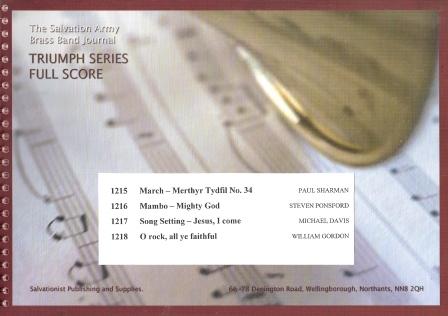
Triumph Series Band Journal July 2011 Numbers 1215 - 1218
No. 1215 March - Merthyr Tydfil No.34 (Paul Sharman)This march was written at the request of Bandmaster Howard Roberts to celebrate the 125th anniversary of Merthyr Tydfil Corps, corps number 34 in The Salvation Army. The tunes used have obvious Welsh connections wit 'Cwm Rhonnda' and 'Aberystwyth' being featured. 'Aberystwyth' was written by Joseph Parry who lived in Merthyr Tydfil for a while.No. 1216 Mambo - Mighty God (Steven Ponsford)Based on words from Isaiah 9, 'Mighty God' is a song of worship and assurance by Chris Bowater and helen and Mark Johnson. This arrangement will afford bands the opportunity to engage the audience into a lively segment of praise.No. 1217 Song Setting - Jesus, I come (Michael Davis)A setting of George C Stebbins' beautiful melody 'Out of my bondage'.No. 1218 O rock, all ye faithful (William Gordon)The Christmas carol 'O come, all ye faithful' is arranged here in a 'rock' style and includes references to other well known Christmas carols.
Estimated dispatch 7-14 working days
-
 £82.95
Occasion (Brass Band - Score and Parts)
Occasion was published especially for the National Youth Brass Band Championship of Great Britain, held at the Royal Albert Hall, London, on 4th October, 1986.Occasion for Brass Band is in four movements: Fanfare, Festivities, Elegy and Dance. The opening Fanfare was originally written as a Wedding Fanfare for Paul and Hazel Patterson in 1981, while the Elegy and Dance were commissioned as a test-piece for the first Westsound/Ayrshire Invitation Contest in 1982 for the leading bands in Scotland. Festivities was therefore written last, to complete the work and give it its essentially 'festive' character. Except for the Elegy, which is contemplative, the music throughout is extrovert and joyful. The opeing Fanfare may be performed separately - of the Fanfare may be ledt out entirely, making the work a three movement Suite.Duration: 11 minutes
Estimated dispatch 7-14 working days
-
£37.95
Occasion (Brass Band - Score Only)
Occasion was published especially for the National Youth Brass Band Championship of Great Britain, held at the Royal Albert Hall, London, on 4th October, 1986.Occasion for Brass Band is in four movements: Fanfare, Festivities, Elegy and Dance. The opening Fanfare was originally written as a Wedding Fanfare for Paul and Hazel Patterson in 1981, while the Elegy and Dance were commissioned as a test-piece for the first Westsound/Ayrshire Invitation Contest in 1982 for the leading bands in Scotland. Festivities was therefore written last, to complete the work and give it its essentially 'festive' character. Except for the Elegy, which is contemplative, the music throughout is extrovert and joyful. The opeing Fanfare may be performed separately - of the Fanfare may be ledt out entirely, making the work a three movement Suite.Duration: 11 minutes
Estimated dispatch 7-14 working days
-
 £34.95
Elixir of Youth (Brass Band - Score and Parts)
Elixir of Youth (2013) was written for the 2013 Brass for Heroes charity event where it was premiered on 19th October 2013 at St Paul's Hall in Huddersfield under the baton of Philip Harper. The title of the work reflects the nature of the band that was put together for that premiere performance; an all-star youth band comprising a selection of the country's young brass banding talent, with the term Elixir referring here to the everlasting talent seen in young brass players throughout the United Kingdom's brass bands and bands' and teachers abilities to keep producing such high quality musicians for the banding movement.The work, structured in three sections, is a showcase for band with a heroic opening where fanfare-like gestures in the cornets and trombones juxtapose rapid euphonium and baritone runs, alongside sweeping horns and percussion effects. As the piece progresses, a grove is introduced - just in the tubas at first, accompanied by a hi-hat - before spreading through the band, definitely stuff to tap your toes to! The middle, slower section of the work sees both flugel and cornet solos, with additional inputs from the euphonium and solo horn before a climax and return to the tempo and music of the opening section. A rousing close concludes the work where all of the work's themes are interweaved to create a sense of power, unity and grandeur; an Elixir of Youth.
Estimated dispatch 7-14 working days
-
 £37.50
Brass Monkey's Jazz Workout
This huge release brings together a selection of music composed by Paul H Traves that introduces your learners to the different style of Jazz that is available. Naturally, the rhythmic work required to play such styles means that this publication will push your learners on and will challenge them at a new level. Syncopation and swing are at the heart of the music in this collection and it is the perfect way to get your learners playing in new styles not always covered by training band music. This title offers excellent value for money with seven titles included. This publication features:SNAKES & LADDERS - (teaching dynamics and expressive playing)CHROMATICS - (As the title suggest, ensuring every valve us used!)ROCKIN' GERONIMO - (featuring triplets and accidentals)TRUMPET DRIFT - (introducing crotchet triplets & syncopation)J.B.'s 12 BAR BLUES - (a well-known style that feature sharp key signatures)J.B.'s CALYPSO (unison playing and tight rhythmic playing required)ZIG-ZAG (getting players into a lazy swing style)
Estimated dispatch 7-14 working days
-
 £33.00
Lux Aeterna (Score and Parts)
The title Lux Aeterna (Eternal Light) can be interpreted on a number of levels. Musically it has a rather mystical feel to it, and the single note with which the piece begins continues uninterrupted throughout, like an inextinguishable flame, or a constant source of hope. There are lyrical and song-like solo lines for cornet, flugel and euphonium. In a recent review Paul Hindmarsh described the piece as a touching new work by Philip Harper that would have got my vote for best new work for its technical ingenuity if not its 'wow factor'.
Estimated dispatch 7-14 working days