
Results
-
 £69.99
Oldies Forever (Brass Band - Score and Parts)
In the field of popular music the years around the change from the 60's to the 70's saw a wealth of great releases. Many of these hits have been re-released or reworked by artists making them popular today with a new young audience. This new medley presents many hits that would be an attractive concert item in their own right but together they form a musical masterpiece with an almost irresistible appeal on the listener. 05:30
Estimated dispatch 7-14 working days
-
 £54.99
Only Time (Brass Band - Score and Parts)
For many years Enya has been selling as many records as pop goddesses like Madonna and Britney Spears. But it was the events of September 11, 2001 that truly brought this Irish singer to the world stage with CNN broadcasting her ballad Only Time with the tragically dramatic images around the World Trade Center in New York. Ron has arranged this moving song in his own familiar creative way 03:00
Estimated dispatch 7-14 working days
-
£89.95
PRELUDE, TOCCATA and FUGUE (Graduation Day) (Brass Band - Score and Parts) - Sparke, Philip
Three connected movements each with their own character. Prelude is energetic and riving, featuring highly syncopated melodies and frequent changes of key and phrase length. The central Toccata is a series of traditional cadenzas for cornet and euphonium that ends ina virtuoso duet for the two soloist and leads directly into the Fugue. The baroque-style fugue keeps breaking out into episodes of 'Swingle' bebop. The conflicting styles both vie for pre-eminence but are eventually happily reconciled and combined to bring this piece to a close. Duration: 13:32 Recorded on Polyphonic QPRL232D Sea Pictures
Estimated dispatch 7-14 working days
-
£44.95
PRELUDE, TOCCATA and FUGUE (Graduation Day) (Brass Band - Score only) - Sparke, Philip
Three connected movements each with their own character. Prelude is energetic and riving, featuring highly syncopated melodies and frequent changes of key and phrase length. The central Toccata is a series of traditional cadenzas for cornet and euphonium that ends ina virtuoso duet for the two soloist and leads directly into the Fugue. The baroque-style fugue keeps breaking out into episodes of 'Swingle' bebop. The conflicting styles both vie for pre-eminence but are eventually happily reconciled and combined to bring this piece to a close. Duration: 13:32 Recorded on Polyphonic QPRL232D Sea Pictures
Estimated dispatch 7-14 working days
-
 £64.95
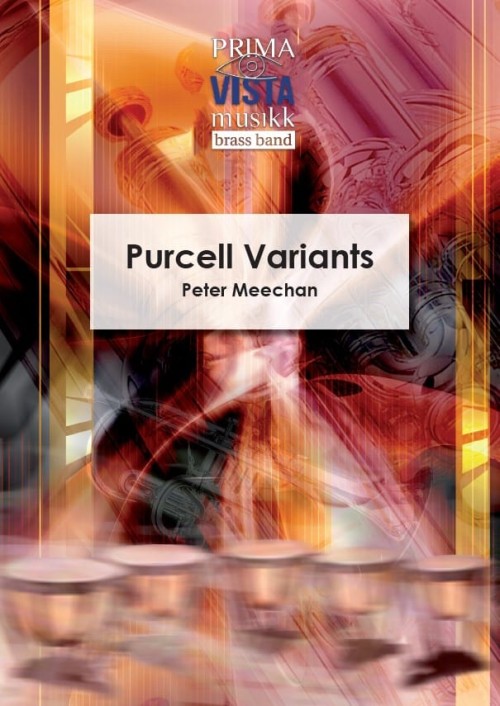
Purcell Variants (Brass Band - Score and Parts) - Meechan, Peter
Purcell Variants is based on Purcell's Queen Mary's Funeral Music, which consists of four canzonas (for brass), two elegies and an anthem.The first movement begins by sounding some of Purcell's original music in the trombones, underpinned by a timpani roll with the cornets articulating the beginnings and endings of the phrases. This leads into a cadenza for cornet and horn before the movement heads in different directions, leading us to its mysterious end, where the original music is sounded this time in the 'stabs' of the muted cornets.Originally composed for the funeral of Queen Mary in 1695, Purcell's original funeral music was used later that same year for Purcell's own funeral - he died aged only 34. The second movement is an elegy, inspired by this story. After an introduction (started by cornets sounding a last post), the main melody of the movement is introduced by the solo euphonium, with other solo roles for an off-stage soprano cornet, and trombone. This is then taken over by the cornets who lead us into the middle section of the movement. This is a quasi-funeral march, inspired by the image of Purcell's coffin being taken to its final resting point. The main melody returns in the euphonium, flugel horn and soprano cornet, this time more elaborated. The movement ends with a snare drum fading away - perhaps a metaphor. The Finale is a fast and furious movement combining thematic material from the two previous movements with new rhythmical ideas. This takes us through to the final passage - the triumphant return of Purcell's original theme.Duration: 13.00
Estimated dispatch 7-14 working days
-
£99.95
ROCOCO VARIATIONS (Gregson) (Brass Band - Score and Parts) - Gregson, Edward
Rococo Variations was commissioned by the British Open Championships for their 2008 contest in Symphony Hall, Birmingham, and co-commissioned by the Norwegian Band Federation, for their National Championship in Bergen in 2009.The title of the work has been used before, of course, most notably by Tchaikovsky in his work for cello and orchestra. My set of variations follows the Tchaikovskian model in that it is based on a quasi-Baroque original theme, and has certain 'dance-like' characteristics in the variations, but beyond that all comparisons end.There are six variations: Toccata, Siciliana, Waltz, Moto Perpetuo, Lament, and Fugal Scherzo, followed by a triumphant re-statement of the theme. Throughout, there is considerable contrast in the music, with the fast variations being rather virtuoso in character, sometimes with constantly changing time patterns, whilst the two slow variations (Siciliana and Lament) are in turn lyrical and pensive in mood with prominent solos and duets for a number of instruments.Although the work overall is dedicated by my brother, each of the six variations pays tribute to a different composer whose contribution to the brass band repertoire during the second half of the twentieth century has been of great significance. To this end, all six composers have their own 'musical signature' embraced within the particular variation, a process which reaches its zenith, contrapuntally speaking, during the final variation and reprise of the theme.- Edward Gregson
Estimated dispatch 7-14 working days
-
£49.95
ROCOCO VARIATIONS (Gregson) (Brass Band - Score only) - Gregson, Edward
Rococo Variations was commissioned by the British Open Championships for their 2008 contest in Symphony Hall, Birmingham, and co-commissioned by the Norwegian Band Federation, for their National Championship in Bergen in 2009.The title of the work has been used before, of course, most notably by Tchaikovsky in his work for cello and orchestra. My set of variations follows the Tchaikovskian model in that it is based on a quasi-Baroque original theme, and has certain 'dance-like' characteristics in the variations, but beyond that all comparisons end.There are six variations: Toccata, Siciliana, Waltz, Moto Perpetuo, Lament, and Fugal Scherzo, followed by a triumphant re-statement of the theme. Throughout, there is considerable contrast in the music, with the fast variations being rather virtuoso in character, sometimes with constantly changing time patterns, whilst the two slow variations (Siciliana and Lament) are in turn lyrical and pensive in mood with prominent solos and duets for a number of instruments.Although the work overall is dedicated by my brother, each of the six variations pays tribute to a different composer whose contribution to the brass band repertoire during the second half of the twentieth century has been of great significance. To this end, all six composers have their own 'musical signature' embraced within the particular variation, a process which reaches its zenith, contrapuntally speaking, during the final variation and reprise of the theme.- Edward Gregson
Estimated dispatch 7-14 working days
-
 £69.95
SEASCAPES (Brass Band - Score and Parts) - Steadman-Allen, Ray
Seascapes was commissioned for the National Brass Band Championships of Great Britain in 1988.Seascapes takes its inspiration from the poem 'Cargos' by John Masefield. In the first movement, a gentle lyric theme, set against a pulsating background is contrasted with a dance. The dance reaches its climax and the music concludes with a quiet theme. The second movement has something of the nature of a sarabande, with a central section, which is a little lighter but retains a Spanish flavour. The composer adds a whimsical thought of his own that there may also have been a party of monks aboard. A variety of ingredients blend in the third movement: the coaster engines, the sea, some jovial shanty-music and the storm element through which the coaster steadily chugs.Suitable for Championship Section bands.
Estimated dispatch 7-14 working days
-
£34.95
SEASCAPES (Brass Band - Score only) - Steadman-Allen, Ray
Seascapes was commissioned for the National Brass Band Championships of Great Britain in 1988.Seascapes takes its inspiration from the poem 'Cargos' by John Masefield. In the first movement, a gentle lyric theme, set against a pulsating background is contrasted with a dance. The dance reaches its climax and the music concludes with a quiet theme. The second movement has something of the nature of a sarabande, with a central section, which is a little lighter but retains a Spanish flavour. The composer adds a whimsical thought of his own that there may also have been a party of monks aboard. A variety of ingredients blend in the third movement: the coaster engines, the sea, some jovial shanty-music and the storm element through which the coaster steadily chugs.Suitable for Championship Section bands.
Estimated dispatch 7-14 working days
-
 £40.00
Symphonic Dance No.3 (Brass Band - Score and Parts) - Rachmaninoff, Sergei - Littlemore, Phillip
Completed in 1940, the set of?Symphonic Dances?was Sergei Rachmaninov's last composition. The work is fully representative of the composer's late style with its curious, shifting harmonies, the almost Prokofiev-like grotesquerie of the outer movements and the focus on individual instrumental tone colours throughout.?Rachmaninov composed the Symphonic Dances four years after his Third Symphony, mostly at the Honeyman Estate, 'Orchard Point', in Centerport, New York, overlooking Long Island Sound. The three-movement work's original name was Fantastic Dances, with movement titles of 'Noon', 'Twilight' and 'Midnight'. When the composer wrote to the conductor Eugene Ormandy in late August, he said that the piece was finished and needed only to be orchestrated, but the manuscript for the full score actually bears completion dates of September and October 1940. It was premiered by Ormandy and the Philadelphia Orchestra, to whom it is dedicated, on 3rd January, 1941. This arrangement is of the last dance and is a kind of struggle between the?Dies Iraetheme, representing Death, and a quotation from Rachmaninov's own?Vespers?(also known as the All-night Vigil, 1915), representing Resurrection. The Resurrection theme proves victorious in the end as the composer actually wrote the word 'Hallelujah' at the relevant place the score (one bar after Fig. 16 in this arrangement).?Duration: 3:45
Estimated dispatch 7-14 working days
 View Music