
Results
-
 £44.95
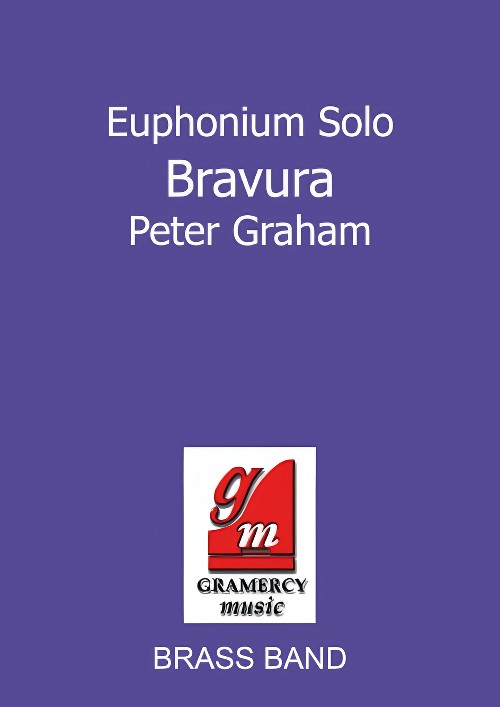
Bravura (A Fantasy on British Folk Songs) (Euphonium Solo with Brass Band - Score and Parts) - Graham, Peter
Bravura is a companion piece to the composer's earlier euphonium display piece Brillante, utilising the same traditional 19th century "fantasy variation" structure, familiar to generations of brass soloists. Folk songs from the four corners of Great Britain are featured; Oranges and Lemons, (England), The Blue Bells of Scotland, The Minstrel Boy (Ireland) and the famous Welsh anthem Men of Harlech.The solo is a conflation of the original version, written for the 2002 Royal Albert Hall Gala Concert, which followed the National Brass Band Championships of Great Britain. On that occasion the combined talents of virtuosi David Childs, Derick Kane, Steven Mead and David Thornton (with guests Robert and Nicholas Childs) were on display, each personalising the cadenza section towards the end. This version incorporates a published cadenza, though soloists should feel free to improvise their own material at this point.
Estimated dispatch 7-14 working days
-
 £59.99
Carnival of Venice (Cornet Solo with Brass Band - Score and Parts) - Freeh, Mark
The jazz cornet legend Harry James was synonymous with taking classical works and crafting versions in his own inimitable style. Carnival of Venice was one of his most famous features and here you have a true-to-the-original arrangement to feature your cornet soloist created by one of the greatest arrangers of jazz for brass band, Mark Freeh. A brass band classic given the jazz treatment, will astound and amaze your audiences every time. Not to be missed.Duration: 3:00
Estimated dispatch 7-14 working days
-
 £34.95
CLAPP! (Brass Band) - McGhee, Paul
Clapp! was originally written in 2006 whilst studying at the Royal Welsh College of Music and Drama and was written for two players at one piano. The music uses rhythmic phasing with each rhythm assigned its own tone cluster - as each shift in rhythm occurs the harmonic structure is altered too. Melodic passages are created through the shifts in rhythm and harmony, but these only occur within the given rhythmic parameters. The music can very much be viewed as a study in momentum, with its unrelenting pulse driving us through the music.The Brass Band version of 'Clapp!!!!' was written for Manger Musikklag and Torstein Aagaard-Nilsen, receiving its premiere at the 2010 BrassWind Festival in Bergen, Norway.Duration: 3:30
Estimated dispatch 7-14 working days
-
 £60.99
Consolation (Brass Band - Score and Parts)
Wer nur den lieben Gott l?sst walten was composed by Georg Neumark in about 1641 and was subtitled 'Trostlied' literally meaning consolation song. Songbooks at the time showed the popularity of this song and it is still well-known today partly due to Johann Sebastian Bach's use of the melody for one of his own chorals. In Jan de Haan's arrangement the choral is heard twice, once, alternating with the original motif from the introduction and a second time, without interruption, reflecting the composer's original intention - a song of consolation. 03:10
Estimated dispatch 7-14 working days
-
£118.99
Elegy I (Brass Band - Score and Parts)
Elegy I 'Jealousy' has been named after John Donne's poem of the same name. This English poet (1572-1631) wrote an entire series of elegies, each with its own theme. Jealousy can trigger various emotions, ranging from disappointment, grief, or regret, to madness and anger. All these emotions have been incorporated into this composition. Jacob de Haan was inspired by three different works of art: a poem (the aforementioned poem by John Donne), a painting by the Norwegian painter Edvard Munch (Jealousy in the Garden) and an old French chanson about jealousy (Je ne l'ose dire) by the sixteenth-century French composer Pierre Certon. The music refers repeatedly to this chanson - sometimes through key notes from the melody that serve as the starting point for new, isolated themes and sometimes through quotations of the original version
Estimated dispatch 7-14 working days
-
 £67.50
HAPPY (from Despicable Me 2) (Brass Band) - Williams, Pharrell - Brown, Michael
Rarely does the title of a song so accurately describe the actual music! Pharrell Williams megahit was recorded for the movie Despicable Me 2 but has taken on a life of its own on the internet and pop charts. Just hearing this tune makes you feel good! American Grade 3
Estimated dispatch 7-14 working days
-
 £42.95
In Memoriam R.K (Brass Band Set - Score and Parts) - Howarth, Elgar
All England National Brass Band Championship 2007. Recored on Polyphonic QPRL226D Master Brass Volume 18, QPRL056D National Brass Band Championship 1992 played by Black Dyke.Composer's NoteRudolph Kempe, the German conductor, was much admired for this interpretations of late romantic music, particularly Mahler and Strauss. No such music exists in the brass band repertoire and this piece, deliberately written in pastiche style, serves both to fill the gap and as my own small tribute to one of the greatest musicians I have known.
Estimated dispatch 7-14 working days
-
 £40.00
LA FIESTA (Brass Band) - Corea, Chick - Harper, Philip
Chick Corea is an American pianist and composer of Sicilian and Spanish descent, whose long career in jazz music continues to this day. A member of Miles Davis's hand in the 1960s, lie formed his own band Return to Forever in the 1970s before establishing himself as one of the greats of modern jazz. La Fiesta was composed in 1972 and included on Return to Forever's debut album. The music is in one in a bar waltz time and switches between Latin carnival style and jazz waltz, with stand-up solos for cornet, baritone and tenor horn. This arrangement was performed as part 01 the Cory Band's winning Brass in Concert programme in 2012. The publisher of this works suggests that it should be playable by championship section bands.
Estimated dispatch 7-14 working days
-
 £24.95
MADIBA (Brass Band Parts) - Scott, Andy
Brass Band parts only. A fiery afro-cuban groove, infectious melodies & great fun! Madiba was the name given to Nelson Mandela by his own Xhosa tribe, and celebrates the forty-six year long battle to end racial segregation in South Africa, via music that is both challenging and uplifting. Written in an afro-cuban style, Madiba opens with an optional short chorale, before a high impact 6/8 groove. Featuring the flugel horn mid-piece, Madiba is a powerful feel good work. Dur: 4:30
Estimated dispatch 7-14 working days
-
£15.00
MADIBA (Brass Band Score) - Scott, Andy
Brass Band score only. A fiery afro-cuban groove, infectious melodies & great fun! Madiba was the name given to Nelson Mandela by his own Xhosa tribe, and celebrates the forty-six year long battle to end racial segregation in South Africa, via music that is both challenging and uplifting. Written in an afro-cuban style, Madiba opens with an optional short chorale, before a high impact 6/8 groove. Featuring the flugel horn mid-piece, Madiba is a powerful feel good work. Dur: 4:30
Estimated dispatch 7-14 working days
 View Music