
Results
-
 £34.95
Of Wind and Weeping (Flugel Horn Solo)
Flugel Horn Solo with Brass BandThe relationship between Achilles and Patroclus is a key element of the myths associated with the Trojan war.. Its exact nature has been a subject of dispute in both the classical period and modern times. In the Iliad, the two heroes have a deep and meaningful friendship. Achilles is tender towards Patroclus, while he is callous and arrogant towards others.Of Wind & Weeping (2015) is a flugel solo, with the soloist representing Greek warrior Achilles and the pain he faces following the death of Patroclus. For a brief moment, Achilles' character shifts from a strong and unbreakable warrior to an emotional and vulnerable character. The solo should be played with expression and feeling, a character who is mourning a loved one with mixed feelings of sadness, shock and vengeance.The work was written in early 2015 for flugel soloist David James and Tongwynlais Temperance Band, with whom he is a member.
Estimated dispatch 7-14 working days
-
 £214.95
Christmas Collection - Wind Band Set - March Card Size
The wind band set contains 30 parts in march card size only:Flute 1 x2Flute 2 x2Oboe x1Bassoon x1Clarinet 1 Bb x2Clarinet 2 Bb x2Soprano Saxophone Bb x1Alto Saxophone 1 Eb x1Alto Saxophone 2 Eb x1Tenor Saxophone Bb x1Baritone Saxophone Eb x1Horn 1 in F x1Horn 2 in F x1Solo & 1st Cornet Bb x22nd Cornet Bb x2Trombone 1 B.C. x1Trombone 2 B.C. x1Bass Trombone x1Euphonium B.C. x1Euphonium Bb T.C. x1Tuba B.C. x2String Bass x1Percussion x1
Estimated dispatch 7-14 working days
-
 £95.00
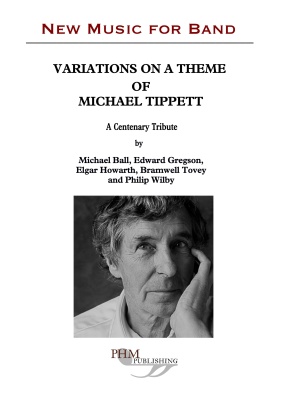
Variations on a Theme of Michael Tippett (Brass Band - Score and Parts)
A Centenary Tribute by Michael Ball, Edward Gregson, Elgar Howarth, Bramwell Tovey and Philip WilbyThis unique 'pice d'occasion' arose out of a telephone conversation in 2004 with Alan Wycherley, who was the soprano cornet player of the Foden's Richardson Band at the time. He indicated that the band would like to include an original birthday tribute for Edward Gregson (60) and Elgar Howarth (70) in its concert at the 2005 RNCM Festival of Brass in Manchester. I have been Artistic Director of Manchester's Festival of Brass since it was established in 1990 as a BBC Radio 3 series, As the centenary of the birth of Sir Michael Tippett fell on 5 January 2005, I devised this collective work as a way of embracing all three anniversaries in a novel way.The idea of joint compositions is not a new one in the classical music world. In the 1860s, Verdi was joined by a number of his contemporaries in a Requiem Mass for Rossini. In this country there have been a number of orchestral examples over the past fifty years, but never before for the brass band. Although Tippett composed only one work for brass band, Festal Brass with Blues, his orchestral works and operas are full of idiomatic brass writing. The theme I chose for this celebration is one of Tippet's most memorable miniatures featuring wind and brass. In the opera Midsummer Marriage it marks the entry of the Ancients. It is also included in the orchestral Suite in D (1948), for the Birthday of Prince Charles.I invited five of the leading contemporary voices in brass band music to add their own creative perspectives to the little Tippett theme, with it's characteristic rhythms, embellishments and modality - the Lydian mode. Each contribution was designed to fit into a tonal and formal template to give the whole work a flow and continuity. In Danse des Amis, Bramwell Tovey has composed a jazzy, humorous variation. Inspiration came from Tippett's love of jazz and, more personally, from the characteristically syncopated gait of the distinguished music critic John Amis, who Tovey once observed leaving a performance of Tippett's opera King Priam before the end. Incidentally, that performance was conducted by Elgar Howarth.We hear Edward Gregson in lyrical mode. His Midsummer Song is redolent of the sound world of Tippett's opera A Midsummer Marriage and it ends with a brief reference to a favourite of Gregson's, Tippett's Concerto for Orchestra. Michael Ball provides a brief moment of light, airy activity bringing to mind perhaps Tippett's love of Shakespearian fantasy, especially The Tempest. Elgar Howarth juxtaposes a slowed down version of the processional theme with distant recollections of fanfares from King Priam. Philip Wilby has rounded the tribute off with a spectacular fugue. During its inexorable progress Wilby ingeniously introduces the two other birthday references - the three-note musical signature that Elgar Howarth includes in much of his music and the characteristic theme which begins Edward Gregson's substantial work for brass an organ The Trumpets of the Angels. An elaborated reprise of Tippett's little theme is followed by a dynamic coda.- Paul HindmarshDuration: 13.00
Estimated dispatch 7-14 working days
-
£40.00
Variations on a Theme of Michael Tippett (Brass Band - Score only)
A Centenary Tribute by Michael Ball, Edward Gregson, Elgar Howarth, Bramwell Tovey and Philip WilbyThis unique 'pice d'occasion' arose out of a telephone conversation in 2004 with Alan Wycherley, who was the soprano cornet player of the Foden's Richardson Band at the time. He indicated that the band would like to include an original birthday tribute for Edward Gregson (60) and Elgar Howarth (70) in its concert at the 2005 RNCM Festival of Brass in Manchester. I have been Artistic Director of Manchester's Festival of Brass since it was established in 1990 as a BBC Radio 3 series, As the centenary of the birth of Sir Michael Tippett fell on 5 January 2005, I devised this collective work as a way of embracing all three anniversaries in a novel way.The idea of joint compositions is not a new one in the classical music world. In the 1860s, Verdi was joined by a number of his contemporaries in a Requiem Mass for Rossini. In this country there have been a number of orchestral examples over the past fifty years, but never before for the brass band. Although Tippett composed only one work for brass band, Festal Brass with Blues, his orchestral works and operas are full of idiomatic brass writing. The theme I chose for this celebration is one of Tippet's most memorable miniatures featuring wind and brass. In the opera Midsummer Marriage it marks the entry of the Ancients. It is also included in the orchestral Suite in D (1948), for the Birthday of Prince Charles.I invited five of the leading contemporary voices in brass band music to add their own creative perspectives to the little Tippett theme, with it's characteristic rhythms, embellishments and modality - the Lydian mode. Each contribution was designed to fit into a tonal and formal template to give the whole work a flow and continuity. In Danse des Amis, Bramwell Tovey has composed a jazzy, humorous variation. Inspiration came from Tippett's love of jazz and, more personally, from the characteristically syncopated gait of the distinguished music critic John Amis, who Tovey once observed leaving a performance of Tippett's opera King Priam before the end. Incidentally, that performance was conducted by Elgar Howarth.We hear Edward Gregson in lyrical mode. His Midsummer Song is redolent of the sound world of Tippett's opera A Midsummer Marriage and it ends with a brief reference to a favourite of Gregson's, Tippett's Concerto for Orchestra. Michael Ball provides a brief moment of light, airy activity bringing to mind perhaps Tippett's love of Shakespearian fantasy, especially The Tempest. Elgar Howarth juxtaposes a slowed down version of the processional theme with distant recollections of fanfares from King Priam. Philip Wilby has rounded the tribute off with a spectacular fugue. During its inexorable progress Wilby ingeniously introduces the two other birthday references - the three-note musical signature that Elgar Howarth includes in much of his music and the characteristic theme which begins Edward Gregson's substantial work for brass an organ The Trumpets of the Angels. An elaborated reprise of Tippett's little theme is followed by a dynamic coda.- Paul HindmarshDuration: 13.00
Estimated dispatch 7-14 working days
-
 £80.00
The Unfortunate Traveller (Brass Band - Score and Parts)
Imogen Holst (1907-1984) submitted The Unfortunate Traveller (1929) as her final work as a student portfolio at the Royal College of Music, where her composition teacher was Gordon Jacob. The title was taken from Thomas Nashe's famous 1594 picaresque novel of the same title. The Suite was first performed on 12 February 1933 at her Majesty's Theatre, Carlisle, by the St. Stephen's Band, with the composer conducting. Te concert was given in memory of Holst's uncle, Dr. H.A. Lediard. Holst had been impressed with the band's performance of his A Moorside Suite at the 1928 National Brass Band Championships (The Crystal Palace, South London) and was keen to work with them. Writing in Imogen Holst, a life in music, Christopher Grogan indicates that it was Gustav Holst's suggestion to include his daughter's work in the programme, quoting Imogen Holst's remarks made in interview to The Daily Mail as follows: "....it is the first time, so far as I know, that a woman has conducted a brass band at a public concert....It has been a delight to rehearse the St. Stephen's Band. It was their performance at the Crystal Palace Festival that inspired me to write this Suite, which I have dedicated to them."Imogen Holst accompanied her father to the Crystal Palace in 1928 to hear the performances of A Moorside Suite, and was so excited by the played and, audibly, by her father's music that she decided to write a brass band piece for her final examination. Te result was The Unfortunate Traveller (1929). However, it was not possible for her to present a brass band work for examination. She arranged it for string orchestra so that it could be played before she left the RCM in July 1930. Following the premiere of the original in 1933, the manuscripts did not resurface until 1969 Imogen found them among her late mother's effects. Although she requested score and parts be destroyed, they ended up in the possession of Manchester composer John Golland, who marked up the score presumably with the intention of creating a new performing edition. The original scoring reveals a lack of experience with what can be a tricky medium.With the agreement of the Holst Foundation, a revised edition, with additional percussion, was prepared in 2011 since when the work has been fortunate to travel round the world as a concert and contest piece. The original includes drums in the March only. The title was taken from Tomas Nashe's famous 1594 picaresque novel of the same title. Several Morris Dance tunes are introduced during the course of the four short movements, including Bonnie Green Garters, Shepherd's Hey, The Rose and The Wind Blaws Cauld. Quirky twists and turns of harmony and spirited rhythms that remind us how much Imogen Holst loved tradition English dance music.In September 2025, I made a performing edition of the composer's arrangement for string orchestra. The manuscript lacks the final movement, which I arranged in a similar style, ie. without extending the upper ranges. Making this edition raised some issues regarding the accuracy of my band version and some of the solutions I used to smooth out the voicing. I have used the composer's second thoughts to refine my performing edition and to correct a textual errors.- Paul HindmarshDuration: 10.00
Estimated dispatch 7-14 working days
-
£40.00
The Unfortunate Traveller (Brass Band - Score only)
Imogen Holst (1907-1984) submitted The Unfortunate Traveller (1929) as her final work as a student portfolio at the Royal College of Music, where her composition teacher was Gordon Jacob. The title was taken from Thomas Nashe's famous 1594 picaresque novel of the same title. The Suite was first performed on 12 February 1933 at her Majesty's Theatre, Carlisle, by the St. Stephen's Band, with the composer conducting. Te concert was given in memory of Holst's uncle, Dr. H.A. Lediard. Holst had been impressed with the band's performance of his A Moorside Suite at the 1928 National Brass Band Championships (The Crystal Palace, South London) and was keen to work with them. Writing in Imogen Holst, a life in music, Christopher Grogan indicates that it was Gustav Holst's suggestion to include his daughter's work in the programme, quoting Imogen Holst's remarks made in interview to The Daily Mail as follows: "....it is the first time, so far as I know, that a woman has conducted a brass band at a public concert....It has been a delight to rehearse the St. Stephen's Band. It was their performance at the Crystal Palace Festival that inspired me to write this Suite, which I have dedicated to them."Imogen Holst accompanied her father to the Crystal Palace in 1928 to hear the performances of A Moorside Suite, and was so excited by the played and, audibly, by her father's music that she decided to write a brass band piece for her final examination. Te result was The Unfortunate Traveller (1929). However, it was not possible for her to present a brass band work for examination. She arranged it for string orchestra so that it could be played before she left the RCM in July 1930. Following the premiere of the original in 1933, the manuscripts did not resurface until 1969 Imogen found them among her late mother's effects. Although she requested score and parts be destroyed, they ended up in the possession of Manchester composer John Golland, who marked up the score presumably with the intention of creating a new performing edition. The original scoring reveals a lack of experience with what can be a tricky medium.With the agreement of the Holst Foundation, a revised edition, with additional percussion, was prepared in 2011 since when the work has been fortunate to travel round the world as a concert and contest piece. The original includes drums in the March only. The title was taken from Tomas Nashe's famous 1594 picaresque novel of the same title. Several Morris Dance tunes are introduced during the course of the four short movements, including Bonnie Green Garters, Shepherd's Hey, The Rose and The Wind Blaws Cauld. Quirky twists and turns of harmony and spirited rhythms that remind us how much Imogen Holst loved tradition English dance music.In September 2025, I made a performing edition of the composer's arrangement for string orchestra. The manuscript lacks the final movement, which I arranged in a similar style, ie. without extending the upper ranges. Making this edition raised some issues regarding the accuracy of my band version and some of the solutions I used to smooth out the voicing. I have used the composer's second thoughts to refine my performing edition and to correct a textual errors.- Paul HindmarshDuration: 10.00
Estimated dispatch 7-14 working days
-
 £34.95
Faith is the Victory (Brass Band - Score and Parts)
James Curnow wrote this march while completing his Masters degree at Michigan State University and unsurprisingly reflects the great tradition of American symphonic wind band marches. Curnow embraces the sound world of the great Mid-Western universities (Michigan, Illinois, Iowa and Ohio State) and the march styles of Eric Osterling and Clifton Williams. Several changes of tempo indicate that this is anything but an ordinary street march. The wonderful changes of key are also notable and propel the music towards an exciting finish.
Estimated dispatch 7-14 working days
-
 £134.99
West Wind - Oliver Waespi
West Wind is structured in three parts, each bearing a subtitle drawn from poems of Emily Bronte (1818-1848). Poetry of the Romantic period, Bronte's in particular, often presents a gentle, almost innocent surface, beneath which lies the most elemental and volatile emotional forces capable of erupting at any moment.Accordingly, the opening movement, West-wind, in the glory and pride!, begins with a mellow, warm soundscape, underpinned by lightly pulsating patterns, almost like an aquarelle. Gradually however, the music transitions into far rougher, forward-driven gestures - turbulent, restless, and at times unpredictable, much like the west wind itself.The ensuing Adagio reflects on the poem Stars, in which a fundamental tension between exaltation and regret, another recurring feature of Bronte's poetry, is palpable throughout. Introspective solo and chamber music statements give way to a broad ecstatic sound field involving the full ensemble, before finally receding into a solitary euphonium soliloquy.The final movement, Wild words of an ancient song, takes the form of an extended rondo-scherzo, driven by virtuosic, perpetual motion. The sense of relentless pursuit bears a nod to The Boy on the Moor by the German poet Annette von Droste-Hulshoff, a contemporary of Bronte who explored similar narratives, albeit from a different perspective.Although certain core musical elements recur - pulsating patterns, a chorale, a tone row - the work is guided less by systematic symphonic development than by an intuitive stream of variants. These generate a sequence of metamorphoses that illuminate the material from shifting vantage points, projecting the emotional landscapes of Romantic poetry into the present day.West Wind was commissioned by the Flowers Band and was first performed under Musical Director Paul Holland, at the 2026 European Brass Band Championships in Linz (AT), where they also became European Champions.
Estimated dispatch 5-14 working days
-
 £119.99
The Lonesome Knight - Saskia Apon
The composition the Lonesome Knight was based on a fairytale. The piece was written by Saskia Apon for the National Brass Band Championships 2001. Once upon a time there was a knight who went to fight and defeat the dragon that had beenkilling the people of his town. There is a short but intense battle between the two and the knight is triumphant. However whilst persuing the dragon the knight has travelled far away from his home and now is lost. He roames around trying to findhis way home, but exhausted and weary he falls to the ground. He awakens startled by a Giant and a group of Goblins who are celebrating the death of the dragon. The knight joins in the festivities but after a long evening is once more leftalone. The sun rises the following morning and he sees a castle on the horizon. He enthousiastcally ventures towards the castle in the hope of meeting other people. However he becomes greatly disillusioned when there is none to be found. Inhis desperation the knight climbs the tower ready to jump off. Suddenly he hears a heavenly voice. Right before him is the most beautiful princess he has ever seen. She graciously thanks him for killing the dragon, a spark ingnites between themand they build a life together and.... live happily ever after! Saskia Apon studied harp at Rotterdam School of music. With this instrument she rounded of her studies by passing with credit, however it was her love of composition thatremained her focus. Self-taught, she began composing at the age of nine. Since then she has written pieces for The Dutch Brass Quintet, The Dutch Brass Ensemble, The Rotterdam Trombone Quartet and the brass band quintet Brass Ability. Atpresent she is the in-house arranger for The Rotterdam Philarmonic Brass Ensemble. Besides the customary attention for the real splashworks she endeavours to add value to the melodic function of the brass wind instruments in her music. Hercompositions and arrangements can be found on many diverse Cds.The composition the Lonesome Knight was based on a fairytale. The piece was written by Saskia Apon for the National Brass Band Championships 2001. Once upon a time there was aknight who went to fight and defeat the dragon that had been killing the people of his town. There is a short but intense battle between the two and the knight is triumphant. However whilst persuing the dragon the knight has travelled far awayfrom his home and now is lost. He roames around trying to find his way home, but exhausted and weary he falls to the ground. He awakens startled by a Giant and a group of Goblins who are celebrating the death of the dragon. The knight joins inthe festivities but after a long evening is once more left alone. The sun rises the following morning and he sees a castle on the horizon. He enthousiastcally ventures towards the castle in the hope of meeting other people. However he becomesgreatly disillusioned when there is none to be found. In his desperation the knight climbs the tower ready to jump off. Suddenly he hears a heavenly voice. Right before him is the most beautiful princess he has ever seen. She graciously thankshim for killing the dragon, a spark ingnites between them and they build a life together and.... live happily ever after! Saskia Apon studied harp at Rotterdam School of music. With this instrument she rounded of her studies by passing withcredit, however it was her love of composition that remained her focus. Self-taught, she began composing at the age of nine. Since then she has written pieces for The Dutch Brass Quintet, The Dutch Brass Ensemble, The Rotterdam Trombone Quartetand the brass band quintet Brass Ability. At present she is the in-house arranger for The Rotterdam Philarmonic Brass Ensemble. Besides the customary attention for the real splashworks she endeavours to add value to the melodic functionof the brass wind instruments in her music. Her compositions and arrangements can be found on many diverse Cds.
Estimated dispatch 5-14 working days
-
 £127.30
The Incredibles - Michael Giacchino - Lars Erik Gudim
Michael Giacchino (1967) has become one of the great composers scoring for Film, Television and Video Games. Music in the movies "Star Trek", "Ratatoille", "Mission Impossible III", "Sin" and "The Incredibles" has come from his hand, but even more known should be the music from the Television shows "Alias" and "Lost". In "The Incredibles", music with high energy and a lot of wind players fits well. To play this music with a wind band takes good care of this intentions. The super heroes are matched with music in all dimensions. This is well taken care of in the arrangement by Lars Erik Gudim.
Estimated dispatch 5-14 working days
 View Music