
Results
-
 £45.00
The Pilgrim - Josiah Walters
Josiah describes his composition'The Pilgrim' as a journey of development and emotion, encompassing three key stages of emotional state: from the opening sounds which are full of anticipation and uncertainty, through to a passage of disillusionment and frustration, then moving on to a concluding stage which reintroduces the positive elements of the opening optimism, yet closing quietly, symbolizing an inner peace and contentment at the end of the musical journey.The composer's emotive approach to the creation of the work embraces a wealth of passion, anguish and enlightenment. Through his use of imaginative melody, themes and harmonic texture, Josiah has represented a collection of powerful emotions. Essentially non-programmatic, the piece opens in a contemplative manner, building with enthusiasm, and first introducing the use of bells and bell effects as a musical metaphor which is used throughout the piece to signify the journey's destination.As the sentiment continues, the music evolves in to an Allegro Furioso section, opening up a strong sense of frustration. At this section's climax, the symbolic use of the bells is reintroduced to create an over-tone of hope and purpose, although this does not last long as they fade into the Misterioso Molto Rubato section.As the melodies and harmonies develop onwards, 'The Pilgrim' evolves into a more reflective phase, reintroducing the sounds and motifs of the more strident opening.This closing section symbolizes the realisation that everything needed was already available to The Pilgrim, but travelling the journey, confronting and overcoming all of the challenges was the only route of discovery - peacefulness prevails, bringing the work to a close with a sense of contentment and enlightenment.'The Pilgrim', highly emotive in its creation, offers a wealth of musical imagery.Even to the uninformed listener, this fascinating, powerful and beautiful work stirs and stimulates a variety of emotional reactions - offering each listener an opportunity to apply the music to their own journey, their own personal pilgrimage.
In Stock: Estimated dispatch 3-5 working days
-
 £42.00
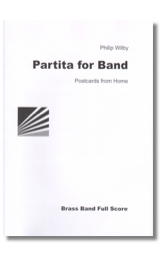
Partita for Band (Postcards from Home) (Score only) - Philip Wilby
The sound and culture of brass bands was part of Philip Wilby's childhood, and this short Partita seeks to commemorate his childish memories in the musical terms of today's currency. Although the music makes technical demands on the players the piece is, nevertheless designed to involve rather than impress its audiences. There are four movements: 'Towers and Chimneys' which is both heraldic and mysterious; 'Churches: Lord of the Dance' is an arrangement of the famous shaker melody made popular in Martin Shaw's hymn of Jesus' life and history; 'Pastorale: Sunday Afternoon recalls those long and languorous days before television, and 'Coronation Day Parade' - a community celebration with a brass band at its centre. Duration: 12:00
Estimated dispatch 7-9 working days
-
 £52.00
Partita for Band (Postcards from Home) (Parts only) - Philip WIlby
The sound and culture of brass bands was part of Philip Wilby's childhood, and this short Partita seeks to commemorate his childish memories in the musical terms of today's currency. Although the music makes technical demands on the players the piece is, nevertheless designed to involve rather than impress its audiences. There are four movements: 'Towers and Chimneys' which is both heraldic and mysterious; 'Churches: Lord of the Dance' is an arrangement of the famous shaker melody made popular in Martin Shaw's hymn of Jesus' life and history; 'Pastorale: Sunday Afternoon recalls those long and langorous days before television, and 'Coronation Day Parade' - a community celebration with a brass band at its centre. Duration: 12:00
Estimated dispatch 7-9 working days
-
 £59.95
Fantasia on an Old Dutch Hymn Tune (Brass Band - Score and Parts)
Kevin Norbury writes:This tune has always been a favourite of mine. It was first published in Holland in 1624 and then appeared in a later collection called David's Psalmen in 1685. In many hymnals it is still known by its original name, Vruechten. In the vast majority of cases, the melody is associated with the lyrics by George Ratcliffe Woodward, an ordained minister of the Church of England, who lived from 1848 to 1934.At no time in this piece do I envisage any heaviness of style. Even in slow movement, whilst predominantly homophonic, the music should flow and be transparent. The music seeks to capture the essence of joy in both the melody and words (S.A.S.B. 234).
Estimated dispatch 7-14 working days
-
 £44.95
Holy Forever (Brass Band - Score and Parts)
The words of Chris Tomlin's popular song, Holy Forever, invite us to join in the Heavenly worship by the faithful voices of those who have gone before us. Across generations, people bow in reverence, while angels continually cry 'holy', bearing witness to a holiness that does not fade or change. Woven together with the historic hymn Holy, holy, holy (S.A.S.B. 31) this music refocuses our attention on God, whose holiness remains, even when our worship is incomplete.The piece moves between complexity and simplicity, rhythmic drive and chorale, uniting styles in a grand and hopeful conclusion that offers praise to God who is holy now and holy forever.
Estimated dispatch 7-14 working days
-
 £34.95
Judd: Stand Strong
This march was written for the North York Temple Band, Toronto, for their tour of the UK in 2012. Inspired by St Paul's words to the Ephesians to 'put on the full armour of God, so that when the day of evil comes, you may be able to stand your ground' (Ephesians 6:13 NIV), the music features three songs of warfare. The first song (S.A.S.B. 989) forms the introduction to the piece and is presented by Percussion and two muted Cornets. The image here is of a distant army approaching with banners aloft. The volume of the music increases as the army approaches:We'll shout aloud throughout the landThe praises of our God,We'll fight beneath our flag unfurled,Kept by his precious blood.
Estimated dispatch 7-14 working days
-
 £34.95
Judd: Almighty - Roger Trigg
'Almighty' was written for Bandmaster Ross Johnson and Camberwell Citadel Band (Australia) for use on the band's 2009 tour of New Zealand. This energetic work takes its title from the opening line of the well-loved hymn, 'Praise to the Lord, the Almighty, the King of creation' (S.A.S.B. 19). It is based on the hymn tune 'Lobe den Herren' (T.B. 721) and whilst the tune is only heard in its entirety once, fragments of the tune can be heard throughout the music. The music is a shout of acclamation to the King of Kings.
Estimated dispatch 7-14 working days
-
 £44.83
Abberline (Euphonium Solo with Brass Band) Karl Whelan
Inspired by the infamous investigation into Jack the Ripper, Abberline follows Detective Inspector Frederick Abberline through the mist-shrouded streets of Victorian London in his desperate pursuit of a killer who remains forever just out of reach. Scored for brass band and solo euphonium, the piece blends atmospheric textures, shifting musical identities, and virtuosic demands to capture a narrative that is as haunting as it is unresolved. The piece opens in a world of shadows - the foggy alleys of Whitechapel - where tension simmers beneath the surface. The euphonium enters cautiously, as if stalking unseen figures, echoing the danger and uncertainty that cloaked the city in fear. This eerie calm is broken suddenly: the Ripper strikes. The moment is brief but brutal, leaving only silence and horror in its wake. From here, the music shifts into an uneasy, angular waltz: the figure of Abberline takes center stage, portrayed by the soloist as he investigates the aftermath. The waltz is melodically off-kilter and harmonically unstable, capturing both the grotesque nature of the crime and the detective's mental burden. The scene then returns to the streets - but this time, the musical material is more intricate, fragmented, and tense. The threat has deepened, and again the silence is shattered by violence. A second, slightly altered waltz follows, further reflecting Abberline's obsessive descent into the case. In the final section, the chase begins in earnest. Themes from earlier return in quick succession, intensified and overlapping as time runs out. The ancient Dies Irae chant is woven into the texture, evoking fate and judgment. In a final, erratic surge, the euphonium and band race toward an ending that is breathless and unresolved - a reflection of history's unanswered questions and the ghost that always stayed one step ahead. To view a rolling score video of the work please visit https://www.youtube.com/watch?v=i59xYzJRMaI Duration: approx. 7.30 minutes This PDF download includes parts and score. Sheet music available at www.brassband.co.uk (UK) or https://satradecentral.org (USA) Instrumentation: Euphonium Soloist Bb Soprano Cornet Eb Solo Cornet 1-2 & 3-4 Bb Repiano Cornet Bb 2nd Cornet Bb 3rd Cornet Bb Flugel Horn Bb Solo Horn Eb 1st Horn Eb 2nd Horn Eb 1st Baritone Bb 2nd Baritone Bb 1st Trombone Bb 2nd Trombone Bb Bass Trombone Euphonium (tutti) Bb Bass Eb Bass Bb Timpani Percussion 1-3
In Stock: Estimated dispatch 1-3 working days
-
 £33.62
Finale - Suite No.3 (Brass Band) Tchaikovsky arr. Ruben Schmidt
This arrangement by Ruben Schmidt is the exciting polonaise finale from the last movement of Tchaikovsky's thrilling Suite No.3 in G Major for Orchestra. This was first performed in Saint Petersburg on January 12th, 1885, at the fifth symphony concert of the Russian Musical Society, conducted by Hans von Bulow. The suite also was Tchaikovsky's first American success when it was performed by the New York Symphony Society at Carnegie Hall on May 7,1891. First intended as its own symphony, it became the most played and most successful of Tchaikovsky's four suites. The finale of the last movement is an invigorating polonaise dance to finish the suite. Tchaikovsky often enjoyed conducting this final movement as an independent work himself. To view a rolling score video of the work please visit www.youtube.com/watch?v=M-Ht80Lnk-c Duration: 4.00 minutes Difficulty Level: 1st Section + PDF download includes parts and score. Sheet music available here. Instrumentation: Soprano Cornet Eb Solo Cornet Bb Repiano Cornet Bb 2nd Cornet Bb 3rd Cornet Bb Flugel Horn Bb Solo Horn Eb 1st Horn Eb 2nd Horn Eb 1st Baritone Bb 2nd Baritone Bb 1st Trombone Bb 2nd Trombone Bb Bass Trombone Euphonium Bb Bass Eb Bass BbTimpani Percussion (Tambourine, Suspended Cymbal & Bass Drum)
In Stock: Estimated dispatch 1-3 working days
-
 £48.56
Peace in Our Time (Brass Band) Andrew Wainwright
Commissioned by Armonico Consort to mark the 85th anniversary of the Coventry Blitz, Peace in Our Time is a profoundly moving reflection on humanity's enduring quest for reconciliation amidst turmoil. Originally scored for choir, orchestra, and organ, this masterful brass band transcription beautifully captures the emotional weight of John Oxenham's evocative poetry and the timeless plea of Psalm 122. The work opens in hushed reverence, where distant muted cornets, a dark bass pedal, and a fragile, militaristic snare drum set a shadowed, contemplative scene. Out of this delicate landscape emerges a poignant cornet solo that yields to the expressive voice of the solo flugel horn, carrying the opening text with quiet conviction before introducing the solemn reminder: "O pray for peace, peace in Jerusalem." As the piece progresses, the setting turns darker and more restless. Harmonic tension builds through rich brass textures to reflect the fears, divisions, and heavy costs of historical and modern conflict. From this emotional turbulence rises a bold, ceremonial fanfare that marks a dramatic turning point, ushering in a glorious, expansive setting of the poem's final verse. Yet rather than ending in simple triumph, the music gently recedes into a serene and tender stillness. The final bars leave performers and audiences alike with a quiet, lingering echo - a persistent hope for peace that resonates just as deeply today as it did 85 years ago. This substantial work is an extraordinary addition to any brass band library, serving as an ideal centerpiece for Remembrance Sunday, historical commemorations, church services or serious concert programming. To view a multimedia presentation of the piece with audio please visit www.youtube.com/watch?v=Y2BKI_GCegw The multimedia presentation is available on request withe purchase of this work - please email [email protected] to receive a link to download it. To view a video performance of the original work for choir, orchestra and organ please visit www.youtube.com/watch?v=m6o6PJJVKCo Duration: approx. 8.45 minutes Difficulty Level: 2nd Section + This PDF download includes the full score and parts. Sheet music available at www.brassband.co.uk (UK) or https://satradecentral.org (USA) Instrumentation: Soprano Cornet Eb Solo Cornet Bb Repiano Cornet Bb 2nd Cornet Bb 3rd Cornet Bb Flugel Horn Bb Solo Horn Eb 1st Horn Eb 2nd Horn Eb 1st Baritone Bb 2nd Baritone Bb 1st Trombone Bb 2nd Trombone Bb Bass Trombone Euphonium Bb Bass Eb Bass Bb Timpani Percussion 1-2
In Stock: Estimated dispatch 1-3 working days
 View Music