Results
-
 £50.00
Greetings to a City (Brass Band - Score and Parts)
Sir Arthur Bliss (1891 - 1975) was a significant composer and pillar of the British musical establishment. Although Born in London, his father was from the United States and both countries were important in his life and career. A pupil of Stanford at the Royal College of Music, Bliss travelled to the United States with his father in 1923, taking a prominent part in Elizabeth Sprague Coolidge's Pittsfield Music Festival, as well as undertaking some teaching and conducting. In 1925 he married Trudy Hoffman and they returned to the UK early in 1926. Bliss's most influential scores were his ballets and film scores. In 1953 Sir Arthur was appointed Master of the Queen's Music, after which he added a steady stream of fanfares and ceremonial works to his list of works. In 1960 he was commissioned by the American Wind Symphony of Pittsburgh, which requested for festive work to feature on an extensive European tour, including a performance in London.Bliss scored Greetings to a City for antiphonal brass, a choir each of 2 trumpets, 2 horns and three trombones, with tuba and percussion. This adaptation for brass band instruments retains an element of antiphony, emphasing the contrast between the fanfare instruments (cornets and trombones) and the horns and tubas. Greetings to a City is cast in three connected sections, with extended fanfare episodes separated by a short lyrical interlude.- Paul HindmarshDuration: 6.00
Estimated dispatch 7-14 working days
-
 £44.95
Judd: The Present Age
It is the present age of the late 1960's and 70's which claims the composer's attention in this attempt to express in music the background against which the modern young Christian has to work.
Estimated dispatch 7-14 working days
-
 £45.00
Aurora Awakes
Aurora Awakes was composed in 2020 for Youth Brass 2000. Sometimes referred to as the Northern Lights, Aurora Borealis is a natural light phenomenon in the Earth's s ky. Predominantly seen in high-latitude regions, they are a result of magnetosphere disturbances caused by solar wind. The resulting ionisation (the process of a molecule acquiring positive or negative charge) of atmospheric components emit light of varying colour and complexity. For those of you familiar with the composer's other space inspired works , Aurora Awakes is a slow alternative, exploring the tonal colour and lyricism of the brass band rather than its raw energy. An effective contrast if you choose to programme it following either Starburst or Andromeda . Duration : 00:03:10 Grade : 3 Flexi-Score
Estimated dispatch 5-7 working days
-
 £29.88
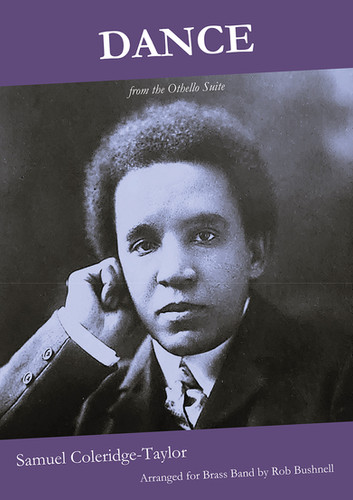
Dance from the Othello Suite (Brass Band) Coleridge-Taylor arr. Bushnell
Samuel Coleridge-Taylor is a British composer, who, from a young age, showed talent on the violin and entered the Royal College of Music, studying with Charles Villers Standford. His music become so popular that his Hiawatha trilogy was the second most performed choral piece (joint with Mendelssohn's Elijah, and only beaten by Handel's Messiah) with choral societies up and down the British Isles. In fact, Hiawatha was arranged by Charles Godfrey as a test-piece for the 1902 National Brass Band Championship of Great Britain, held at Crystal Palace.Commissioned by the theatre impresario Herbert Beerbohm, Coleridge-Taylor composed incidental music for His Majesty's Theatre London production of the Shakespeare play, Othello, in the West End, in 1909. In 1912, the play opened to the public, with a suite of five movements put together soon afterwards. The Dance, arranged here by Rob Bushnell, makes a great concert opener.This arrangement is for the British-style brass band, with alternative parts for horns in F and bass-clef lower brass. A recording of the original composition can be found at www.youtube.com/watch?v=OQeO_Ij9CV8 Duration: approx. 2.30 minutes Difficulty Level: 3rd Section + PDF download includes parts and score. Sheet music available at www.brassband.co.uk (UK) or https://satradecentral.org (USA) Instrumentation: Soprano Cornet Eb Solo Cornet Bb Repiano Cornet Bb 2nd Cornet Bb 3rd Cornet Bb Flugel Horn Bb Solo Horn Eb 1st Horn Eb 2nd Horn Eb 1st Baritone Bb 2nd Baritone Bb 1st Trombone Bb 2nd Trombone Bb Bass Trombone Euphonium Bb Bass Eb Bass Bb Timpani Percussion - Triangle, Cymbal & Bass Drum
In Stock: Estimated dispatch 1-3 working days
-
 £33.62
Swan Theme from 'Swan Lake' (Brass Band) Tchaikovsky arr. Jack Lythaby
Tchaikovsky's Swan Lake is made up of folk tales from Germany and Russia, and tells the story of Odette, a princess turned into a swan by an evil sorcerer's curse. The ballet was premiered on 4th March 1877 by the Bolshoi Ballet company in the Bolshoi Theatre in Moscow, and despite its initial failure, has become one of the greatest ballets ever written. The Swan Theme depicts the magic and mystery of the lake, with the oboe (solo horn in this version) playing the famous melody, which returns in various guises throughout the ballet. Tchaikovsky's symphonic approach to ballet music was called "undanceable" by some critics after its premiere, but the score to Swan Lake has now become considered as the epitome of ballet music. Sheet music available from: UK - www.brassband.co.uk USA - www.solidbrassmusic.com Difficulty Level: 4th Section + Instrumentation: Soprano Cornet Eb Solo Cornet Bb Repiano Cornet Bb 2nd Cornet Bb 3rd Cornet Bb Flugel Horn Bb Solo Horn Eb 1st Horn Eb 2nd Horn Eb 1st Baritone Bb 2nd Baritone Bb 1st Trombone Bb 2nd Trombone Bb Bass Trombone Euphonium Bb Bass Eb Bass Bb Timpani Vibraphone
In Stock: Estimated dispatch 1-3 working days
-
 £34.95
Vissi d'arte - Christopher Bond
Vissi d'arte is a soprano aria from act 2 of the opera Tosca, by Giacomo Puccini. It is sung by Floria Tosca in total anguish, in the form of a prayer to God, asking 'why he rewards her thus?'. Just before the aria is performed (and the reason for its presence) Baron Scarpia, the chief of police, tells Tosca that in order to save her lover Cavaradossi's life, she must sleep with him. Vissi d'arte is Tosca's cry of anguish; she reasons that although she has never done anything wrong, she is still being faced with an impossible choice: either way, she will have to betray Cavaradossi, in the form of sleeping with another man, or not doing everything she could to save his life. This arrangement was made for Rose Hancock and City of Cardiff (Melingriffith) Brass Band for their performance at the 2020 Welsh Open Entertainment Contest.
Estimated dispatch 10-14 working days
-
 £34.95
Puffing Devil, The - Christopher Bond
The Puffing Devil (2013) was commissioned by Camborne Trevithick Day Committee on the occasion of Camborne's 30th Trevithick Day celebration. The premiere performance of the work, written for brass band and children's choir, saw a massed performance by six brass bands and children from nine local schools. With the intention of being an educational work as well as a musical work, The Puffing Devil reflects the story of Richard Trevithick both in the lyrics and the musical material.A mysterious opening sees running semiquavers in the euphoniums as the flugel horn introduces the work with a solo, before the entry of the horns playing rhythmic quavers. The addition of the voices at the outset is for effect - working with the instruments to create the sound of a steam engine gathering pace simply to the words 'Trevithick'. Once a steady tempo is reached, themes are introduced and sung by the choir, where the vocal writing is a very simple singular-melody; easy for any primary school aged children to learn. An ending of grandeur in a majestic nature is presented, to create a big finish to a feel-good educational work.
Estimated dispatch 10-14 working days
-
 £40.00
Losgaintir. For solo Baritone/Euphonium and brass band
Recommended - Championship to 2nd Section Written for Katrina Marzella and the Black Dyke band, Losgaintir (or Luskentyre in English) is one of my favourite places in Scotland. Losgaintir is on the west coast of the isle of Harris in the Outer Hebrides and has an outstanding beach widely regarded as one of the most beautiful in the world. Losgaintir is a wonderful place to be on warm sunny days with its long stretch of white sands, aqua marine seas, the incredible mountain backdrop of south Lewis and the uninhabited island of Taransaigh in view. The weather in Harris is notorious for changing very quickly and this piece tries to reflect this. Although idyllic on a calm, sunny days, on stormy days Losgaintir's character becomes dark and foreboding, with low dark clouds and sweeping winds from the Atlantic creating a dark, brooding atmosphere. The opening melody (written modally like a traditional Scottish Gaelic air) depicts the calm serenity of Losgaintir on a beautiful summer's day. The character of the fast section that follows portrays winter in Losgaintir during a tempestuous storm with bracing winds. Includes score & parts Also see: Losgaintir for Solo Baritone/Euphonium & Piano
-
£55.00
Mary Poppins Suite (Score & Parts) - Richard Sherman
Mary Poppins' mixture of live action and animation, together with the exceptional songs from Robert and Richard Sherman, provides a thoroughly entertaining movie spectacle. Julie Andrews's Oscar-winning performance as the title character is exceptional and Dick Van Dyke's Bert, the chimney sweep, is equally stunning (despite that comical cockney accent). Andrew Duncan has put together a very enjoyable symphonic suite of music from the film including Chim chim cher-ee; Feed the Birds, Let's go Fly a Kite, A Spoonful of Sugar, Sister Suffragette and the inimitable Supercalifragilisticexpialidocious! Brass Band Grade 4: Advanced Youth and 3rd Section. Duration: 5 minutes.
In Stock: Estimated dispatch 1-3 working days
-
 £19.95
As A Cloud... - Jonathan Bates
'As A Cloud..' is a work for Solo Baritone and Piano composed for Nick Wilson in 2021. The inspiration for the work comes from the words of the poet William Wordsworth and his much loved text "I wandered lonely as a cloud". In the process of writing this work, the dedicatee's desire was to have a work to reflect his passion for the Lake District - a part of Northern England which Wordworth (and several other renowned poets of the time) became synonymous with; the group of writers becoming known as 'The Lake Poets'. Musically, this programmtic work reflects the words from Wordsworth's text, painting each line of the first stanza in a variety of settings and moods before the work floats away with an audio extract from the poem itself.
In Stock: Estimated dispatch 1-3 working days
 Watch video