
Results
-
£90.00
Fragile Oasis - Peter Meechan
Fragile Oasis is the name of a collective who describe themselves as aaa grass-roots participatory initiative that connects the shared perspective of astronauts from different countries and cultures with people on Earth, encouraging all to work together so that our planet is not only visibly beautiful, but beautiful for alla.Many involved in the project are astronauts on the International Space Station (I.S.S.), who post, on their website (http://www.fragileoasis.org) many different details of their experiments, photos from space, and some incredible video footage of our Earth.One such time lapse video (a video made up many still images) was posted on their website by astronaut Ron Garan (http://www.fragileoasis.org/blog/2011/11/coming-back-down-to-our-fragile-oasis-2/) in 2011. It is made up of images taken from the I.S.S. of what Garan described as aaa couple of laps around our Fragile Oasis before coming back down [to Earth]a and features all kinds of amazing views from space.Each of the five sections of this work relate to an aspect of the video - either something literal or something more metaphorical. The opening section, i: The lights from Above, is a musical description of the view of the Aurora Australis from above the lights. The second section, ii: The Storm from Above (part i), is also a musical portrayal of portions of the video clip - in this case the many lightning storms we see from above. The storms that are so powerful on Earth appear as small bolts of electricity dancing through the clouds.The third section, iii: Freya, has its roots in personal family tragedy. The name Freya derives from a Norse goddess who was associated with both beauty and love, and in this central section I wanted to write music that not only acknowledged how fragile life itself is, but that every day of it counts and should be celebrated.iv: The Storm from Above (part ii) is a again a reference to the lightning storms, but also to the huge hurricanes we see in the video. It leads us to the final section, v: The Oasis from Above - a description of the size and grandeur of Earth, our Fragile Oasis.Fragile Oasis was commissioned by Leyland Brass Band and Michael Bach, and partly funded by The John Golland Trust, for their appearance at the 2013 European Brass Band Championships in Oslo, Norway. It is dedicated to Natalie Youson, in friendship
Estimated dispatch 12-14 working days
-
 £77.00
General Series Brass Band Journal, Numbers 2234 - 2237, August 2023
2234: Festival March - Above all names (Geoff McCorriston)This Festival March was originally written for the Camberwell Citadel Band, Melbourne, Australia. This composition marks the composers debut within our band journals. Geoff McCorriston served as Deputy Bandmaster at Preston Corps (Australia) for many years before joining the Camberwell Citadel Band. He has also been a member of the Melbourne Red Shield Band. Above all names is distinct from a standard street march in that it is more developed, both rhythmically and thematically. It is an original march that references We plough the fields and scatter (S.A.S.B. 70) and Camberwell (T.B. 182).2235: Flugel Horn Solo - Father, Creator (Simon Gash)Emma Pears has a gift for contemporary song-writing, with several of her songs featuring in the Sing to the Lord publication. The style and relaxed nature of the melody of Father, Creator (first published in the Children's Voices Series in 2011, and later in the Mixed Voices in 2014) seemed a perfect fit for the Flugel Horn. Throughout the piece, juxtaposed with Father, Creator, we hear snippets of the tune St Theodulph (T.B. 231), which outline the first lines of Albert Chesham's words, 'O Father and Creator, Thou God of perfect love' (S.A.S.B. 46).2236: A winter's carol (trs. Neil Smith)The history of the carol O come, Immanuel (C.C. 62) is, like the carol itself, a little mysterious! The melody was conceived as a monastic chant during the 8th century. It was not until 1851 that the priest and hymn writer John Mason Neale translated the verses into English, exposing the carol to a wider audience. There is an aura and enigmatic feel to this melody which is captivating to so many who hear it. This setting was originally conceived for wind band by American composer Mark Williams. The brass band transcription introduces a new name to our journals, Bandmaster Neil Smith, who is the Territorial Music Director for the USA Western Territory.2237: Mighty to keep (Eiliv Herikstad)Mighty to keep marks the composer's first publication since his Promotion to Glory in April 2023. Bandmaster Eiliv Herikstad served faithfully in his native Norway throughout his life, and since the early 1970s, has provided The Salvation Army with a wealth of original compositions and skilful arrangements. Eiliv explored many styles of big-band and jazz writing which, in the 70s, were not commonplace amongst brass bands, particularly in The Salvation Army. Music Editorial are grateful to Eiliv for using his gifts to support Salvation Army music ministry.The subject of this piece is Herbert Booth's song Mighty to keep, which was first published by The Salvation Army in 1889. The chorus of the song is more well-known that the verse and was included in the chorus section of the 1986 Salvation Army Song Book.
Estimated dispatch 7-14 working days
-
 £69.99
Tribute to Whitney Houston - Christopher Bond
It has been ten years since the American pop singer Whitney Houston passed away, but the world has not forgotten her beautiful voice. Her timeless hits - from ballads to wonderful dance tracks - are still heard on the radio. This attractive medley includes some of her greatest successes: 'How Will I Know', 'Saving All My Love for You', 'I Wanna Dance with Somebody', and 'I Will Always Love You'.
Estimated dispatch 10-14 working days
-
 £79.95
Corineus - Christopher Bond
Corineus, in medieval British legend, was a prodigious warrior, a fighter of giants, and the eponymous founder of Cornwall. The first of the legendary rulers of Cornwall, he is described as a character of strength and power. It is on the medieval ruler that this new work, Corineus, is based, presented in three contrasting sections. The work opens with heraldic fanfares and a sense of jubilance before presenting musical material which changes and develops organically, portraying the journey taken by Corineus, Brutus, and the Trojans from modern-day mainland Europe to Britain. The central section of the work is slower, creating a feeling of longing. Brutus' son, Locrinus, had agreed to marry Corineus' daughter, Gwendolen, but instead fell in love with a German princess. In writing this part of the work, the composer portrays the longing of Gwendolen for her husband, knowing he is in love with somebody else. After Corineus died, Locrinus divorced Gwendolen, who responded by raising an army in Cornwall and making war against her ex-husband. Locrinus was killed in battle, and legend suggests that Gwendolen threw Locrinus' lover into the River Severn. This dramatic battle provides the inspiration for the final part of the work. In writing this work, the composer hopes to flare the imagination of young brass players around the country, in an engaging new take on a firm fixture in British folklore.
Estimated dispatch 10-14 working days
-
 £30.00
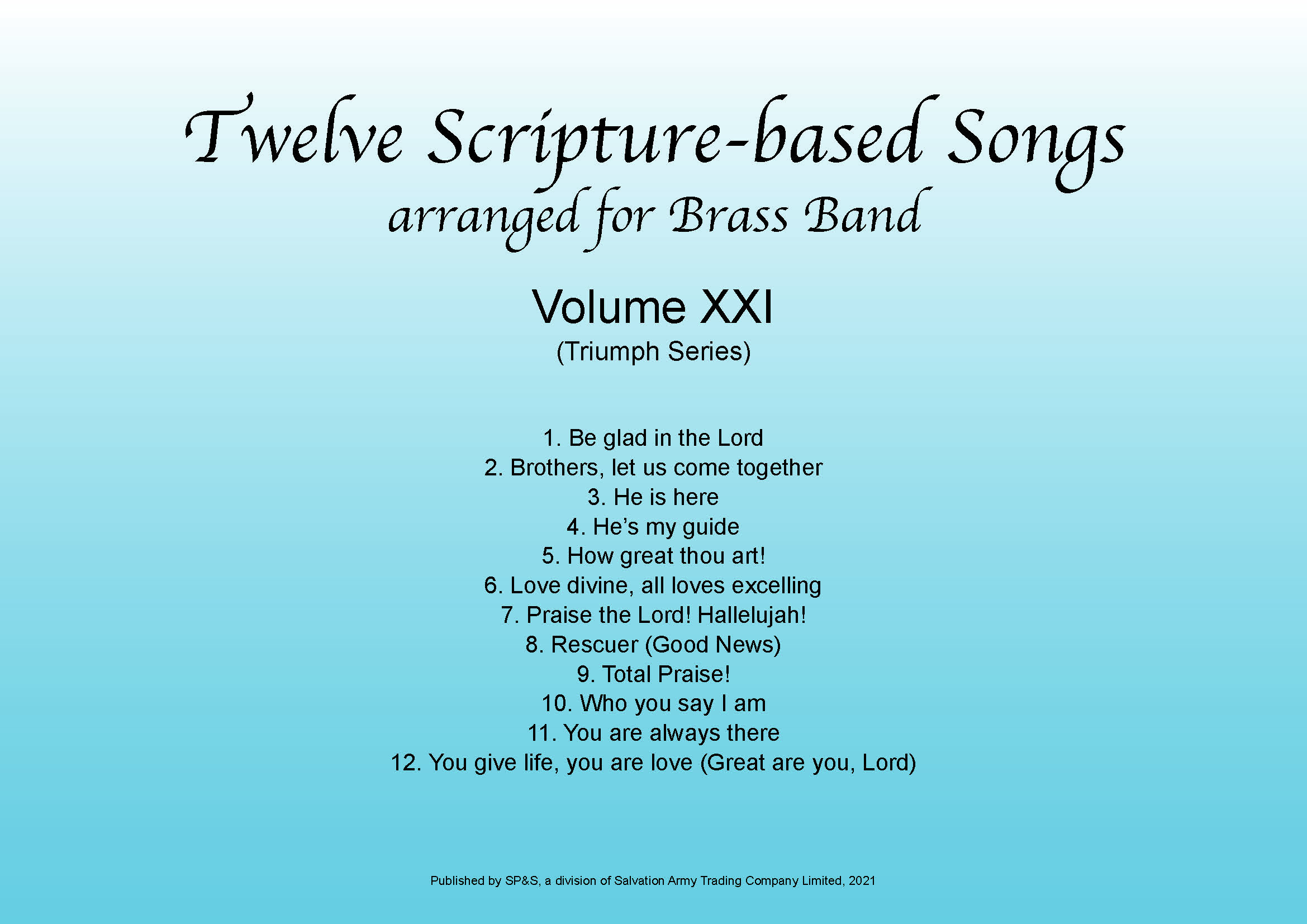
Twelve Scripture-based Songs Volume XXI
Twelve scripture-Based Songs arranged for Brass Band (Volume XXI) are packaged and marketed in complete sets which include a full score and a set of master parts. It is intended that these parts be used as 'masters', for the purpose of photocopying a quantity of parts to accommodate the precise instrumentation needs of the band for which this has been purchased. 1. Be glad in the Lord2. Brothers, let us come together3. He is here4. He's my guide5. How great thou art!6. Love divine, all loves excelling7. Praise the Lord! Hallelujah!8. Rescuer (Good News)9. Total Praise!10. Who you say I am11. You are always there12. You give life, you are love (Great are you, Lord)
Estimated dispatch 7-14 working days
-
 £38.95
Unity Series Band Journal - Numbers 490 - 493, February 2021
490: March - Resounding Praise (David Rowsell)This march features the chorus God is so good and the song Praise him! Praise him! Jesus our blessd Redeemer (S.A.S.B. 231)491: I want to live right (arr. Simon Gash)A fun setting of this popular song, the chorus I want to live right originally derives from a West Indian melody.492: Remember God is love (Ruben Schmidt)An uplifting arrangement of the Sunday School chorus When you see a rainbow, remember God is love, based on the English folk song Early One Morning.493: March - Temple 1 (Wycliffe Kortin)Featuring the songs They'll sing a welcome home (S.A.S.B. 534) and Christ the Lord is risen today (S.A.S.B. 218), this march was written for the Nairobi Central Corps' inauguration as a Temple, making it the first Salvation Army Temple in East Africa.
Estimated dispatch 7-14 working days
-
 £38.95
Unity Series Band Journal - Numbers 486 - 489, February 2020
486: March - Love Divine (Ian Clarke)This lively march features Charles Wesley's song, Love divine, all loves excelling (S.A.S.B. 262) set to the tune Stainer (T.B. 349) and Charles Gabriel's I stand amazed in the presence (S.A.S.B. 466).487: Song Arrangement - The potter's hand (Daniel Elson)A simple but effective arrangement of Dalene Zschech's popular worship song The potter's hand (S.A.S.B. 355).488: Ma-(cha-cha)-jesty (Gary Rose)The cha-cha-ch is a dance that originates from Cuba. It is danced to the music of the same name, introduced by Cuban composer and violinist Enrique Jorrin in the early 1950s. This work combines the cha-cha syle with the well-known song Majesty (S.A.S.B. 382).489: The old rugged cross (Andreas Holmlund)A flowing two-verse arrangement of George Bennard's much-loved song.
Estimated dispatch 7-14 working days
-
 £79.95
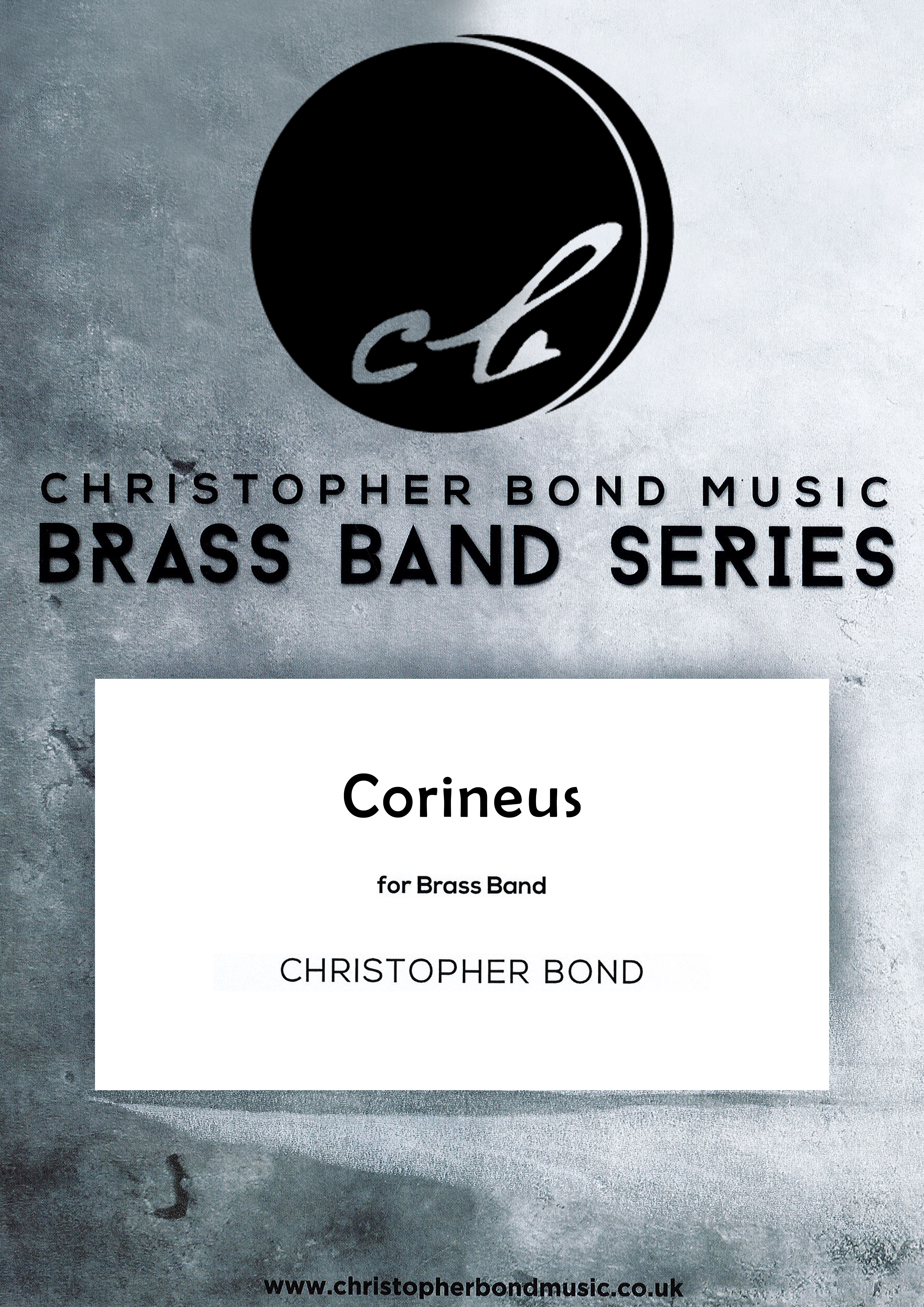
Corineus (Brass Band - Score and Parts)
Premiered by Cory Band at the 2018 Festival of Brass, Manchester. Selected as the set-work for the Championship Section at the 2019 National Youth Championships of Great Britain.Corineus, in medieval British legend, was a prodigious warrior, a fighter of giants, and the eponymous founder of Cornwall. The first of the legendary rulers of Cornwall, he is described as a character of strength and power. It is on the medieval ruler that this new work, Corineus, is based, presented in three contrasting sections. The work opens with heraldic fanfares and a sense of jubilance before presenting musical material which changes and develops organically, portraying the journey taken by Corineus, Brutus, and the Trojans from modern-day mainland Europe to Britain. The central section of the work is slower, creating a feeling of longing. Brutus' son, Locrinus, had agreed to marry Corineus' daughter, Gwendolen, but instead fell in love with a German princess. In writing this part of the work, the composer portrays the longing of Gwendolen for her husband, knowing he is in love with somebody else. After Corineus died, Locrinus divorced Gwendolen, who responded by raising an army in Cornwall and making war against her ex-husband. Locrinus was killed in battle, and legend suggests that Gwendolen threw Locrinus' lover into the River Severn. This dramatic battle provides the inspiration for the final part of the work. In writing this work, the composer hopes to flare the imagination of young brass players around the country, in an engaging new take on a firm fixture in British folklore.Duration: 11.00
Estimated dispatch 7-14 working days
-
 £30.00
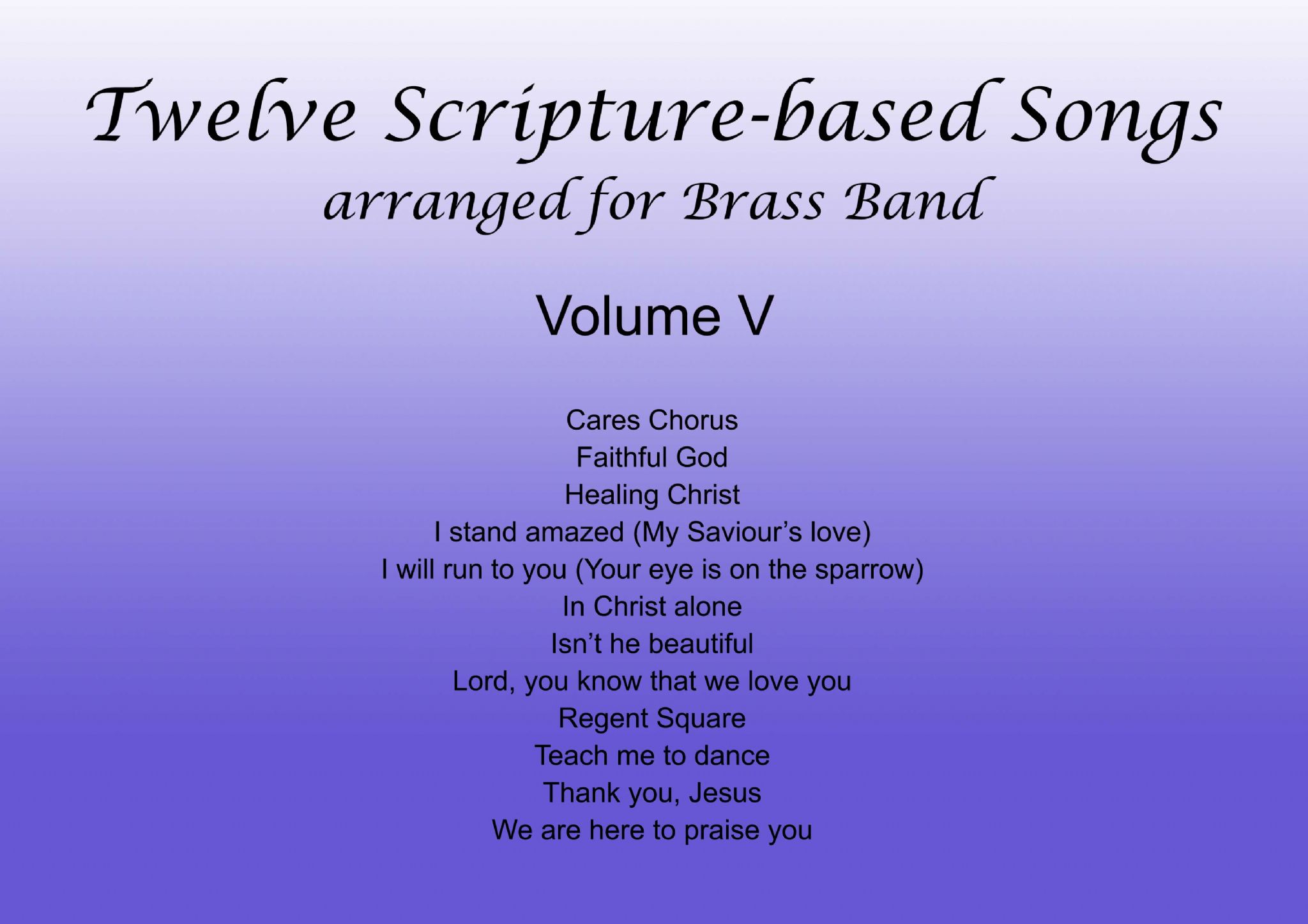
Twelve Scripture-Based Songs Volume V
Twelve scripture-Based Songs arranged for Brass Band (Volume V) are packaged and marketed in complete sets which include a full score and a set of master parts. It is intended that these parts be used as 'masters', for the purpose of photocopying a quantity of parts to accommodate the precise instrumentation needs of the band for which this has been purchased.Cares ChorusFaithful GodHealing ChristI stand amazed (My Saviour's love)I will run to you (Your eye is on the sparrow)In Christ aloneIsn't he beautifulLord, you know that we love youRegent SquareTeach me to danceThank you, JesusWe are here to praise you
Estimated dispatch 7-14 working days
-
 £30.00
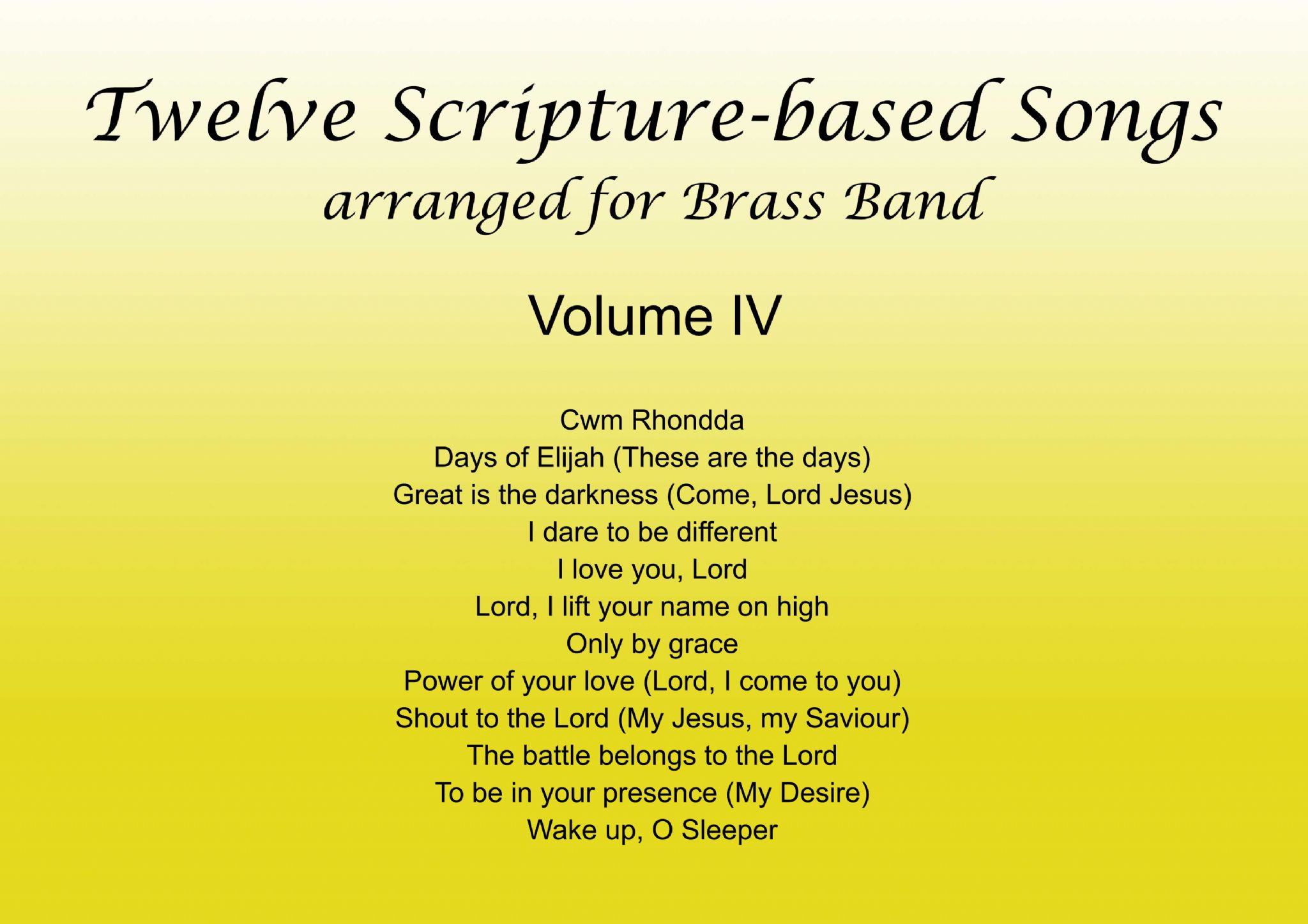
Twelve Scripture-Based Songs Volume IV
Twelve scripture-Based Songs arranged for Brass Band (Volume IV) are packaged and marketed in complete sets which include a full score and a set of master parts. It is intended that these parts be used as 'masters', for the purpose of photocopying a quantity of parts to accommodate the precise instrumentation needs of the band for which this has been purchased.Cwm RhonddaDays of Elijah (These are the days)Great is the darkness (Come, Lord Jesus)I dare to be differentI love you, LordLord, I lift your name on highOnly by gracePower of your love (Lord, I come to you)Shout to the Lord (My Jesus, my Saviour)The battle belongs to the LordTo be in your presence (My Desire)Wake up, O Sleeper
Estimated dispatch 7-14 working days
 View Music