
Results
-
 £119.99
The Lonesome Knight - Saskia Apon
The composition the Lonesome Knight was based on a fairytale. The piece was written by Saskia Apon for the National Brass Band Championships 2001. Once upon a time there was a knight who went to fight and defeat the dragon that had beenkilling the people of his town. There is a short but intense battle between the two and the knight is triumphant. However whilst persuing the dragon the knight has travelled far away from his home and now is lost. He roames around trying to findhis way home, but exhausted and weary he falls to the ground. He awakens startled by a Giant and a group of Goblins who are celebrating the death of the dragon. The knight joins in the festivities but after a long evening is once more leftalone. The sun rises the following morning and he sees a castle on the horizon. He enthousiastcally ventures towards the castle in the hope of meeting other people. However he becomes greatly disillusioned when there is none to be found. Inhis desperation the knight climbs the tower ready to jump off. Suddenly he hears a heavenly voice. Right before him is the most beautiful princess he has ever seen. She graciously thanks him for killing the dragon, a spark ingnites between themand they build a life together and.... live happily ever after! Saskia Apon studied harp at Rotterdam School of music. With this instrument she rounded of her studies by passing with credit, however it was her love of composition thatremained her focus. Self-taught, she began composing at the age of nine. Since then she has written pieces for The Dutch Brass Quintet, The Dutch Brass Ensemble, The Rotterdam Trombone Quartet and the brass band quintet Brass Ability. Atpresent she is the in-house arranger for The Rotterdam Philarmonic Brass Ensemble. Besides the customary attention for the real splashworks she endeavours to add value to the melodic function of the brass wind instruments in her music. Hercompositions and arrangements can be found on many diverse Cds.The composition the Lonesome Knight was based on a fairytale. The piece was written by Saskia Apon for the National Brass Band Championships 2001. Once upon a time there was aknight who went to fight and defeat the dragon that had been killing the people of his town. There is a short but intense battle between the two and the knight is triumphant. However whilst persuing the dragon the knight has travelled far awayfrom his home and now is lost. He roames around trying to find his way home, but exhausted and weary he falls to the ground. He awakens startled by a Giant and a group of Goblins who are celebrating the death of the dragon. The knight joins inthe festivities but after a long evening is once more left alone. The sun rises the following morning and he sees a castle on the horizon. He enthousiastcally ventures towards the castle in the hope of meeting other people. However he becomesgreatly disillusioned when there is none to be found. In his desperation the knight climbs the tower ready to jump off. Suddenly he hears a heavenly voice. Right before him is the most beautiful princess he has ever seen. She graciously thankshim for killing the dragon, a spark ingnites between them and they build a life together and.... live happily ever after! Saskia Apon studied harp at Rotterdam School of music. With this instrument she rounded of her studies by passing withcredit, however it was her love of composition that remained her focus. Self-taught, she began composing at the age of nine. Since then she has written pieces for The Dutch Brass Quintet, The Dutch Brass Ensemble, The Rotterdam Trombone Quartetand the brass band quintet Brass Ability. At present she is the in-house arranger for The Rotterdam Philarmonic Brass Ensemble. Besides the customary attention for the real splashworks she endeavours to add value to the melodic functionof the brass wind instruments in her music. Her compositions and arrangements can be found on many diverse Cds.
Estimated dispatch 5-14 working days
-
 £127.30
Graceful Ghost - William Bolcom
I came to know of this piece when hearing famous Norwegian ragtime pianist Morten Gunnar Larsen playing it at a concert with the Norwegian Navy Band Bergen. I was struck by its melancholic beauty and wanted to arrange it for band.Ragtimes are rarely in a minor key (which this one is) and when you first hear it, you might think it was written around the time when Scott Joplin was the main ragtime composer. But, if you listen more carefully, you notice that some of theharmonies are more advanced than one might expect in traditional ragtime, giving the piece a slightly more contemporary feel. The composer William Bolcom wrote Graceful Ghost in 1970 to honour the memory of his father and it is one of hismost popular pieces.
Estimated dispatch 5-14 working days
-
 £228.70
Fanfare and Chorale - Egil Hovland - Ray Farr
This arrangement (or edition) for brass band will give the possibility for more performances of this fine work by Hovland. The composer, before his death, examined my work and made no suggestions for changes, and his approving comments were complimentary and encouraging. The work was originally written for Concert Band in 1966 as Op. 54a to St. Olaf College Band in the US. It was transcribed in 1967 for symphony orchestra as Op. 54b by the composer himself. The challenges in arranging the piece for brass band were mostly concerned with satisfactorily covering the upper register used by piccolo, flutes and clarinets, and while there are wonderful brass players around who have amazing high registers, I have aimed this edition at a level achievable by reasonably good brass band players who are willing to give time and effort into the proper preparation and delivery of the music. Having worked on this new edition with a top-class brass band, I think it sounds wonderful and interestingly different to the original. Besides the obvious differences of tone-colour and absent high notes, I have used in my scoring, the option for using a vibraphone in place of a celeste. Vaughan Williams, in his Variations for brass band writes for celeste, but because the instrument is quite rare, performances have been mostly given using a glockenspiel- but this, of course sounds two octaves higher than it was intended. I think that vibraphone and brass is an excellent combination and recommend it without hesitation in this piece. Every detail of articulation and dynamic has been considered, so in order to keep the integrity of the music, please do not change anything in the name of "interpretation". As Ravel says- "What is there to interpret?" Ray Farr
Estimated dispatch 5-14 working days
-
 £78.20
The Rocketeer - James Horner - Roland Smeets
Before Titanic,James Horner was not above composing scores for cartoonish family films, and many of those that brought him on their production board owe him greatly. The Rocketeer entails the story of a young pilot during World War II who happens upon a rocket pack that allows him to fly. The film is based on the tradition of old film serials that left theater-goers hanging with "To be continued," and aside from modern production, it is old fashioned and innocent fun. Horner's score begins and ends with the brilliant "Main Title," which is so moving it was used in previews for later films that did not yet have finished scores. Most of th Rocketeersoundtrack elicits the adventure and lifting spirit of the film and reveals how Horner incorporates rich instrumentals in the tiniest crevices. Even when the film involves danger, as in "Jenny's Rescue," the composer takes care when it is hardly even required. Instead of some "duh-duh-duhs," he brings on a full, stunning orchestra and when he overdoes it, it is in a jolly way -- he never exhausts his medium. That is what separates him from inferior composers, and what makes a nice film like The Rocketeer extra nice. It is a soundtrack worth listening to.
Estimated dispatch 5-14 working days
-
 £115.60
Dream of the Return - Pat Metheny - Ray Farr
Dream of the Return is one of the tracks on Pat Metheny's album of 1989 "Letter from Home".The CD recording is remarkable for its variety, imagination and musical artistry, and the combining of Latin American rhythms with jazz harmonyproduces magical results especially with Pat Metheny's guitar playing.While most tracks on the CD are instrumental, this song stands out because of its beautiful lyrics (by Pedro Aznar) which, roughly translated, are:I tossed a poemto the sea that took my questions and my voice.Like a sinking ship it was lost in the waves.I begged it not to return without having seen the open seaAnd in my dreams, show me what it had seen.Even if it did notcomeback I would know that it had journeyed.Floating all the time on calm or stormy seasEven though some safe haven waits.I waited long for its answer and almost gave up hope,And with a yearning voice I cried desperatelyto the heavens.Much later, somehow, it was washed ashore like an answered prayer.Now the rolling sea beats in my veins and sets my heart free
Estimated dispatch 5-14 working days
-
 £54.99
Onward! - Gawan Roberts
A brief history: Pentecost Monday was a special day for schools in Yorkshire (England). There were a variety of activities. The pupils of Sabine Baring-Gould would meet with the children of a nearby village. It seemed like a good idea that during the walk would be sung. But she could not find a suitable song and decided to write one by herself. "Onward Christian Soldiers" was the result. It soon became very popular, though she herself was not entirely satisfied with the rhyme scheme. The melody used (St. Gertrude) was by the famous English composer Sir Arthur S. Sullivan. Back to now: Gawan Roberts, has given the hymn a proper update. He gave the still popularsong a solid rock beat and added daring harmonies. So it's popular, for current generations, again for years. Onward!
Estimated dispatch 5-14 working days
-
 £54.99
Jamaica - Timothy Travis
Jamaica is an island in the Caribbean. In 1494 it was discovered by Christopher Columbus, who used it as private property until 1509. After some skirmishes it fell under British rule and the sugar trade on the island flourished. After the abolition of slavery in 1834 it was only granted Home Rule in 1944, but it remained a member of the British Commonwealth of Nations. Whereas the export of cane sugar used to be Jamaica's main export product for many years, nowadays music has taken over this role. At first American music used to be very popular on the island. Later, however, Jamaican musicians started to experiment and thus in the end created their ownmusical style called Reggae. Well-known Reggae musicians are Bob Marley and Peter Tosh. The most important instruments used in Reggae are the bass and the drums. Together they form the base for the style: the riddim. A bass drum accent on the second and fourth beat are characteristic of a typically reggae drum beat. To this syncopic patterns are often added. The rhythm guitarist plays chords in a characteristic Reggae rhythm, not on, but between the beats.
Estimated dispatch 5-14 working days
-
 £95.00
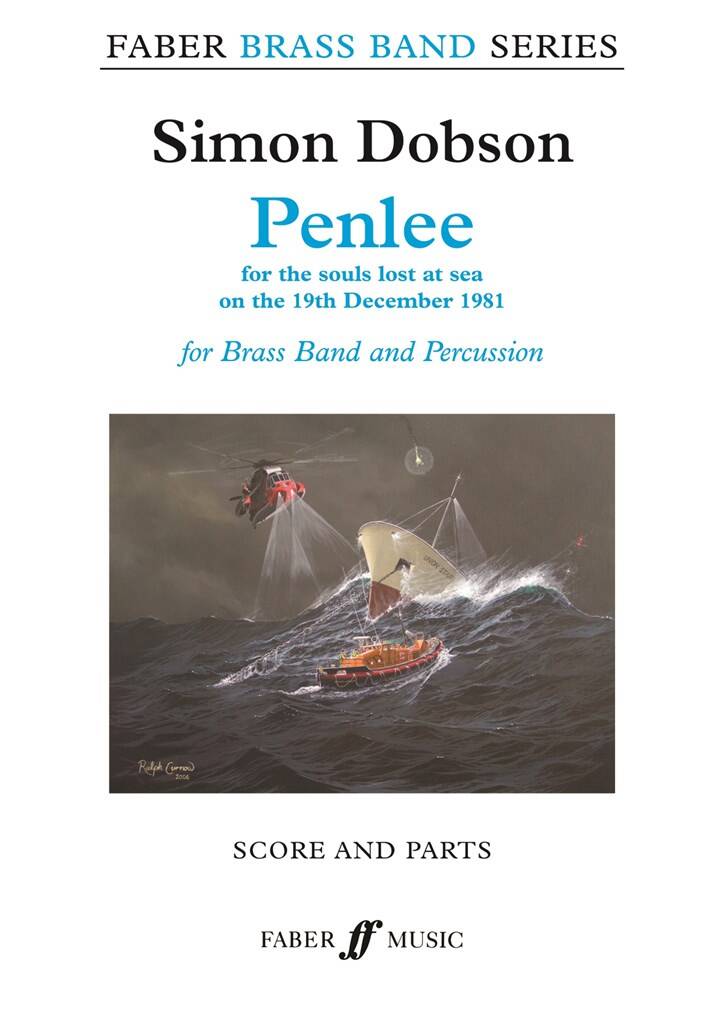
Penlee - Simon Dobson
To some, the tragic story of the Penlee lifeboat, Solomon Browne, would need no introduction, and to some the pain felt is still very much a reality. The composer, born just a few weeks before that fateful night on the19th December 1981, has created this work as a musical homage to the bravery of the souls who lost their lives and has dedicated it to their memory. Penlee was commissioned by the Cornwall Youth BrassBand using funds bequeathed by Michael Pickett. The first performance was given by the Cornish Youth Brass Band, conducted by Ian Porthouse, at St. Michael's Church, Newquay, on 30th December 2008.Penleehas been voted into the Classic FM Hall of Fame 2011 at No.106. Not only is it the first time a brass work has been featured in the Hall of Fame, but it was also thehighest new entry. The work has subsequently been recorded by the Leyland Band, conducted by Jason Katsikaris, on the CD entitled Penlee.Brass Band Grade 4: Advanced Youth and 3rd Section Duration: 13 minutes
Estimated dispatch 5-14 working days
-
£60.99
Centennial Prelude - Jan Van der Roost
This short opening music was composed on commission of the symphonic band of Jan Van der Roost's village (= Kontich near Antwerp / Belgium). In 1991, this community band celebrated its 100th anniversary. After composing commissioned pieces from different countries (even from Japan), this was the most 'near' commission he ever received indeed!It is a short but varied piece, featuring all sections of the band. After a short introduction, played by the brass instruments, a crisp rhythm starts and boxes the main theme. After a second theme, played by brass and percussion, a short melodical passage brings some 'rest'. At the end, the fanfare of the introductionreoccurs.Although this "Centennial Prelude" isn't a really demanding piece, it sounds colourful and energetic. It has been recorded on CD by the band of the 'Royal Dutch Airforce' and the 'Desford Colliery Brass band'.
Estimated dispatch 5-14 working days
-
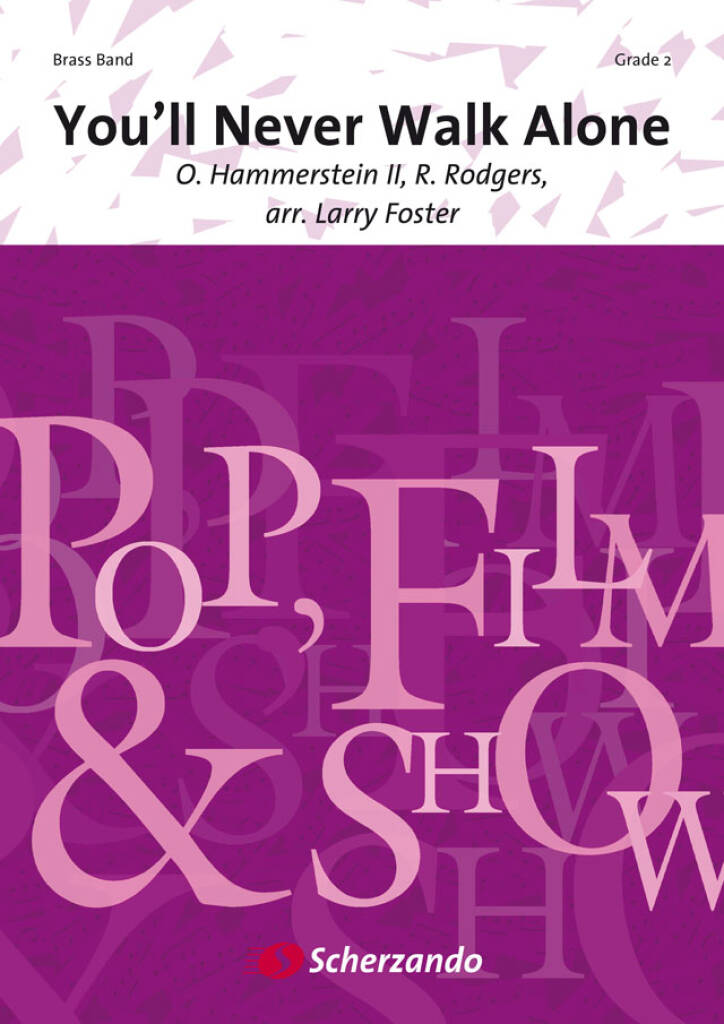 £54.99
You'll Never Walk Alone - Oscar Hammerstein II - Larry Foster
This great football anthem (don't be put off if you are not a Liverpool supporter!) was originally featured in the Rogers and Hammerstein musical Carousel, however it was made famous worldwide when it was sung against the background of the Eiffel Tower to close the 1998 World Cup. It can now be performed by your band, with or without football scarves, to end your concert on a winning note.
Estimated dispatch 5-14 working days
 View Music