
Results
-
 £40.00
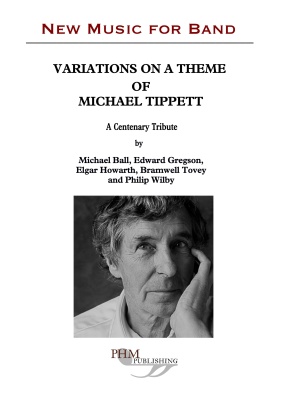
Variations on a Theme of Michael Tippett (Brass Band - Score only)
A Centenary Tribute by Michael Ball, Edward Gregson, Elgar Howarth, Bramwell Tovey and Philip WilbyThis unique 'pice d'occasion' arose out of a telephone conversation in 2004 with Alan Wycherley, who was the soprano cornet player of the Foden's Richardson Band at the time. He indicated that the band would like to include an original birthday tribute for Edward Gregson (60) and Elgar Howarth (70) in its concert at the 2005 RNCM Festival of Brass in Manchester. I have been Artistic Director of Manchester's Festival of Brass since it was established in 1990 as a BBC Radio 3 series, As the centenary of the birth of Sir Michael Tippett fell on 5 January 2005, I devised this collective work as a way of embracing all three anniversaries in a novel way.The idea of joint compositions is not a new one in the classical music world. In the 1860s, Verdi was joined by a number of his contemporaries in a Requiem Mass for Rossini. In this country there have been a number of orchestral examples over the past fifty years, but never before for the brass band. Although Tippett composed only one work for brass band, Festal Brass with Blues, his orchestral works and operas are full of idiomatic brass writing. The theme I chose for this celebration is one of Tippet's most memorable miniatures featuring wind and brass. In the opera Midsummer Marriage it marks the entry of the Ancients. It is also included in the orchestral Suite in D (1948), for the Birthday of Prince Charles.I invited five of the leading contemporary voices in brass band music to add their own creative perspectives to the little Tippett theme, with it's characteristic rhythms, embellishments and modality - the Lydian mode. Each contribution was designed to fit into a tonal and formal template to give the whole work a flow and continuity. In Danse des Amis, Bramwell Tovey has composed a jazzy, humorous variation. Inspiration came from Tippett's love of jazz and, more personally, from the characteristically syncopated gait of the distinguished music critic John Amis, who Tovey once observed leaving a performance of Tippett's opera King Priam before the end. Incidentally, that performance was conducted by Elgar Howarth.We hear Edward Gregson in lyrical mode. His Midsummer Song is redolent of the sound world of Tippett's opera A Midsummer Marriage and it ends with a brief reference to a favourite of Gregson's, Tippett's Concerto for Orchestra. Michael Ball provides a brief moment of light, airy activity bringing to mind perhaps Tippett's love of Shakespearian fantasy, especially The Tempest. Elgar Howarth juxtaposes a slowed down version of the processional theme with distant recollections of fanfares from King Priam. Philip Wilby has rounded the tribute off with a spectacular fugue. During its inexorable progress Wilby ingeniously introduces the two other birthday references - the three-note musical signature that Elgar Howarth includes in much of his music and the characteristic theme which begins Edward Gregson's substantial work for brass an organ The Trumpets of the Angels. An elaborated reprise of Tippett's little theme is followed by a dynamic coda.- Paul HindmarshDuration: 13.00
Estimated dispatch 7-14 working days
-
 £30.00
All Shall Be Well - Brass Band Sheet Music Full Score & Parts - LM931
COMPOSER: Tamsin TateCOMPOSERS NOTE"All shall be well" was composed during the first lockdown of the Covid crisis, from May 2020.This was a worrying time for many and a time of great anxiety and sadness for some.I have always tried to be practically optimistic in trying times, but still I needed hope.I am lucky to have a faith in God which gives me hope and assurance that things will be better,and I also know that music, particularly playing it, can help express some of these emotions.Certainly, music through the crisis was a wonderful, enjoyable escape for meand one I shared with my family and my band family through our online recordings.Julian of Norwich was an anchoress in the 14th Century.She set herself apart for God and spent a lot of time in prayer.Interestingly, she was the first published woman in the English language.Julian of Norwich is quoted as saying "all shall be well, all shall be well,and all manner of thing shall be well." The paraphrase of this spurred me on to develop this piece for brass band.Hopefully you will also find that the music portrays the worries and trials of this uniquetime through the natural minor key, with the rhythm hinting towards the phrase"All shall be well" and then the dawning transition to the major keyfollowed by a triumphant ending with the whole band joining together.Thanks to Adam Cable and the Martlesham Brass family for support and encouragement always.Thanks also to Alan Fernie and his supportive critique of my initial efforts.LM931 - ISMN : 9790570009312
In Stock: Estimated dispatch 3-5 working days
-
 £95.00
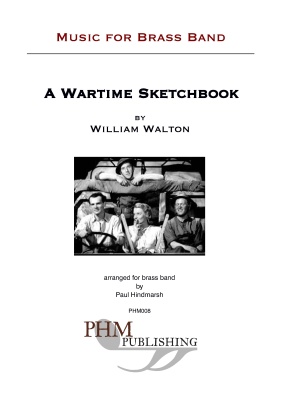
A Wartime Sketchbook (Brass Band - Score and Parts)
Early in 1941 William Walton, 39, received his call-up papers. He was by then one of the most eminent of British composers and was exempted from military service on condition that he provided music for films deemed to be of 'national importance'. Scoring Lawrence Olivier's Shakespeare epic Henry V in 1943 was the most substantial of these wartime projects. His role in patriotic films from 1941 and 42 like The Foreman went to France, Next of Kin, Went the day Well and The First of the Few was to provide appropriate title music and some underscoring at key moments. Walton extracted the most substantial portions of the latter as the popular Spitfire Prelude and Fugue for orchestra. The remaining music remained unpublished until 1990, when Christopher Palmer assembled the highlights into A Wartime Sketchbook. I was intrigued to hear these examples of Walton's wartime music and having discovered that they would fit naturally and idiomatically onto the brass band, I arranged six of the numbers into a suite for Besses o' th' Barn Band, which I was conducting at the time.In 1995 the brass band suite was recorded by the famous Black Dyke Mills Band as part of an all Walton album which I produced for the ASV label (ASV CD WHL 2093). This award- winning CD also included Walton's First Shoot, in the edition by Elgar Howarth, my transcription of movements from Music for Children and two substantial brass versions by Edward Watson of the suite from Henry V (with narrator) and the March and Siegfried Music from The Battle of Britain music.Prologue: This is the stirring title music from Went the day Well, a screen play by Graham Greene about a German airborne invasion of an English village. The main theme leads toBicycle Chase: Characteristic musical high-jinks for J.B.Priestley's The Foreman went to France.Refugees: From the same film, this is a poignant accompaniment to the long march of refugees. As Ernest Irving, the film's musical director, put it, "this really makes your feet sore and your knees sag."Young Siegfrieds: This lively movement comes from the music that Walton composed for The Battle of Britain in 1968, with the assistance of Malcolm Arnold, but which the film's producer rejected. It portrays first the Berliners, cheerfully ignoring the black-out and then, in the trio, the Young Siegfrieds of the Luftwaffe, courtesy of a parody of Siegfried's horn call from Wagner's opera.Romance: A soldier and a Dutch refugee snatch a few tender moments together in Next of Kin.Epilogue: At the end of The Foreman went to France, the French look forward with hope and optimism to eventual liberation.- Paul HindmarshDuration: 14.00
Estimated dispatch 7-14 working days
-
£40.00
A Wartime Sketchbook (Brass Band - Score only)
Early in 1941 William Walton, 39, received his call-up papers. He was by then one of the most eminent of British composers and was exempted from military service on condition that he provided music for films deemed to be of 'national importance'. Scoring Lawrence Olivier's Shakespeare epic Henry V in 1943 was the most substantial of these wartime projects. His role in patriotic films from 1941 and 42 like The Foreman went to France, Next of Kin, Went the day Well and The First of the Few was to provide appropriate title music and some underscoring at key moments. Walton extracted the most substantial portions of the latter as the popular Spitfire Prelude and Fugue for orchestra. The remaining music remained unpublished until 1990, when Christopher Palmer assembled the highlights into A Wartime Sketchbook. I was intrigued to hear these examples of Walton's wartime music and having discovered that they would fit naturally and idiomatically onto the brass band, I arranged six of the numbers into a suite for Besses o' th' Barn Band, which I was conducting at the time.In 1995 the brass band suite was recorded by the famous Black Dyke Mills Band as part of an all Walton album which I produced for the ASV label (ASV CD WHL 2093). This award- winning CD also included Walton's First Shoot, in the edition by Elgar Howarth, my transcription of movements from Music for Children and two substantial brass versions by Edward Watson of the suite from Henry V (with narrator) and the March and Siegfried Music from The Battle of Britain music.Prologue: This is the stirring title music from Went the day Well, a screen play by Graham Greene about a German airborne invasion of an English village. The main theme leads toBicycle Chase: Characteristic musical high-jinks for J.B.Priestley's The Foreman went to France.Refugees: From the same film, this is a poignant accompaniment to the long march of refugees. As Ernest Irving, the film's musical director, put it, "this really makes your feet sore and your knees sag."Young Siegfrieds: This lively movement comes from the music that Walton composed for The Battle of Britain in 1968, with the assistance of Malcolm Arnold, but which the film's producer rejected. It portrays first the Berliners, cheerfully ignoring the black-out and then, in the trio, the Young Siegfrieds of the Luftwaffe, courtesy of a parody of Siegfried's horn call from Wagner's opera.Romance: A soldier and a Dutch refugee snatch a few tender moments together in Next of Kin.Epilogue: At the end of The Foreman went to France, the French look forward with hope and optimism to eventual liberation.- Paul HindmarshDuration: 14.00
Estimated dispatch 7-14 working days
-
 £34.99
Submerged... (Cornet Concerto No.2) - Jonathan Bates
'Submerged..' is a virtuoso concerto for Cornet composed as a response to the 'lost' Derbyshire villages of Ashopton & Derwent,. both of which were drowned in the early 1940's to make way for a new reservoir to aid the ever-increasing water demand from nearby. Sheffield and it's steel industry during World War 2. The work is through-composed but is defined by 3 clear main sections, 'The . Packhorse Bridge, Derwent', 'Ashopton Chapel' and 'Operation Chastise'. Much of the melodic and harmonic material throughout the. concerto is inspired by 3 contrasting sources; an original motif of towering block chords which opens the concerto, the famous opening. fragment of Eric Ball's 'High Peak' (1969) which was composed as a tribute to the district of Derbyshire where Ashopton & Derwent lie, . and finally Claude Debussy's haunting 'La Cath drale Engloutie' or 'The Sunken Cathedral', which was composed in 1910 around the legend of. the submerged cathedral of Ys. . I. Packhorse Bridge, Derwent (1925). One of the most striking features of the former village of Derwent was it's Packhorse Bridge, which spanned the River Derwent. adjacent to the Derwent Hall - a grand, picturesque Jacobean country house. In 1925, the renowned impressionist artist Stanley. Royle painted a striking image of the two in midwinter, with the partially frozen river sat quietly underneath the snow-topped. bridge in the foreground, while the old hall sits peacefully and dark in the background. The opening setion of this concerto paints. this picture in a quite schizophrenic manner; with frosty, shrill march-like material picturing the villagers crossing the narrow icy. bridge, combined with wild and frenzied waltz music of the grand hall and it's masquerade balls laying, for now, quietly mysterious. across the river. . II. Ashopton Chapel (1939). Ashopton was much the smaller and less-populated of the 2 'lost' villages, but still bore home to a Roman Catholic Chapel which was. the focal point of the village. The chapel - along with the rest of Ashopton - was drowned in 1943, but the final service to take place there. was held in 1939, with the final hymn being 'Day's Dying in the West'. This hymn forms a haunting coda to the 2nd section, with firstly the . piano leading the melody before an audio track containing an old recording of the hymn is accompanied by the sound of flowing water and . the rumble of storms as the village hypothetically disappears from existence with the hymn tune still echoing around the valley, before . subsiding into the growing roar of the engine of a Lancaster Bomber as it soars overhead towards Derwent to practise it's 'Dam-Buster' raid. . III. Operation Chastise (1943). The Derwent Reservoir lies adjacent to Ladybower Reservoir (of which Ashopton & Derwent were flooded to make way for) in the . Derbyshire High Peak, and during the 2nd World War was used as one of the central low-atitude practise areas of the 617 Squadron - more . commonly known affectionately as the 'Dambusters'. Before the destruction of Derwent, it's 'Packhorse Bridge' was dismantled stone by stone . and re-assembled upstream at Howden Dam to the north end of Derwent Reservoir. This is where the music begins, with a reconstruction of . the opening material before taking flight into a whirlwind tour of virtuosity from the soloist. .
In Stock: Estimated dispatch 1-3 working days
-
 £19.95
Mythical Tales (Brass Quintet)
Mythical Tales (2012) is a ten minute work in three movements which represents three of the most popular folk stories or indeed in the case of the first movement, true stories, in Welsh culture.I. Owain GlyndwrOwain Glyn Dwr was born around the 1350s into an Anglo-Welsh gentry family. His estates provided him with a modest power base in north-east Wales. After a number of disputes, he proclaimed himself prince of Wales in September 1400.Glyn Dwr led several battles with the English, although he was never captured. Over the next few years punitive measures were enacted to keep control of Wales, but these were matched by many acts of Welsh rebellion - among them the capture of Conwy Castle in April 1401. In June 1402, at the Battle of Pilleth on Bryn Glas Hill, Glyn Dwr led his troops to victory over an English army. By now Glyn Dwr was leading a national revolt. In 1404, he led a march towards Wocester, but failed, with the English capturing parts of Wales. He died defending his country.II. MyfanwyMyfanwy was the most beautiful woman in Powys, but she was vain and liked nothing better than to be told how beautiful she was. Many handsome men would court her, but she would not show interest because they couldn't sing and play to her, reflecting her true beauty.Luckily, a penniless bard, Hywel ap Einion was in love with Myfanwy, and one day plucked up the courage to climb up the hill to the castle with his harp, to sing and play to her. He's allowed in to play for her, and while he's playing and complimenting her on her beauty she can neither listen nor look at any other man. Because of this Hywel believes that she has fallen in love with him. But his hopes are dashed when a richer, more handsome and more eloquent lover comes along. The music of the second movement portrays the despair and upset that Hywel must have felt.III. Battle of the DragonsMany centuries ago when dragons roamed the land, a white ice dragon descended on a small village and decided to live there, not knowing that a red fire dragon was already living nearby.Six months later the red dragon awoke to find a huge white dragon wrapped around his village that he cared for. He could tell that his people were ill from the cold. The Land was bare; nothing was able to grow not even the pesky dandelions. The people were starving. The people longed for the red dragon to free them from the icy misery, so that their life and land could return to the sunny and warm climate that it was once before.The red fire dragon challenged the white ice dragon to a single combat fight at the top of the cliff the next day. The people of the village watched in terror awaiting their fate. The red dragon beat the white dragon, and the crowd cheered with joy as the red dragon roared with triumph. The mayor of the village declared that the land should always fly a flag with the symbol of a Red dragon on it. The flag's background should be half green and half white; the green to represent the lush green grass of the land and the white to represent the ice. This way no one would ever forget what happened.
Estimated dispatch 7-14 working days
-
 £45.00
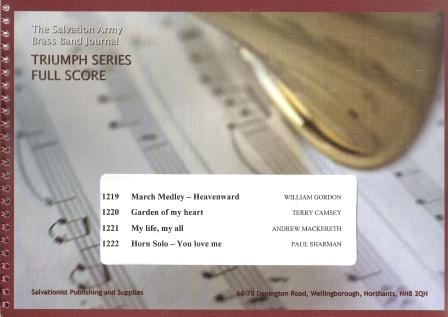
Triumph Series Band Journal November 2011 Numbers 1219-1222
No.1219 March Medley - Heavenward (William Gordon)A variety of songs are used in this up-tempo march medley which potrays the celebration of a life looking forward to an eternity in Heaven. The tunes used are 'When we all get to Heaven', 'When the roll is called up yonder' and 'We shall win'.No.1220 Garden of my heart (Terry Camsey)The publication of this music is, in a small part, a fitting tribute to Major Terry Camsey who was Promoted to Glory in June 2011. The title is taken from the refrain from a much-loved Sidney Cox song; 'Jesus, Jesus, Lily of the valley, Bloom in all thy beauty in the garden of my heart'.No.1221 My life, my all (Andrew Mackereth)This selection attempts to emphasise the personal nature of Christian commitment hence the emphasis given to the words 'my' and 'I' in the songs chosen. The tunes 'Rockingham', 'All I have I am bringing to thee' and 'At thy feet I bow adoring' are included.No.1222 Tenor Horn Solo - You love me (Brian Willetts arr. Paul Sharman)This arrangement was made at the request of David Lynch, Solo Horn player in The International Staff Band. Originally published in April 1993, the song speaks of the fact that, despite the wonder and vastness of God's creation, he still loves each one of us individually.
Estimated dispatch 7-14 working days
-
£120.00
Rhapsody in Black (Bra) - Andi Cook
The primary inspiration for this work comes from the composer's first encounter with the genre of Symphonic Metal - the opening track of the 2004 Nightwish album 'Once', entitled Dark chest of Wonders. The combination of full orchestra, operatically trained female vocals and the raw power of a Scandinavian metal band was a potent mix that instantly had me hooked.That same dark and powerful sound is one that a brass band can generate, and I've tried to capture that in this composition. Heavy Rock/Metal as a genre is arguably fifty years old now, but symphonic metal is a newer concept, and I feel possibly the one that can bridge the gap between two musical styles very dear to me.Composer Gilbert Vinter had explored through music the connotations that different colours held for him, and his movement Purple from 'Spectrum' gave me an idea for the structure of 'Rhapsody in Black'. Andi Cook explored the different connotations of one colour within his own life, black being an easy choice due to the personal dichotomy of the black leather jacket he wore to the rock club on Friday night and the black suit jacket and tie he wore to the concert hall the next day.To avoid repetition the word 'black' is omitted from the five movement titles, each of which is a different episode. '...as Thunder' is a furious argument between two people - the top and bottom of the band - set against the backdrop of a storm, with lightning flashing outside while barbs, insults, sarcasm, tears and even violence is traded inside. Following that '...Satin and Pearls' is an old black-and-white movie with a wistful character to it as if we're looking back a screen icon with fondness long after their career or even their life has ended. '...as the Raven's Wing.' is deliberately gothic and funereal, hinting at Edgar Allen Poe's similarly named poem, with undertones of death and afterlife. The shift into F/C Minor (band pitch) represents the descent - alive - into the grave that Poe had a paranoid fear of his entire life. Family and friends standing around grieving, oblivious as we're lowered into the earth despite frantic attempts to make ourselves heard. '...and Chrome' is an unashamed motorcycle reference with all its born-to-be-wild, open air, high speed and freedom overtones. In a deliberate contrast to what went before it continues several of the same motifs though this time in the major key. Lastly, we reprise the second movement with '...as the Night Sky' which is simply the feeling of walking home under the summer stars, with someone important - who that is, is left to the listener, but a walk under the stars is always that bit special.There's an old saying that very few things are black and white. I hope this work will prove that even black alone isn't quite as simple as it's often made out....'Rhapsody in Black' is dedicated to the composer's friend and mentor John Roberts, who shares his love of both brass and rock.
Estimated dispatch 7-14 working days
-
 £30.00
Meanwhile - Jock McKenzie
Just imagine being free of stress, anxiety, time pressures, workload & the general 'busy-ness' of everyday life... For the lucky few that may find themselves in this position, the clock keeps ticking for the rest of us. "Meanwhile" seeks to represent the relentless challenges of the 'everyday'. It is a full-on, driving swing number, very much in the style of a big band chart. In my orchestration of this piece I have deliberately treated the brass dectet somewhat similarly to that of a big band / jazz orchestra. The two 'rows' of four trumpets and four trombones are employed in the typical way, with the horn representing a unison / octave saxophone section. The tuba busily walks around the harmonic foundation of the piece. This piece was conceived out of the chaos of an overcrowded school music department. In one room I was rehearsing a brass ensemble whilst the other side of a (very) thin wall was a saxophone group attempting to make themselves heard over our dulcet tones. The brass ensemble would stop regularly to receive pearls of wisdom from yours truly, MEANWHILE the saxes could be heard in these gaps, plodding through their material. This seemed to go on interminably. In this piece the independent horn line represents the work weary saxes; occasionally breaking through the textures of the other brass lines. J.M.
-
 £49.95
That Promised Land - Jonathan Bates
DURATION: 8 minutes. DIFFICULTY: 1st+. That Promised Land was the culmination of 5 years of my personal interest in spiritual music since performing Michael Tippett's wonderful Oratorio 'A Child of Our Time' at the RNCM. Tippett's work combines original material, with music inspired and based upon spirituals, whilst all of the major 'chorus' sections are direct settings of those tunes. This was a work that had stuck with me for a long time, and one I tried to emulate in a smaller form with this work. The title is a quote from one of the verses of the spiritual 'Deep River'. This piece was composed for Jaren Hornmusikkforening as part of their programme for the 2018 SIDDIS Championships held in Stavanger, Norway. .
In Stock: Estimated dispatch 1-3 working days

 View Music