
Results
-
 £102.60
Cherubic Hymn of Ukraine - Yakiv Yatsynevych - John Philip Hannevik
Ukraine was invaded on February 24, 2022, and the world again became spectators to a conflict between unequal opponents. Once again we saw lies, injustice and brutality up close.I must admit that a feeling of powerlessness arose when experiencing this, an empty feeling of not being able to do anything useful.One early Monday morning, a few weeks into the conflict, I sat down to listen to Ukrainian music.I hardly knew any Ukrainian music, but I was familiar with the composer Mykola Leontovych, the man who composed "Carol of the Bells". He was a member of the Ukrainian liberation movement, and he was assassinated by a Soviet agent in 1921.One of his contemporary colleagues was the composer, teacher and conductor Yakiv Yatsynevych (1869-1945). He wrote church music and choral music, and I became very taken by his Hymn to the Cherubim, a part of the Orthodox Mass.I could not find any sheet music for this. But I have listened to numerous choral recordings, and I have tried to notate the music as I believe the composer himself has done originally.I chose to do the arrangement for a solo group of 4 players. These players can be placed at a distance from the ensemble, maybe on a gallery or at the back of your concert hall.The arrangement was made for Brottum Brass for their participation in the Oslo Brass Festival in April 2022.The performance in the church this particular night was met with a long-lasting silence after the last note. The warm respect, the moving response and love we felt from the audience is a memory I will carry with me for a long time.In the lyrics to this psalm, one finds the phrase:Let us now lay aside all earthly cares- John Philip Hannevik -
Estimated dispatch 5-14 working days
-
 £106.99
Evolution - Philip Sparke
Evolution was commissioned by Kunstfactor for the 4th section of the Dutch National Brass Band Championships (NBK) 2011. It is dedicated to Jappie Dijkstra and the Music Information Centre (MUI), Arnhem, Holland, in acknowledgement of their outstanding work in developing brass band repertoire. The composer writes:-The idea for the piece came when I was reading an article about a branch of Chinese philosophy which is abbreviated as Wu Xing, which has no exact translation but can mean, for example, five elements, five phases or five states of change. It is central to all elements of Chinese thought, including science, philosophy, medicine and astrology, and in simpleterms tries to create various cyclic relationships between five elements in all walks of life. An example is: Earth - Metal - Water - Wood - Fire - (Earth) etc. where (in one cycle) earth bears metal, metal changes to liquid (water) when heated, water helps trees grow, wood burns to create fire, fire produces ash (earth) and the cycle continues.I was particularly interested in the cycle of emotions: Meditation - Sorrow - Fear - Anger - Joy - (Meditation) etc. and thought this cyclic principle would provide an effective emotional journey for a piece of music. So Evolution has five equal sections which loosely characterise this emotional cycle. I have tried to make the music grow organically, with minimal repetition, and each movement evolves from the musical elements at the end of the previous one, with the opening material appearing, transformed, at the end of the piece to complete the cycle.
Estimated dispatch 5-14 working days
-
 £127.30
Graceful Ghost - William Bolcom
I came to know of this piece when hearing famous Norwegian ragtime pianist Morten Gunnar Larsen playing it at a concert with the Norwegian Navy Band Bergen. I was struck by its melancholic beauty and wanted to arrange it for band.Ragtimes are rarely in a minor key (which this one is) and when you first hear it, you might think it was written around the time when Scott Joplin was the main ragtime composer. But, if you listen more carefully, you notice that some of theharmonies are more advanced than one might expect in traditional ragtime, giving the piece a slightly more contemporary feel. The composer William Bolcom wrote Graceful Ghost in 1970 to honour the memory of his father and it is one of hismost popular pieces.
Estimated dispatch 5-14 working days
-
 £137.70
Mitt hjerte alltid vanker - Fantasi - Hans Adolph Brorson - Svein H. Giske
This arrangement was commissioned by B3 (The Bergen Woodwind Ensemble). B3 is a large woodwind ensemble located in Bergen with a mix of professional and amateur players. My Heart Remains in Wonder is a well-known Christmas hymn in Scandinavia. I wanted my version to be different to the traditional hymn tune style in which it is normally performed. One day I was outside walking and this idea came to me: an ostinato-like, mechanical skeleton of arpeggio semiquavers on which I could 'hang' the melody. However, I also wanted to do the melody line a bit different. The inspiration for this comes from folk music and the way fiddlers hardly ever lift their bow off the strings when they play. Because of this, it is important that the melody is played in a very sostenuto style in this arrangement. The harmonies lie somewhere between jazz and folk music with a little nod towards Grieg (himself heavily influenced by folk music) in the slow middle section.
Estimated dispatch 5-14 working days
-
 £115.60
Vem kan segla forutan vind - Torstein Aagaard-Nilsen
Who can Sail without the Wind is an old folk tune from Aland in Finland. I believe the song was one of the first one I learnt to sing and play on the guitar. The melancholic character of the song is something I have brought with me ever since.
Estimated dispatch 5-14 working days
-
 £115.60
Vidda - Ole Edvard Antonsen - Ole Edvard Antonsen
I composed the song "Vidda" after I got my ultimate boy's dream fulfilled; To fly one of the Air Force's F-16 fighter jets! We flew out from Norwegian city Bodo on to the Finnmark plateau, where we flew so-called "low level" (at low altitude). It was such a great experience for me that I immediately wrote the song "Vidda" based on my experience of the trip. Here, I try to describe the meeting between the technical perfection of a machine that surpasses most of the various forces in it's escape through the magnificent scenery passing at great speed, and the pilot who is alone with both the adventure and responsibility. The drums which start the song is meant to describes theenergy in the power of the plane, while the lonely and kind of melancholy melody from the trumpet in the beginning describes the feelings of the pilot. As the song develop, we pass both the mountains and big beautiful plateaus with g-forces quivering body. Hopefully you will share some of my experiences through this song. Have a nice flight! Ole Edvard Antonsen
Estimated dispatch 5-14 working days
-
 £74.99
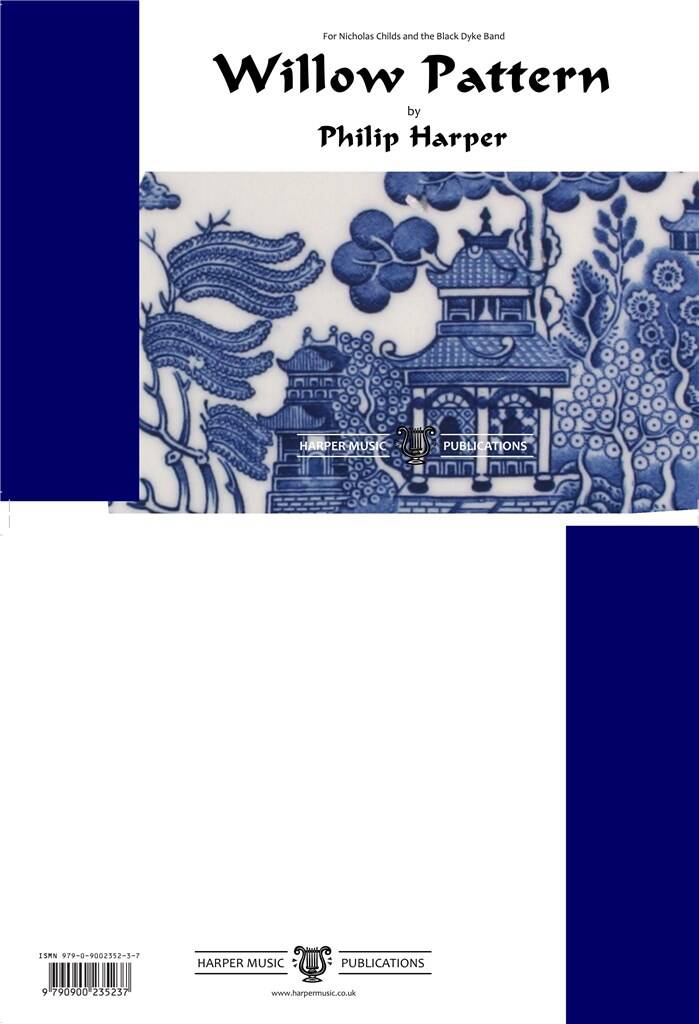
Willow Pattern - Philip Harper
Composed in 2009 for Nicholas Childs and the Black Dyke BandThis piece tells the Willow Pattern legend through music. Several leitmotifs are used both for the different characters and also for some of the important emotions in the tale. Additionally, Knoon-se's part is mainly played by the flugel horn, Changby the euphonium, the Mandarin by the Eb Bass and the Duke Ta-jin by the trombone. The Willow Pattern LegendOnce, in ancient China, there lived a wealthy and powerful Mandarin who had a beautiful daughter, Knoon-se. She had fallen in love with Chang, a humble accountant, which angered her father who imprisoned her in the Pavilion by the river with only theexotic birds for company. She learnt that the Mandarin planned to marry her to the pompous Duke Ta-jin and that the wedding would take place on the day the blossom fell from the willow tree, so she sent Chang a message: "Gather thy blossom, ere it bestolen". The Duke arrived by sea amid great fanfare when the tree was heavy with bud, and nights of magnificent banquets followed. After one such occasion when the Mandarin slept, Chang crept over the crooked fence and tiptoed into the Pavilion to rescueKnoon-se, but as they escaped the alarm was raised. They fled over the bridge with the Mandarin close on their heels brandishing his whip.They managed to escape by boat to a secluded island where they lived happily for a time. Meanwhile, the Mandarin learned of their refuge and, intent on revenge, he ordered his soldiers to kill them. As Knoon-se and Chang slept at night, the men setfire to the pagoda in which they lived and the lovers perished in the flames. However, the Gods, moved by the lovers' plight, transformed their souls into two turtle-doves which rose from the charred remains, soaring above the Earth, symbolising eternal happiness. Willow Pattern is dedicated to the memory of Jean Harper who passed away as I was completing the piece and who was a great collector of porcelain and china-ware. NOTES ON PERFORMANCEMute Requirements:Metal mutes soprano cornet, repiano cornet, 2nd cornets, 3rd cornets (6 in total) Cup mutes all cornets and trombones (10 + 3) Harmon mutes soprano cornet, solo cornets, repiano cornet (6) Percussion Requirements:There are two parts for percussion on the score. The minimum requirements are as follows: 2 players - Timpani, 2 Large tom toms, 2 Wood Blocks, Triangle, Sleigh Bells, Whip, Clash Cymbals, Suspended Cymbal, Hi-hat, Glockenspiel, Xylophone, Tam tam (or susp. cym.) For performances with extra resources, and to achieve closer authenticity, the full requirements are as follows: 3 players - Timpani, 3 Taiko Drums played with thick wooden sticks (or Large tom toms), 2 Wood Blocks, Triangle, Chinese Bells (or Sleigh Bells), Whip, Clash Cymbals, Chinese Cymbals (small clash cymbals approx 12"), Suspended Cymbal, Glockenspiel,Xylophone, Tam tam
Estimated dispatch 5-14 working days
-
 £105.20
Hard to Say I'm Sorry - Peter Cetera - Jan Utbult
"Hard to Say I'm Sorry" is one of the greatest hits by US rock band Chicago. It was the first single record from the "Chicago 16"-album (1982). The song went to no. 1 on the Billboard charts and stayed there for two weeks. Produced by David Foster, the song was given a typical early 80's sound with synthesizers and heavy guitars dominating the sound. The album-version of the song included a part two of the song, "Get Away", a up-tempo song featuring the famous horn-section of the band.
Estimated dispatch 5-14 working days
-
 £54.95
Sonata - Derek Bourgeois
This work, composed in 1998, was commissioned by the American trombonist Don Lucas as a work for trombone and piano and first performed by him in Birmingham on 19th May 2000. Subsequently, I arranged the music for both solo trombone and brass band and solo trombone and wind band so that it now exists in three formats. The first movement, in B flat major, is brisk and energetic, and is cast in sonata form. The second subject is gentler and more lyrical. The second movement, a scherzo in C major, is the most complex of the four. Basically the structure is a rond. For a long time the music remains in the opening 5/8 time until a new theme introduces more broken rhythms in a more jazzy idiom. After a return of the opening theme the following episode is more tonally ambiguous. Finally, the main theme returns to round off the movement. The third movement, a lyrical adagio, is really one long extended melodic flow. The harmonies are lush and the textures simple and direct. The tonal center is A minor, but the music meanders through so many keys, that this key centre is heavily disguised. The finale is a fiery affair. G minor is really its home key, but throughout the movement the music moves about a lot and the second subject is first heard in A flat minor. The movement's underlying sonata structure is masked not only by its loose tonality but also by its frequently changing time signatures. Like the first movement the second subject is more lyrical in nature and for a while it seems that the music will end peacefully, but a final flurry heralds a triple forte unison on the home note of the first movement - B flat. Derek Bourgeois
Estimated dispatch 5-14 working days
-
 £95.00
Variations on a Theme of Michael Tippett (Brass Band - Score and Parts)
A Centenary Tribute by Michael Ball, Edward Gregson, Elgar Howarth, Bramwell Tovey and Philip WilbyThis unique 'pice d'occasion' arose out of a telephone conversation in 2004 with Alan Wycherley, who was the soprano cornet player of the Foden's Richardson Band at the time. He indicated that the band would like to include an original birthday tribute for Edward Gregson (60) and Elgar Howarth (70) in its concert at the 2005 RNCM Festival of Brass in Manchester. I have been Artistic Director of Manchester's Festival of Brass since it was established in 1990 as a BBC Radio 3 series, As the centenary of the birth of Sir Michael Tippett fell on 5 January 2005, I devised this collective work as a way of embracing all three anniversaries in a novel way.The idea of joint compositions is not a new one in the classical music world. In the 1860s, Verdi was joined by a number of his contemporaries in a Requiem Mass for Rossini. In this country there have been a number of orchestral examples over the past fifty years, but never before for the brass band. Although Tippett composed only one work for brass band, Festal Brass with Blues, his orchestral works and operas are full of idiomatic brass writing. The theme I chose for this celebration is one of Tippet's most memorable miniatures featuring wind and brass. In the opera Midsummer Marriage it marks the entry of the Ancients. It is also included in the orchestral Suite in D (1948), for the Birthday of Prince Charles.I invited five of the leading contemporary voices in brass band music to add their own creative perspectives to the little Tippett theme, with it's characteristic rhythms, embellishments and modality - the Lydian mode. Each contribution was designed to fit into a tonal and formal template to give the whole work a flow and continuity. In Danse des Amis, Bramwell Tovey has composed a jazzy, humorous variation. Inspiration came from Tippett's love of jazz and, more personally, from the characteristically syncopated gait of the distinguished music critic John Amis, who Tovey once observed leaving a performance of Tippett's opera King Priam before the end. Incidentally, that performance was conducted by Elgar Howarth.We hear Edward Gregson in lyrical mode. His Midsummer Song is redolent of the sound world of Tippett's opera A Midsummer Marriage and it ends with a brief reference to a favourite of Gregson's, Tippett's Concerto for Orchestra. Michael Ball provides a brief moment of light, airy activity bringing to mind perhaps Tippett's love of Shakespearian fantasy, especially The Tempest. Elgar Howarth juxtaposes a slowed down version of the processional theme with distant recollections of fanfares from King Priam. Philip Wilby has rounded the tribute off with a spectacular fugue. During its inexorable progress Wilby ingeniously introduces the two other birthday references - the three-note musical signature that Elgar Howarth includes in much of his music and the characteristic theme which begins Edward Gregson's substantial work for brass an organ The Trumpets of the Angels. An elaborated reprise of Tippett's little theme is followed by a dynamic coda.- Paul HindmarshDuration: 13.00
Estimated dispatch 7-14 working days
 View Music