
Results
-
 £25.00
Christmas Concerto
DescriptionThis arrangement of Corelli's famous "Christmas Concerto" features soprano cornet, two solo cornets and solo euphonium. Arcangelo Corelli was one of the first masters of the baroque period, a skilled violinist much admired by fellow composers like Bach and Handel. He was born in Fusignano, near Ferrara in Northern Italy in 1653. He studied in nearby Bologna where he became an extremely competent violinist. By the 1670s he was working in Rome and building a reputation as a composer at the important and powerful Papal court. By the late 1600s he was widely famous all over Europe, regularly invited to important courts and palaces. Although he had a huge influence on the virtuoso writing of later composers, his writing for string instruments was designed to be playable by average, often amateur players.His set of Concerti Grossi known as Opus 6 was not published in his lifetime. We think they were written around 1690, and they were first published in Amsterdam in 1714, a year after Corelli's death. A 'Concerto Grosso' is a concerto for a group of soloists (the "concertino" group) accompanied by an ensemble (the "ripieno" group) and was an important form in the Baroque era. Handel's very successful examples were modelled on Corelli's example. Number 8 from the Opus 6 set was commissioned by the Venetian Cardinal Pietro Ottoboni and bears the inscriptionFatto per la notte di Natale('made for the night of Christmas'). It was used as part of the soundtrack for the 2003 film 'Master and Commander: The Far Side of the World".Performance Notes.In this arrangement the 'Concertino' group are the soprano cornet, solo cornets 1 & 2 and the solo euphonium. If logistics allow they should stand either at the front of or some distance away from the band. There is no percussion in this arrangement. All tutti cornets will require cup mutes.Duration approximately 3'15".You can listen to a preview while following the score below:
Estimated dispatch 7-14 working days
-
 £33.62
E lucevan le stelle (Cornet/Euphonium Duet with Brass Band) Puccini arr.Bushnell
Tosca is an opera in three acts by the Italian composer Giacomo Puccini. The opera is set in June 1800 in Rome, and tells the story of the Kingdom of Naples and the threat to its control of Rome by Napoleon's invasion of Italy. Some of Puccini's best-known arias can be found in Tosca. The opera is based on Victorien Sardou's dramatic play of the same name (La Tosca). Puccini saw the play at least twice in 1889 and begged his publisher, Giulio Ricordi, to obtain the rights to turn it into an opera, which were secured in 1891 - although Puccini relinquished the rights to Alberto Franchetti before being recommissioned in 1895. Puccini wrote "I see in this Tosca the opera I need, with no overblown proportions, no elaborate spectacle, nor will it call for the usual excessive amount of music." It took four years to write, with Puccini arguing with his librettists (Luigi Illica and Giuseppe Giacosa) and his publisher. Although the first performance was delayed by a day due to the unrest in Rome at the time, the opera was premiered on 14 January 1900 at the Teatro Costanzi in Rome. The critics reviews were indifferent, but it was an immediate success with the public. The opera is through-composed, with the different musical elements weaved from piece to piece. Puccini used the Wagner's leitmotif concept to identity different parts of the opera. Taken from Act 3, E lucevan le stelle is sung by Cavaradossi, a painter, who has fallen for the singer Tosca. The corrupt Chief of Police, Baron Scarpia, longs for Tosca himself and, upon suspecting Cavaradossi of helping a political prisoner escape, he takes the opportunity to get rid of Cavaradossi and blackmail Tosca into being with him. The guards lead Cavaradossi to the roof of Castel Sant'Angelo, where he is told he has 1 hour to live before being executed. He asks to write a letter to Tosca, overcome by memories, he sings E lucevan le stelle (And the stars shone). It was selected by the tenor Wynne Evans as one of the most romantic songs for his top ten arias for Classic FM. He described it as "another tenor classic, both tragic and beautiful." This arrangement (for cornet and euphonium duet with brass band) includes alternative parts for horns in F and lower brass in bass clef. A recording of the original song can be found here: www.youtube.com/watch?v=EAqHQMX7GHY
In Stock: Estimated dispatch 1-3 working days
" frameborder="0" allowfullscreen> -
 £45.00
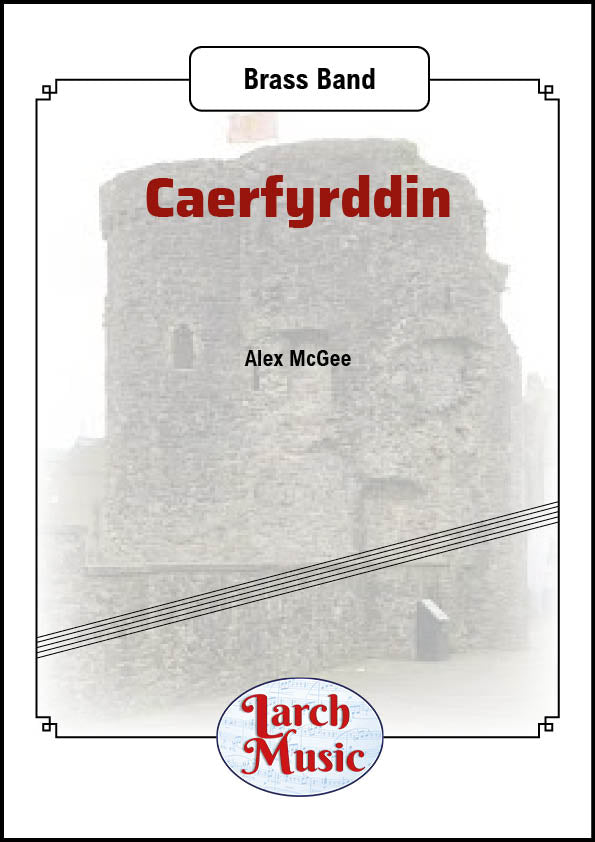
Caerfyrddin - Brass Band - LM957
COMPOSER: Alex McGeeA four movement work describing the historic county town of Carmarthen.1. FanfareThe first movement is an opening Fanfare,2. Castell Caerfyrddyn(Carmarthen Castle)The second movement is a lament describing the now ruined castle.Carmarthen Castle(Welsh:Castell Caerfyrddin) is a ruinedcastleinCarmarthen,West Wales. First built by Walter, Sheriff of Gloucester in theearly 1100s, the castle was captured and destroyed on severaloccasions before being rebuilt in stoneduring the 1190s. The castle was captured byOwain Glyndrin 1405.Henry VII's father died at Carmarthen Castle in 1456. During theWars of the Rosesthe castle fell toWilliam Herbertand, during theCivil War,was captured by Parliamentary forces. It was dismantled by order ofOliver Cromwellin the mid 1600s.It has been used as the site of Carmarthen's gaol until the 1920s.The remains of the castle were given a Grade Iheritage listingin 1954and is currently a tourist attraction and site of the town's Tourist Information Centre.3. Pysgota Cwrwgl(Coracle Fishing)The third movement is a Scherzo which depicts coracle fishing on the river Towy.Should you take an evening stroll down by the River Towy,if the weather and river conditions are suitable, you may be lucky enough to see apair of coracles float gently down river with a net suspended between them.The coracle man will hold the net in one hand and skilfully moving the paddle in afigure of eight motion in the other. As soon as a fish in caught, which many havedescribed as a 'silent noise travelling from the fish, into the net and up into thefisherman's arm', the two coracles are drawn together by pulling at the net.Sewin (sea trout) or salmon being the chosen catch.4. MarchThe Fourth movement is a March representing the town itself. Carmarthenshire in West Wales lies on the River Towy and claims to be the oldest town in Wales. Some variants of theArthurian legendclaim thatMerlinwas born outside the town and that he lies imprisoned in a cave in nearbyBryn Myrddin(Merlin's Hill), which stands right by the A40 trunk road.The myth maintains that his groans can be heard issuing forth from the hill and will continue until he is called to help his fellow countrymen. It is also claimed that, when Merlin's Oak fell, it would be the downfall of the town.For many years great effort was employed to brace the tree, situated in the town.Although it eventually died, it is hoped that catastrophe was averted by preservingsome bits in theCarmarthenshire County Museum.Larger branches are in the Civic Hall in Nott Square and a statue of Merlincarved from another local tree stands in the town centre.St. Peter's Church, the largest parish church in Wales,also has thelongest navemeasuring 60 metres and its tower containseight bellswith the heaviest weighing just under a tonne.It is surprising that few traces survive of the medieval town; however,a small section ofCivil War defences, thrown up by the Royalists, survives on the south-west of the town. They are known as "The Bulwarks," and consist of an earthwork bank and a well-preserved four-sided bastion.Suitable for Most Bands - Duration 8 mins (Approx.)
In Stock: Estimated dispatch 3-5 working days
-
 £38.95
Unity Series Band Journal - Numbers 514 - 517, February 2023
514: Shine! (Samuel Shelley)This is a bright, energetic piece of work which Bandsman Samuel Shelley originally wrote at the request of Young People's Band Leader Neil Baker for Staple Hill YP Band. The two songs featured are Shine, by Nick Jackson, and Graham Kendrick's Shine, Jesus, shine.515: He's got the whole world in his hands (Morgan Juel Stavik)Morgan Juel Stavik has arranged one of the most widely known and loved spirituals, He's got the whole world in his hands, into a jazzy work perfect for family services.516: The blood will never lose its power (Stephen Hull)The blood will never lose its power, is an arrangement of Andra Crouch's gospel classic. It is composer Stephen Hull's debut work in the Brass Band Journals.517: You encircle me (Andrew Mackereth)You encircle me has been popular in Scandinavia for many years and is now available in this beautifully reflective setting by Andrew Mackereth.
Estimated dispatch 7-14 working days
-
 £25.00
Ring'd with the Azure World
DescriptionRing'd with the Azure World was commissioned by the Harmonia Brass quintet for their final recital at the University of Huddersfield in 2016.He clasps the crag with crooked hands; Close to the sun in lonely lands, Ring'd with the azure world, he stands.The wrinkled sea beneath him crawls; He watches from his mountain walls, And like a thunderbolt he falls.- The Eagle by Alfred, Lord TennysonThe music was inspired by Tennyson's poem reproduced above; it seeks simply to reflect the spirit of the poem. It opens in sparse, lonely mood as the eagle surveys the world beneath. The work quickens in three bursts using metrical modulation to disguise the actual moment of acceleration, reflecting the lazy energy stored in the circling raptor before concluding dramatically in a fall 'like a thunderbolt'. Tennyson's poem, although brief, has inspired much analysis and writing, and is notable for being written in the (then somewhat unfashionable) iambic tetrameter, indicating a foursquare emphasis reflected in the main theme of the music. This is heard first in an octatonic version and later in a purely tonal (if somewhat modal) version. The instrumentation reflects that of Harmonia Brass, a quintet composed of brass band instruments (two B flat cornets, an E flat tenor horn, tenor trombone and E flat tuba). However the music is also available for the more conventional brass quintet of two trumpets, french horn, trombone and tuba.To listen to an audio export preview and follow the music, click play on the video below!Performance Notes1st cornet/trumpet requires a cup mute, ideally with an adjustable cup (the marking "tight" denotes that the cup should be adjusted closer to the bell), and a harmon mute with the tube removed (denoted by "TR" in the score). 2nd cornet/trumpet requires a fibre straight mute and a harmon mute with the tube removed. Tenor horn require a fibre straight mute and a practice mute (any sort) - in the orchestral brass version the french horn requires a stop mute. Trombone requires a cup mute (only). Tuba requires a fibre straight mute and a practice mute (of any sort).Metronome marks should be closely observed - starting either too fast or too slow will have a disproportionate effect on the tempi later in the piece due to the metrically controlled tempo changes.
Estimated dispatch 7-14 working days
-
 £42.35
A Suffolk Prelude - Andrew Duncan
Written for the Ipswich & Norwich Co-Op Band, A Suffolk Prelude is based around five traditional tunes from Suffolk:'Nutting Time','Blackberry Fold','Cupid's Garden','A Seaman's Life''The Bold Richard'The piece begins on the percussion and timpani alone leading through a crescendo into the first statement of the fanfare which is derived from a motif from the tune 'Nutting Time'. This leads into a playing of the 'Nutting Time' tune which is then developed as the tune is passed around the band.'Nutting Time' is a jolly lighthearted tune about a 'fair maid' who meets a handsome young farmer called 'Johnny' when out gathering nuts in the wood. After a pause on the tubular bells the slow tune 'Blackberry Fold' is presented as a solo for Flugel Horn, then as a full band version.'Blackberry Fold' is a touching song about a Suffolk squire who gets married well below his station to a beautiful milkmaid, simply because he loves her! They live happily ever after.The next tune to be heard is the juanty 'Cupid's Garden' played firstly as a solo on the Euphonium, and again this is about the subject of love. This song is sung from a sailors prospective and he tells how he met a lovely maiden and has promised to marry her when he returns from duty at sea.The trombones then play the noble tune 'A Seaman's Life'. This tune seems to serve as a warning to young girls about the fickle nature and the total unsuitability of marrying a sailor! 'Oh a seaman's life is a merry merry life, they'll rob young girls of their heart's delight, they will leave them behind for to sail one morn, but they never know when they'll return'. Despite this it is a fine tune!The last tune featured is 'The Bold Richard' which is played by all the bass instruments in the band. This is a song telling how the Royal Navy friggate 'The Bold Richard' went to battle against a French friggate destroying her and taking her crew as prisoners.Suffolk Prelude goes on to feature a slow version of the tune 'A Seaman's Life' played alongside a fast version of the tune 'Cupid's Garden'. The opening fanfare then returns leading into a final coda section.
In Stock: Estimated dispatch 3-5 working days
-
 £87.95
Masquerade (Score and Parts)
The first performance took place on the 4th. September 1993 at the Free Trade Hall in Manchester during the British Open Brass Band Championships.Note by Philip Wilby:Masquerade is a centenary tribute to Verdi's last opera Falstaff and takes its final scene as the basis for my own piece. Thus I have used some of Verdi's music, and some of Shalespeare's plot, and woven them into a fabric with highly demanding music of my own to produce a work in the great tradition of operatically-based brass band pieces. Such scores date from the very beginnings of band repertory and are often not direct arrangements in the established sense but new compositions produced in homage to a past master. They may still offer performers and audience alike something familiar interwoven with something new. My own piece reuses some elements from the original story: . .Falstaff has been caught in a web of his own lies by the ladies of the town, who propose to teach him a lesson. The story opens at night in Windsor Great Park. The plotters, variously disguised in Hallowe'en fashion (as fairies,elves hobgoblins etc!) assemble in the park to await Falstaff's arrival (musicologists will, perhaps, note a rare use of 'large bottle in F' being used during this scene of suppressed alcoholic revelry!). Falstaff's companions, Bardolph,Piston and Robin, enter (represented here by the three trombones!), and are variously abused by the masqueraders. At the height of the Tout an alarm sounds and Falstaff (euphonium cadenza) enters as Midnight strikes. From a safe hiding place he watches as the disguised Nanetta (principal comet) sings a serene solo as the moon appcars above the trees. With sudden force the others seize him and drag him from his hiding place. As in the traditional game 'Blind Man's Buff', he is roughly turned seven times (a sequence of solo accelerandi) until, at last, he recognizes his assailants as his sometime friends. Far from complaining, Verdi's character concludes the opera with a good-humoured fugue on the words.... 'All the World's a Joke... Every mortal laughs at the others, But he laughs best who has the final laugh. Philip Wilby.
Estimated dispatch 7-14 working days
-
 £44.95
Masquerade (Score Only)
The first performance took place on the 4th. September 1993 at the Free Trade Hall in Manchester during the British Open Brass Band Championships.Note by Philip Wilby:Masquerade is a centenary tribute to Verdi's last opera Falstaff and takes its final scene as the basis for my own piece. Thus I have used some of Verdi's music, and some of Shalespeare's plot, and woven them into a fabric with highly demanding music of my own to produce a work in the great tradition of operatically-based brass band pieces. Such scores date from the very beginnings of band repertory and are often not direct arrangements in the established sense but new compositions produced in homage to a past master. They may still offer performers and audience alike something familiar interwoven with something new. My own piece reuses some elements from the original story: . .Falstaff has been caught in a web of his own lies by the ladies of the town, who propose to teach him a lesson. The story opens at night in Windsor Great Park. The plotters, variously disguised in Hallowe'en fashion (as fairies,elves hobgoblins etc!) assemble in the park to await Falstaff's arrival (musicologists will, perhaps, note a rare use of 'large bottle in F' being used during this scene of suppressed alcoholic revelry!). Falstaff's companions, Bardolph,Piston and Robin, enter (represented here by the three trombones!), and are variously abused by the masqueraders. At the height of the Tout an alarm sounds and Falstaff (euphonium cadenza) enters as Midnight strikes. From a safe hiding place he watches as the disguised Nanetta (principal comet) sings a serene solo as the moon appcars above the trees. With sudden force the others seize him and drag him from his hiding place. As in the traditional game 'Blind Man's Buff', he is roughly turned seven times (a sequence of solo accelerandi) until, at last, he recognizes his assailants as his sometime friends. Far from complaining, Verdi's character concludes the opera with a good-humoured fugue on the words.... 'All the World's a Joke... Every mortal laughs at the others, But he laughs best who has the final laugh. Philip Wilby.
Estimated dispatch 7-14 working days
-
 £44.95
Triumphant (Brass Band - Score and Parts)
Triumphant was written as the opening work for the 2024 Future All-Stars final concert. Based on the well-known hymn Victory in Jesus (S.A.S.B. 464), the piece reimagines the familiar melody and words with energetic drumline-inspired rhythms and driving Bass groove.O victory in Jesus, my Saviour, for ever!He sought me and bought me with his redeeming blood;He loved me ere I knew him, and all my love is due him -He plunged me to victory beneath the cleansing flood.Musically speaking, the rhythmic pulse should remain confident and consistent throughout, with the percussion establishing the groove and the band locking in with precision. Take time to find a tempo that allows the Bass and Percussion parts to remain clear and accurate. A slightly steadier pace will produce a stronger, more convincing groove. However, a slower tempo can result in the band's playing becoming too heavy. Melodic lines should be played on the longer side, allowing phrases to sing over the rhythmic accompaniment that can be more defined and articulated. As the work builds, be patient and disciplined with dynamics, saving the band's fullest sound for the climactic moments, maximising their impact.
Estimated dispatch 7-14 working days
-
 £38.95
Unity Series Band Journal - Numbers 530 - 533, June 2024
530: Carol Arrangement - God rest you merry, gentlemen (Noel Jones)This swing arrangement of the traditional English carol also features references to O come, all ye faithful (C.C. 61) and Jingle Bells (C.C. 121). Play with imagination and a sense of style!531: Go, tell it on the mountain! (Nathanael Watchorn)Historically, the passion of enslaved people in America for singing about the Gospel of Jesus is well documented, but it was men of three generations, each named John Wesley Work, who enabled spirituals to become more widely known. John Wesley Work Sr, a church choir director in Nashville, Tennessee, wrote and arranged music for the pioneering Fisk Jubilee Singers whose early repertoire consisted largely of spirituals. This passion and knowledge of spirituals was passed down through the generations. John Work III travelled hundreds of miles to collect songs by attending church services in remote areas. In 1940, he published a collection of 230 songs which included a setting of Go, tell it on the mountain! that is still performed today.Nathanael Watchorn, a Bandsman at Regent Hall Corps in London, is a new contributor to the journals. He originally wrote this as a vocal arrangement for the group FourHymn, subsequently transcribing it for the corps' Young People's Band, while he was Band Leader.532: Carol Arrangement - They all were looking for a king (Stephen Hull)At the North American Composers Forum, Major Len Ballantine challenged participants to find an unfamiliar song in the Salvation Army Song Book and try to write an arrangement of the listed tune. Stephen Hull happened across They all were looking for a king (S.A.S.B. 128) and the tune Childhood (T.B. 421) which lead to this arrangement.533: March - Washed and healed (Eiliv Herikstad)The Christian experience of many people will have been positively impacted by the life of the late Bandmaster Eiliv Herikstad, either personally or through his musical leadership and compositions. This march is the second publication from this well-known Salvation Army composer since his Promotion to Glory last year. This march is more traditional in style that many of his compositions but contains a strong Christian message and demonstrates his compositional expertise.
Estimated dispatch 7-14 working days
