
Results
-
 £34.95
Vissi d'arte - Christopher Bond
Vissi d'arte is a soprano aria from act 2 of the opera Tosca, by Giacomo Puccini. It is sung by Floria Tosca in total anguish, in the form of a prayer to God, asking 'why he rewards her thus?'. Just before the aria is performed (and the reason for its presence) Baron Scarpia, the chief of police, tells Tosca that in order to save her lover Cavaradossi's life, she must sleep with him. Vissi d'arte is Tosca's cry of anguish; she reasons that although she has never done anything wrong, she is still being faced with an impossible choice: either way, she will have to betray Cavaradossi, in the form of sleeping with another man, or not doing everything she could to save his life. This arrangement was made for Rose Hancock and City of Cardiff (Melingriffith) Brass Band for their performance at the 2020 Welsh Open Entertainment Contest.
Estimated dispatch 10-14 working days
-
£110.00
Legend - Geert Jan Kroon
Other than the title, there is no real story that connects this piece to eyeballs or werewolves. There is no real legend that precedes this work. The legend will evolve in the listener's mind while listening to this piece. For me, it started with the title. It was dreamed up by my son. He also suggested a musical gesture, which I then used to build all the musical materials in this piece. I have sought to capture a dark atmosphere with a sense of excitement. Although, there are some not so dark moments in the piece which serve as a musical contrast. I would like to invite every listener to imagine a world where there exists a legend of a bleeding eyeball and a blind werewolf. And if you do dream up a great story, please let me know and share it with each other!
-
 £29.95
Ghost of Christmas Yet To Come, The - Jonathan Bates
DURATION: 3'00". DIFFICULTY: 2nd+. Composed for Strata Brass in 2020 as part of their COVID-19 induced, virtually recorded 'A Christmas Carol' (a new suite for brass bandlasting around 30 minutes in total), 'The Ghost of Christmas Yet To Come' is a jagged and virtuosic solo for Euphonium portraying what Ebenezer Scrooge sees when he is shown how his Christmases in the future will occur by the Ghost of Christmas Yet To Come. Having already been shown how is mean and uncaring ways have impacted his life this far by the previous two visions, this 3rd and final vision is enough to force Scrooge to become a changed man and embrace the Christmas spirit with all his heart. Throughout this solo, you may hear small references to Camille Saint-Saens' 'Danse Macabre'. .
In Stock: Estimated dispatch 1-3 working days
-
 £25.00
Canzona XIII
DescriptionCanzona XIII, also known as Canzon Septimi Octavi Toni a 12, was first published in 1597 as part of a collection entitled 'Symphoniae Sacrae' - this collection was a mixture of instrumental and choral pieces, and also included the famous Sonata Pian'e Forte, probably his best known work.Gabrieli was born in Venice sometime between 1554 and 1557 and studied with the renowned Dutch composer Orlando di Lassus. He also studied with his uncle, Andrea Gabrieli, and eventually succeeded him as the organist and composer at St Mark's Basilica in Venice. Already renowned as a musical centre, Venice became a magnet for composers wishing to study with Gabrieli after 'Symphoniae Sacrae' was published.Like many of his works, this Canzona was written to take advantage of the unique layout of St Mark's, which had galleries on three sides where the musicians could be placed to create novel spatial effects - utterly new and exciting for sixteenth century listeners. Canzona XIII has three different antiphonal 'choirs' and in this arrangement the band is split into three groups to reflect Gabrieli's innovative idea. Ideally the three groups should be clearly separated so the the antiphonal effect comes across clearly, although this will of course depend on the performance space. On no account should the band remain in its normal seated formation!As Gabrieli didn't have any percussionists (and percussion was widely thought inappropriate for music performed in church anyway) there are no percussion parts in this music.This arrangement was first performed by the Coppull and Standish Band conducted by Andrew Baker in 2009.You can follow a preview of the score while listening to an audio export of the music below!
Estimated dispatch 7-14 working days
-
 £16.00
Sonata Pian'e Forte
DescriptionSonata Pian'e Forte means an instrumental piece using soft and loud dynamics. A "Sonata" (at this time) meant a piece for instruments (as opposed to voices). It was probably written to be played as part of a service at St Mark's, Venice. This is the earliest known piece to specify both the instruments to be played AND the dynamics in the written music.Gabrieli was born in Venice sometime between 1554 and 1557 and studied with the renowned Dutch composer Orlando di Lassus. He also studied with his uncle, Andrea Gabrieli, and eventually succeeded him as the organist and composer at St Mark's Basilica in Venice. Already renowned as a musical centre, Venice became a magnet for composers wishing to study with Gabrieli after 'Symphoniae Sacrae' was published.Like many of his works, Sonata Pian'e Forte was written to take advantage of the unique layout of St Mark's, which had galleries on three sides where the musicians could be placed to create novel spatial effects - utterly new and exciting for sixteenth century listeners. Sonata Pian'e Forte has two different antiphonal 'choirs' and in this arrangement the band is split into two groups to reflect Gabrieli's innovative idea. Ideally the two groups should be clearly separated so the the antiphonal effect comes across clearly, although this will of course depend on the performance space. On no account should the band remain in its normal seated formation!As Gabrieli didn't have any percussionists (and percussion was widely thought inappropriate for music performed in church anyway) there are no percussion parts in this music.This arrangement is available for full brass band or 8-piece brass ensemble andwas first performed by the Blackley Band conducted by Andrew Baker in 2004.Listen to a computer realisation and follow the score in the video below:Duration approximately 4'20".
Estimated dispatch 7-14 working days
-
 £35.00
strange geometry
Descriptionstrange geometrywas commissioned by Morgan Griffiths and the Hammonds Saltaire Band for their performance at the Brass in Concert Championships of 2015.As a bit of a space/sci-fi geek, as well as a musician, two events during the summer of 2015 had a particular effect on me. The first was the tragic early death in a plane crash of the famous film composer James Horner. Horner's music, particularly in films like 'Star Trek II: The Wrath of Khan', 'Avatar', 'Apollo 13' and even his debut in Roger Corman's 1980 budget film 'Battle Beyond the Stars', defined for a generation the sound of sci-fi at the cinema. Along with John Williams he created the vocabulary for those who wish to express other-worldly wonder in music and his inventive talent will be much missed in an industry where originality has become something of a dirty word in recent years.The second event was the epic flyby of Pluto by the NASA New Horizons spacecraft. There are many reasons to find this mission inspiring - for example, the scientists and engineers behind it created a craft that has travelled at 37,000 mph for nine years and three billion miles to arrive within seventy-two seconds of the predicted time for the flyby. That they achieved this with such accuracy is an outstanding tribute to humanity's ingenuity and insatiable curiosity. However, the most exciting aspect of the mission was the clear, high resolution pictures of this unthinkably remote and inhospitable world beamed back to mission control. The best previous image of Pluto was an indistinct fuzzy blob - suddenly we could see mountains made of ice, glaciers of methane and carbon monoxide and nitrogen fog - features previously unimagined on a world thought to be a slightly dull ball of cold rock. The BBC's venerable astronomy programme 'The Sky at Night' waxed lyrical about these newly discovered features, referring to "the surprising discoveries of mountains and strange geometry on the surface of this cold distant world".I like to think that Horner would have been as inspired as I have been by this real-life science story, and this piece uses some of the vocabulary of the sci-fi movie soundtrack in a tribute to the memory of a great musician and to the inspirational geeks at NASA who have boldly taken us where no-one has gone before.Note: This work comes with a B4 portrait score. Listen to a preview and follow the music below!
Estimated dispatch 7-14 working days
-
£44.95
CHRIST-HYMN (Brass Band Set) - Robert Redhead
Christ-Hymn is an expression of response to the ancient Christian hymn quoted by Paul in his letter to the Philippian church (Philippians 2:5-11). After an opening which creates a tone of sadness and quiet suffering, the following music is a joyous expression of the truth that 'He is exalted', 'His name is above all names' and 'Every tongue will confess that Jesus Christ is Lord'.
Estimated dispatch 7-14 working days
-
£35.00
Scene From the Silver Plate - Peter Meechan
Scene From the Silver Plate takes itas title from the Rio de la Plata, the literal translation being Silver River.This piece, using some of the traditional music from the region (Variants on the tango etc.), is quasi-incidental music from a fictional film, involving some kind of chase from the silver mountains to the estuary. Our fictional hero also has a romantic interest - will he make it away with his silver, and his lady?The trombone duets with various members of the band, including solo horn, euphonium and cornet.
Estimated dispatch 12-14 working days
-
 £30.00
O.B.1. Fanfare - Tom Watson
Tom Watson was born into a musical family in Hertfordshire, England and showed a flare for playing the trumpet from the age of just 4. Taught by his father James Watson, the prolific international soloist, conductor, educator and session trumpeter, Tom studied at the Royal Academy of Music, where he gained a first class honours degree. Whilst still at college, Tom embarked on a varied professional freelance-playing career and was guest principal trumpet with the Mahler Chamber Orchestra performing under Claudio Abbado, Daniel Harding, and Sir Neville Marriner. Tom can be regularly found performing and recording with the London Symphony Orchestra, The BBC National Orchestra of Wales and many of the UK's finest orchestras. Commercially, Tom has played in sessions or concerts for artists such as Sir Elton John, Sir Paul McCartney, Sir Tom Jones, Dame Shirley Bassey, Ozzy Osbourne, Phil Collins, Eric Clapton, Joe Cocker, Jarvis Cocker, Pete Doherty, Nick Cave, Karl Jenkins and Victoria Wood. Some of his film session work has included recording the scores for Brave, Eragon and Stormbreaker. Tom also works as a musical director, arranging and conducting various projects such as Tony Christie's album Made in Sheffield and for renowned harpist Catrin Finch. Tom also runs his own independent recording and production company Pro Audio, part of Prozone Music, which Tom owns and runs alongside his brother William. The O.B.1. Fanfare was written for the Harper Ensemble, a brass ensemble comprising of Tom's contemporaries from his time at the Royal Academy of Music. It was written for the Leicester Square UK premiere of the film "Ali" starring Will Smith. Composed as a salute to Hollywood and the big screen, this fine pastiche of film scoring is an ideal fanfare and concert opener.
-
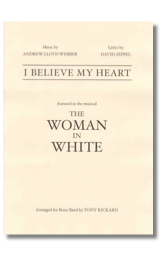 £39.95
I Believe My Heart (Score and Parts) - Andrew Lloyd Webber arr. Tony Rickard
The Ofcially Authorised brass band arrangement of this chart success. Tony Rickard's arrangement brilliantly captures the essence of this marvellous song and will make all grades of band sound like champions! What the papers say about The Woman in White... "...return to spectacular form" Sunday Times "A dazzling white hit" Daily Express "Andrew Lloyd Webber's best score in years" Guardian Tony Rickard is a skilled arranger whose work has been played and recorded by The London Trumpet Sound and Canadian Brass. He is the co-author of the highly sucessful Well Easy Trumpet Book.
Estimated dispatch 7-9 working days
 View Music