
Results
-
 £58.00
Hymns at Heaven's Gate (Parts only) - Elgar Howarth
A flourish: a crowd assembles at the gate of Heaven, saints and sinners. As in a film the immensity of the crowd is illustrated, and the camera zooms to focus onparticular groups and individuals. Monks sing a 'medieval' hymn, interrupted by the fanfares of mischievous seraphim; gradually the whole crown join in. The fanfares grow wilder, and grubby, naughty children enter, singing mock fanfares, making jazzy gestures and trying to sing a chirldren's hymn. They are joined by roughnecks who take up the fanfare idea. The camera zooms again at the entrance of Jesus. A commanding flourish causes consternation. Separate groups react, interrupted by mysterious percussion effects. Then, as the whole panorama explodes in sound, William Booth (founder of the Salvation Army) approaches awestruck. A triple Alleluia is followed by the third hymnand further Alleluias. A dance finale begins using material from the whole piece. A tumultuous climax preceds sudden quiet Alleluias, and the crown exits into Heaven to the music of the monks, reharmonised and transformed. The camera shots extend to the heavens and the stars. Duration: 15:00
Estimated dispatch 7-9 working days
-
 £94.99
20,000 Leagues Under the Sea (Brass Band - Score and Parts)
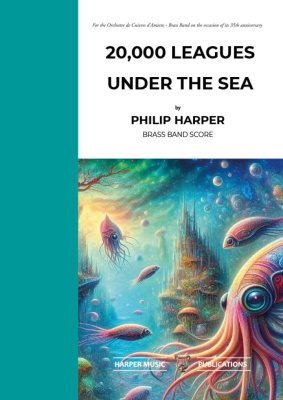
Frenchman Jules Verne was a pioneer in science fiction during the late 19th Century, penning some classic stories such as Journey to the Centre of the Earth and Around the World in 80 Days - both of which have already been the subject of brass band test-pieces. It was therefore natural for me to choose Verne's 1869 watery magnum opus as the subject for this piece to which there are five sections, as well as an introduction and a finale.THE NAUTILUS. After a mysterious introduction we are introduced to The Nautilus - a fantastical submarine.THE CORAL KINGDOM. We visit awe-inspiring underwater coral formations.SQUID ATTACK. The Nautilus is attacked by a school of giant squid, or 'devilfish'.CAPTAIN NEMO. Captain Nemo is a loner and an eccentric. Some say he is a madman. Soloists of the band help to uncover the character of this enigmatic but powerful figure.MAELSTROM. The Nautilus is dragged into the ocean's deadliest whirlpool but Captain Nemo lives to fight another day.Duration: 12.30
Estimated dispatch 7-14 working days
-
£43.99
20,000 Leagues Under the Sea (Brass Band - Score only)
Frenchman Jules Verne was a pioneer in science fiction during the late 19th Century, penning some classic stories such as Journey to the Centre of the Earth and Around the World in 80 Days - both of which have already been the subject of brass band test-pieces. It was therefore natural for me to choose Verne's 1869 watery magnum opus as the subject for this piece to which there are five sections, as well as an introduction and a finale.THE NAUTILUS. After a mysterious introduction we are introduced to The Nautilus - a fantastical submarine.THE CORAL KINGDOM. We visit awe-inspiring underwater coral formations.SQUID ATTACK. The Nautilus is attacked by a school of giant squid, or 'devilfish'.CAPTAIN NEMO. Captain Nemo is a loner and an eccentric. Some say he is a madman. Soloists of the band help to uncover the character of this enigmatic but powerful figure.MAELSTROM. The Nautilus is dragged into the ocean's deadliest whirlpool but Captain Nemo lives to fight another day.Duration: 12.30
Estimated dispatch 7-14 working days
-
 £19.99
Journey of the Lone Wolf (Brass Band - Score Only)
Championship Section Test Piece for the 2016 National Finals of the British Brass Band Championship.The Lone Wolf of the title is the great Hungarian composer and folklorist Bla Bartok. Bartok's journey took him from the hills of the Balkans to the heart of the new world. His singular vision may have meant a life out in the cold, a life without warmth and love, a life without true happiness, a death mourned by a few in a strange land.The first of the three linked movements is capturing the Peasants' Song and follows the young Bartok and fellow composer Zoltan Kolday as they embark on Summertime adventures through the Hungarian countryside to collect and catalogue the astonishing variety of Gypsy and folk music heard in the Balkan hills. The arrival of WW1 plunges Bartok's beloved Hungary into chaos.Bartok was at times a cold man, aloof and lonely. The occasional moments of tenderness he showed are portrayed in Night Music. His brief but intense affairs speak of a love he could only long for. Jazz is my night music and here there are hints of what Bartok may have heard in the USA later in his life.Having been forced by the world's evils to leave his homeland of Hungary for America Bartok, the anti-fascist, felt isolated and angry. In the finale, Flight and Fight, we hear his longing for a simpler time of Gypsy folk dances as well as his maturity and depth as a composer finally exploring deeper colours and darker themes.Duration: 15.00
Estimated dispatch 7-14 working days
-
 £40.00
Abide With Me (Euphonium Solo with Brass Band - Score and Parts)
My arrangement of William H. Monk's tune of 1861, uses the euphonium soloist as the central figure for the melodic line in the three verses. Surrounding the solo line is an irregular pulsed figure in the percussion to give the music an unsettled feel whilst the muted ensemble lightly colour the melodic contour of the soloist. From the low beginnings of the piece, where no high instrumentation is used, we are led through the darkened texture to a bright finale, although the sense of the forbidding is always present.Abide With Me has always been a favourite hymn of mine and it was when watching the film 28 Days Later that I believed it would make a rather striking arrangement for brass band. This was confirmed further when the hymn was used at the 2012 opening ceremony of the London Olympics. The juxtaposition between the static, slow moving melody and the rhythmic effects of the dancers was something that I thought could be captured in an arrangement.- Paul McGheeDuration: 5.00
Estimated dispatch 7-14 working days
-
 £29.95
St. Andrew's Variations (Score Only)
This piece, written for the East Anglian Brass Band Festival in 1998, takes the form of eight variations and a finale, loosely based on the descending third motif heard in the initial theme. It was initially composed for junior band, and expanded and rescored for full band in 2006. There is no significance in the title, other than the fact it was written by a Scotsman to be played in the St Andrew's Hall, in Norwich!Alan Fernie was born and brought up in the Scots mining village of Newtongrange. From the age of 13 he learned to play the trombone both at school and with the local brass band, going on to study music in Glasgow and London. After a short period working as an orchestral musician, Alan moved into instrumental education, spending over 20 years teaching brass in schools all over the East of Scotland. It was during this time that he began to conduct and he has since directed bands at all levels, winning many awards. He first wrote for brass whilst still a student, and his music is now played, recorded and published throughout the world.In 2009, Alan was honoured with the "President's Award" from the Scottish Brass Band Association for services to banding. He is also proud to be associated as composer in residence with the acclaimed charity "Brass for Africa", with whom he spent two months recently teaching in Kampala, Uganda. Living in the Scottish Borders, Alan now works as a freelance musician, finding time to write, teach, conduct, judge, perform and act as compere throughout the UK and beyond.
Estimated dispatch 7-14 working days
-
 £89.95
Tuba Concerto (Score and Parts)
This work was commissioned by the Besses o' th' Barn Band with funds provided by the Arts Council of Great Britain. It was written for, and is dedicated to, John Fletcher, who gave the first performance in Middleton Civic Hall, near Manchester, on 24 April, 1976, with Besses o' th' Barn Band conducted by the composer. Another interesting feature about the premire was that it was recorded by BBC Television for an Omnibus programme with Andr Previn as presenter. The concerto exists in three versions: with brass band (1976), orchestra (1978) and wind band (1984).The concerto is in three movements, following the usual, quick-slow-quick pattern: Allegro deciso,Lento e mesto, Allegro giocoso. The first movement has a sonata form shell with two contrasting themes, the first one being rhythmic in character, the second lyrical. There is a reference made in passing to the Vaughan Williams Tuba Concerto, but this merges into the other material in the development section.The second movement begins with a chorale, but after the entry of the tuba it leads to a cantabile theme, softly unfolded by the soloist. The opening chorale passage returns, this time briefly on muted brass, and leads to a middle section which is more chromatic in style and soon builds to a powerful climax, where the opening cantabile theme triumphantly returns. The music subsides, returning to the opening chorale and ending peacefully.The finale is light and breezy in style, and is cast in rondo form. After a brief introduction the tuba announces the main rondo theme, which is dance-like and a little jaunty. There are two episodes: the first a broad sweeping tune, the second a slowish waltz and a little jazz-like. After a virtuoso cadenza reference is made to the very opening of the concerto before the work ends with a triumphal flourish.The Tuba Concerto has established itself as one of the main works in the solo tuba repertoire. It has been performed and broadcast in over 40 countries all over the world. There are currently six commercial recordings of the concerto in its various versions.resolution in C major, pointed by a simple but expansive melody towards which the piece has been heading, and ending in a blaze of joyful colour.
Estimated dispatch 7-14 working days
-
£60.00
Exterminate! - Harper, P
Included as part of Cory Band's Dr Who programmes of 2023, this piece is an exciting finale which taps into the spirit of Dr Who and the Daleks, whilst quoting from diabolical music from Liszt and Holst.Click here to listen to a short excerptChampionship SectionDuration 4 mins 30 seconds
In Stock: Estimated dispatch 1-3 working days
-
 £15.99
A Road Less Travelled By (Brass Band - Study Score) - Sparke, Philip
A Road Less Travelled By was commissioned by Palangos Orkestras for the Championship Section of the 2020 European Brass Band Championships held in Palanga, Lithuania.The following was written by the composer, Philip Sparke:The title alludes to a poem by American author, Robert Frost, which appeared in his 1916 collection, Mountain Intervals: The Road Not Taken.In common with most of my larger works, this piece in not programmatic, but purely abstract; there is no extrinsic musical story. The choice of title shares my view of how composers can often develop. There can be no 'destination' in a composer's career, but rather a continuing journey to an unknown place. From piece to piece a composer needs to decide his or her next steps, never really knowing where they might lead. As Frost so eloquently describes, these sorts of instinctive decisions guide all our lives.Set in three movements, which play without a break, A Road Less Travelled By opens with a Moto Perpetuo firmly rooted in classical language, form and syntax. A continuous river of semiquavers, veering from melody to accompaniment and back again, adds drive, every and motion. The second movement, Nocturne, is in the form of a free fantasia; solos for vibraphone, flugel horn and euphonium set the stage for a central cornet solo, quietly echoed by the full band. A triumphal climax is reached before the movement dissolves into a Scherzo Finale. Mercurial and quixotic in nature, this third movement starts jovially until trios for trombones and horns darken the atmosphere. A change of mood and meter leads to a reprise of the opening and a return of the cornet melody, this time accompanied by figures derived from the scherzo theme. A brief coda based on earlier material drives the piece to a close.Duration: 15.30
Estimated dispatch 7-14 working days
-
£154.99
A Road Less Travelled By (Brass Band - Score and Parts) - Sparke, Philip
A Road Less Travelled By was commissioned by Palangos Orkestras for the Championship Section of the 2020 European Brass Band Championships held in Palanga, Lithuania.The following was written by the composer, Philip Sparke:The title alludes to a poem by American author, Robert Frost, which appeared in his 1916 collection, Mountain Intervals: The Road Not Taken.In common with most of my larger works, this piece in not programmatic, but purely abstract; there is no extrinsic musical story. The choice of title shares my view of how composers can often develop. There can be no 'destination' in a composer's career, but rather a continuing journey to an unknown place. From piece to piece a composer needs to decide his or her next steps, never really knowing where they might lead. As Frost so eloquently describes, these sorts of instinctive decisions guide all our lives.Set in three movements, which play without a break, A Road Less Travelled By opens with a Moto Perpetuo firmly rooted in classical language, form and syntax. A continuous river of semiquavers, veering from melody to accompaniment and back again, adds drive, every and motion. The second movement, Nocturne, is in the form of a free fantasia; solos for vibraphone, flugel horn and euphonium set the stage for a central cornet solo, quietly echoed by the full band. A triumphal climax is reached before the movement dissolves into a Scherzo Finale. Mercurial and quixotic in nature, this third movement starts jovially until trios for trombones and horns darken the atmosphere. A change of mood and meter leads to a reprise of the opening and a return of the cornet melody, this time accompanied by figures derived from the scherzo theme. A brief coda based on earlier material drives the piece to a close.Duration: 15.30
Estimated dispatch 7-14 working days
 View Music