
Results
-
 £54.99
Go West - Ron Sebregts
The Pet Shop Boys are one of the finest examples of an English electro pop group. Since their formation in the early 1980s they have had 38 top 40 hits in the UK and are still often in the charts today. This highly inventive duo owes their long-term career to the ability to bridge melodic pop and dance music with intelligence and style. Go West was one of their hits from 1993 and this arrangement by Ron Sebregts retains all the splendor of the original. A fantastic pop arrangement which will have all your audience dancing in the aisles.
Estimated dispatch 5-14 working days
-
 £127.30
Hoppeslatt - Øystein Olsen Vadsten
This is an original piece of music composed by Oystein Olsen Vadsten, inspired by old Norwegian folk dances. "Jumpety Jump" actually started out as a "reinlender" (Norwegian Folk Dance) which origins from Rhinland. The reinlender is well disguised in this arrangement by adding the shuffle- and swing style to it. The piece is first of all meant as a "happy go lucky" tune, but is full of rhythmical and technical challenges. Its put up as a jazz-tune, first presenting the melody, then "improvisasations" by the different instrument groups, before going back to the first theme. The title "Jumpety Jump" refers to the kind of jumping feeling the shuffle groove gives.
Estimated dispatch 5-14 working days
-
 £115.60
Czardas - Vittorio Monti - Jerker Johansson
There are composers that have gone done in history by just a single composition. One of those is the Italian violinist and composer Vittorio Monti (1868-1922). Around 1904 he wrote "Czardas", which soon became a favourite among violinists inrestaurant and gipsy orchestras. Monti was also conductor of the Lamoureux Orchestra in Paris and wrote music for ballets and operettas.Csardas is originally a Hungarian folk dance with a slow part (lassu) and a fast part (friska). The virtuoso solo in this arrangement for brass band is written for euphonium and marimba.
Estimated dispatch 5-14 working days
-
 £19.95
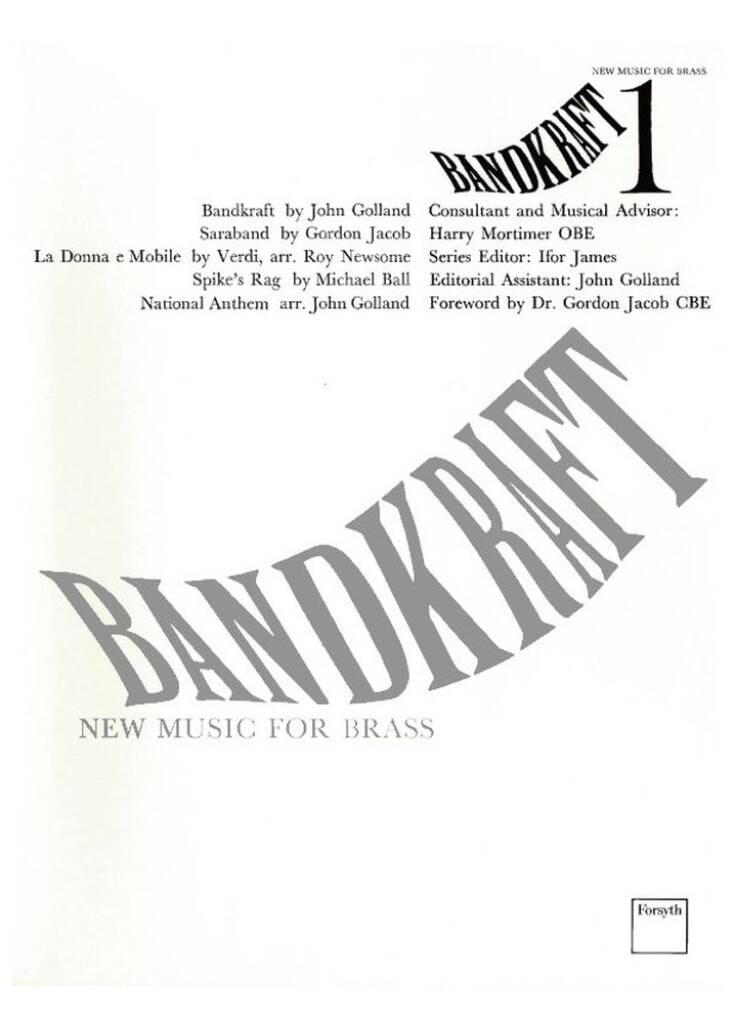
Bandkraft 1
The first of three superb sets of new music and arrangements for brass ensemble, edited by John Golland.1. Bandkraft - John Golland: A substantial piece with an exciting syncopated rhythm introduced in the opening bars and referred to throughout in a fanfare-like manner, to which a hint of dissonance adds extra thrill to the sound.2. Saraband - Gordon Jacob: A stately Elizabethan dance of great beauty, utilising modal harmony in Jacob's characteristic style. Constant speed, full note values and careful playing will achieve a beautiful, delicate effect.3. La Donna E Mobile - Verdi, arr. Roy Newsome: An amusing arrangement of this popular favourite by a conductor and adjudicator of international acclaim. Easy and enjoyable to play and to listen to.4. Spike's Rag - Michael Ball: A skilfully written piece in the true tradition of Scott Joplin, with the ragtime rhythm the backdrop to an unfolding conversation between the sections of the band. Really persuasive entertainment.5. National Anthem - arr. John Golland: A simple first verse setting the scene for the colourful and majestic second, utilising chromatic harmonies and an optional tenor counter melody for added splendour.
Estimated dispatch 5-14 working days
-
£60.99
Es ist ein Ros Entsprungen - Michael Praetorius - Otto M. Schwarz
The many sided and productive Michael Praetorius (1571-1621) is knwon as a composer of dance music, sacred music and music for the advent and Christmas time. He worked as Kapelmeister to the court at Wolffenbuttel, but he was also asked to serve in other places, includin Dresden. Praetorius was valued for the new impulses he gave to music by means of his use of instrumental accompaniment. His main contribution is his theoretical work "Syntagma Musicum", one of the most important musical refernce books, in connection with instruments and instrumentation in the early 17th Century. "Es ist ein ros entsprungen" is a well known ancient melody which has inspired numerous composers andarrangers througout the Centuries. Otto M. Schwarz has made a choral arrangement.
Estimated dispatch 5-14 working days
-
 £54.99
I'm So Excited - Peter Kleine Schaars
The sisters Ruth, Anita and June Pointer from West Oakland in California learned how to sing in the sixties in church where their father was a minister. At the beginning of the 1970s they entered the music business, where they proved to have a mastery of many styles - including rhythm & blues, jazz, and country. However, the Pointer Sisters acquired international fame at the beginning of the eighties with their soul-like pop music. A great hit was the up-tempo number I'm So Excited, which is still a success on every dance floor. This sparkling arrangement by Peter Kleine Schaars certainly provides the excitement that is suggested in the title.
Estimated dispatch 5-14 working days
-
 £38.95
Unity Series Band Journal - Numbers 486 - 489, February 2020
486: March - Love Divine (Ian Clarke)This lively march features Charles Wesley's song, Love divine, all loves excelling (S.A.S.B. 262) set to the tune Stainer (T.B. 349) and Charles Gabriel's I stand amazed in the presence (S.A.S.B. 466).487: Song Arrangement - The potter's hand (Daniel Elson)A simple but effective arrangement of Dalene Zschech's popular worship song The potter's hand (S.A.S.B. 355).488: Ma-(cha-cha)-jesty (Gary Rose)The cha-cha-ch is a dance that originates from Cuba. It is danced to the music of the same name, introduced by Cuban composer and violinist Enrique Jorrin in the early 1950s. This work combines the cha-cha syle with the well-known song Majesty (S.A.S.B. 382).489: The old rugged cross (Andreas Holmlund)A flowing two-verse arrangement of George Bennard's much-loved song.
Estimated dispatch 7-14 working days
-
 £29.88
Ding Dong Merrily on High (Brass Band) Trad. arr. Stephen Tighe
VIEW SCORE PDF This arrangement of the popular carol Ding Dong Merrily on High is the first published work by BrookWright Music of English arranger Stephen Tighe. This accessible setting receives a fresh, rhythmic treatment, aided by the use of sleigh bells and tubular bells. The tune itself first appeared as a secular dance tune known under the title Branle de l'Official in Orchesographie, a dance book written by the French cleric, composer and writer Jehan Tabourot (1519-1593). The carol was first published in 1924 in his The Cambridge Carol-Book: Being Fifty-two Songs for Christmas, Easter, and Other Seasons. Woodward took an interest in church bell ringing, which no doubt aided him in writing it. The macaronic style is characteristic of Woodward's delight in archaic poetry. Sheet music available from: UK - www.brassband.co.uk USA - www.solidbrassmusic.com Difficulty Level: 4th Section + Instrumentation: Soprano Cornet Eb Solo Cornet Bb Repiano Cornet Bb 2nd Cornet Bb 3rd Cornet Bb Flugel Horn Bb Solo Horn Eb 1st Horn Eb 2nd Horn Eb 1st Baritone Bb 2nd Baritone Bb 1st Trombone Bb 2nd Trombone Bb Bass Trombone Euphonium Bb Bass Eb Bass Bb Timpani Sleigh Bells Drum Kit Tubular Bells (or Glockenspiel)
In Stock: Estimated dispatch 1-3 working days
-
 £48.56
Nutcracker Overture (Brass Band) Tchaikovsky arr. Kevin Larsson
The Nutcracker, for many, has become a must-see event every Christmas, often the principle of Christmas traditions that has been passed down for generations. The original ballet by Pyotr Ilyich Tchaikovsky (1840-1893), which premiered in 1892 was not received with the critical acclaim that befitted such as masterpiece, so he wrote two suites based on the music, and the popularity of the ballet soared, although Tchaikovsky would regrettably not live to witness the success. This arrangement loosely interprets five of the most well-known themes from the ballet in a quasi-jazz setting: March, Waltz of the flowers, Dance of the Sugar Plum Fairy, Dance of the Mirlitons and Trepak. To view a performance of the work please visit www.youtube.com/watch?v=Ix9dxX2rpSo PDF download includes score and parts. Sheet music available from: UK - www.brassband.co.uk USA - www.solidbrassmusic.com Difficulty Level: 2nd Section + Instrumentation: Soprano Cornet Eb Solo Cornet Bb 1st Cornet Bb 2nd Cornet Bb Flugel Horn Bb Solo Horn Eb 1st Horn Eb 2nd Horn Eb 1st Baritone Bb 2nd Baritone Bb 1st Trombone Bb 2nd Trombone Bb Bass Trombone Euphonium Bb Bass Eb Bass Bb Percussion 1-4
In Stock: Estimated dispatch 1-3 working days
-
 £77.00
General Series Brass Band Journal, Numbers 2226 - 2229, December 2022
2226: March - Joyful Warrior (Steve Kellner)This march was written to celebrate the rededication and renaming of the USA National Capital & Virginia Division's music conservatory building in honour of Bandmaster James B. Anderson. It is based on two songs, Joy! joy! joy! there is joy in The Salvation Army (S.A.S.B. 963) and Joyful, joyful, we adore thee (S.A.S.B. 39).2227: Song and Dance (Ian Clarke)This music is built around two main subjects, the song Jesus put this song into our hearts (S.A.S.B. 875) and an original theme reminiscent of Slavic dance music.2228: Horn Solo - Time and talents (Stephen Bulla)A reverent tenor horn solo inspired by All there is of me, Lord (S.A.S.B. 569)2229: Promises (Sam Creamer)The well-known hymn Standing on the promises (S.A.S.B. 522) is presented in this arrangement in a driving shuffle style.
Estimated dispatch 7-14 working days
 View Music
 Watch video