
Results
-
 £12.50
TO THE ANCIENT CROSSES (Brass Band Score) - Scott, Andy
Brass Band score only. To the Ancient Crosses is a passionate fanfare and features rhythmic, fanfare-like motifs contrasting with lyrical melodic lines, with an uplifting finale. Ideal as a concert first half or second half opening piece of music, the title refers to two 9th century stone Anglo-Saxon crosses in the centre of Sandbach. Dur: 3:45
Estimated dispatch 7-14 working days
-
 £144.99
Toccata e Fantasia (Brass Band - Score and Parts)
Toccata e Fantasia was inspired by the composers' love of Anton Bruckner's fantastic wind instrument scoring in his symphonies. Within Toccata e Fantasia Thomas Doss has used several of Bruckner's motifs. In addition to these obvious references you will also find hints of Eastern music with the small motifs being repeated again and again in a sort of Indian guru's mantra, and an improvised blues section with a Big Band feel! A unique concert work that will thrill your audience. 10:40
Estimated dispatch 7-14 working days
-
 £133.70
Spirit of Time (Brass Band - Score and Parts) - Schwarz, Otto M.
Zeitgeist; transformations; a departure for new shores... these are buzzwords we often encounter nowadays. Above all in this digital age, it is essential that we face changes positively and that we make the very best of them. Music is emotion! Otto M. Schwarz begins many of his lectures with this phrase, and this is exactly what we feel in this new concert work. Rapid, and full of energy, is the leap into a new chapter, wonderful opportunities are waiting to be discovered in uncharted lands. But change is not only loud and momentous. The creative power of the future lies dormant in the inventive spirit of the individual, quietly, thoughtfully, silently and alone! The final sequence of this work is all about good vibes: it lights the way to a positive future and stands for the dawn of a new era!Duration: 10.00
Estimated dispatch 7-14 working days
-
 £69.99
Sarabande and Polka (from Solitaire) (Brass Band - Score and Parts) - Arnold, Malcolm - Sparke, Philip
In 1956 Sir Kenneth MacMillan created a one-act ballet for the Sadler's Wells Theatre Ballet, London. He selected the music from the two sets of English Dances which Sir Malcolm Arnold had written in 1950 and 1951 to great acclaim. The composer wrote two new dances, a Sarabande and a Polka, especially for the ballet, which was premiered at Sadler's Wells Theatre in June 1956. The two new dances have taken on a life of their own in the concert hall and are typical Arnold: the Sarabande contains one of his most memorable melodies and the Polka shows him at his quirky, tongue-in-cheek best. Duration: 5.30
Estimated dispatch 7-14 working days
-
 £118.99
Lions of Legends (Brass Band - Score and Parts) - Deleruyelle, Thierry
This work was commissioned by Eurofestival. Ever since antiquity, mankind has been fascinated by the lion: symbolising courage, strength and temperance. Many have made use of the lion to represent themselves in symbols and emblems. In five movements the composer describes both the history of the lion throughout centuries, as well as the characteristics. A challenging idea to turn into music! The final movement King of Kings is extremely spectacular. A great choice for thematic concerts or as a main piece in your concert or contest.Duration: 11.45
Estimated dispatch 7-14 working days
-
 £49.95
Caprice (Euphonium Solo with Brass Band - Score and Parts) - Batterham, Andrew
Caprice was written for Matthew can Emmerik, to showcase his virtuosity in an engaging piece of concert music. It is in theme and variation form, with the primary material being the theme from the last of Paganini's Ventiquattro Capricci per violino solo. This theme has been the inspiration for similar works by many composers, including Liszt, Brahms, Rachmaninov, Benny Goodman and Andrew Lloyd Webber.In this work, the famous theme is treated to a more contemporary approach.The first variation, Capricious, relies on motor rhythms and jagged dialogues between the soloist and the accompaniment. It is couched in an organic scale reminiscent of the Phrygian mode.The second variation, Sad, is in direct contrast, acting as a traditional ballad and allowing the soloist to explore the expressive side of the instrument.The third variation, Energetic, is a micro set of variations in itself, designed to display the soloist's innovative technique and stamina. Each section is more challenging than the previous one, until the work concludes with a whirlwind dance at breakneck speed.Like all of Batterham's recent work, the musical language of Caprice draws upon classical, jazz, funk and ska elements to create a unique sound where anything can happen, and probably will!
Estimated dispatch 7-14 working days
-
 £60.99
Moon River Cha Cha (Brass Band - Score and Parts) - Mancini, Henry - Harper, Philip
Moon River Cha Cha was arranged to be part of Cory Band's winning set from Brass in Concert 2016 which was entitled; 'The Remarkable Life of Roald Dahl'. The centenary of Dahl's birth in Wales was celebrated in 2016, and this piece comes from the 1961 film Breakfast at Tiffany's which starred Dahl's first wife, Patricia Neal. The easy-listening style of the music portrays the glamour and glitz of Roald Dahl's immediate post-war life in the USA.Duration: 2.30
Estimated dispatch 7-14 working days
-
 £118.99
Introduction and Variations on Dies Irae (Brass Band - Score and Parts) - De Haan, Jan
After the introduction, in which the landscape of Groningen with its beautiful wide views is presented, follows five variations based on the 13th-century Gregorian theme Dies Irae that is attributed to Thomas van Celano. Each variation can be seen as a stage or a scene in the rich history of the village of Grijpskerk, making this work a very exciting and expressive piece of music for a contest or a concert.
Estimated dispatch 7-14 working days
-
 £38.00
Tango de Buenos Aires (Brass Band - Score and Parts) - Anderson, Keiron
Tango de Buenos Aires was written to celebrate the harmonic and rhythmic idioms used by the great Astor Piazzola, composer of dramatic Argentinian Tango music. This work attempts to capture the atmosphere with a modern adaptation of the dynamic rhythms and descending chromatic harmonies. It is a colourful addition to any programme and good for a quite serious or light concert. Duration: 3.00. Suitable for 2nd Section Bands and above
Estimated dispatch 7-14 working days
-
 £33.00
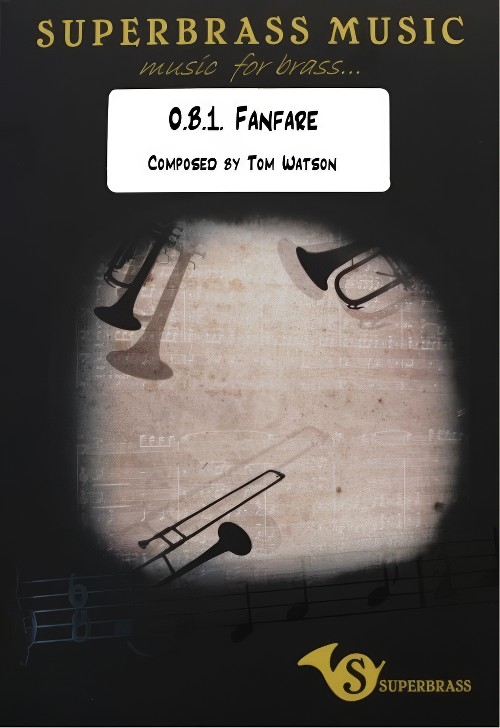
O.B.1 Fanfare (Brass Band - Score and Parts) - Watson, Tom
A salute to Hollywood and the big screen, this fine pastiche of film scoring is an exciting fanfare and concert opener, composed by Tom Watson, one of the directors of Prozone Music. The RPO Brass have performed this at the Barbican Hall. Duration: 2.30. Suitable for 2nd Section Bands and above.
Estimated dispatch 7-14 working days
 View Music