
Results
-
 £44.95
TRUMPETS OF THE ANGELS - 2016 Edition (Gregson) (Brass Band - Score only) - Gregson, Edward
The Trumpets of the Angels is a large-scale work, scored for seven solo trumpets (or cornets), brass band and percussion (deploying 'dark' instruments such as three tam-tams, bass drum and two sets of timpani). The genesis of the work is a quotation from the Book of Revelation ... and I saw the seven angels which stood before God; and to them were given seven trumpets.Thus the idea behind the work is highly dramatic and I have tried to achieve this by the spatial deployment of seven solo trumpets around the band. Trumpet 7 remains separate from the band throughout and, indeed, has the most dramatic and extended cadenza, representing the words of the seventh angel ... and time shall be no more.The work opens with a four-note motif announced by off-stage horns and baritones and answered by fanfare figures on four solo trumpets. In turn, each then play cadenzas before joining together, independently playing their own music. This leads to a sung Kyrie Eleison with accompanying solos for Flugel Horn and Baritone, after which we hear the entry of solo trumpets 5 and 6 with music that is more urgent and rhythmic, describing the Horsemen of the Apocalypse.The music reaches another climax, more intense this time, with the horns and baritones (now on-stage) again sounding the transformed motif, before subsiding into what might be described as a lament of humanity - slow, yearning music, which builds from low to high, from soft to loud, with a melody that is both simple and poignant. At its climax, Trumpet 7 makes a dramatic entry, playing the opening four-note motif, but expanded to almost three octaves. This cadenza (to the partial accompaniment of 3 tam-tams, representing the Holy Trinity) introduces new material and foreshadows the ensuing Scherzo, introduced by antiphonal timpani before the band enters with music that is fast and foreboding. Despite the somewhat desolate and 'unstable' mood of this music, it slowly moves towards an optimistic conclusion, transforming the 'humanity' music into an affirmative and triumphant statement.The original version of The Trumpets of the Angels was commissioned by the Fodens Band for their centenary concert at The Bridgewater Hall, Manchester, in 2000, and contained an important part for organ. In 2015 I was asked by Nicholas Childs to create a New Performing Edition for the Black Dyke Band; without organ, and including newly composed material. This New Performing Edition was given its first performance at the European Brass Band Festival in Lille in April 2016. The work is dedicated In tribute to Olivier Messiaen.- Edward Gregson
Estimated dispatch 7-14 working days
-
 £32.95
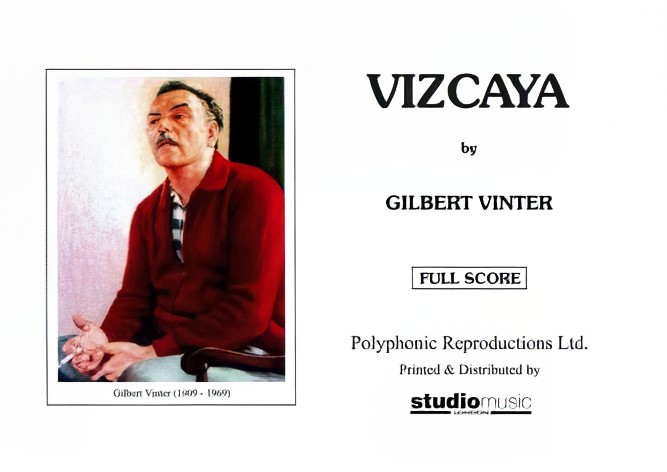
Vizcaya (Brass Band - Score only) - Vinter, Gilbert
This work makes use of three Basque melodies. The final section, Fete Basque, may be played separately as a concert item with an approximate duration of 4.30Suitable for 3rd Section bands and aboveRecorded on Polyphonic QPRL058D SPECTRUM: The Music of Gilbert Vinter Vol.1
Estimated dispatch 7-14 working days
-
 £69.95
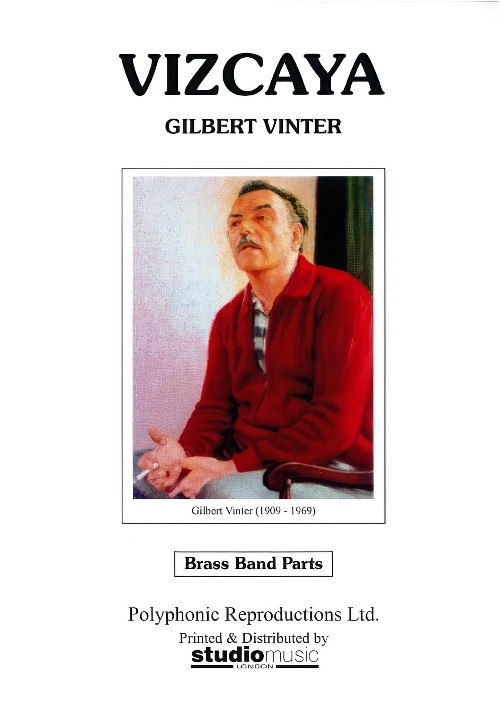
Vizcaya (Brass Band - Score and Parts) - Vinter, Gilbert
This work makes use of three Basque melodies. The final section, Fete Basque, may be played seperately as a concert item with an approximate duration of 4.30Suitable for 3rd Section bands and aboveRecorded on Polyphonic QPRL058D SPECTRUM: The Music of Gilbert Vinter Vol.1
Estimated dispatch 7-14 working days
-
 £52.50
Farewell with a Little Smile (Brass Band - Score and Parts) - Doss, Thomas
A farewell can have many faces: sad, happy, content, grateful... This special piece was composed as a heart-warming gift for an exceptional musician upon retirement from his beloved music society. The work carries an important message: every farewell is also an opportunity for a new beginning; a moment to cherish with a little smile.This atmospheric work opens with subdued, warm brass sounds that create a sense of intimacy. Through alternating (smaller) instrumentations, it builds up to a sonorous tutti climax, eventually leading to a subdued mood again. The closing passage offers room for reflection, memories, and gratitude. Farewell With a Little Smile is a beautiful, solemn composition suitable for countless occasions. Whether the work serves as a resting point in a concert programme or is used to frame a meaningful farewell, this music will add lustre to numerous precious moments.Duration: 6.30
Estimated dispatch 7-14 working days
-
 £80.00
Haven't Met You Yet (Optional Vocal Solo with Brass Band - Score and Parts) - Kjaernes, Bjorn Morten
Haven't Met You Yet is the first single from Canadian singer Michael Buble's sixth album, Crazy Love, released on August 31, 2009. According to Buble, the single and its official music video are about everyone's dream of finding a relationship and love. Buble co-wrote Haven't Met You Yet with Alan Chang and Amy Foster-Gillies, and dedicated it to his then fiancee and now wife, Luisana Lopilato (who appears as his love interest in the music video).In 2012, Nick Jonas covered the song in the TV series Smash, so this music can also be used in a TV/Movie theme concert.
Estimated dispatch 7-14 working days
-
 £159.99
Other Lives (Brass Band - Score and Parts) - Waespi, Oliver
Other Lives is works perfectly for a competition but can also be programmed as concert work. The dark chords at the beginning of the piece are derived from Der Doppelganger, one of Franz Schubert's late songs. After a short development the music begins to accelerate and find its own shape, gradually moving away from the introduction. The entire first part, Rage, has an intensely agitated character. The ensuing Reflection turns back to the initial chord progression, before a series of interspersing solos explore time and space at a slower pace. After another musical surge, the music is brought close to silence and then gives way to the third part, Redemption. Here, a widely spaced sound field contains a remote allusion to another work by Schubert, Ruckblick. After this farewell, an abstract musical transformation triggers an emotional change, as the initial motifs are now presented in their inversed form in order to create a much brighter harmonic landscape. Moreover, in the last part of the piece, Renewal, the grim, tense atmosphere of the first part is transformed into a great energy.Duration: 18.00
Estimated dispatch 7-14 working days
-
 £40.00
Fanfare for a New Era (Brass Band - Score and Parts) - Gregson, Edward
Fanfare for a New Era is the most substantial of Edward Gregson's fanfares and was the result of a private commission by Lady Sheila Stoller to celebrate the opening in April 2017 of the Stoller Hall at Chetham's School of Music, Manchester. Gregson dedicated it to Sir Norman Stoller, who donated the funding for the new concert hall. The Fanfare was designed to fill the whole space, with separate brass choirs - trumpets, horns, trombones and tuba - playing their own music. A solo trumpeter playing 'on high' announces first the four horns and timpani, who enter with a stately measure. Next the herald trumpeter ushers in trombones, tuba and drums, with a faster dance. Finally, the remaining three trumpets amplify the peeling of bells. All four elements then come together, surrounding the audience with a 'joyful noise' of festive brass and percussion.Duration: 3.00
Estimated dispatch 7-14 working days
-
£14.00
Fanfare for a New Era (Brass Band - Score only) - Gregson, Edward
Fanfare for a New Era is the most substantial of Edward Gregson's fanfares and was the result of a private commission by Lady Sheila Stoller to celebrate the opening in April 2017 of the Stoller Hall at Chetham's School of Music, Manchester. Gregson dedicated it to Sir Norman Stoller, who donated the funding for the new concert hall. The Fanfare was designed to fill the whole space, with separate brass choirs - trumpets, horns, trombones and tuba - playing their own music. A solo trumpeter playing 'on high' announces first the four horns and timpani, who enter with a stately measure. Next the herald trumpeter ushers in trombones, tuba and drums, with a faster dance. Finally, the remaining three trumpets amplify the peeling of bells. All four elements then come together, surrounding the audience with a 'joyful noise' of festive brass and percussion.Duration: 3.00
Estimated dispatch 7-14 working days
-
 £50.00
Firefly (Brass Band - Score and Parts) - Dobson, Simon
Firefly was composed by award-winning composer Simon Dobson (b.1981) to provide an entertaining up-tempo concert work for community and youth bands. Composed in funk-rock style, and is based on the groove beat with which it opens. Dobson says, "Firefly was written as a break from my more serious music and as a 'hat tip' to the various types of beat orientated music I listen to." It was first performed by Oslofjord Brass in Norway and in its wind version by Harmonie Shostakovich, Switzerland. Duration: 5-6 minutes.
Estimated dispatch 7-14 working days
-
 £59.99
A Klezmer Karnival (Brass Band - Score and Parts) - Sparke, Philip
Klezmer music originated in the 'shtetl' (villages) and the ghettos of Eastern Europe, where itinerant Jewish troubadours, known as 'klezmorim', had performed at celebrations, particularly weddings, since the early Middle Ages. Since the 16th century, lyrics had been added to klezmer music, due to the 'badkhn' (the master of ceremony at weddings), to the 'Purimshpil' (the play of Esther at Purim) and to traditions of the Yiddish theatre, but the term gradually became synonymous with instrumental music, particularly featuring the violin and clarinet. In recent years it has again become very popular and in A Klezmer Karnival Philip Sparke has used three contrasting traditional tunes to form a suite that will bring a true karnival atmosphere to any concert.Duration: 4:30
Estimated dispatch 7-14 working days
 View Music