
Results
-
 £94.90
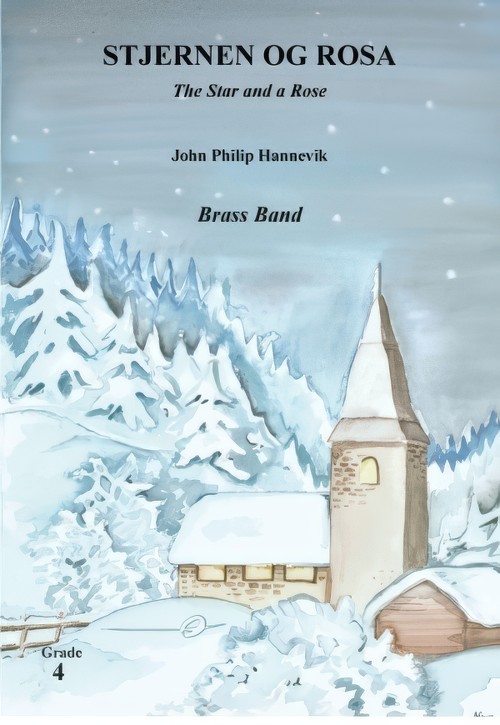
Stjernen og Rosa (The Star and a Rose) (Brass Band - Score and Parts) - Hannevik, John Philip
The Star and a Rose is a big-scale Christmas piece for band, featuring four seasonal chorales.The first is a Gregorian-like chant Hodie Christus natus est.In this section of the piece, a soloist can be placed away from the band, maybe on a gallery. The soloist can be a tenor instrument, maybe trombone, or you can feature a vocal soloist. After this, the music leads us on to the old German Christmas chorale Lo, how a rose e'er blooming. This song is given a fairly rhythmical treatment, but make sure that the melody is presented in a cantabile style. An interlude follows, before the piece presents one of the most used and loved Scandinavian Christmas chorales, Mitt hjerte alltid vanker (My Heart will always wander), composed by the Danish bishop Hans Adolph Brorson around 1732. This song is building towards a climax, before the solo horn brings it all down to the Stable view described in the lyrics. Then comes a transition that brings us in to the final section of the piece, which presents the international Christmas Carol Adeste Fideles. As many will notice, I have borrowed a section from David Wilcocks majestic harmonization towards the end.The title of the piece has its background form the lyrics in My heart will always wander, where the text speaks about the stars in the sky. But also in the Latin text for Adeste Fideles: Stella duce, Magi, Christum adorantes. The Rose is of course from the lyrics in the chorale Lo, how a Rose.Duration: 10.30
Estimated dispatch 7-14 working days
-
 £68.80
When the Lights Go Down (Brass Band - Score and Parts) - Houben, Kevin
Kevin Houben created with When the Lights Go Down, a wonderful chorale that can be a moment of reflection in any concert program. The resigned, magnificent melodies at the beginning of this composition slowly build up to a highlight with an increasing orchestration. The piece starts with a suggestive Adagio Meditativo, after which the main theme is immediately announced. A central bridge section takes the listener along through the different spheres at which the melodic and rhythmic drums embellish the chorale melodies. Thematic elements from the introduction brings the piece to a quiet and peaceful end. The sheer simplicity with which this work is written, makes it a resplendent, magnificent concert piece. 'When the Lights Go Down', refers to a moment when time stand still for a while, stillness within and around yourself.Duration: 9.00
Estimated dispatch 7-14 working days
-
 £107.95
Symphony in Two Movements (Brass Band - Score and Parts) - Gregson, Edward
Selected as the Championship Section test piece for the National Brass Band Championships of Great Britain 2025This work was jointly commissioned by the National Youth Brass Band of Great Britain (NYBBGB) and the National Youth Brass Band of Wales (NYBBW), the latter with funding from T Cerdd (Music Centre Wales), to celebrate their 60th and 30th anniversaries respectively. The first performances were given at Cadogan Hall, London, in April 2012, by the NYBBGB, conducted by Bramwell Tovey; and at the Great Hall, Aberystwyth University, in July 2012, by the NYBBW, conducted by Nicholas Childs.When I was approached about a joint commission to write a new work to celebrate the anniversaries of these two outstanding youth bands I was delighted to accept, and decided to respond by writing a work apposite for the magnitude of these special occasions, namely a 'symphony for brass'.Through a long journey of writing music for brass band, which commenced with Connotations (1977), and continued with Dances and Arias (1984), Of Men and Mountains (1991), The Trumpets of the Angels (2000) and Rococo Variations (2008), I arrived at what I regard as the most important work of the cycle to date, combining as it does serious musical intent with considerable technical demands. It is perhaps my most abstract work for brass band, avoiding any programmatic content.The symphony lasts for some 19 minutes and is structured in two linked movements. The form is based on that used by Beethoven in his final piano sonata (Op.111), which is in two movements only: a compact sonata-form allegro, followed by a more expansive theme and four variations. Prokofiev also adopted this model in his 2nd Symphony of 1925.The opening Toccata of this Symphony is highly dramatic but compact, whilst still retaining the 'traditional' structural elements of exposition, development and recapitulation; indeed, it also has the 'traditional' element of a contrasting second subject - a gentle, lyrical modal melody first heard on solo cornets.In contrast, the longer and more substantial second movement Variations is built around a theme and four variations. The slowly unfolding chorale-like theme accumulates both added note harmony and increasing instrumentation, whilst the four variations which follow are by turn mercurial (fast, starting with all the instruments muted), march-like (menacing, with short rhythmic articulations underpinning an extended atonal melody), serene (a series of 'romances' for solo instruments alongside echoes of the chorale) with an emerging theme eventually bursting into a climax of passionate intent; whilst the final variation is a dynamic scherzo (concertante-like in its series of rapid-fire solos, duets, trios and quartets) with the music gradually incorporating elements of the main ideas from the first movement, thus acting as a recapitulation for the whole work. It reaches its peroration with a return to the very opening of the symphony, now in the 'home' tonality of F, and thus creating a truly symphonic dimension to the music.Most of the melodic material of the symphony is derived from the opening eleven-note 'row', which contains various intervallic sets, and although the work is not serially conceived it does use some typical quasi-serial procedures, such as canons, inversions, and retrogrades. The symphony uses somewhat limited percussion, in line with a 'classical' approach to the sound world of the brass band, alongside a use of multi-divisi instrumentation, whereby each player has an individual part rather than the traditional doubling within certain sections of the band.- Edward GregsonDuration: 19.00
Estimated dispatch 7-14 working days
-
 £60.99
Sparkling Overture (Brass Band - Score and Parts) - Jeanbourquin, Marc
Sparkling Overture was written to celebrate the centenary of the Swiss brass band La Musique Militaire de Rougemont. This energetic and dynamic piece opens with a festive and resolutely positive fanfare. The much more tranquil and lilting second theme is a magnificent chorale which is then followed by a brilliant return of the first motif. Used as a theme tune, this piece will be ideal as a contrasting, joyful and sparkling concert opening.Duration: 3.00
Estimated dispatch 7-14 working days
-
 £99.99
Sparkling Brass (Brass Band - Score and Parts) - Sparke, Philip
Sparkling Brass was commissioned by Osaka Concert Brass, one of Japan's top brass bands, and premiered by them on 27th December 2018 during a concert which celebrated their 10th Anniversary. The work opens in lively mood with fanfare-style figures from the lower band which are answered by the cornets. This interplay intensifies until the mood calms suddenly to introduce a chorale which leads to a duet-cadenza for cornet and euphonium. The rhythmic mood of the opening soon returns and leads to the main theme of the work, a modal caccia which features various section of the band. A short bridge passage leads to a change of key and a new cantabile theme which is introduced by euphoniums and baritone. This is taken up by the full band after another change of key and leads back to the caccia theme. A transformed version of the opening fanfare returns to close the work.Duration: 5.30
Estimated dispatch 7-14 working days
-
 £95.00
Concertante (Piano Solo with Brass Band - Score and Parts) - Gregson, Edward
This work was written in 1966, when I was a student at the Royal Academy of Music in London. It was the first major work to be written for this combination. The Concertante is unashamedly romantic in idiom and is cast in three movements: Prelude, Nocturne and Rondo.The Prelude is in sonata form with a contracted recapitulation. There are two main themes, the first announced after the opening flourish on piano. The second theme is lyrical in character and the interplay between these two themes forms the main focus of the movement.The pensive Nocturne opens with an introduction from the band which contains hints of the two main ideas to follow. The solo piano announces the main theme, which has a slightly 'blues' character in its flattened third and seventh notes of the scale. The band enters with the chorale theme already heard in the introduction. Eventually the first theme returns, this time from piano and band and building to a powerful climax before subsiding to a peaceful ending.The Rondo is full of energetic rhythms and changing time patterns. The main theme is 'giocoso' in character and in the first episode there is more than a hint of the tune 'Onward Christian Soldiers' in what amounts to a good humoured parody. Before the final coda there is a long piano cadenza underlying the virtuoso element of the work.The work had a number of public performances leading up to a memorable one in the Royal Albert Hall in 1989 as part of the Gala Concert that used to be held after the National Brass Band Championship in the Royal Albert Hall. That year, the 'centre band' in the massed bands concert were the GUS Band (then known for sponsorship reasons as 'Rigid Containers Group Band'!) conducted by my great friend and champion, Bramwell Tovey, with myself as the soloist.- Edward GregsonDuration: 18.00
Estimated dispatch 7-14 working days
-
 £119.99
The Essence of Youth (Brass Band - Score and Parts) - Roels, Stijn
In The Essence of Youth the composer gives an insight into childhood and youth -- inspired by his own daughter. The opening of sparking rhythms, dynamic contrasts and changes of time signature paint a vivid picture of the unpredictability of children. The first and second movements recount the love -- and also tension and the worries -- in the adult-child bond, through dissonant harmonies but also pretty melodies. The fugue-like ending leads to a final splendid chorale: a picture of proud parents with their child! Duration: 9.45
Estimated dispatch 7-14 working days
-
 £104.99
Parnassus (Brass Band - Score and Parts) - Van der Roost, Jan
Since most of the bands competing in the 4th Section of the Dutch National Championships have many young players, this piece is stylistically youthful, especially in the opening and closing sections. An arpeggio pattern appears numerous times in all registers and is the basic musical element of the main melody, alternating with a second theme that has a slightly different melodic character. The middle section is conceived like a chorale, introduced and developed stepwise: firstly with short patterns and gradually in increasingly long snippets, until it's played in its glorious entirety at measure 216. No real solo passages are included but rather small chamber combinations, thus offering the opportunity to various players to display their technical and performance skills. The finale recaptures musical material from the first section of the piece and provides a majestic conclusion.Duration: 11:45
Estimated dispatch 7-14 working days
-
 £60.99
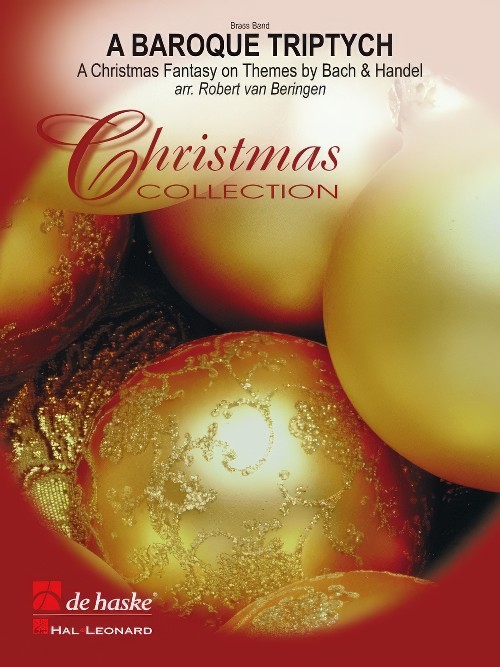
A Baroque Triptych (Brass Band - Score and Parts) - Beringen, Robert van
In his own distinctive style, Robert van Beringen has composed a very unique fantasy on three themes by the famous Baroque composers Johann Sebastian Bach and George Friedrich Hndel. Van Beringen used Bach's chorale Brich an, o schnes Morgenlicht ('Break forth, O Beauteous Heavenly Light') from his Christmas Oratorio and the recitative Behold, a Virgin shall conceive, and bear a son, and shall call his name Emmanuel, God with Us from Hndel's Messiah. A perfect way to say Merry Christmas in music!Duration: 5:00
Estimated dispatch 7-14 working days
-
 £69.99
South Down Pictures (Brass Band - Score and Parts) - Sparke, Philip
South Down Pictures was commissioned by Millenium Brass 2000, an organisation comprising three brass bands from the county of Sussex, England.The bands (Patcham Silver, Hangleton and Brighton Silver) had got together to organise many events to mark the new millennium and these culminated in a concert in Hove Town Hall on July 9th 2000 when all three bands combined to give the first performance of South Down Pictures. The composer spent much of his childhood amongst the South Downs, a range of hills in Sussex which runs parallel to the sea.Opening with a strong unison passage, interrupted briefly by faster figures based on the interval of a fifth, South Down Pictures develops with an often-passionate legato melody. Reaching a climax, this is then followed by the main vivo section of the work, whose main theme is based on the earlier 'fifth' figures. A bridge passage leads to a short chorale figure and a rhythmic climax which dissolves into a plaintive cornet solo over staccato chords. This theme is taken up by the whole band and leads back to a recapitulation of the main theme and earlier material. The cornet tune returns triumphantly in the major key before the opening unison passage reappears to provide a stirring coda.Duration: 5:30
Estimated dispatch 7-14 working days
 View Music