
Results
-
 £59.99
Sheep May Safely Graze (Brass Band - Score and Parts) - Bach, Johann Sebastian - Sparke, Philip
The Hunt Cantata (No.208) is one of more than 20 secular cantatas. It contains the famous aria 'Sheep May Safely Graze', originally written for a rather large orchestra and mixed choir. Bring a little of the Baroque era to your concert with this first class arrangement by Philip Sparke.Duration: 5:00
Estimated dispatch 7-14 working days
-
 £42.95
NATIONAL ANTHEM (arr. Jacob) (Brass Band) - Jacob, Gordon
with optional choir
Estimated dispatch 7-14 working days
-
 £38.95
Unity Series Band Journal - Numbers 530 - 533, June 2024
530: Carol Arrangement - God rest you merry, gentlemen (Noel Jones)This swing arrangement of the traditional English carol also features references to O come, all ye faithful (C.C. 61) and Jingle Bells (C.C. 121). Play with imagination and a sense of style!531: Go, tell it on the mountain! (Nathanael Watchorn)Historically, the passion of enslaved people in America for singing about the Gospel of Jesus is well documented, but it was men of three generations, each named John Wesley Work, who enabled spirituals to become more widely known. John Wesley Work Sr, a church choir director in Nashville, Tennessee, wrote and arranged music for the pioneering Fisk Jubilee Singers whose early repertoire consisted largely of spirituals. This passion and knowledge of spirituals was passed down through the generations. John Work III travelled hundreds of miles to collect songs by attending church services in remote areas. In 1940, he published a collection of 230 songs which included a setting of Go, tell it on the mountain! that is still performed today.Nathanael Watchorn, a Bandsman at Regent Hall Corps in London, is a new contributor to the journals. He originally wrote this as a vocal arrangement for the group FourHymn, subsequently transcribing it for the corps' Young People's Band, while he was Band Leader.532: Carol Arrangement - They all were looking for a king (Stephen Hull)At the North American Composers Forum, Major Len Ballantine challenged participants to find an unfamiliar song in the Salvation Army Song Book and try to write an arrangement of the listed tune. Stephen Hull happened across They all were looking for a king (S.A.S.B. 128) and the tune Childhood (T.B. 421) which lead to this arrangement.533: March - Washed and healed (Eiliv Herikstad)The Christian experience of many people will have been positively impacted by the life of the late Bandmaster Eiliv Herikstad, either personally or through his musical leadership and compositions. This march is the second publication from this well-known Salvation Army composer since his Promotion to Glory last year. This march is more traditional in style that many of his compositions but contains a strong Christian message and demonstrates his compositional expertise.
Estimated dispatch 7-14 working days
-
 £50.00
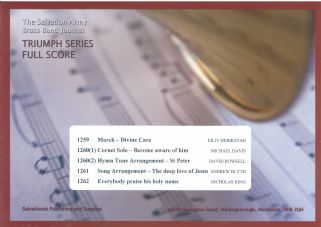
Triumph Series Band Journal March 2015 Numbers 1259 - 1262
No. 1259 March - Divine Care (Eiliv Herikstad)The message of this march is 'God will take care of you!' The introduction reflects the beginning of the song, God will take care of you (T.B.C.S. 124), which is presented in full at sections C and D.No. 1260 (1) Cornet Solo - Become aware of him (Michael Davis)A setting for Cornet and band of Colonel Robert Redhead's song, Become aware of him, which was originally published in The Musical Salvationist.No. 1260 (2) Hymn Tune Arrangement - St Peter (David Rowsell)An arrangement of the tune, St Peter, associated with the song, In Christ there is no east or west.No. 1261 Song Arrangement - The deep love of Jesus (Andrew Blyth)The strong hymn tune of Ebenezer (T.B. 433) was composed by Welshman, Thomas John Williams (1869-1944), who served as organist and choir director at various churches in and around Llanelli. This arrangement is more relaxed in style than the original and attempts to convey the freedom of the verses mostly associated witht he tune by Samuel T. Francis (1835-1925) O deep, deep love of Jesus, vast, unmeasured, boundless, free.No. 1262 Everybody praise his holy name (Nicholas King)A bright arrangement by Nicholas King of Remco Hakkert's song, Praise his holy name.
Estimated dispatch 7-14 working days
-
 £127.30
Love? Magic With a Capital M - Frode Rydland
Imagine an extravagant magic show at Caesar's Palace in Las Vegas. All shows like this feature great superstars as guest artists. For instance, it can be Celine Dion and Josh Groban who enters the stage for a duet...Love... Magic with a capital M is a ballad for an imaginary magic show where the great stars are flugelhorn and trombone.A bit different stage setup, a bit of choreography, a bit of singing and a lot of sweet music!The Choir parts are intended to be sung by the band. But if your concert features a choir, you may add the choir to this performance.This music was written for Norwegian band Eikanger-Bjorsvik Musikklag for their winning program "MAGIC!", performed at the Norwegian equivalent to Brass in Concert, Siddis Brass in 2019.
Estimated dispatch 5-14 working days
-
 £84.99
Christmas Brass - Richard Peaslee
Christmas Brass is a fantasy on six carols, originally commissioned by Mark Freeh for the Manhattan Brass Choir. Duration: 16:30The well-known tune, O Come, O Come Emmanuel, a hymn originally based on a plainsong melody, is here set in 5/4 meter. Modal harmonies are combined with big band style as the piece gains momentum, greatly accentuating the mood of the words, "Rejoice! Rejoice! Emmanuel." The opening 5/4 statement of the theme returns, and the piece ends quietly.In Beautiful Savior (also known by the title Fairest Lord Jesus), a hushed beginning featuring horns, euphoniums, and a muted trumpet, leads through a key change to a satisfying, chorale-likeclosing passage.In Away in a Manger, Peaslee sets two tunes, Cradle Song and Away in a Manger. Following a straightforward presentation of each melody, Peaslee plays them against one another. The music swells to a full climax followed by a hushed ending.Peaslee employs a gentle hand in It Came Upon a Midnight Clear, using flugelhorn solos and duets in a jazz-waltz style.In Silent Night, the traditional carol gets an untraditional harmonization, propelled forward by give-and-take between the two groups of brass instruments in the brass choir: trumpets and trombones versus horns, euphoniums, and tuba.Hark! The Herald Angels Sing begins with a humorous blast of discordant harmonies as multiple carols are sounded at the same time. An up-tempo 4/4 announcement of the melody in the trombone is followed by a metrical modulation in 6/8-3/4 time. An additional metrical modulation bring the music back into 4/4, but at a slower tempo and in a pronounced jazz style. Tempo I returns, and the set of six pieces closes with a big ending.Instrumentation: 4 Trumpets, 2 Horns in F, 4 Trombones, 2 Euphoniums, Tuba, Guitar, Bass, Percussion
Estimated dispatch 5-14 working days
-
£47.50
With Sweet Jubilation - James Curnow
Explore different settings of the Medieval Latin carol "In Dulci Jubilo" via this solid arrangement by James Curnow. Opening with an exquisite "Brass Choir" section a la Michael Praetorius (1571-1621) and progressing through a "Woodwind Choir" section in the later J.S.Bach style, WITH SWEET JUBILATION is wonderful "style study" material. The grace of the early masters and the clearly focused unifying concept of the arrangement by James Curnow combine to make this addition to the Curnow Music Press "Splendor of Christmas Series" a wonderful holiday experience for the young band.
Estimated dispatch 5-14 working days
-
 £60.99
Fantasia Di Pasqua - Michael Bilkes
Fantasia di Pasqua is a fantasy in which traditional Easter melodies have been used. The work is written for brass band with a separate brass quartet which, since this music is often performed in churches, the composer suggests should be positioned on a gallery. This creates a double choir effect and perfectly fits the Renaissance-like style. Each of the melodies is played in various dance-like cadences that, partly because of the double choir effect, will result in a very lively and original performance.
Estimated dispatch 5-14 working days
-
 £60.99
Grace and Glory - Wim Stalman
The chorale Glory to God on High is one of todays most often sung hymns. The words are an expression of praise to God and gratefulness for his mercy. The internationally familiar melody of this chorale forms the basis for Wim Stalman's Grace and Glory, in which the elements of praise and thanks are shown by means of both festive and more subdued melodies and harmonies. The choir parts allow the work to be performed by brass band with mixed choir.
Estimated dispatch 5-14 working days
-
 £54.20
ADESTE FIDELES (Choir with Brass Band) - Wade, John F. - Lorriman, Howard
O Come All Ye Faithful. Grade: Easy.
Estimated dispatch 7-14 working days
 View Music