
Results
-
 £89.95
Revelation (Brass Band - Score and Parts) - Wilby, Philip
Symphony for Double Brass on a theme of Purcell1995 marked the tercentenary of Purcell's death and Revelation was written as a tribute to his music and the ornate and confident spirit of his age.The five major sections are:PrologueVariations on a ground bass IFugueVariations on a ground bass IIEpilogue and ResurrectionDuration: 19.00
Estimated dispatch 7-14 working days
-
 £44.95
Revelation (Brass Band - Score only) - Wilby, Philip
Symphony for Double Brass on a theme of Purcell1995 marked the tercentenary of Purcell's death and Revelation was written as a tribute to his music and the ornate and confident spirit of his age.The five major sections are:PrologueVariations on a ground bass IFugueVariations on a ground bass IIEpilogue and ResurrectionDuration: 19.00
Estimated dispatch 7-14 working days
-
 £60.99
The Farmer's Fair (Bass Solo with Brass Band - Score and Parts) - Broadbent, Derek
For Bass/Tuba Solo in Eb, Bb or C.Duration: 3:00
Estimated dispatch 7-14 working days
-
 £37.95
HOCK (Bass/Brass Band) - Richards, Goff
from Homage to the Noble Grape. E flat Bass Solo. Recorded on QPRL055D The Music of Goff Richards
Estimated dispatch 7-14 working days
-
 £35.00
Humming Chorus (from Madam Butterfly) (Flugel Quartet with Brass Band - Score and Parts) - Puccini, Giacomo - Littlemore, Phillip
In Puccini's opera, Madam Butterfly, the Coro a bocca chiusa (Humming Chorus) is performed by an off-stage chorus which hums a wordless, melancholy tune, whilst Butterfly, her maid Suzuki, and her child begin the long wait for husband Pinkerton to return after many years away. As night falls, Suzuki and the child are soon asleep, but Butterfly keeps her vigil. This arrangement features four flugel horns, each of which plays into the bell of a bass whilst the bass player moves the valves - creating a unique humming sound. Puccini actually wrote five versions of the opera,?Madam Butterfly. After a disastrous premiere in early 1904, Puccini withdrew the opera and substantially rewrote it creating a very successful second version. However, he continued to tinker with the orchestration, not being satisfied until the fifth, and now standard, version dating from 1907.?Duration: 2:40
Estimated dispatch 7-14 working days
-
 £59.70
Maple Leaf Rag (Euphonium & Eb Bass Quartet with Brass Band - Score and Parts) - Joplin, Scott - Richards, Goff
For 2 Euphoniums and 2 Eb Bass
Estimated dispatch 7-14 working days
-
£37.95
SWISS AIR (Bass/Brass Band) - Newsome, Roy
E flat Bass Solo. Duration: 5:52
Estimated dispatch 7-14 working days
-
 £110.00
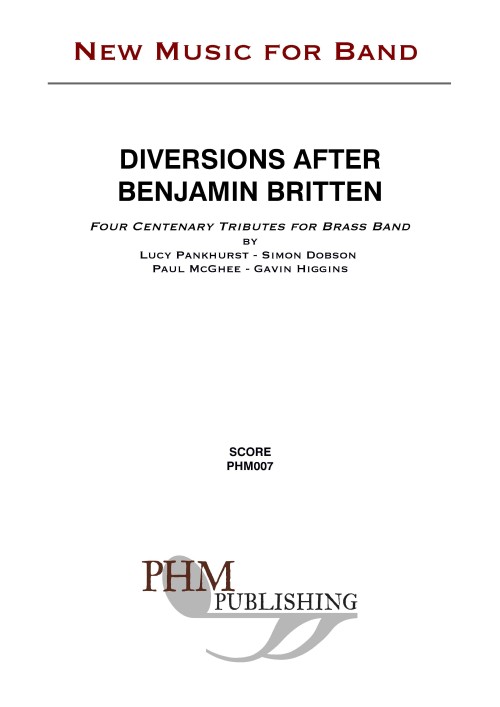
Diversions after Benjamin Britten (Brass Band - Score and Parts)
Suite by Lucy Pankhurst, Simon Dobson, Paul McGhee and Gavin HigginsHaving devised a collective centenary tribute for Michael Tippett at the 2006 RNCM Festival of Brass (Variations on a Theme of Michael Tippett by five eminent composers of brass band music, PHM002), I commissioned this companion piece as a Benjamin Britten tribute for the 2013 festival. In the late 1970s, while researching a book about the English composer, and Britten's first teacher, Frank Bridge (1879 - 1941), I came across a copy of the printed score of Benjamin Britten's Variations on a Theme of Frank Bridge (Op.10) for string orchestra, in which Britten had written descriptive titles for each of the variations suggesting appropriate character traits of his much loved mentor and guide. The character variations are cast in march, song and dance forms.Taking inspiration from Britten's youthful tribute, I invited four award-winning composers, who have all made significant contributions to the brass band medium, to create their own personal reflections on four aspects of Britten's character and music, designed to form a suite of Diversions after Benjamin Britten, but which can also be played separately.Lucy Pankhurst's hauntingly lyrical Prelude: His Depth refers to the emotional and symbolic subtexts that underpin Britten's operas, taking its musical cue from Britten's many arrangements of folk songs. The flugel horn takes a prominent role throughout.Simon Dobson's breathless Scherzo: His Vitality reminds us with its rapid passage work and leaping bass 'groove' that Britten loved tennis and fast cars in his younger days.Paul McGhee's evocative interpretation of the March: His Sympathy represents Benjamin Britten's pacifism, as the composer writes: 'We view the music through the eyes of a pacifist. Whilst war and violence surround us, we do not engage in it and though it continues to happen around us. With the use of muted effects in most of the band throughout the piece, the flugel horn is the lone voice of reason, standing firm against the mechanical and destructive society in which it is forced to live. As the machine of war continues around the lone voice, the voice is gradually dismissed and mocked as the war machine rumbles on into the distance.'In an extended finale, entitled Toccata: His Skill, Gavin Higgins celebrates Benjamin Britten's consummate creativity. For the RNCM Festival of Brass premiere, the four contrasting movements were framed and connected by Britten's Fanfare for St. Edmundsbury for three trumpets, with the trumpet soloists spaced round the hall. I am grateful to the Britten Estate and publishers Boosey & Hawkes for giving permission for the elements of Britten's fanfare to be incorporated in the collective work.- Paul HindmarshDuration: 19.30
Estimated dispatch 7-14 working days
-
£45.00
Diversions after Benjamin Britten (Brass Band - Score only)
Suite by Lucy Pankhurst, Simon Dobson, Paul McGhee and Gavin HigginsHaving devised a collective centenary tribute for Michael Tippett at the 2006 RNCM Festival of Brass (Variations on a Theme of Michael Tippett by five eminent composers of brass band music, PHM002), I commissioned this companion piece as a Benjamin Britten tribute for the 2013 festival. In the late 1970s, while researching a book about the English composer, and Britten's first teacher, Frank Bridge (1879 - 1941), I came across a copy of the printed score of Benjamin Britten's Variations on a Theme of Frank Bridge (Op.10) for string orchestra, in which Britten had written descriptive titles for each of the variations suggesting appropriate character traits of his much loved mentor and guide. The character variations are cast in march, song and dance forms.Taking inspiration from Britten's youthful tribute, I invited four award-winning composers, who have all made significant contributions to the brass band medium, to create their own personal reflections on four aspects of Britten's character and music, designed to form a suite of Diversions after Benjamin Britten, but which can also be played separately.Lucy Pankhurst's hauntingly lyrical Prelude: His Depth refers to the emotional and symbolic subtexts that underpin Britten's operas, taking its musical cue from Britten's many arrangements of folk songs. The flugel horn takes a prominent role throughout.Simon Dobson's breathless Scherzo: His Vitality reminds us with its rapid passage work and leaping bass 'groove' that Britten loved tennis and fast cars in his younger days.Paul McGhee's evocative interpretation of the March: His Sympathy represents Benjamin Britten's pacifism, as the composer writes: 'We view the music through the eyes of a pacifist. Whilst war and violence surround us, we do not engage in it and though it continues to happen around us. With the use of muted effects in most of the band throughout the piece, the flugel horn is the lone voice of reason, standing firm against the mechanical and destructive society in which it is forced to live. As the machine of war continues around the lone voice, the voice is gradually dismissed and mocked as the war machine rumbles on into the distance.'In an extended finale, entitled Toccata: His Skill, Gavin Higgins celebrates Benjamin Britten's consummate creativity. For the RNCM Festival of Brass premiere, the four contrasting movements were framed and connected by Britten's Fanfare for St. Edmundsbury for three trumpets, with the trumpet soloists spaced round the hall. I am grateful to the Britten Estate and publishers Boosey & Hawkes for giving permission for the elements of Britten's fanfare to be incorporated in the collective work.- Paul HindmarshDuration: 19.30
Estimated dispatch 7-14 working days
-
 £59.99
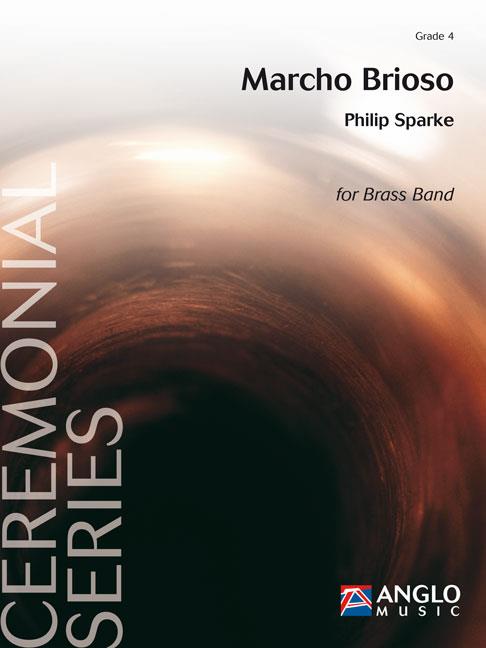
Marcho Brioso (Brass Band - Score and Parts) - Sparke, Philip
Marcho Brioso was commissioned by The Brioso Brass, a British-style brass band from Hokkaido, Japan. They gave the first performance in January 2012.The commission was for a bright and breezy march that the band could use as their theme tune, so Marcho Brioso falls into the composer's series of Broadway-style marches, which includes Slipstream, The Bandwagon and Jubiloso. After a short introduction a solo cornet plays the main theme, accompanied by a euphonium counter-melody. A secondary phrase from the horns and baritones leads to a tutti version of the main theme which is followed by the traditional 'bass' strain. A change of key heralds the trio section, which features a cantabile melody on euphonium; this is then taken up by the full band after a short bridge passage and further change of key. This takes us back to the home key which sees a quiet staccato version of the main theme lead to a recapitulation and a short coda which brings the march to a close.Duration: 3:45
Estimated dispatch 7-14 working days
 View Music