
Results
-
 £38.95
Unity Series Band Journal - Numbers 534 - 537, October 2024
534: Boldly Going (Wycliffe Kortin)This arrangement is derived from a Kenyan Swahili gospel melody Simama Imara, which means 'to stand firm'. The song is an encouragement to Christians to stay strong in the Lord, even in times of difficulty. The piece has a lively rock feel which requires precision in articulation and a sense of drive throughout.535: Fill me anew (Mark Feltwell)The melody Fill me anew (T.B. 611) has always been a favourite of the composer and this composition was used at the Worchester Corps in their Pentecost services. It is a simple melody with a simple purpose and associated prayer that is the focus of the piece, 536: There's something about that name (William Gaither arr. Kingsley Layton)The chorus (S.A.S.B. 80) from which this piece takes its title was composed by Bill and Gloria Gaither. They wrote it in 1970, having watched their grandparents near the end of their lives and pass away. At the same time, they were, as a couple, embracing parenthood. It resonated with them how the young loved to say the name of Jesus as well as those that were nearing the end of their lives. The chorus reflects the peace and comfort which comes to us when we call on that name during both the good and challenging times in life. The Gaithers are a performing and songwriting couple who have become well-known within the Southern Gospel music genre.537: Selection - Singing Praises! (Noel Jones)A motif, based on the phrase 'Praise him!, Praise him!, Ever in joyful song', appears throughout the selection. Songs also featured include I love to sing of the Saviour (S.A.S.B. 845) and Singing glory, glory, Glory be to God on high (S.A.S.B. 840)
Estimated dispatch 7-14 working days
-
 £44.95
Powerhouse (Brass Band - Score and Parts)
Spirit divine, come as of old. So begins the song by Brindley Boon (S.A.S.B. 311), and that phrase becomes the message of this piece, and an important motif in the music. It appears at the very beginning of the work and recurs at important points during the piece. The theme of the need for spiritual power is further underlined by the use of the hymns Show your power (S.A.S.B. 365), Wonder-working power (S.A.S.B. 451) and the very old chorus Send a new touch of power on my soul, Lord (S.A.S.B. 785).The composer first heard Boon's song Spirit Divine when it was sung by Parkhead Songsters in the Sunday morning meeting at his home Corps of Greenock Citadel. They were visiting for the weekend from Glasgow, and were conducted by Songster Leader Walter Chalmers, himself a beautiful lyric tenor soloist. They sang it in a moving fashion, unaccompanied, and such was the impact that, at the conclusion, many people went to the mercy seat. It made a huge impression on the young composer. It was the first time that Downie discovered the enormous power of music in worship. It also serves as a reminder to us all that young people of a tender age are very capable of grasping deeply significant events happening around them. This music was written for the 2020 UK Territorial Youth Band course.
Estimated dispatch 7-14 working days
-
 £55.00
Triumph Series Brass Band Journal, Numbers 1359 - 1362, March 2024
1359: Festival March - Coastal Celebration (Sam Creamer)Coastal Celebration was commissioned in 2019 by Nambour Salvation Army Band for the Corps' 125th anniversary celebrations. Nambour was the birthplace of The Salvation Army's work on the Beautiful Sunshine Coast in Queensland, Australia. Firring with this theme are subtle tributes to iconic Sunshine Coast landmarks, referenced with small phrases of popular secular melodies intertwined with the main tunes What a faithful God (S.A.S.B. 378) and All through the years (S.A.S.B. 826).1360: He's always been faithful (Craig Woodland)This meditative selection is an arrangement of the song by American singer and record producer Sara, Groves, He's always been faithful. The words express the joy and thankfulness in having a relationship with Jesus and knowing his presence in life. The melody and motifs of the traditional hymn, Great is thy faithfulness (S.A.S.B. 26), are heard throughout.1361: Christ's living water (Dean Jones)Christ's sacrificial love has been beautifully portrayed through the imagery of water in many songs, none more so that the skilfully crafted words we find in the chorus of I know a fount (S.A.S.B. 197), written by Oliver Cooke. To enhance the sentiments expressed, the pure sounds derived from Handel's Water Music fit perfectly in terms of music and imagery.1362: March - Fear Not! (Avelan Ntsiete)The Salvation Army continues to proclaim its music ministry in all corners of the world and, with this item under review, we introduce a new composer, originally from Congo Brazzaville, Central Africa. Avelan Ntsiete is currently a Bandsman at the Lilas Corps in Paris but has previously served in the Congo Brazzaville Territorial Band. This march, in traditional format, was written for an evangelistic campaign in Kindamba, where civil war has brought upheaval to the area and uncertainty for the local Salvationists. The composer was part of a small brass group which travelled for over 24 hours by truck and on foot to reach Kindamba and bring encouragement to the Salvationists within that community.
Estimated dispatch 7-14 working days
-
 £38.95
Unity Series Band Journal - Numbers 522 - 525, October 2023
522: Festival March - The Rescuers (Andrew Hedley)This exciting and bright festival march comes from a new contributor to the band journals. Andrew Hedley is a bandsman at Chester-le-Street Corps and a member of the Euphonium Section of the International Staff Band. This work contains inventive harmonic and melodic patterns and we hope this will be the first of many works from this composer to be seen in our journals.523: Moses and Pharaoh (Ralph Pearce)This piece owes its creation to the playing of the Montclair Citadel Young Peoples' Band in the Sunday School assembly every weekend. The song Pharaoh, Pharaoh is extremely popular and is sung with gusto and much movement. The presentation of this song derives for an accompaniment written for the band to play along with the singing. To widen its use, the spiritual Go down, Moses (STTL Vol.7, Part 2) was added to make the present composition. This music should have drive throughout and be played with a sense of fun.524: Lord, to thee (Alan Williams)This is a setting of the tune Hendon (T.B. 249). The piece uses the first verse of Frances Ridley Havergal's commonly associated text 'Take my life and let it be consecrated, Lord, to thee' (S.A.S.B. 623), and from there it takes its title.525: Song Arrangement - This is why (Noel Jones)This music is based on the tune This is why (T.B. 353) by Elisha Albright Hoffman and this two-verse arrangement reflects the great song of testimony Would you know why I love Jesus (S.A.S.B. 912). An associated scripture reference is found in Mark 10:45 'For even the Son of Man did not come to be served, but to serve, and to give his life as a ransom for many'. The motif 'Would you know' occurs in the opening bars and is repeated throughout the piece, along with fragments of the first verse. The chorus confirms the hoy that Christians experience knowing that Christ's sacrifice has bought forgiveness for our wrongdoings.
Estimated dispatch 7-14 working days
-
 £55.00
Triumph Series Brass Band Journal, Numbers 1351 - 1354, July 2023
1351: The anointed King (Marcus Venables)This piece was originally written as a massed band item for the Ontario Central-East Divisional Music Day in 2019. The updated version includes two songs, King of kings, majesty (S.A.S.B. 376) and O worship the King (S.A.S.B. 52) to a rhythmic setting of the tune Laudate Dominum (T.B. 481). Both songs present the contrasting characteristics of God; the powerful King and gentle, loving Saviour.1352: A suite of English Christmas carols (Kenneth Downie)This suite is the result of a request for a piece of music featuring exclusively English Christmas carols.The first movement features The holly and the ivy (C.C. 87). In sharp contrast, the second movement calls for a broad, sensitive, song-like approach. Using The cherry tree carol (C.C. 85), a much slower tempo than is normally applied to encourage the listener to see this beautiful tune in a new light. The rumbustious arrival of the finale is based on I saw three ships come sailing in (C.C. 44) with the festive mood prevailing until the end.1353: Nothing but thy blood (Norman Bearcroft)This two-verse setting of Richard Slater's much-loved hymn Nothing but thy blood (S.A.S.B. 769) appears straight-forward in nature, but requires a careful sense of the musical line across all parts.1354: Meditation - Reflections on Advent (Andrew Blyth)Two well-known carols, Away in a manger (C.C. 12) and Silent Night! (C.C. 77) are featured alongside original material. The piece attempts to convey a sense of reflection and meditation on the wonderful and awe-inspiring Advent story.
Estimated dispatch 7-14 working days
-
 £70.00
General Series Band Journal April 2016 Numbers 2154-2157
No. 2154 Cornet Solo - The victory cry! (Andrew Blyth)This solo features the popular song by Stuart Townend and Keith Getty entitled 'Power of the Cross', along with an original song by the composer, 'The Cross of hope'. It was originally written at the request of Staff Bandsman Gerry Todd and the Melbourne Staff Band.No.2155 Mission Force (Stephen Bulla)This is programmatic music, portraying the determination and forward vision of the modern church's mission. It includes two well-known hymns, 'Trentham' (T.B.159) and 'Slane' (T.B.831), using their words as metaphors that describe this quest into a spiritual future.No.2156 Prelude on 'Lavenham' (Geoffrey Nobes)An arrangement of a hymn, written by the composer with words by Reverend Nick Fawcett. The three statements of the melody correspond to three verses of the hymn and seek to reflect their meaning.No. 2157 On we march (Kevin Larsson)This piece was written for the Pasadena Tabernacle Band for their 120th anniversary. It includes a number of tunes closely connected with the Corps including 'Everything's coming up roses' from Gypsy, a song closely associated with the Rose Parade, and 'Hooray for Hollywood' as the Corps was previously called Hollywood Tabernacle. Continuing on the Rose Parade theme, 'On we march' (T.B.788) and the well-known hymn tune, 'Rachie' (T.B.190), are also featured.
Estimated dispatch 7-14 working days
-
 £45.00
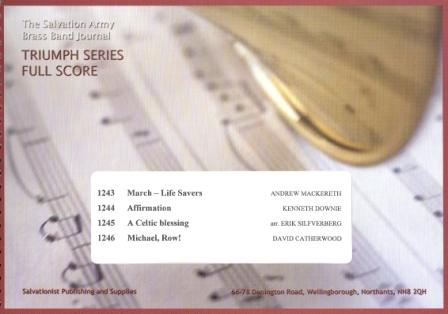
Triumph Series Band Journal November 2013 Numbers 1243-1246
No. 1243 March - Life Savers (Andrew Mackareth)This march was written for the band weekend at Belfast Citadel and incorporates the tune Jesus Saves (T.B. 703)No. 1244 Affirmation (Kenneth Downie)The title comes from the affirming tone of the chorus on which the music is built, He is the Lord, which itself is inspired by Phillippians, chapter 2. The chorus does not appear in its entirety at any point, but is obvious to a greater or lesser extent, in the texture of the music.No. 1245 A Celtic Blessing (arr. Erik Silfverberg)This is a simple arrangement of c Celtic traditional tune used to the lyrics of the familiar blessing:May the road rise to meet you,May the wind be always at your back,May the sun shine warm upon your face,The rain fall soft upon your fields,Until we meet again,May God hold you in the palm of his hand.No. 1246 Michael, Row! (David Catherwood)This arrangement of the traditional chous, 'Michael, row the boat ashore' (T.B. 285), is in a light swing style and also incorporates the tunes, 'Love lifted me' (T.B. 725) and 'Will uour anchor hold?' (T.B. 60).
Estimated dispatch 7-14 working days
-
 £38.95
Unity Series Band Journal - Numbers 510 - 513, October 2022
510: March - There is a fountain (Zachary Docter)This bright and cheerful march takes two songs as its basis; Jesus loves me! This I know (S.A.S.B. 807) and There is a fountain (S.A.S.B 202).511: Shine, Jesus, shine (Marcus Venables)While this piece was originally written for young people at a summer music camp in Canada, the piece is a light programme item suitable for smaller ensembles of any age.512: My Trust (Alan Williams)This setting is based on the simple chorus In thee, O Lord, do I put my trust (S.A.S.B 594). Ordinarily heard in 3/4 times, this 4/4 version of the tune has the space for reflection written into the notation.513: Power in the blood (Martyn Thomas)This is a blues/rock arrangement of the traditional hymn Would you be free from your burden of sin? (S.A.S.B 451). It can be used as a stand-alone piece or equally well as an accompaniment for congregational singing.
Estimated dispatch 7-14 working days
-
 £38.95
Unity Series Band Journal - Numbers 498 - 501, October 2021
498: Prelude - Armageddon (Munashe Chikwezvero)This prelude to worship is based on the tune Armageddon (T.B. 181) and features the well-known hymn Who is on the Lord's side? (S.A.S.B. 992) by Frances Ridley Havergal499: Joshua (William Gordon)An easy-listening swing setting of the spiritual Joshua fought the battle of Jericho.500: Trombone Solo - O save me, dear Lord! (Erik Silfverberg)This devotional setting of the song I bring thee my cares and my sorrows by General Evangeline Booth, is scored here as a trombone solo.501: This is my desire (Gavin Lamplough)Meditative music based on two popular worship songs, Reuben Morgan's This is my desire (S.A.S.B. 397) and Martin Smith's Thank you for saving me (S.A.S.B. 477).
Estimated dispatch 7-14 working days
-
 £81.99
A Bandsman's Overture (Brass Band - Score and Parts)
A Bandsman's Overture was commissioned by British Bandsman magazine to celebrate its 125th anniversary in 2012. It was premiered by Black Dyke Band, conducted by Dr Nicholas Childs, at a special anniversary concert held in Symphony Hall, Birmingham, on July 1st.British Bandsman was for a period known as British Bandsman and Contest Field, following an amalgamation of two magazines. The then owner, John Henry Iles, celebrated this new title by commissioning Ord Hume to write the famous march, BB & CF. As a salute to this heritage A Bandsman's Overture starts with the four notes, B(b)-B(b)-C-F, a motive which permeates an opening fanfare, which contrasts a busy opening with a more legato central section. This gives way to a bustling Vivo, based on repeated staccato notes. A change of key heralds a central cantabile melody, first on euphoniums and baritone and then played by the full band, which is followed by a short development section. This leads to a transformed reprise and a return of the opening fanfare, decorated this time by florid muted cornets.Duration: 6:00
Estimated dispatch 7-14 working days