
Results
-
Galloping Home (The theme from TV's Black Beauty) - Dennis King - Len Jenkins
"The Adventures of Black Beauty" was a British children's television drama series produced by London Weekend Television and shown by ITV in the United Kingdom between 1972 and 1974. The theme tune, "Galloping Home", written by Denis King and performed by the London String Chorale, was released as a single and peaked at number 31 in the UK charts in the week of 2 February 1974. It was later used at the climax of the first series of Absolutely Fabulous, with Edina Monsoon dreaming of running through a field as Black Beauty does in the series' title sequence. The piece has been arranged for both Full Brass Band and Brass Ensemble, in this case a Quintet with optional percussion. Both arrangements are well within the capabilities of most bands.
-
Aldebaran - Maurice Forslund - Maurice Forslund
We are pleased to offer this new piece from our colleague, Maurice Forslund, in Sweden. "Aldebaran" is a traditional-style brass band march, named after one of the brightest and largest stars in the Northern sky. (The star is a red giant over 40 times the size of our Sun). The music starts off in a sombre minor key that turns progressively brighter step by step. This sequence is arrested by a brief section featuring a setting of the hymn tune 'Bangor' which dramatically puts the march firmly back into the minor key before setting it up for progression to the finale. This piece is graded in the range 'easy' to 'intermediate' and is well within the capabilities of most bands.
-
Postman Pat - Bryan Daly - Len Jenkins
The original music for the phenomenally successful Postman Pat series was composed by Bryan Daly (who sadly died in January 2012) and included not only the well-known theme tune "Postman Pat & His Black and White Cat", but also the tuba solo "Walking in Greendale", both of which are now available, arranged for brass, from Wobbleco Music. The theme tune was originally sung by Ken Barrie and was released as a single in the UK where it reached number 44 in the charts in July 1982. The Postman Pat TV series and the later Postman Pat SDS TV series continue to delight and entertain children not least because of the instantly recognizable theme tune. What is less well known is that Bryan was also one of the most sought-after session-musician guitar players of the 1960's and 1970's, a first-call studio musician for the likes of Burt Bacharach, and his performances grace numerous classic hit recordings that have remained radio staples to this day. This "twin-pack" contains 2 arrangements: one of which follows faithfully the original theme and is generally A4 in size, and another which is a march/fete edition and is slightly easier to play. They are printed back-to-back and by folding the parts in half, the march/fete edition becomes lyre-ready.
-
Dance On (Je me sens bien aupres de toi) - Adams, Murtagh, Murtagh & Stellman - Len Jenkins
"Dance On" is probably best remembered in the UK by two versions. One by the Shadows which went to Number 1 in the UK Singles chart and the other by Kathy Kirby which made number 11 in the 1963 UK charts. The other side of the Channel, in France, Petula Clark recorded the song in French ("Je me sens bien aupres de toi") and Italian ("Sto volentieri con te") which made the Top 5 of the French and Italian charts. She also recorded an English version for album release on the Canadian market. The infectious rhythm will get you tapping your feet or even getting up to dance. It's a real bopping number from the 60's, and well within the capabilities of most bands. Enjoy.
-
 £62.00
Montage (Score only) - Peter Graham
Each of the movements of the symphony take as their starting point forms originating in music of the 16th and 17th centuries. The first, an intrada, introduces the main thematic material (based on the interval of a minor third) in its embryonic state. As the piece progresses, this material is developed and manipulated in a variety of ways. The interval of the third remains central to the overall scheme of the work, even unifying the three movements on a tonal plane (I: F (minor); II: A flat (major); III: C flat (minor). The internal structure of the intrada is an arch form: ABCBA, roughly modelled on the first movement of Concerto for Orchestra by Witold Lutoslawski, to whose memory the movement is dedicated. A chaconne follows - the basic material now transformed into expansive solo lines underpinned by a recurring sequence of five chords (again, a third apart). The movement's structure combines both ternary form and golden section principles and the chaconne's continuous cycle of chords may be visualised as circles. The final movement, a rondo, bears the dramatic weight of the entire work, as the underlying tonal tensions surface. A musical journey ensues, making diversions through lyrical territories as well as through more spiky, jazz-flavoured ones. The aural (and visual) montage is perhaps most apparent towards the climax of the piece, where three keys and polyrhythms sound simultaneously in the upper brass, xylophone, horns, and timpani. The climax itself combines the lyrical music heard earlier with the rondo theme, now presented by cornets and trombones in canon. The teleological thrust of the movement (if not the entire work) can be symbolized by the flight of an arrow, as it steers a predetermined course towards its target. Duration: 16:00
Estimated dispatch 7-9 working days
-
 £74.00
Montage (Parts only) - Peter Graham
Each of the movements of the symphony take as their starting point forms originating in music of the 16th and 17th centuries. The first, an intrada, introduces the main thematic material (based on the interval of a minor third) in its embryonic state. As the piece progresses, this material is developed and manipulated in a variety of ways. The interval of the third remains central to the overall scheme of the work, even unifying the three movements on a tonal plane (I: F (minor); II: A flat (major); III: C flat (minor). The internal structure of the intrada is an arch form: ABCBA, roughly modelled on the first movement of Concerto for Orchestra by Witold Lutoslawski, to whose memory the movement is dedicated. A chaconne follows - the basic material now transformed into expansive solo lines underpinned by a recurring sequence of five chords (again, a third apart). The movement's structure combines both ternary form and golden section principles and the chaconne's continuous cycle of chords may be visualised as circles. The final movement, a rondo, bears the dramatic weight of the entire work, as the underlying tonal tensions surface. A musical journey ensues, making diversions through lyrical territories as well as through more spiky, jazz-flavoured ones. The aural (and visual) montage is perhaps most apparent towards the climax of the piece, where three keys and polyrhythms sound simultaneously in the upper brass, xylophone, horns, and timpani. The climax itself combines the lyrical music heard earlier with the rondo theme, now presented by cornets and trombones in canon. The teleological thrust of the movement (if not the entire work) can be symbolized by the flight of an arrow, as it steers a predetermined course towards its target. Duration: 16:00
Estimated dispatch 7-9 working days
-
 £29.95
Soliloquy II (Euphonium Solo with Brass Band - Score and Parts)
A few years ago, I wrote a Soliloquy based on a Salvation Army song by George Marshall called Soliloquy (In the Stillness), since published in the General Series. This solo follows up the form of that previous work, though it is quite different in emotional content, and was a commission during Covid lockdown from Euphonium player Micah Dominic Parsons.The main inspiration is the tune Cross of Jesus by John Stainer as well as a motif from some older Euphonium Studies from the Royal Military School of Music, Kneller Hall, that Micah had discovered. The tune is used in a chorale form and, after an introduction, the very first section is a reversal of the chorale that appears in the second half of the work. The Euphonium exclamations are all derived from the main tune and the study motif. The work begins in quite a dark reflective manner, representing those aspects of the song, without being too specific. The second half reflects the more positive characteristics and finds a triumphal nature in its conclusion. The soloist lines throughout have a very declamatory style and can have a freedom in performance.There is one new element in the coda, where the triplet motif (bars 87-89) is a direct quotation from Romans 8 - A brass celebration by Ray Steadman-Allen. RSA was a good friend, mentor and encourager to me. The glorious climax of Romans 8 is his presentation of the same tune (Cross of Jesus) used in this work. And so the piece ends with a final and personal reference to RSA!- Howard Evans
Estimated dispatch 7-14 working days
-
 £38.95
Unity Series Band Journal - Numbers 538 - 541, February 2025
538: For Christ alone (Morgan Juel Stavik)This gentle and delicate march takes its title from the chorus of Fred Fry's song (S.A.S.B. 960).539: Calling Today! (Noel Jones)The words for this three-verse arrangement were written by Fanny Crosby, with music composed by George Cole Stebbins. While the song doesn't feature in the current Salvation Army Song Book, it was included in both the 1955 and 1986 editions. This arrangement was prepared during the pandemic, where people were encouraged to make contact by telephone as much as possible, and certainly welcomed phone calls from so many friends. Thinking of the calls, led to the words of this song.540: When the saints go marching in (Thomas Mack)This arrangement was written for the service celebrating the life of Irma Long at the request of her daughter. Irma, a gentle and kind woman, was a soldier for 70 years, 40 of which were at Corry Corps, Pennsylvania, USA, where she was also a songster, a pre-school Sunday School teacher, and corps treasurer. She drove the country roads from her village to Corry five times a week, even during the hard snow and ice of winters, so that she and her three daughters could attend corps activities. 541: There is sunshine (Wilfried Weiland)This work introduces a new composer to our band journals. Wilfried Weiland was the Band master at Berlin Central Corps and a member of the German Staff Band for several years. Although this is Wilfried's first published contribution with The Salvation Army, he has had several brass pieces published in the United Kingdom and abroad. The arrangement was originally written in July 2022 for the 25th anniversary of the Naumburg Corps, Germany. The reggae genre, employed here, has not been featured within our journals before but suits the style of a brass band well.
Estimated dispatch 7-14 working days
-
 £42.95
Little Suite (Brass Band - Score and Parts)
Trevor Duncan (1924 - 2005) was an English composer, particularly noted for his light music compositions. Born in London, and largely self-taught, he originally composed as a side line while working for the BBC. In the UK, he is well known for pieces such as High Heels and the March from A Little Suite, all of which gained fame as television and radio themes.Composed in 1959, and remembered by most for TV's Dr Finlay's Casebook fame, 'A Little Suite', was not necessarily inspired by Scotland, in fact it was more English in inspiration according to the composer. The piece was described by the composer as 'absolute music', and taking the three movements into account, this is not far from the mark.
Estimated dispatch 7-14 working days
-
 £94.99
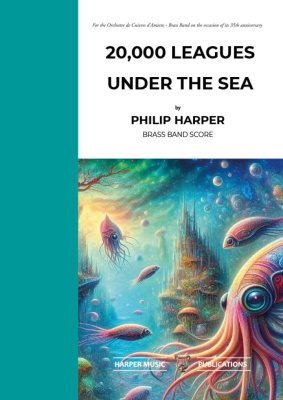
20,000 Leagues Under the Sea (Brass Band - Score and Parts)
Frenchman Jules Verne was a pioneer in science fiction during the late 19th Century, penning some classic stories such as Journey to the Centre of the Earth and Around the World in 80 Days - both of which have already been the subject of brass band test-pieces. It was therefore natural for me to choose Verne's 1869 watery magnum opus as the subject for this piece to which there are five sections, as well as an introduction and a finale.THE NAUTILUS. After a mysterious introduction we are introduced to The Nautilus - a fantastical submarine.THE CORAL KINGDOM. We visit awe-inspiring underwater coral formations.SQUID ATTACK. The Nautilus is attacked by a school of giant squid, or 'devilfish'.CAPTAIN NEMO. Captain Nemo is a loner and an eccentric. Some say he is a madman. Soloists of the band help to uncover the character of this enigmatic but powerful figure.MAELSTROM. The Nautilus is dragged into the ocean's deadliest whirlpool but Captain Nemo lives to fight another day.Duration: 12.30
Estimated dispatch 7-14 working days