
Results
-
 £11.50
SHORT STUDY FOR BRASS (score) - Chapman, Dave
If you require further information on SHORT STUDY FOR BRASS (score), please
In Stock: Estimated dispatch 1-3 working days
-
 £37.50
SHORT STUDY FOR BRASS (score & parts) - Chapman, Dave
If you require further information on SHORT STUDY FOR BRASS (score & parts), please
In Stock: Estimated dispatch 1-3 working days
-
 £15.00
Breath of Souls Study Score - Paul Lovatt-Cooper
This is a study score for the Breath of Souls that was commissioned especially for the 100th National Brass band Championships of Great Britain at the Royal Albert hall on October 15th 2011.
Estimated dispatch 10-14 days
-
 £15.99
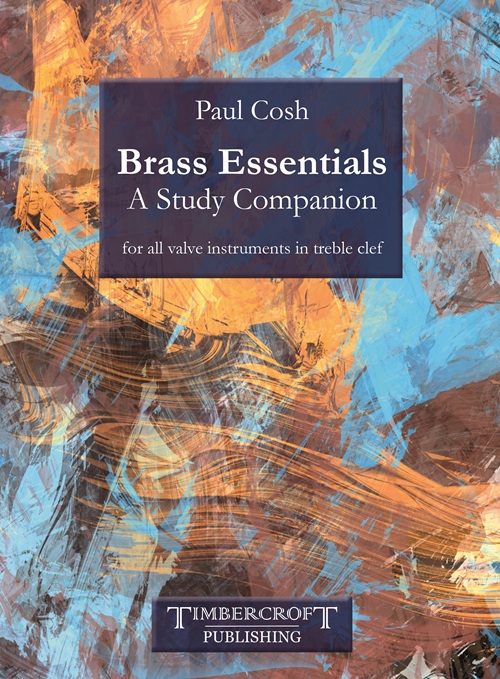
Brass Essentials - An Study Companion (for all valve instruments in treble clef)
This book of 32 studies has been drawn from those Paul Cosh used as a student at the Royal Academy of Music, throughout his years as a professional player and as a teacher at the Guildhall School of Music & Drama.The studies are divided into four main sections: Articulation, Finger Technique, Lyrical & Flexibility and Stamina & Technique and are drawn from those written by Arban, Charlier, Boehme, Brandt, Kopprasch and Sachse. Some of the studies have been re-imagined and edited to include new tempi and expression.There are helpful tips at the start of each section with most of the studies given suggested practice and performance tempi, although these are just a guide. Slow practise of the highly technical passages is vital to adhere to the overriding principle that every note counts.The Brass Essentials Study Companion can also work in conjunction with both the Brass Essentials: Arban Companion and the Brass Essentials: Practice Companion to vary your practice diet.
Estimated dispatch 7-14 working days
-
 £12.50
TERRA AUSTRALIS (Brass Band - Study Score) - Ellerby, Martin
Study only (reduced size). National Brass Band Championships of Great Britain Championship Section Finals 2010 . Australian Championships Easter 2007. A descriptive work in one continuous movement. Terra Australis portrays the discovery of Australia, the wonders of the land, the promise of new life and the nation's anthem, closing with a massive grand chorale and an engergetic conclusion. Recorded on Polyphonic QPRL231D Terra Australis
Estimated dispatch 7-14 working days
-
£74.95
Symphonic Study - Gordon Jacob
Estimated dispatch 5-14 working days
-
£10.00
ISAIAH 40 (Brass Band Study Score) - Robert Redhead
Commissioned for the final of the 1996 National Brass Band Championships of Great Britain. The timeless truths contained in Isaiah 40 were written to encourage a people facing very intimidating circumstances. The Jewish people of the 5th Century BC were preparing to make an arduous journey though the desert to return to their ravaged homeland after a lengthy exile in the sophisticated society of Babylon. Both Scripture and music sound out a message of hope, as they view life from an eternal perspective, thus placing change in its proper context. Because 'the Lord is the everlasting God' his word 'stands forever' and 'those who hope in the Lord will renew their strength'. They will not merely get through somehow but 'they will soar on wings like eagles'.
Estimated dispatch 7-14 working days
-
£10.00
INFINITY (Brass Band Study Score) - Robert Redhead
In the post-modern age in which we live, 'absolutes' are difficult for many to comprehend. Yet infinity, which means absolute, total, all-embracing, having no limits or boundaries in time, space, extent, or magnitude, has always been central to the Christian's concept of God.Through the ages, as human understanding has grown, particularly at a remarkable rate from the latter part of the twentienth century, Christianity has been continually challenged to interpret traditional beliefs in the light of new discoveries, but always within the reality of the infinite Being. In addition, scripture tells us that 'humanity was made in God's image'. Humankind is part of God's creation and as such, responsible for its upkeep. Such a commission has never been more relevant than in this present age. Psalm 8 creates a great picture of the majesty, eternal, infinte quality of God and yet reveals the desire of God to share in spirit with humankind. It recognises humankind as being, not a tool of the infinite, but as a creative contributing part of the ongoing movement and activity of the infinite. The music is deliberately melodic in context, creating a sense of unity with the infinite, in tandem with the varying expressions of individuality. It is not based on the Psalm but reflects some of the sentiments lying therein. The 'hymn-like' theme expresses the nature of the Divine using the Old Testament image of the infinite God coming to finite humankind, not in the 'wind', the 'earthquake', the 'fire', but in the 'still small voice' of quietness (1 Kings 19: 11-13). The ensuing musical development, in different styles and patterns, expresses this continual link between infinite and finite. Thus the conclusion, rather than being a symbol of might, power and magnificence, reflects the same sentiment as the opening.
Estimated dispatch 7-14 working days
-
£10.00
VISIONS OF GERONTIUS (Brass Band Study Score) - Kenneth Downie
Estimated dispatch 7-14 working days
-
 £15.00
Symphony in Two Movements (Study Score Only)
Selected as the Championship Section test piece for the National Brass Band Championships of Great Britain 2025This work was jointly commissioned by the National Youth Brass Band of Great Britain (NYBBGB) and the National Youth Brass Band of Wales (NYBBW), the latter with funding from T Cerdd (Music Centre Wales), to celebrate their 60th and 30th anniversaries respectively. The first performances were given at Cadogan Hall, London, in April 2012, by the NYBBGB, conducted by Bramwell Tovey; and at the Great Hall, Aberystwyth University, in July 2012, by the NYBBW, conducted by Nicholas Childs.When I was approached about a joint commission to write a new work to celebrate the anniversaries of these two outstanding youth bands I was delighted to accept, and decided to respond by writing a work apposite for the magnitude of these special occasions, namely a 'symphony for brass'.Through a long journey of writing music for brass band, which commenced with Connotations (1977), and continued with Dances and Arias (1984), Of Men and Mountains (1991), The Trumpets of the Angels (2000) and Rococo Variations (2008), I arrived at what I regard as the most important work of the cycle to date, combining as it does serious musical intent with considerable technical demands. It is perhaps my most abstract work for brass band, avoiding any programmatic content.The symphony lasts for some 19 minutes and is structured in two linked movements. The form is based on that used by Beethoven in his final piano sonata (Op.111), which is in two movements only: a compact sonata-form allegro, followed by a more expansive theme and four variations. Prokofiev also adopted this model in his 2nd Symphony of 1925.The opening Toccata of this Symphony is highly dramatic but compact, whilst still retaining the 'traditional' structural elements of exposition, development and recapitulation; indeed, it also has the 'traditional' element of a contrasting second subject - a gentle, lyrical modal melody first heard on solo cornets.In contrast, the longer and more substantial second movement Variations is built around a theme and four variations. The slowly unfolding chorale-like theme accumulates both added note harmony and increasing instrumentation, whilst the four variations which follow are by turn mercurial (fast, starting with all the instruments muted), march-like (menacing, with short rhythmic articulations underpinning an extended atonal melody), serene (a series of 'romances' for solo instruments alongside echoes of the chorale) with an emerging theme eventually bursting into a climax of passionate intent; whilst the final variation is a dynamic scherzo (concertante-like in its series of rapid-fire solos, duets, trios and quartets) with the music gradually incorporating elements of the main ideas from the first movement, thus acting as a recapitulation for the whole work. It reaches its peroration with a return to the very opening of the symphony, now in the 'home' tonality of F, and thus creating a truly symphonic dimension to the music.Most of the melodic material of the symphony is derived from the opening eleven-note 'row', which contains various intervallic sets, and although the work is not serially conceived it does use some typical quasi-serial procedures, such as canons, inversions, and retrogrades. The symphony uses somewhat limited percussion, in line with a 'classical' approach to the sound world of the brass band, alongside a use of multi-divisi instrumentation, whereby each player has an individual part rather than the traditional doubling within certain sections of the band.- Edward GregsonDuration: 19.00
Estimated dispatch 7-14 working days