
Results
-
 £24.50
A Yorkshire Manger - William Kirtpatrick - Stephen Tighe
A new take on an old favorite. Based on the Carol "Away In A Manger", this arrangement adds a hint of Yorkshire flavour to it with, coupling it with the accompaniments from "Last Of The Summer Wine". A melodious opening from the horn section, with gentle sleigh bells to help us move along. This is sure to warm the hearts of all the listeners this Christmas. For Christmas 2020, we have made backing tracks of this title for you to download. These can be used either for personal playback use, or to create a virtual performance of the piece with your full band. To download the backing track, please RIGHT CLICK HERE & Save As .
In Stock: Estimated dispatch 1-3 working days
-
£29.50
Pachelbango - Pachelbel - Ed Keeley
Pachelbel's most famous work as you've never heard it before. This arrangements features all sections of the band and gives them a chance to shine making the piece perfect for both concert or contest venues. Pachelbel's Canon in D is one of the most famous pieces of classical music of all time. Simply written for 3 violins and a cello, the music is basically 8 bars repeated 28 times. Mostly unforgotten until the 1970s it has become one of the most recorded pieces and used at more than 90% of all weddings as an introit. This arrangement has reset the Canon into a Latin-American tango style, pushing it into a new accessible groove and will bring a smile to your audiences & players. A must have for your upcoming concerts.
In Stock: Estimated dispatch 1-3 working days
-
£29.50
Michaelmas March - Various - Alexander Scaife McGee
March into Christmas with the new arrangement for brass band!Set to a lively march tempo are the following the Christmas classics;Deck the HallsHark! The Herald Angels SingJoy to the WorldGod Rest Ye Merry GentlemenTroikaCarol of the BellsO Come all Ye FaithfulAngels from the Realms of GloryWhile multiple percussion lines are provided the piece will work without them all being included
In Stock: Estimated dispatch 1-3 working days
-
 £54.99
Rock da House (Brass Band - Score and Parts)
Rock da House is not just the name of this new piece, it is also what it will do at your next concert! A hip tune and a groovy beat will have everyone dancing in (or on) their chairs. Whether for a concert hall, an outdoor show or any other occasion, if you are looking for a new piecethat everyone will love and enjoy, look no further; Rock da House is the piece for you! 03:50
Estimated dispatch 7-14 working days
-
 £59.99
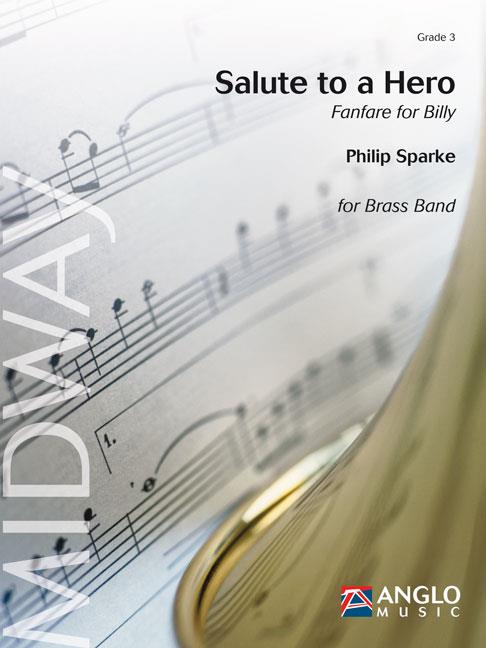
Salute to a Hero (Brass Band - Score and Parts) - Sparke, Philip
It is a tradition at Marlow High School, Oklahoma, that the band members' parents host a Band Banquet every May, at which the senior members of the band present a gift to the band director as a token of gratitude for his year's work. In 2009, clarinet player Brenna Hensley had the idea to commission a new piece from composer Philip Sparke to present to band director Billy Daniel, which would be played at the Spring Concert later that month. Salute to a Hero was the result. The piece opens with a decorated fanfare played on cornets and trombones and, after a short bridge passage, this reappears, played by the full band. A central lyrical section brings a mood of calm, utilising different brass colours, before the fanfare returns to close the work.Duration: 2:15
Estimated dispatch 7-14 working days
-
 £59.99
Almshouse Street Blues (Brass Band - Score and Parts) - Sparke, Philip
In 2007 Philip Sparke was appointed composer-in-residence to Monmouth School, situated on the Welsh/English border. The school, which has a venerable history dating back to 1614, has a thriving music department which boasts two concert bands, in co-operation with the nearby Haberdashers' Monmouth School for Girls, and a brass band.This exciting and innovative appointment involved three visits by the composer during the year as well as the commissioning of a new piece for each of the bands, all of which were premiered in a concert at the end of the year.Almshouse Street Blues was written for the brass band, whose members were allowed to vote for which type of piece they would get! Monmouth School is based in Almshouse Street and the town has a thriving summer festival which, alongside blues bands, features a wide variety of music including jazz, soul, rock and bangra.Duration: 4.45
Estimated dispatch 7-14 working days
-
 £104.99
High Flyers - Andrew R. Mackereth
From the composer: High Flyers are regarded as people with promise and potential.They are winners. This is music for winners.The title, as well as being a play-on-words, implies the nature of the work. It is a bright, optimistic, and upbeat piece attempting to depict an exhilarating ride on flying carpet. The opening rising chords immediately suggest the gentle elevation of the carpets' ascent towards unknown heights, leading to a hint of a first theme in the horns at Fig. B. The first four notes provide the thematic material for the whole work: C F G A.A perpetual sense of movement is achieved through accented quaver chords punctuating the melodicmaterial of the first main theme. Fig. E sees the music of the opening bars fully realised, with flourishes from the euphonium and baritones representing swirling clouds, shooting stars, or passing birds in flight.The same subject is developed into a lyrical second theme with a new lush harmonic treatment, evocative of gliding over an expanse of sparse countryside.This section ends with a note of serenity but is shattered by the urgent insistence of the percussion rhythms.The third section introduces a new idea with a slightly distorted fanfare in the cornets and trombones. This figure suggests for the first time that there may be trouble ahead. In fact, there is no need to fear and the journey can continue without aggravation. This fanfare returns near the end to signal a final note of triumph.A new rhythmic variant of the cell motif emerges as the third theme now transformed by the addition of a triplet figure. The music steadily gains momentum before moving inexorably towards the climactic return of the music and tonality of the opening bars of the piece.
Estimated dispatch 5-14 working days
-
 £134.99
Origenes - Carlos Cárdenas
Or genes (Origins) was commissioned by the European Brass Band Association as a test piece for the challenge section of the 38th European Brass Band Championship in Freiburg, Germany 2015. It is a spectacular piece from the pen of CarlosCardenas, who belongs to a new generation of composing talent. The clave, a rhythmic pattern, which originally comes from African music, was the inspiration for this innovative piece, all motifs and structures being derived from it. The six parts feature a wide spectrum of percussion instruments, reveal animpressive range of new sound combinations and yet are very accessible for the audience.
Estimated dispatch 5-14 working days
-
 £60.99
Jubilus! - Jan Van der Roost
Jan van der Roost's new work Jubilus will make an ideal opening piece for any event. It is in a classical ABA form, beginning with a rising brass fanfare which is quickly replaced by a contrasting expressive lyrical theme. The two themes alternate for a few seconds until an exciting new atmosphere is created with the lively allegro. This eventful piece lets you show off many aspects of your player's style and technique without losing overall unity
Estimated dispatch 5-14 working days
-
 £104.99
Variations on a Chord - Jan de Haan
Variations on a Chord was composed on the occasion of the second lustrum of the Dutch Brass Band Championships celebrated in 1990. The piece is the immediate sequel to Contrasten a piece which was composed in 1986, and which is performed all over the world. Not only was the final chord of this previous work used as a starting point for the new composition, but Variations on a Chord is also the first concert piece for brass band composed by Jan de Haan since then. The several variations are based on a solemn theme. The so-called minor-major seventh chord is easily detectable. The structure of the piece is such that the lyrical theme is preceded by a majestic introduction, and isfollowed by eight variations each strongly contrasting in character. The piece finishes in a short but extremely spectacular coda.
Estimated dispatch 5-14 working days
 View Music
 Listen to MP3