
Results
-
 £271.60
Aubade - Dawn Songs of the Fabulous Birds - Torstein Aagaard-Nilsen
Commissioned by The Norwegian Band Federation for The European Brass Band Championship 2003, in Bergen, Norway (Third edition) I remember as a kid the very early morning wake-up ceremonies caused by Seagulls having a "party" outside our home. Very few would describe it as beautiful, particularly not at 4:30 in the morning... But by listening carefully to birds I was fascinated by their diversity and musical language: they dont sing tunes or long phrases, they rather make sounds and signals, based on short motives. Aubade is based on musical pictures of the imaginary birds: the creatures with wings that exists only in myths and legends. The whole story starts with aBaritone-cadenza that evoke all the sleeping creatures. Very soon they all start to sing their songs in one way or another. The composition has a burlesque scherzo-character including slow espressive intersections. Traditional elements like melody and harmony is combined with extensive sounds and textural effects created by use of multiple muting, singing and playing at the same time. I am not too concerned about having a program for the piece. I just know that by thinking of the unheard dragon-songs, griffin-songs, the sound of the dodo, my creativity was stimultated. As a piece of music, Aubade follows its own rules based on well-known elements like melodies, arpeggio-figures, harmonies, rhythms, variations and recapitulation of ideas. - Torstein Aagaard-Nilsen
Estimated dispatch 5-14 working days
-
 £154.60
Circius - Torstein Aagaard-Nilsen
The work is important for me because it was my first piece to be performed outside Norway. Black Dyke Band/David King performed it and did a recording of it in 1991. In the original score I quote a Swedish bishop (Olaus Mangnus) who lived in the 15th century. He travelled around Scandinavia and drew maps - very important historic material. When he came to the north of Norway (where I come from) he decribed the wind from the north as Ciricus: (something like) Worst of all winds is Circius, that revolves (?= turn upside down) heaven and earth. (Well, not a good translation Im afraid). The fast sections reflects the mighty winds from the north. In the middle section, I borrowed afolksong-like tune (by C. Elling, a Norwegian composer). The text (by Kristoffer Janson) tells about old times when the fishermen used open boats: they had to put their lives in the hands of God.
Estimated dispatch 5-14 working days
-
 £115.60
Vidda - Ole Edvard Antonsen - Ole Edvard Antonsen
I composed the song "Vidda" after I got my ultimate boy's dream fulfilled; To fly one of the Air Force's F-16 fighter jets! We flew out from Norwegian city Bodo on to the Finnmark plateau, where we flew so-called "low level" (at low altitude). It was such a great experience for me that I immediately wrote the song "Vidda" based on my experience of the trip. Here, I try to describe the meeting between the technical perfection of a machine that surpasses most of the various forces in it's escape through the magnificent scenery passing at great speed, and the pilot who is alone with both the adventure and responsibility. The drums which start the song is meant to describes theenergy in the power of the plane, while the lonely and kind of melancholy melody from the trumpet in the beginning describes the feelings of the pilot. As the song develop, we pass both the mountains and big beautiful plateaus with g-forces quivering body. Hopefully you will share some of my experiences through this song. Have a nice flight! Ole Edvard Antonsen
Estimated dispatch 5-14 working days
-
 £109.99
Fantasy for Brassband and Organ - Jan Bosveld
When I was approached to compose a work for brassband and church organ I already envisioned the concept I would use. It would indeed literally become a work for brassband and organ. Without the traditional solos, the organ would form an addition to the brassband orchestration as would the brassband provide an extra register for the organ. In short a homogeneous entity. The most important reason for doing this is quite simple. Since this work can only be performed in a church and because of the specific acoustics of the church, the brassband would sound in al its tone colour like an organ. By using certain registers of the organ and combining these with the brassband a wonderfulsound palette can be created. The use of complementary or contrasting tone quality is also possible. The primary theme of this composition is based on these three methods of "colouring". As far as structure is concerned this work consists of two parts. slow fast. It is built on a number of motifs in which some behave like a consecutive canon. In the fast movement the primary motif develops into a fugue-like section. The canon and fugato are techniques frequently used in classical and contemporary organ literature. The liberal use of structure and motif has lead to the title. "Fantasy for Brassband and Organ".
Estimated dispatch 5-14 working days
-
 £115.60
Funky Hedde - Torstein Aagaard-Nilsen
A good friend of mine, trombonist and professor Jesper Juul Windahl commissioned me a trombone quartet. I then wrote Four Nordic Folk Pops. The last of the four is a Norwegian tune called Havard Hedde in a funky version. Then I made a brass quintet version for Lofoten Brass Quintet for a their Australia tour. The trombonist in the quintet asked me for a brass band version to be used in an entertainment contest (SIDDIS Brass). Havard Hedde did not succeed in getting married, but I think this version wil make him dance again. Torstein Aagaard-Nilsen
Estimated dispatch 5-14 working days
-
 £127.30
Rendezvous - Torstein Aagaard-Nilsen
Rendezvous was commissioned by Krohnengen Brass Band for their 50th Anniversary in 2019.Rendezvous is devided into three sections. Each section are referring to Edvard Grieg's own titles. but twisted, to make sure that everybody understand that this music is a mash-up of themes Edvard Grieg used in opus 54 (for piano) and opus 61 (songs for children).1. Trolltog med avsporing (March of the Trolls derailment)March of the Trolls is a famous part of Edvard Grieg lyric pieces, opus 54.2. Klokkeklang i feil sang (Bell ringing in wrong tune).Bell ringing show that Grieg was one of the first composers to write the way impressionists did. What happens if this beatiful piece is combined with several other themes from the same book? It somehow works in its own way.3. Pep talk til Blakken (Pep talk to Blakken)The riff used in the first part becomes an important part of the third part: a funky treat of the childrens song "Kveldssang for Blakken" (Evening song for Blakken).I felt that a rather tired old horse needed a pep talk more than a slow tune. So that is why you get this music(!) - and this is how my rendezvous with Grieg ends.Not sure what maestro Grieg would have thougt... But, I have read that the fiddlers that played the tunes Grieg used was not happy with the way Grieg used them.So there you go...Torstein Aagaard-Nilsen
Estimated dispatch 5-14 working days
-
 £115.60
Dance Monkey - Toni Watson - Idar Torskangerpoll
Dance Monkey er en catchy lat av den Australske musikeren Toni Watson ogsa kjent som Tones and I. Tones and I forklarer at sangen handler om forholdet hun hadde med publikum da hun var gatemusikant hjemme i Australia: "Jeg skrev denne sangen da jeg opptradte pa gata, og den handler om presset jeg folte om alltid a underholde folk." Like kjent som selve lata er videoen som er laget til. Pr mars 2020 er videoen vist over 825 mill ganger pa YouTube. Eb-kornett er en optinoal stemme. Den er identisk med Cornet 1-stemmen og ikke med i partituret.
Estimated dispatch 5-14 working days
-
 £106.99
Evolution - Philip Sparke
Evolution was commissioned by Kunstfactor for the 4th section of the Dutch National Brass Band Championships (NBK) 2011. It is dedicated to Jappie Dijkstra and the Music Information Centre (MUI), Arnhem, Holland, in acknowledgement of their outstanding work in developing brass band repertoire. The composer writes:-The idea for the piece came when I was reading an article about a branch of Chinese philosophy which is abbreviated as Wu Xing, which has no exact translation but can mean, for example, five elements, five phases or five states of change. It is central to all elements of Chinese thought, including science, philosophy, medicine and astrology, and in simpleterms tries to create various cyclic relationships between five elements in all walks of life. An example is: Earth - Metal - Water - Wood - Fire - (Earth) etc. where (in one cycle) earth bears metal, metal changes to liquid (water) when heated, water helps trees grow, wood burns to create fire, fire produces ash (earth) and the cycle continues.I was particularly interested in the cycle of emotions: Meditation - Sorrow - Fear - Anger - Joy - (Meditation) etc. and thought this cyclic principle would provide an effective emotional journey for a piece of music. So Evolution has five equal sections which loosely characterise this emotional cycle. I have tried to make the music grow organically, with minimal repetition, and each movement evolves from the musical elements at the end of the previous one, with the opening material appearing, transformed, at the end of the piece to complete the cycle.
Estimated dispatch 5-14 working days
-
 £379.99
Tranquil Abiding - Paul Mealor
An 18-minute work for brass band, written for the world renowned Foden's Band. This is a melodic work divided into three movements. All sections of the band are featured with solo parts. Each movement is headed by a line from a poem by James Agee, the American novelist and poet. 'Tranquil Abiding', often referred to as 'Shamatha' in Buddhist traditions, signifies a state of peaceful and calm mental stillness, achieved through focused meditation, where the mind rests peacefully and without agitation."The term has always resonated with me particularly during my long, regular walks into, around and along the amazingly beautiful woodlands, mountains and streams of North Wales at night lit only by the stars. It's during these walks that my meditative focus is at its most emotive and I am at one with the 'it' that surrounds us", says Paul Mealor. "Often on these walks and meditations I am reminded of the American poet, James Agee's pantheistic vision of the natural world and the stars above, 'Sure on this Shining Night' which conjures a serene and harmonious image of a summer night, illuminated by celestial bodies and bathed in kindness. The poem evokes a sense of peace and tranquillity as nature heals and the earth is rejuvenated".
Estimated dispatch 5-14 working days
-
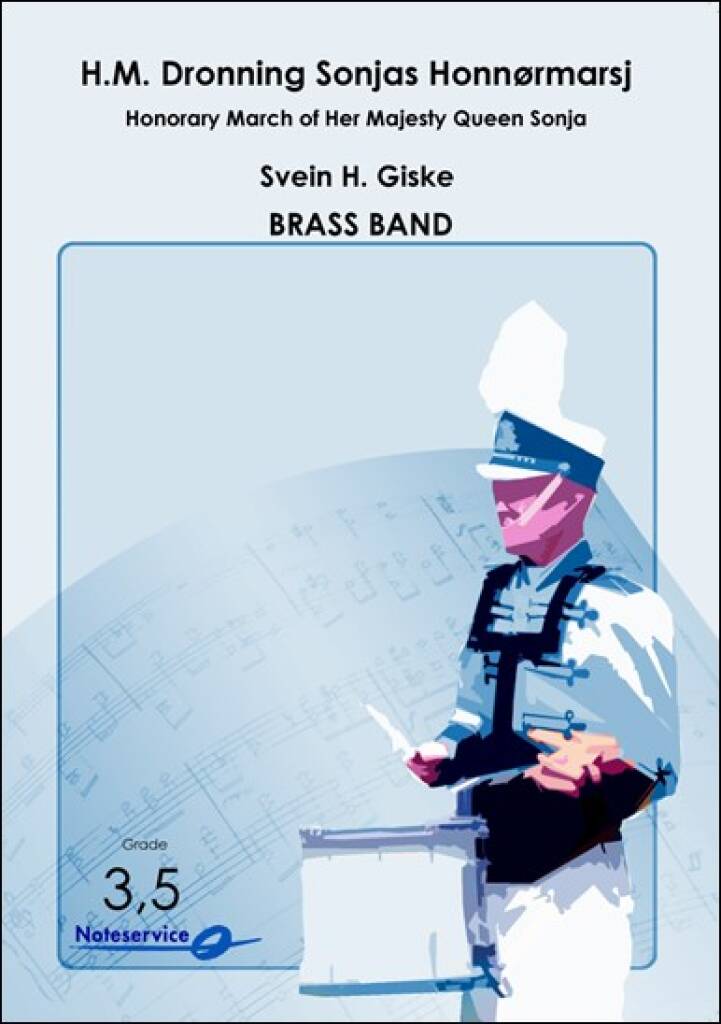 £72.70
Honorary March of Her Majesty Queen Sonja - Svein H. Giske
This march was commissioned by The office of cultural affairs in Fana and Ytrebygda (a part of Bergen Municipality) for the opening of The Bergen Light Rail.The premiere was given by The Norwegian Navy Band Bergen and Smoras skolemusikkduring the light rails maiden voyage. Her Majesty Queen Sonja of Norway opened the light rail on June 22nd 2010.My idea was to give the march a strong link to Bergen. In the bass solo (letter B) I have quoted Bergens "national"anthem Nystemtn and in the Trio (letter E) I have used a bugle call from Bergens unique tradition of archerchery brigades. The first part of the march is meant to have a sort of train feel to it; somethingthats moving steadily through thestreets of the city.
Estimated dispatch 5-14 working days
 View Music