
Results
-
 £60.99
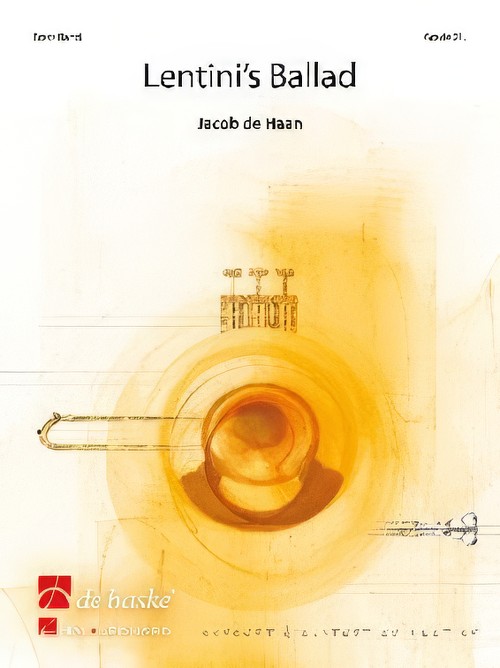
Lentini's Ballad (Optional Vocal Solo with Brass Band - Score and Parts) - De Haan, Jacob
Giacomo da Lentini was a 13th century Italian poet who was a notary at the court of the Holy Roman Emperor Frederick II and is said to have invented the sonnet. Lentini's Ballad is based on the famous poem 'Amor e un desio che ven da core' (Love is a desire that comes from the heart). It sounds great as an instrumental work, but there is also an option for a vocal version using the Italian lyrics of the poem, making the arrangement even more special!Duration: 3:30
Estimated dispatch 7-14 working days
-
 £60.99
Cantique de Noel (Brass Band - Score and Parts)
The French composer Adolphe Charles Adam's (1803- 1856) carol Cantique de No?l (better known in France as Minuit, Chr?tiens, and also widely known as O Holy Night) was initially criticised by church authorities who observed a lack of musical taste and the absence of religious perception. How wrong they were is now clear as the song is popular worldwide and is often performed in churches as well as carol concerts. Roland Kernen has produced this beautiful version of Cantique de No?l for brass band. 03:45
Estimated dispatch 7-14 working days
-
 £100.00
King Arthur (Scenes from a Radio Drama) (Brass Band - Score and Parts) - Britten, Benjamin - Hindmarsh, Paul
King Arthur (Scenes from a radio drama) was the first of 28 scores Benjamin Britten (1913-1976) composed for radio between 1937 and 1947. It was an ambitious dramatisation of King Arthur's life and times - part pageant, part play, part cantata - written by D.G. Bridson.This colourful suite incorporates the Introduction, a dramatic Wild Dance, some of the music underscoring the scenes for Galahad and The Holy Grail, and two vivid battle scenes, ending with The Final Battle and Apotheosis.King Arthur (Scenes from a radio drama) for brass band should not be confused with a much longer orchestral suite which Paul Hindmarsh devised from the same source in 1995.Suitable for Premier Youth/2nd Section Bands and aboveDuration: 14.00
Estimated dispatch 7-14 working days
-
£19.99
King Arthur (Scenes from a Radio Drama) (Brass Band - Score only) - Britten, Benjamin - Hindmarsh, Paul
King Arthur (Scenes from a radio drama) was the first of 28 scores Benjamin Britten (1913-1976) composed for radio between 1937 and 1947. It was an ambitious dramatisation of King Arthur's life and times - part pageant, part play, part cantata - written by D.G. Bridson.This colourful suite incorporates the Introduction, a dramatic Wild Dance, some of the music underscoring the scenes for Galahad and The Holy Grail, and two vivid battle scenes, ending with The Final Battle and Apotheosis.King Arthur (Scenes from a radio drama) for brass band should not be confused with a much longer orchestral suite which Paul Hindmarsh devised from the same source in 1995.Suitable for Premier Youth/2nd Section Bands and aboveDuration: 14.00
Estimated dispatch 7-14 working days
-
£76.99
Prima Luce (Brass Band - Score and Parts)
Prima Luce (First Light) was commisioned by the Holy Angels Elementary School located in Aurora (USA). The name of the town (which means dawn), the town's great religious history and the fact that this town was one of the first in the USA to have streetlights were the inspiration for this Gregorian influenced atmospheric composition 08:43
Estimated dispatch 7-14 working days
-
 £29.95
SOUNDS OF CHRISTMAS (Full Score)
Sounds of Christmas is a brand new collection of 36 Christmas arrangements and compositions that can be played by groups as small as five players, with the parts available as follows: Part 1: Bb and C; Part 2: Bb, Eb and F; Part 3: Bb, Eb, F and C BC; Part 4: Bb TC and C BC; Part 5: Eb TC, Bb TC and C BC. The full score does not contain all the instruments available, only the Bb and Eb pitched instruments (except the optional Eb Soprano cornet) and Percussion. Sounds of Christmas is sure to add interest to your Christmas carol playing and offers interesting additions to your Christmas concert repertoire. Includes: A Holly Waltz (The Holly and the Ivy); A Starry Night; Away in a Manger; Chiming Bells (Sweet Chiming Christmas Bells); Christmas Joy (March); Christmas Praise (March); Coventry Carol; Ding Dong! (Ding Dong! Merrily on High); God Rest You Merry, Gentlemen; Good Christian Men, Rejoice; Good King Wenceslas; Hark! THe Herald Angels Sing; Have Yourself a Merry Little Christmas; Infant Holy; It Came Upon a Midnight Clear; Jesus, Good Above All Other; Joy to the World; Mary's Boy Child; Mid-Winter (In the Bleak Mid-Winter); Normandy Carol (Away in a Manger); O Come, All Ye Faithful; O Little Town of Bethlehem; Once in Royal David's City; Rudolph, the Red-Nosed Reindeer; Silent Night; Sounds of Christmas (March Medley); The Andel Message (While Shepherds Watched); The Everlasting Light (O Little Town of Bethlehem); The First Nowell; The Infant King; The Manger Scene; The Virgin Mary had a Baby Boy; Three Kings' March; To Celebrate His Birth (March); We Wish You a Merry Christmas; Yuletide Rag (Deck the Hall).
Estimated dispatch 7-14 working days
-
 £64.00
SPIRIT OF CHRISTMAS, The (Brass Band) - Fernie, Alan
Includes: Hark, The Herald Angels Sing; O Holy Night (cornet solo); O Come All Ye Faithful; Silent Night (Wiegenlied). Grade: Medium.
Estimated dispatch 7-14 working days
-
£89.95
TRUMPETS OF THE ANGELS - 2016 Edition (Gregson) (Brass Band - Score and Parts) - Gregson, Edward
The Trumpets of the Angels is a large-scale work, scored for seven solo trumpets (or cornets), brass band and percussion (deploying 'dark' instruments such as three tam-tams, bass drum and two sets of timpani). The genesis of the work is a quotation from the Book of Revelation ... and I saw the seven angels which stood before God; and to them were given seven trumpets.Thus the idea behind the work is highly dramatic and I have tried to achieve this by the spatial deployment of seven solo trumpets around the band. Trumpet 7 remains separate from the band throughout and, indeed, has the most dramatic and extended cadenza, representing the words of the seventh angel ... and time shall be no more.The work opens with a four-note motif announced by off-stage horns and baritones and answered by fanfare figures on four solo trumpets. In turn, each then play cadenzas before joining together, independently playing their own music. This leads to a sung Kyrie Eleison with accompanying solos for Flugel Horn and Baritone, after which we hear the entry of solo trumpets 5 and 6 with music that is more urgent and rhythmic, describing the Horsemen of the Apocalypse.The music reaches another climax, more intense this time, with the horns and baritones (now on-stage) again sounding the transformed motif, before subsiding into what might be described as a lament of humanity - slow, yearning music, which builds from low to high, from soft to loud, with a melody that is both simple and poignant. At its climax, Trumpet 7 makes a dramatic entry, playing the opening four-note motif, but expanded to almost three octaves. This cadenza (to the partial accompaniment of 3 tam-tams, representing the Holy Trinity) introduces new material and foreshadows the ensuing Scherzo, introduced by antiphonal timpani before the band enters with music that is fast and foreboding. Despite the somewhat desolate and 'unstable' mood of this music, it slowly moves towards an optimistic conclusion, transforming the 'humanity' music into an affirmative and triumphant statement.The original version of The Trumpets of the Angels was commissioned by the Fodens Band for their centenary concert at The Bridgewater Hall, Manchester, in 2000, and contained an important part for organ. In 2015 I was asked by Nicholas Childs to create a New Performing Edition for the Black Dyke Band; without organ, and including newly composed material. This New Performing Edition was given its first performance at the European Brass Band Festival in Lille in April 2016. The work is dedicated In tribute to Olivier Messiaen.- Edward Gregson
Estimated dispatch 7-14 working days
-
£44.95
TRUMPETS OF THE ANGELS - 2016 Edition (Gregson) (Brass Band - Score only) - Gregson, Edward
The Trumpets of the Angels is a large-scale work, scored for seven solo trumpets (or cornets), brass band and percussion (deploying 'dark' instruments such as three tam-tams, bass drum and two sets of timpani). The genesis of the work is a quotation from the Book of Revelation ... and I saw the seven angels which stood before God; and to them were given seven trumpets.Thus the idea behind the work is highly dramatic and I have tried to achieve this by the spatial deployment of seven solo trumpets around the band. Trumpet 7 remains separate from the band throughout and, indeed, has the most dramatic and extended cadenza, representing the words of the seventh angel ... and time shall be no more.The work opens with a four-note motif announced by off-stage horns and baritones and answered by fanfare figures on four solo trumpets. In turn, each then play cadenzas before joining together, independently playing their own music. This leads to a sung Kyrie Eleison with accompanying solos for Flugel Horn and Baritone, after which we hear the entry of solo trumpets 5 and 6 with music that is more urgent and rhythmic, describing the Horsemen of the Apocalypse.The music reaches another climax, more intense this time, with the horns and baritones (now on-stage) again sounding the transformed motif, before subsiding into what might be described as a lament of humanity - slow, yearning music, which builds from low to high, from soft to loud, with a melody that is both simple and poignant. At its climax, Trumpet 7 makes a dramatic entry, playing the opening four-note motif, but expanded to almost three octaves. This cadenza (to the partial accompaniment of 3 tam-tams, representing the Holy Trinity) introduces new material and foreshadows the ensuing Scherzo, introduced by antiphonal timpani before the band enters with music that is fast and foreboding. Despite the somewhat desolate and 'unstable' mood of this music, it slowly moves towards an optimistic conclusion, transforming the 'humanity' music into an affirmative and triumphant statement.The original version of The Trumpets of the Angels was commissioned by the Fodens Band for their centenary concert at The Bridgewater Hall, Manchester, in 2000, and contained an important part for organ. In 2015 I was asked by Nicholas Childs to create a New Performing Edition for the Black Dyke Band; without organ, and including newly composed material. This New Performing Edition was given its first performance at the European Brass Band Festival in Lille in April 2016. The work is dedicated In tribute to Olivier Messiaen.- Edward Gregson
Estimated dispatch 7-14 working days
 View Music