
Results
-
 £33.62
Disinformation! (Brass Band) Joe Galuszka
This atmospheric work by English composer Joe Galuszka is set in three movements: I. Fear II. Hope III. Solidarity (March for Truth) The composer writes: 'All around us is mistrust in the information we receive. Chinese misinformation. Russian disinformation. 'Fake News' in the United States. At every turn we doubt what we hear, what we see. Disinformation was composed in response to the ever-growing and all powerful misinformation campaigns worldwide that reached dizzying levels of influence, coming from some of the most eminent heads of states, during the turn of the 21st century. With division and disillusionment now rife and engrained in Western democracies, the unravelling of the social order is reflected in this short work for brass band. Opening with Fear, Disinformation starts with vast amounts of noise taking over the establishment and paints a world with people coming to terms with the cacophony of sound that is 'false information'. With a retreat to a brief moment of solace, Hope conjures up a calm escapism where on the outside, the brave and the wise look on to what is becoming of our new world. Maybe there is chance to pull together? Ending with a frenzied, brazen climax, the piece concludes with Solidarity - where people and the politicians come to loggerheads in a battle - where those who seek division are called out and the lies are laid bare for all to see, as we enter, once more, the unknown.' To listen to a recording of Solna Brassperforming the work please visit https://open.spotify.com/track/2gvPdCsvmykdWpm2yjz3Uk?si=68cc33805d16449c To view a rolling score video of this work please visit www.youtube.com/watch?v=z-0I47yfvM0 PDF download includes score and parts. Sheet music available from www.brassband.co.uk Difficulty Level: 1st Section + Length: 4.35 minutes Instrumentation: Soprano Cornet Eb Solo Cornet Bb Repiano Cornet Bb 2nd Cornet Bb 3rd Cornet Bb Flugel Horn Bb Solo Horn Eb 1st Horn Eb 2nd Horn Eb 1st Baritone Bb 2nd Baritone Bb 1st Trombone Bb 2nd Trombone Bb Bass Trombone Euphonium Bb Bass Eb Bass Bb Timpani Percussion 1-4 (Part 2 optional)
In Stock: Estimated dispatch 1-3 working days
-
 £33.62
Excursion (Brass Band) Christopher Cook
Excursion was the winner of the 2022 BrookWright International Brass Band Composition Competition. The composer Christopher Cook writes: 'In this short and effervescent study for brass band, I wanted to take the listener and players on a journey which moves from a soundworld of bristling, bubbling energy to a triumphant fanfare and finally a moment of repose. The initial fast flurry of notes, highlighted and emphasised by precise elements of percussion, informs the motivic development of the rest of the piece and eventually forms the basis for the textural backdrop to the filmic sounding melody heard around halfway through the piece. The unexpected final passage is intended to be a nod to works for brass band by Paul Patterson and Harrison Birtwistle.' To view a rolling score video of the piece performed by the Royal Northern College of Music (RNCM) Brass Band please visit www.youtube.com/watch?v=rSCrQIv_W2k PDF download includes score and parts. Sheet music available from www.brassband.co.uk Difficulty Level: 1st Section + Instrumentation: Soprano Cornet Eb Solo Cornet Bb Repiano Cornet Bb 2nd Cornet Bb 3rd Cornet Bb Flugel Horn Bb Solo Horn Eb 1st Horn Eb 2nd Horn Eb 1st Baritone Bb 2nd Baritone Bb 1st Trombone Bb 2nd Trombone Bb Bass Trombone Euphonium Bb Bass Eb Bass Bb Timpani Percussion 1-3
In Stock: Estimated dispatch 1-3 working days
-
 £29.88
Fanfare from La Peri(Brass Band) Dukas arr. Rob Bushnell
La Peri is a one-act ballet by the French composer Paul Dukas, best known for The Sorcerer's Apprentice (L'apprenti sorcier) as in the 1940 Disney film Fantasia. Dukas was commissioned to write La Peri by the Ballets Russes, producing a Poeme danse en un tableau ('dance poem in one scene') in 1911; this become his last published work. With Natalia Trouhanova due to play the Peri and Vaslav Nijinsky to play Iskender (the name of Alexander the Great in Persian, who is scouting around Iran in search of the Flower of Immortality), the production was ultimately cancelled because Serge Diaghilev feel Trouhanova was not a skilled enough dancer to be partnered to Nijinsky. Trouhanova later hired Ivan Clustine to choreograph the music, with the ballet premiering at the Theatre du Chatelet in Paris on 22 April 1912.The brilliant fanfare that precedes the ballet is often performed separately and is the arrangement available here. Arranged for British-style brass band, it has optional percussion parts as well as alternative parts for horns in F and bass-clef lower brass. The piece has been lowered by a tone compared to the original. A recording of the original composition can be found here: www.youtube.com/watch?v=7EDekMos1ok. Duration: Approx. 2 minutes Difficulty Level: 2nd Section + Duration: 4 or 5 minutes (depending on tempo and without any cuts) PDF download includes parts and score. Sheet music available at www.brassband.co.uk (UK) or https://satradecentral.org (USA) Instrumentation: Soprano Cornet Eb Solo Cornet Bb Repiano Cornet Bb 2nd Cornet Bb 3rd Cornet Bb Flugel Horn Bb Solo Horn Eb 1st Horn Eb 2nd Horn Eb 1st Baritone Bb 2nd Baritone Bb 1st Trombone Bb 2nd Trombone Bb Bass Trombone Euphonium Bb Bass Eb Bass Bb Timpani Percussion 1 - Snare Drum Percussion 2 - Bass Drum & Cymbal
In Stock: Estimated dispatch 1-3 working days
-
 £33.62
Fanfare Prelude on 'Richmond' (Brass Band) Charles Wesley arr. Andrew Wainwright
Fanfare Prelude on 'Richmond' was written for the inaugural Texas Brass Fest, held at Round Top Festival Institute on 27 May 2023, for the four premier brass bands in Texas - Austin, Dallas, Houston and San Antonio Brass Bands. It is based on the much loved hymn of the church by Charles Wesley, which is also known as 'O For a Thousand Tongues to Sing', the first verse of which reads: O for a thousand tongues to sing my great Redeemer's praise, the glories of my God and King, the triumphs of his grace! For maximum effect it is suggested that cornets and trombones are staged stood around the band, although if this is not possible then traditional band formation will be acceptable. To view a video of the premiere performance featuring the massed bands of Austin, Dallas, Houston and San Antionio at Texas Brass Fest 2023, please visit www.youtube.com/watch?v=22GJM4A6mbM or the Chicago Staff Band at www.youtube.com/watch?v=Gjp8N_U9U2c PDF download includes score and full set of parts. Sheet music available from: UK - www.brassband.co.uk USA - www.solidbrassmusic.com Difficulty Level: 2nd Section + Instrumentation: Soprano Cornet Eb Cornets 1-5 Bb Flugel Horn Bb Solo Horn Eb 1st Horn Eb 2nd Horn Eb 1st Baritone Bb 2nd Baritone Bb 1st Trombone Bb 2nd Trombone Bb Bass Trombone Euphonium Bb Bass Eb Bass Bb Timpani Percussion 1-3
In Stock: Estimated dispatch 1-3 working days
-
 £33.62
Margaret - Brass Band (Timothy Matthews arr.Kenneth Downie)
VIEW SCORE PDF The arranger, Kenneth Downie writes: 'This music was commissioned by Mike Griffiths, Music Director of Riviera Concert Brass, based in Torquay in Devon, England. It is developed around the hymn tune Margaret, and written in memory of the lady of that name who was a renowned supporter of, and generous donor to the band. The graceful melody was written by Timothy Matthews (1826-1910), and it is usually associated with the words of the hymn, the first verse of which says: Thou didst leave thy throne and thy kingly crown When thou camest to earth for me; But in Bethlehem's home was there found no room For thy holy nativity, O come to my heart, Lord Jesus; There is room in my heart for thee. I feel that there is a strong emotional core to this lovely tune and any performance should seek to bring out this quality, in a musical manner.' PDF download includes score and full set of parts. Sheet music available from: UK - www.brassband.co.uk USA - www.solidbrassmusic.com Difficulty Level: 4th Section + Instrumentation: Soprano Cornet Eb Solo Cornet Bb 1st Cornet Bb 2nd Cornet Bb Flugel Horn Bb Solo Horn Eb 1st Horn Eb 2nd Horn Eb 1st Baritone Bb 2nd Baritone Bb 1st Trombone Bb 2nd Trombone Bb Bass Trombone Euphonium Bb Bass Eb Bass Bb Timpani Glockenspiel Percussion
In Stock: Estimated dispatch 1-3 working days
-
 £48.56
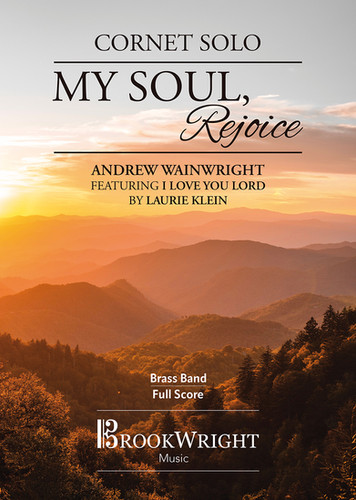
My soul, rejoice (Cornet Solo with Brass Band) Andrew Wainwright
My soul, rejoice (Andrew Wainwright) was commissioned in 2022 by Elizabeth Malovance, principal cornet of the Chicago Staff Band. A spirited and celebratory work, it is designed to showcase the dual nature of the cornet: its sparkling technical agility and its rich, vocal lyricism. The music begins in meditative fashion before transitioning into a joyful caprice featuring playful syncopations which are handed around the band. This is followed by a reflective section based on the much-loved worship song I love you Lord by Laurie Klein. The work concludes with a reprise of the original theme, building in momentum and intensity. Through a series of brilliant runs and virtuosic flourishes, the soloist leads the charge toward a majestic and triumphant finale, bringing the work to a ringing, glorious close. The solo was recorded by Richard Marshall on the 2026 CD Gothique Fantasy - The Music of Andrew Wainwright, which was his last solo recording of his 20-year tenure as principal cornet of Black Dyke Band. Technical Requirements & Electroacoustic Integration This work features an optional digital delay effect for the soloist, indicated in the score by "pedal on" and "pedal off" markings. If the required equipment is unavailable, the piece can be performed entirely acoustically. To listen to Beth Malovance performing the work with the Chicago Staff Band please visit https://on.soundcloud.com/c8IoU3CF3srTD4z0wX Duration: approx. 8 minutes Difficulty Level (Band): 2nd Section + Soloist: Advanced This PDF download includes the full score and parts. Sheet music available at www.brassband.co.uk (UK) or https://satradecentral.org (USA) Instrumentation: Soprano Cornet Eb Solo Cornet Bb 1st Cornet Bb 2nd Cornet Bb Flugel Horn Bb Solo Horn Eb 1st Horn Eb 2nd Horn Eb 1st Baritone Bb 2nd Baritone Bb 1st Trombone Bb 2nd Trombone Bb Bass Trombone Euphonium Bb Bass Eb Bass Bb Timpani & Bass Drum Percussion 1-3
In Stock: Estimated dispatch 1-3 working days
-
 £55.00
Triumph Series Brass Band Journal, Numbers 1379 - 1382, November 2025
1379: March - True to the colours (Noel Jones)This march is a reminder of the symbolism of The Salvation Army flag - blue representing God's purity, red for the blood of Christ and yellow for the fire of the Holy Spirit. I love the dear old Army flag, I'll be true and Yellow star and red and blue are three songs featured where writers have been equally inspired and have made declaration of their allegiance to God by service in The Salvation Army.1380: In all its fullness (Alan Williams)This music was written for the East of England Youth Summer School in 2024, where the delegates explored the theme 'Living life in full colour with Jesus' and as such this work is a joyous and fun-filled celebration of all the good things God has provided.1381: Eternal Spring (Nick Simmons-Smith) This simple hymn tune arrangement is based on the tune Martyrdom which is associated with the words 'As pants the heart for cooling streams'. It is a Scottish tune written around 1800 by Hugh Wilson.1382: March Medley - Emblems of service (Stephen Bulla)This march celebrates the occasion of the Coorparoo Corps' reunion (now Carindale Corps, Australia) in 2022. The music itself features a spirited medley: Joy! joy! joy! there is joy in The Salvation Army, What a friend we have in Jesus and Steadily forward march!
Estimated dispatch 7-14 working days
-
 £77.00
General Series Brass Band Journal, Numbers 2226 - 2229, December 2022
2226: March - Joyful Warrior (Steve Kellner)This march was written to celebrate the rededication and renaming of the USA National Capital & Virginia Division's music conservatory building in honour of Bandmaster James B. Anderson. It is based on two songs, Joy! joy! joy! there is joy in The Salvation Army (S.A.S.B. 963) and Joyful, joyful, we adore thee (S.A.S.B. 39).2227: Song and Dance (Ian Clarke)This music is built around two main subjects, the song Jesus put this song into our hearts (S.A.S.B. 875) and an original theme reminiscent of Slavic dance music.2228: Horn Solo - Time and talents (Stephen Bulla)A reverent tenor horn solo inspired by All there is of me, Lord (S.A.S.B. 569)2229: Promises (Sam Creamer)The well-known hymn Standing on the promises (S.A.S.B. 522) is presented in this arrangement in a driving shuffle style.
Estimated dispatch 7-14 working days
-
 £15.00
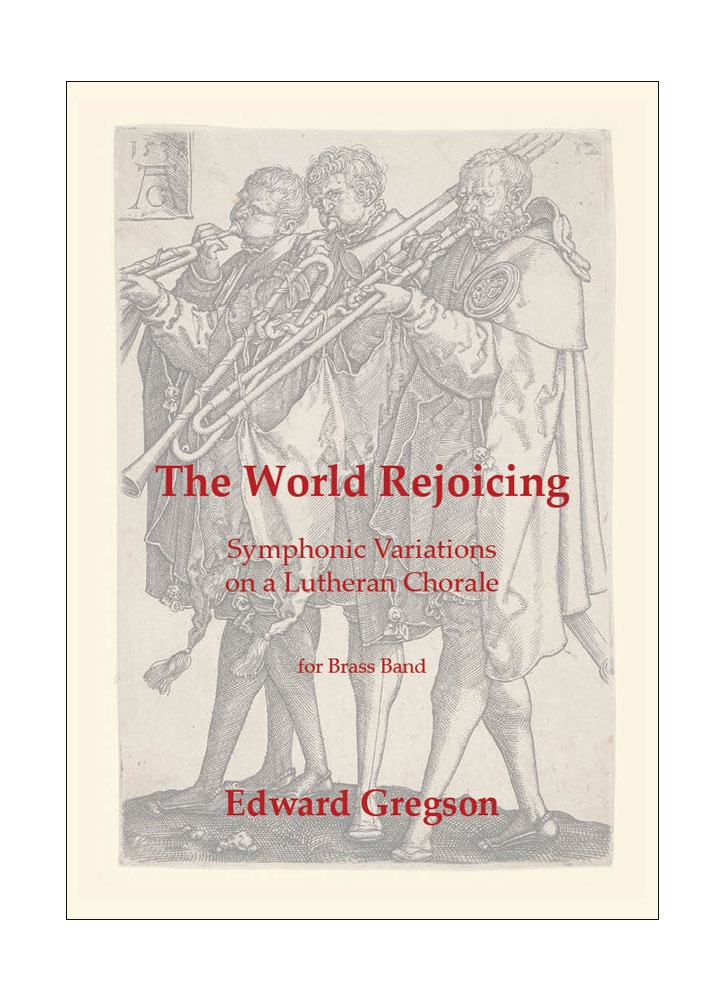
The World Rejoicing (Brass Band - Study Score)
In searching for a common link between the brass band traditions of the various European countries that commissioned this work, I considered the fact that hymns have always played an important role in the relationship that brass bands have with their particular communities; and thus I turned to a well-known Lutheran chorale, Nun danket alle Gott (Now thank we all our God), written around 1636 by Martin Rinkart, with the melody attributed to Johann Crger. A number of composers have incorporated this chorale into their music, most famously J.S.Bach in his Cantatas no. 79 and 192, and Mendelssohn in the Lobsegang movement of his 2nd Symphony (the harmonization of which is usually used when this hymn is sung).It seemed fitting therefore for me to return to a compositional form I have used many times before (Variations) and to write a work based on this hymn. I have used it in a similar way to that which I employed in my Variations on Laudate Dominum of 1976 - that is, rather than writing a set of variations using elaborations of the complete tune, I have taken various phrases from the chorale and used them within the context of other musical material, applying an overall symphonic process of continuous variation and development. The structure, or sub-divisions of the work, which is through composed and plays without a break, is as follows: Prelude, Capriccio, La Danza 1, Processional, La Danza 2, Arias and Duets, Fuga Burlesca, Chorale, and Postlude.The work is also partly autobiographical - in the manner say of Strauss's Ein Heldenleben - in that I have incorporated into the score brief quotations from many of my other major works for brass band. In that respect, The World Rejoicing sums up a particular facet of my life as a composer, and reflects the admiration I have always had for what is surely one of the great amateur music-making traditions in the world.The World Rejoicing is dedicated 'in loving memory of my brother', Bramwell Logan Gregson, who sadly passed away in the Autumn of 2018.Edward Gregson
Estimated dispatch 7-14 working days
-
 £9.99
£9.99Christmas Collection - Large Print A4
Christmas Collection is a newly revised carol book with original, additional and rearranged carols from New Christmas Praise as well as 10 extended pieces. Parts are now also available in large print A4 size!Titles:A child this day is bornA Christmas lullabyA great and mighty wonderAll I want for Christmas is youAll my heart this night rejoicesAngels, from the realms of Glory (Come and worship)Angels, from the realms of Glory (Iris)Angels we have heard on highA starry nightAs with gladness men of oldAuld lang syneA virgin most pureAway in a manger (The manger scene)Away in a manger (Traditional)A winter's taleBethlehemBrightest and best (Spean)Brightest and best (Traditional)Calypso CarolCarol for the NativityCarol of the bellsCarol of the drumChild of MaryChristians Awake!Christ is born (Il est n)Christ was born on Christmas DayCome and join the celebrationCome, children, come quicklyCoventry CarolDeck the hallDing dong! merrily on highDo you hear what I hear?Frosty the snowmanGabriel's MessageGaudeteGlory in the highestGlory in the highest HeavenGod of God, the uncreatedGod rest you merry, gentlemenGood Christian men, rejoiceGood King WenceslasGo, tell it on the mountain!Happy Christmas (War is over)Hark the glad sound!Hark! the herald angels singHave yourself a merry little ChristmasHere we come a-wassailingHow far is it to Bethlehem?Huron CarolInfant HolyIn the bleak midwinter (Cranham)In the bleak midwinter (Darke)I saw mommy kissing Santa ClausI saw three ships come sailing inIt came upon a midnight clear (Traditional)It came upon a midnight clear (Willis)It's beginning to look a lot like ChristmasIt's the most wonderful time of the yearI wish it could be Christmas everydayI wonder as I wanderJesus, good above all otherJingle BellsJingle bell rockJoy to the world!Last ChristmasLet it snow!Little baby JesusLittle children, wake and listenLittle DonkeyLittle Jesus, sweetly sleepLo! he comes with clouds descendingLong, long agoLove came down at ChristmasMary's boy childMary's ChildMasters in this hallMerry Christmas everyoneMistletoe and wineNoelO Christmas treeO come, all ye faithfulO come, ImmanuelO Heaven-sent KingO holy night!O little town of Bethlehem (Christmas Carol)O little town of Bethlehem (Forest Green)O little town of Bethlehem (St Louis)Once in royal David's cityPast three o'clockPatapanPersonent HodiePraise ye the LordRing the bellsRise up, shepherd!Rockin' around the Christmas treeRudolph, the red-nosed reindeerSans day carolSanta Claus is comin' to townSaviour's DaySee, amid the winter's snowSilent Night!Sleigh RideSoftly the night is sleepingSo here it is, merry ChristmasStars are shiningStill, still, stillStop the cavalrySussex CarolSweet chiming bellsSweet chiming Christmas bellsThe candle songThe cherry tree carolThe Christmas songThe first NowellThe holly and the ivyThe infant KingThe light has comeThe shepherds' farewellThe stable doorThe star in the eastThe twelve days of ChristmasThe virgin Mary had a baby boyThey all were looking for a kingThou didst leave thy throneThree kings' marchUnto us a boy is bornWalking in the airWe gather round the manger-bedWe three kings of Orient areWe wish you a merry ChristmasWhat child is this?When a child is bornWhen Santa got stuck up the chimneyWhence is that goodly fragrance flowing?When wise men came seekingWhile shepherds watched (Cranbrook)While shepherds watched (Handel)While shepherds watched (Winchester Old)White ChristmasWho is he?Winter WonderlandWorldwide Christmas messageZither CarolA starry nightChristmas JoyChristmas PraiseCoventry CarolInfant HolyMid-winterRudolph, the red-nosed reindeerThe everlasting lightTo celebrate his birthYuletide Rag
Estimated dispatch 7-14 working days
 Watch video