
Results
-
 £29.95
Keep in step! (Brass Band - Score and Parts)
The Salvation Army song Keep in step (S.A.S.B. 986) is given a tongue-in-cheek treatment, with the irony of a song that speaks of keeping in step at all times being used in a time signature that would be impossible to march to! This does make the music technically challenging and therefore careful preparation is needed to ensure everything remains within the correct bear, and that the rhythms sound convincing to the listener. There is also a touch of Broadway thrown in, with a recurring motif reminiscent of Gershwin's appropriately named Fascinating Rhythm.
Estimated dispatch 7-14 working days
-
 £12.00
Of Men and Mountains (Brass Band Study Score)
Of Men and Mountains was commissioned by the Netherlands Brass Band Championships for their 10th Anniversary Contest, held in Drachten in December 1990.The title of the work and its genesis came about as a result of a train journey the composer took in July 1989 across Canada from Toronto to Vancouver. The awe-inspiring journey through the Rocky Mountains, with its high peaks and shafts of sunlight breaking through the clouds, with its canyons and ferocious rapids, made the composer understand a little more about the majesty of nature and the fragility of humanity. The eternal struggle between man and nature was personified in the building of this incredible railway, hence the title (after Blake).The work is dedicated to the memory of Eric Ball, who died shortly before the writing of the work commenced.Of Men and Mountains is in one continuous movement and lasts about 17 mins. Its form is difficult to describe because of its motivic and accumulative nature, but it is essentially a symphonic tone poem in search of a theme, which eventually comes in its final and complete state in the majestic ending after an ever-increasing paced scherzo.Duration: 17.00
Estimated dispatch 7-14 working days
-
 £38.95
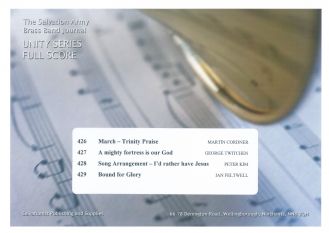
Unity Series Band Journal February 2015 Number 426 - 429
No. 426 March - Trinity Praise (Martin Cordner)Written in 2013 for the first anniversary of the Trinity Brass training band (a joint initiative between Rock Ferry and Birkenhead corps), this march celebrates God the Father, Son and Holy Spirit and calls to mind two songs: Father, we love you and verse 5 of Will J. Brand's song, Sing we many years of blessing.No. 427 A mighty fortress is our God (George Twitchen)The words and melody to this great hymn were written by Martin Luther and are based on PSalm 46. It has been called 'The battle hymn of the Reformation' for the effect it had on increasing support for the Reformer's cause. The words and melody are so closely associated with its author, that the first lines are inscribed on Luther's monument at Wittenberg.No. 428 Song Arrangement - I'd rather have Jesus (Peter Kim)Bandmaster Peter Kim from the USA Central Territory presents an arrangement of the popular gospel song, 'I'd rather have Jesus than silver or gold.' The lyrics were written by Rhea F. Miller in 1922 and have proved popular with many Christian denominations ever since.No. 429 Bound for Glory (Ian Feltwell)The song 'I'm a soldier bound for glory' was first published in 1922, is a great Salvation Army song of testimony and still remains a firm favourite today.
Estimated dispatch 7-14 working days
-
 £45.00
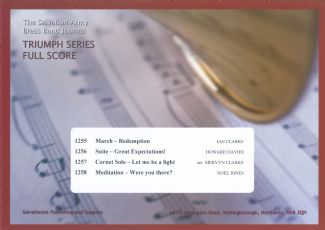
Triumph Series Band Journal November 2014 Numbers 1255 - 1258
No. 1255 March - Redemption (Ian Clarke)The words redemption and salvation are synonymous with each other. In theology, the word redemtion is defined as 'delivering from sin' or 'saving from evil'; sentiments that are expressed in some of the words associated with the songs that are featured in this music.No. 1256 Suite - Great Expectations! (Howard Davies)Three songs (written over a period of 25 years) are drawn together in this suite as a reminder of the great expectations rightfully held by every child of God.No. 1257 Cornet Solo - Let me be a light (arr. Mervyn Clarke)A setting for Cornet and band of Major Joy Webb's song, 'Let me be a light'.No. 1258 Meditation - Were you there? (Noel Jones)This meditation on Christ's crucifixion features the song, 'Were you there?', and the chorus, 'He died of a broken heart'.
Estimated dispatch 7-14 working days
-
 £38.95
Unity Series Band Journal October 2014 Numbers 422 - 425
No. 422 March - Jubilant Day! (Harold Burgmayer)This accessible march was written for the small, but faithful, corps band in Lock Haven, Pannsylvania, USA, on the occasion of the corps' 125th anniversary.No. 423 Euphonium Solo - Abide with me (Martin Cordner)A sensitive three-verse setting of William H. Monk's well-known tune for Euphonium and band.No. 424 March - God's Faithfulness! (Howard Davies)This march was written to assist celebrations for a recent Salvation Army Congress held in the Indonesian Territory. The music is deliberately written in the style of a 'parade (or street) march' with a steady and unhurried tempo.No. 425 Song Arrangement - Oi, oi, we are gonna praise the Lord! (Doug Engle)This chorus by Doug Horley uses some 'invented' words, but it clearly communicates how our response should be to a God who loves us.
Estimated dispatch 7-14 working days
-
 £152.99
Rem-Scapes (Brass Band - Score and Parts)
Sweet echoes of Beethoven's Moonlight Sonata in the introduction bring a gentle slumber. Breathing is calm and sleep holds the promise of rest and relaxation. With the onset of the REM sleep phase, however, in which most dreams take place and where the day's events are worked through, we hear other sounds played. With distorted sounds, reminiscent of an old gramophone, the music pulls the listener inevitably ever deeper into the dreamscape, in a very realistic dangerous situation that comes to a dramatic head. It triggers a desperate struggle between the impulse to awaken and the exhausting urge to flee. For a short moment, it seems as if the wakeful urge has won out, before dream's powerful spell is again cast, and there's no escape...Duration: 17:00
Estimated dispatch 7-14 working days
-
 £34.95
Fanfare of Joy (Brass Band - Score and Parts)
Based on 'Joy to the World' and 'The First Nowell', this spectacular work opens with a majestic brass fanfare, before breaking in a Celtic-style dance which builds to a dramatic conclusion.
Estimated dispatch 7-14 working days
-
 £24.50
Celtic Flavour
New from the pen of Ron Glynn, comes a new composition with a Scottish feel throughout. With percussion driving the peice forward from start to finish, the haunting melody leaves you with the images of the Scottish landscape.
Estimated dispatch 7-14 working days
-
 £15.99
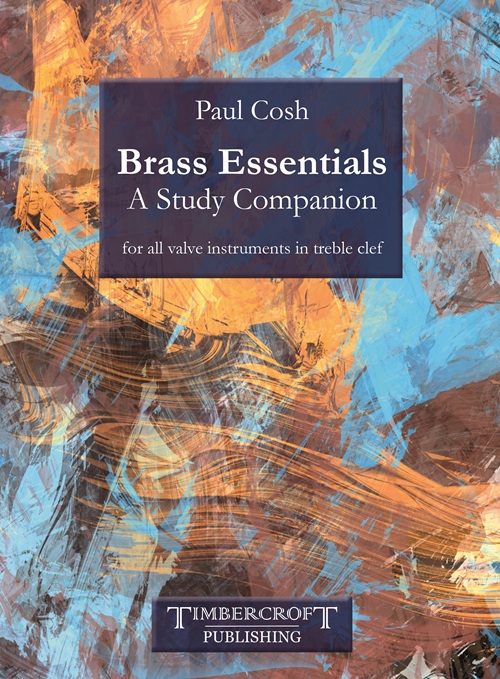
Brass Essentials - An Study Companion (for all valve instruments in treble clef)
This book of 32 studies has been drawn from those Paul Cosh used as a student at the Royal Academy of Music, throughout his years as a professional player and as a teacher at the Guildhall School of Music & Drama.The studies are divided into four main sections: Articulation, Finger Technique, Lyrical & Flexibility and Stamina & Technique and are drawn from those written by Arban, Charlier, Boehme, Brandt, Kopprasch and Sachse. Some of the studies have been re-imagined and edited to include new tempi and expression.There are helpful tips at the start of each section with most of the studies given suggested practice and performance tempi, although these are just a guide. Slow practise of the highly technical passages is vital to adhere to the overriding principle that every note counts.The Brass Essentials Study Companion can also work in conjunction with both the Brass Essentials: Arban Companion and the Brass Essentials: Practice Companion to vary your practice diet.
Estimated dispatch 7-14 working days
-
 £82.95
Vivat! (Score and Parts)
VIVAT! was commissioned by Kapitol for the 2012 National Championship of Great Britain first section final as a celebration of the Queen's Diamond Jubilee. The work is split into three contrasting sections that run continuously, with music derived from elements of Parry's coronation anthem I Was Glad. In Memoriam evokes the noble but gentle personality of the Queen's father, George VI. Opening with an atmospheric baritone solo (and later featuring solo horn, flugel, euphonium & solo cornet), the music explores themes of grief, sentimentality and hope. Coronation, a fanfare and subsequent theme, is grandiose in style capturing the spirit and excitement of British pomp and ceremony.The closing Jubilate is a celebration of life and family values, Vivat being the Latin for life or long live. The music passes through moments of tension, virtuosity, humour and jubilance before a finale constructed from connected musical fragments drawn from throughout the work, forming (for the first time) Parry's majestic I was Glad theme.
Estimated dispatch 7-14 working days