
Results
-
 £54.99
The Logical Song (Brass Band - Score and Parts)
The Logical Song was written by the lead singer of the famous British pop band Supertramp - a song about a happy, carefree child growing up to become a cynical adult. It was one of the group's biggest worldwide hits. Andr? Waignein's brass band arrangement will be a big hit with all Supertramp fans and may well attract many new fans! 03:40
Estimated dispatch 7-14 working days
-
£14.99
The Logical Song (Brass Band - Score only)
The Logical Song was written by the lead singer of the famous British pop band Supertramp - a song about a happy, carefree child growing up to become a cynical adult. It was one of the group's biggest worldwide hits. Andr? Waignein's brass band arrangement will be a big hit with all Supertramp fans and may well attract many new fans! 03:40
Estimated dispatch 7-14 working days
-
 £60.99
TURTLE DOVE, The (Brass Band) - Crausaz, Etienne
The Turtle Dove is without a doubt one of the most well-known British folk songs, right up there with the likes of Greensleeves or Drink to Me Only. The Turtle Dove has been skilfully arranged for brass band by Swiss composer and arranger Etienne Crausaz, carefully keeping the mood and intimacy of the original melody. Duration: 3:40.
Estimated dispatch 7-14 working days
-
£37.95
Bass in the Ballroom (Eb Bass Solo with Brass Band) - Newsome, Roy
Solo part provided in Eb TC and C BC.Duration 4:40
Estimated dispatch 7-14 working days
-
 £45.00
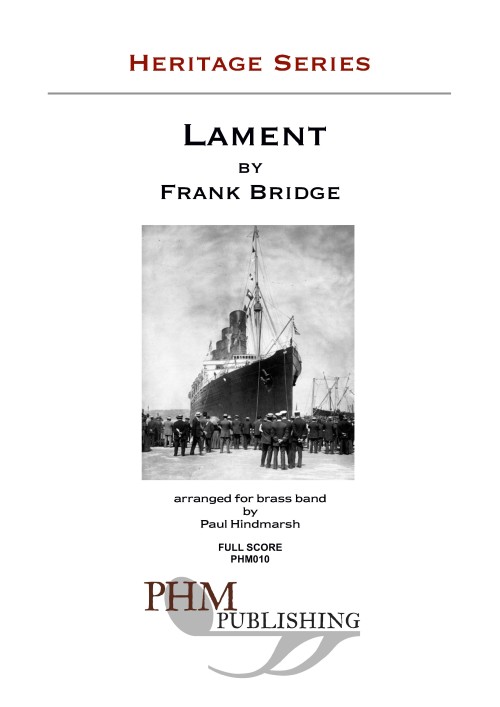
Lament (Brass Band - Score and Parts) - Bridge, Frank - Hindmarsh, Paul
The English composer Frank Bridge (1879 - 1941) did not take an active part in the First World War. However, he was devastated by the slaughter on the western and the eastern fronts, especially the loss of so many of his musicians friends and colleagues. Writing in 1963, his former pupil Benjamin Britten confessed that 'a lot of my feelings about the First World War which people seemed to see in the War Requiem came from Bridge. He had written a piano sonata in memory of a friend killed in France and though he didn't encourage me to take a stand for the sake of a stand, he did make me argue and argue and argue. His own pacifism was not aggressive, but typically gentle'.Bridge composed this Lament for string orchestra on 14 June 1915, in memory of Catherine Crompton, who drowned when the Cunard liner Lusitania was torpedoed by a German submarine on 7 May, 1915. According to figures researched by Liverpool historian Kevin Roach (www.lusitania.net), 1201 men, women and children lost their lives out of the 1962 people aboard. Ninety-four children died, including Catherine, her twin brother Paul and four other siblings. Paul Crompton, Snr. (44), a British businessman working in Philadelphia, his wife Gladys (40) and the family nanny were also drowned. How Bridge's dedication came about is uncertain. The music critic Edwin Evans, who knew Bridge well, has written that the Catherine was a young friend. It is also possible that he came across the family photograph which was published in many newspapers in the wake of the tragedy. By that time, Bridge was greatly distressed by the war as a whole. It seems perfectly in keeping with his pacifist leanings and the strength of his reaction, that this poignant and deeply touching 'war memorial' should mourn a child who he did not know, rather than one of the thousands of young men who fell in battle.Through the musical tears of this melancholy lullaby, Bridge may have regarded the death of young Catherine Crompton as symbolic of the loss of so many innocent lives in wartime. His response to this personal tragedy was characteristically spontaneous and utterly sincere. It is one of his most effective miniatures, poignant yet restrained in its lyrical beauty, with a compelling directness and simplicity of construction.This brass band transcription is pitched one tone lower than the original for string orchestra.- Paul HindmarshDuration: 5.00
Estimated dispatch 7-14 working days
-
 £54.99
Mid-Winter (Brass Band - Score and Parts) - Bulla, Stephen
This beautiful Christmas tune by Stephen Bulla sets the perfect atmosphere for your Christmas concert. Light the candles and enjoy the most wonderful time of the year with friends, family and music.Duration: 4:40
Estimated dispatch 7-14 working days
-
 £56.00
ENGLISH PASTORALE (Brass Band Set) - Jones, Dean
2015 National Championships Regional Testpiece - 4th Section. Score and Parts. This piece realises a long-time ambition of the composer to write a descriptive piece in a pastorale style. The idea of depicting the seasons and reflecting some of the grandeur of the English scenery proved an inspiring source to write this 4 movement piece. After the dignified initial theme Heralding the Dawn is established, the piece moves naturally into Autumn on the Plaines, a light, joyful scene. Winter in the Dales has a more mysterious and contains a somewhat darker feel in the minor key while Spring on the Lakes is a flowing, scenic movement. Summer on the Quays starts with some exciting fanfare-like qualities initially from the Cornets and Trombones, but then extra impetus is provided from the whole band. The music moves then into a dynamic and resounding conclusion. Duration: 11:40
Estimated dispatch 7-14 working days
-
 £30.00
Fanfare (from La Peri) (Brass Band - Score and Parts) - Dukas, Paul - Littlemore, Phillip
La Peri is a 1912 ballet in one act by French composer Paul Dukas, about a man's search for immortality and encounter with a mythological Peri (a winged, fairy-like creature). The original music to La Peri was written in 1911 as a Poeme Danse En Un Tableau (Dance Poem in One Scene), and was his last published work. The ballet itself is preceded by this brilliant fanfare which is often performed separately. This arrangement is for full brass band, and would make a good opener for any concert or event. It can also be performed with or without percussion. Duration: 1:40
Estimated dispatch 7-14 working days
-
 £45.00
Symphony No.1, Finale from (Brass Band - Score and Parts) - Rachmaninoff, Sergei - Littlemore, Phillip
Rachmaninov composed his First Symphony in 1895, at the age of just 22 years. It received its first performance on March 27, 1897, at a Russian Symphony Society concert in St. Petersburg with Alexander Glazunov conducting. The premiere was not well-received, and Rachmaninov himself blamed Glazunov for a lacklustre approach for beating time rather than finding the music. Some contemporary reports even suggested that Glazunov was inebriated when he took to the stage! Despite the disappointment of the premiere performance, Rachmaninov never destroyed the score but left it behind when he left Russia to settle in the West, eventually it was given up for lost. After the composer's death, a two-piano transcription of the symphony surfaced in Moscow, followed by a set of orchestral parts at the conservatory in Saint Petersburg. In March 1945, the symphony was performed in Moscow for the first time since its 1897 premiere. It was a grand success, and this led to a new and more enthusiastic evaluation of the symphony. In March 1948 it received a similarly successful American premiere and the work proceeded to establish itself in the general repertory. The final movement (Allegro con fuoco) is colourful and grand but not without its darkly contrasting, menacing episodes that intensifies its malevolence. It is a work overflowing with ideas demonstrating a strong, highly individual, and self-assured young talent. Duration: 5:40
Estimated dispatch 7-14 working days
-
£144.99
Toccata e Fantasia (Brass Band - Score and Parts)
Toccata e Fantasia was inspired by the composers' love of Anton Bruckner's fantastic wind instrument scoring in his symphonies. Within Toccata e Fantasia Thomas Doss has used several of Bruckner's motifs. In addition to these obvious references you will also find hints of Eastern music with the small motifs being repeated again and again in a sort of Indian guru's mantra, and an improvised blues section with a Big Band feel! A unique concert work that will thrill your audience. 10:40
Estimated dispatch 7-14 working days
 View Music