
Results
-
 £95.00
Concertante (Piano Solo with Brass Band - Score and Parts)
This work was written in 1966, when I was a student at the Royal Academy of Music in London. It was the first major work to be written for this combination. The Concertante is unashamedly romantic in idiom and is cast in three movements: Prelude, Nocturne and Rondo.The Prelude is in sonata form with a contracted recapitulation. There are two main themes, the first announced after the opening flourish on piano. The second theme is lyrical in character and the interplay between these two themes forms the main focus of the movement.The pensive Nocturne opens with an introduction from the band which contains hints of the two main ideas to follow. The solo piano announces the main theme, which has a slightly 'blues' character in its flattened third and seventh notes of the scale. The band enters with the chorale theme already heard in the introduction. Eventually the first theme returns, this time from piano and band and building to a powerful climax before subsiding to a peaceful ending.The Rondo is full of energetic rhythms and changing time patterns. The main theme is 'giocoso' in character and in the first episode there is more than a hint of the tune 'Onward Christian Soldiers' in what amounts to a good humoured parody. Before the final coda there is a long piano cadenza underlying the virtuoso element of the work.The work had a number of public performances leading up to a memorable one in the Royal Albert Hall in 1989 as part of the Gala Concert that used to be held after the National Brass Band Championship in the Royal Albert Hall. That year, the 'centre band' in the massed bands concert were the GUS Band (then known for sponsorship reasons as 'Rigid Containers Group Band'!) conducted by my great friend and champion, Bramwell Tovey, with myself as the soloist.- Edward GregsonDuration: 18.00
Estimated dispatch 7-14 working days
-
 £14.95
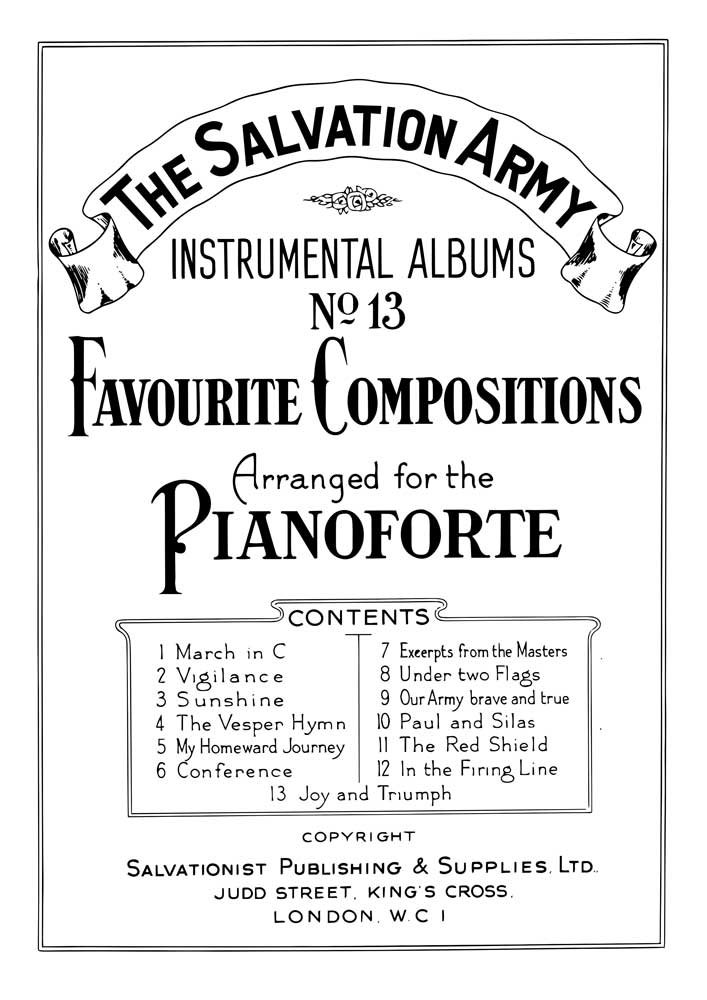
Instrumental Album No.13 - Piano Solos
Includes: March in C; Vigilance; Sunshine; The Vesper Hymn; My homeward journey; Conference; Excerpts from the Masters; Under two flags; Our Army brave and true; Paul and Silas; The Red Shield; In the firing line; Joy and TriumphInstrumentation: Favourite Compositions for the Pianoforte
Estimated dispatch 7-14 working days
-
 £14.95
Healing Waters (Cornet and Piano)
This is an original, poignant setting by Kenneth Downie of words by Albert Osborn, the 6th General of The Salvation Army. The words of the chorus are perhaps better known than the verses; 'From a hill I know, Healing waters flow, O rise Immanuel's tide, And my soul overflow!'
Estimated dispatch 7-14 working days
-
 £95.00
Concertante (Piano Solo with Brass Band - Score and Parts) - Gregson, Edward
This work was written in 1966, when I was a student at the Royal Academy of Music in London. It was the first major work to be written for this combination. The Concertante is unashamedly romantic in idiom and is cast in three movements: Prelude, Nocturne and Rondo.The Prelude is in sonata form with a contracted recapitulation. There are two main themes, the first announced after the opening flourish on piano. The second theme is lyrical in character and the interplay between these two themes forms the main focus of the movement.The pensive Nocturne opens with an introduction from the band which contains hints of the two main ideas to follow. The solo piano announces the main theme, which has a slightly 'blues' character in its flattened third and seventh notes of the scale. The band enters with the chorale theme already heard in the introduction. Eventually the first theme returns, this time from piano and band and building to a powerful climax before subsiding to a peaceful ending.The Rondo is full of energetic rhythms and changing time patterns. The main theme is 'giocoso' in character and in the first episode there is more than a hint of the tune 'Onward Christian Soldiers' in what amounts to a good humoured parody. Before the final coda there is a long piano cadenza underlying the virtuoso element of the work.The work had a number of public performances leading up to a memorable one in the Royal Albert Hall in 1989 as part of the Gala Concert that used to be held after the National Brass Band Championship in the Royal Albert Hall. That year, the 'centre band' in the massed bands concert were the GUS Band (then known for sponsorship reasons as 'Rigid Containers Group Band'!) conducted by my great friend and champion, Bramwell Tovey, with myself as the soloist.- Edward GregsonDuration: 18.00
Estimated dispatch 7-14 working days
-
£35.00
Concertante (Piano Solo with Brass Band - Score only) - Gregson, Edward
This work was written in 1966, when I was a student at the Royal Academy of Music in London. It was the first major work to be written for this combination. The Concertante is unashamedly romantic in idiom and is cast in three movements: Prelude, Nocturne and Rondo.The Prelude is in sonata form with a contracted recapitulation. There are two main themes, the first announced after the opening flourish on piano. The second theme is lyrical in character and the interplay between these two themes forms the main focus of the movement.The pensive Nocturne opens with an introduction from the band which contains hints of the two main ideas to follow. The solo piano announces the main theme, which has a slightly 'blues' character in its flattened third and seventh notes of the scale. The band enters with the chorale theme already heard in the introduction. Eventually the first theme returns, this time from piano and band and building to a powerful climax before subsiding to a peaceful ending.The Rondo is full of energetic rhythms and changing time patterns. The main theme is 'giocoso' in character and in the first episode there is more than a hint of the tune 'Onward Christian Soldiers' in what amounts to a good humoured parody. Before the final coda there is a long piano cadenza underlying the virtuoso element of the work.The work had a number of public performances leading up to a memorable one in the Royal Albert Hall in 1989 as part of the Gala Concert that used to be held after the National Brass Band Championship in the Royal Albert Hall. That year, the 'centre band' in the massed bands concert were the GUS Band (then known for sponsorship reasons as 'Rigid Containers Group Band'!) conducted by my great friend and champion, Bramwell Tovey, with myself as the soloist.- Edward GregsonDuration: 18.00
Estimated dispatch 7-14 working days
-
 £9.99
£9.99Christmas Collection - Words and music (piano)
Christmas Collection is a newly revised carol book with original, additional and rearranged carols from New Christmas Praise as well as 10 extended pieces. Parts are now also available in large print A4 size!Titles:A child this day is bornA Christmas lullabyA great and mighty wonderAll my heart this night rejoicesAngels, from the realms of Glory (Come and worship)Angels, from the realms of Glory (Iris)Angels we have heard on highA starry nightAs with gladness men of oldA virgin most pureAway in a manger (The manger scene)Away in a manger (Traditional)BethlehemBrightest and best (Spean)Brightest and best (Traditional)Calypso CarolCarol for the NativityCarol of the drumChild of MaryChristians AwakeChrist is born (Il est n)Christ was born on Christmas DayCome and join the celebrationCome, children, come quicklyCoventry CarolDing dong! merrily on highDo you hear what I hear?Gabriel's MessageGaudeteGlory in the highestGlory in the highest HeavenGod of God, the uncreatedGod rest you merry, gentlemenGood Christian men, rejoiceGood King WenceslasGo, tell it on the mountain!Hark the glad sound!Hark! the herald angels singHow far is it to Bethlehem?Huron CarolInfant HolyIn the bleak midwinter (Cranham)In the bleak midwinter (Darke)I saw three ships come sailing inIt came upon the midnight clear (Traditional)It came upon the midnight clear (Willis)I wonder as I wanderJesus, good above all otherJoy to the world!Little baby JesusLittle children, wake and listenLittle DonkeyLittle Jesus, sweetly sleepLo! he comes with clouds descendingLong, long agoLove came down at ChristmasMary's boy childMary's ChildMasters in this hallNoelO come, all ye faithfulO come, ImmanuelO Heaven-sent KingO holy night!O little town of Bethlehem (Christmas Carol)O little town of Bethlehem (Forest Green)O little town of Bethlehem (St Louis)Once in royal David's cityPast three o'clockPersonent HodiePraise ye the LordRing the bellsRise up, shepherd!Sans day carolSaviour's DaySee, amid the winter's snowSilent Night!Softly the night is sleepingStars are shiningStill, still, stillSussex CarolSweet chiming bellsSweet chiming Christmas bellsThe candle songThe cherry tree carolThe first NowellThe holly and the ivyThe infant KingThe light has comeThe shepherds' farewellThe stable doorThe star in the eastThe virgin Mary had a baby boyThey all were looking for a kingThou didst leave thy throneThree kings' marchUnto us a boy is bornWe gather round the manger-bedWe three kings of Orient areWhat child is this?Whence is that goodly fragrance flowing?When wise men came seekingWhile shepherds watched (Cranbrook)While shepherds watched (Handel)While shepherds watched (Winchester Old)Who is he?Zither Carol
Estimated dispatch 7-14 working days
-
 £14.95
My Love is Like a Red, Red Rose (Euphonium and Piano)
An arrangement for Euphonium solo with brass band accompaniment of surely one of the world's greatest melodies. Its wide-ranging intervals and exquisitely shaped climax near the end give it a natural line that is truly memorable.
Estimated dispatch 7-14 working days
-
 £127.30
Rendezvous - Torstein Aagaard-Nilsen
Rendezvous was commissioned by Krohnengen Brass Band for their 50th Anniversary in 2019.Rendezvous is devided into three sections. Each section are referring to Edvard Grieg's own titles. but twisted, to make sure that everybody understand that this music is a mash-up of themes Edvard Grieg used in opus 54 (for piano) and opus 61 (songs for children).1. Trolltog med avsporing (March of the Trolls derailment)March of the Trolls is a famous part of Edvard Grieg lyric pieces, opus 54.2. Klokkeklang i feil sang (Bell ringing in wrong tune).Bell ringing show that Grieg was one of the first composers to write the way impressionists did. What happens if this beatiful piece is combined with several other themes from the same book? It somehow works in its own way.3. Pep talk til Blakken (Pep talk to Blakken)The riff used in the first part becomes an important part of the third part: a funky treat of the childrens song "Kveldssang for Blakken" (Evening song for Blakken).I felt that a rather tired old horse needed a pep talk more than a slow tune. So that is why you get this music(!) - and this is how my rendezvous with Grieg ends.Not sure what maestro Grieg would have thougt... But, I have read that the fiddlers that played the tunes Grieg used was not happy with the way Grieg used them.So there you go...Torstein Aagaard-Nilsen
Estimated dispatch 5-14 working days
-
 £30.00
A Rachmaninoff Prelude - Rachmaninoff
An arrangement by Tim Paton of this Rachmaninoff favourite for brass band.Comments from Tim:I first heard the Rachmaninoff Prelude in G minor when my brother, (Dr) Rod Paton, used to play it on the piano. The martial sound of the opening theme caught my imagination, and I knew then that this piece would sound magnificent if played by a brass band - if you like the music of Rachmaninoff, then you will love this piece! That spectacular sound that we all know, with busy, melodic bass lines, and a middle section in his well known 'romantic' style - I could already hear the euphonium playing those rippling arpeggios. In response to the enthusiasm for this magnificent piece, I have lightheartedly commented that maybe he wrote it for brass band, but there wasn't one available, so he did it for piano instead!Look and Listen (Score-reading digital sound sample):
In Stock: Estimated dispatch 3-5 working days
-
 £45.00
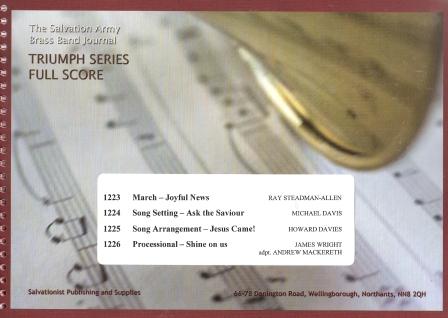
Triumph Series Band Journal March 2012 Numbers 1223-1226
No.1223 March - Joyful News (Ray Steadman-Allen)the composer freeli admits that it was probably 'doodling' on the piano that prompted this march! The title is linked to one of the incorporated tunes, 'My bonnie lies over the ocean' which, in The Salvation Army, is linked to the words, 'God's love is as high as the heavens'. In style, the march has a light swing feel.No.1224 Song Setting - Ask the Saviour (Michael Davis)A setting of the well-known melody, 'Yield not to temptation'.No.1225 Song Arrangement - Jesus Came! (Howard Davis)An arrangement of an old Salvation Army song, 'Jesus came with peace to me, His strong arm was stretched to me, Then my burden took from me - My Saviour'.No.1226 Processional - Shine on us (James Wright adapted by Andrew Mackereth)This bolero-style setting of Michael W Smith's anthem was originally made for s wedding at Sheffield Citadel. It was subsequently adapted for use at the Belfast Temple Music School when players entered the arena in groups, through several entrances, playing from memory.
Estimated dispatch 7-14 working days
 View Music