
Results
-
 £60.99
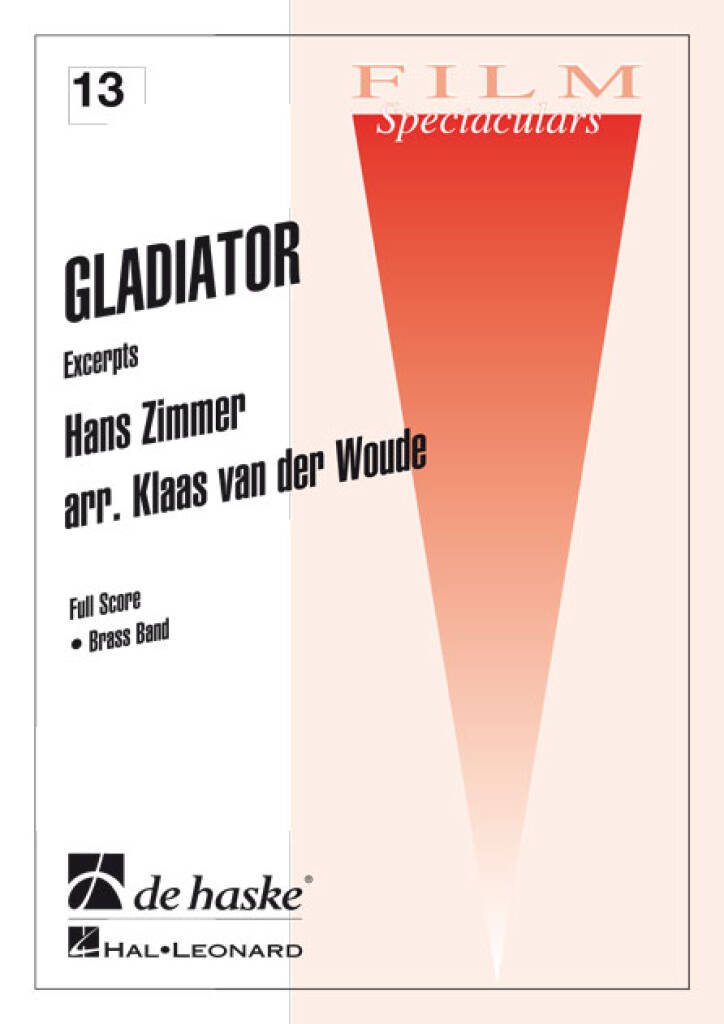
Gladiator - Hans Zimmer - Klaas van der Woude
The long list of musical film scores by the German composer Hans Zimmer includes such works as Armageddon, Rain Man, Speed and Thelma and Louise, showing he is at ease with many types of film music. Some of his best work was his music for the epic Gladiator. Klauss van der Wourde has created a great arrangement from this wonderful score.
Estimated dispatch 5-14 working days
-
 £30.00
Los Canarios - Gaspar Sanz
Gaspar Sanz (1640-1710) "The Master of the Spanish Baroque Guitar" was an Aragonese composer, guitarist, organist, teacher and priest born to a wealthy family in Calanda near Teurel. He studied music, theology and philosophy at the University of Salamanca, where he was later appointed Professor of Music. He wrote three volumes of works and studies for the Baroque guitar that form an important part of today's classical guitar repertory. The ninety guitar works he wrote included works both for the punted (pluck) and rasqueado (strummed) styles. He was also well known as a poet and writer. The Spanish composer Joaquin Rodrigo composed his famous "Fantasia para un Gentilhombre" on themes taken from Sanz's guitar works.
-
 £49.95
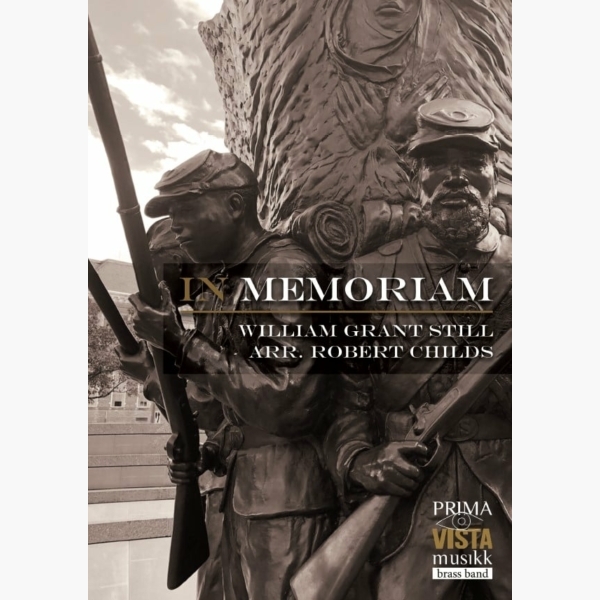
In Memoriam - William Grant Still - Robert Childs
William Grant Still Jr. (1895 - 1978) was an American composer of nearly two hundred works, including five symphonies, four ballets, nine operas, over thirty choral works, art songs, chamber music, and solo works. Born in Mississippi and growing up...
Estimated dispatch 5-7 working days
-
£29.95
The Land of the Long White Cloud (Score Only)
Dating from 1979, The Land of the Long White Cloud (Aotearoa) was Philip Sparke's first test-piece. It was commissioned by the New Zealand Brass Band Association for their 1980 National Championships (their centenary year) and set for the European Brass Band Championships, the same year, at the Royal Albert Hall in London. Aotearoa was the name given to New Zealand by its Polynesian settlers whose first sight of the islands was a long, flat cloud lying low over the land. The work has no specific programme although many have seen pictures of the surging ocean in the opening bars. A faster dance-like section leads to a slow, haunting solo for soprano cornet; this is taken up by the whole band before earlier material returns. The dance-like tune is, this time, given a fugal treatment and the opening bars return to close the work.Philip Sparke was born in London and studied composition, trumpet and piano at the Royal College of Music, where he gained an ARCM. It was at the College that his interest in bands arose. He played in the College wind orchestra and also formed a brass band among the students, writing several works for both ensembles.At that time, his first published works appeared - Concert Prelude (brass band) and Gaudium (wind band). A growing interest in his music led to several commissions, his first major one being this featured piece for the Centennial Brass Band Championships in New Zealand - The Land of the Long White Cloud. He has written for brass band championships in New Zealand, Switzerland, Holland, Australia and the UK, including three times for the National Finals at the Royal Albert Hall.In September 2000, he was awarded the Iles Medal of the Worshipful Company of Musicians for his services to brass bands and in 2005 Music of the Spheres won the National Band Association/William D. Revelli Memorial Band Composition Contest. In 2011, he received the BUMA International Brass Award for his contribution to brass music.His conducting and adjudicating activities have taken him to most European countries, Scandinavia, Australia, New Zealand, Japan, Taiwan, South Korea, Canada and the USA. In May 2000, he took the major step of becoming a full-time composer by founding his own publishing company, Anglo Music Press. The company is devoted to publishing his brass band, concert band, fanfare band and instrumental publications as well as recordings dedicated to his latest works.
Estimated dispatch 7-14 working days
-
£90.00
Kobolt - John Brakstad
"Cobalt" was commisioned by Modum Janitsjar as own choice piece for the Norwegian Wind Band Championships, third section in 2009.The Royal Cobalt Works of Modum were established in 1773 to extract cobalt ore from the local mines. The works were in operation until 1893.The cobalt was used in the production of cobalt blue pigment for the worlds porcelain and glass industry.To day it is a museum showing us how people at that time worked and lived.Most of the work was done by hand. There were also bad accidents with many fatalites.But in their free time there were dancing and drinking, and the entire piece ends with a dance-episode including a local tune.
Publisher Closed for Holidays. Est Delivery 13-14th Aug
-
£59.95
LORD IS KING, The (Brass Band Set) - Ray Steadman-Allen
Ray Steadman-Allen was for many years the driving force in Salvation Army music. His publication list of both brass and vocal works can be measured literally by the hundred. 'The Lord is King' is arguably his crowning achievement of over twenty major works for brass band. Although described as a suite, the work is more symphonic in conception and scale as well as being formidable to perform. The work is based on the Welsh hymn tune 'Llangollen' to which the hymn 'The Lord is King, I own His power' are associated. The three movements derive inspiration from the lines 'My joy, my toil, my craftman's skill, all have their place, and serve His will' found in verse five of the hymn.
Estimated dispatch 7-14 working days
-
 £30.00
Leviathan - Paul Denegri
Leviathan began its evolution as a workshop work inspired by the poem written by Heathcote Williams entitled; Whale Nation. At the time of this workshop the tentet brass repertoire existed of extremely well written original or arranged works of a lighter nature but there was a shortage of works with a greater emotional depth and edge, hence Leviathan's early conception as an atmospheric and emotive work. The workshop piece explored whale sound and song and was a 25-minute work in two parts. After many years of the workshop sketches sitting dormant the new work Leviathan is a much shorter and concise work. It contains only one of the original melodic themes of the workshop work. Leviathan is driven and underpinned by melodic and rhythmic elements. It is a programmed work following the awe inspiring majestic might and beauty of whales through to a hunt scene, the chase and the ultimate demise of earth's largest mammal.
-
 £40.00
Legends of Cyfarthfa - Matthew Hall
Legends of CyfarthfaCombining the music of Joseph Parry and the legendary Cyfarthfa Band, Legends of Cyfarthfa is a technically challenging but musically rewarding concert work. Robert Crawshay owned the Cyfarthfa Ironworks in South Wales creating a business empire second to none.Cyfarthfa Castle was built by Crawshay as the family home from the income made via the ironworks. He wanted his own private band to play under the name of the ironworks with the best players in the world, playing on the highest quality instruments at the time. Employing the band members under the guise of iron workers, the Cyfarthfa Band was made up of virtuoso players, performing for the pleasure of the Crawshay dynasty.This virtuosity can be heard in some of the more technically challenging sections of Legends of Cyfarthfa. Joseph Parry was born in Cyfarthfa.He composed the first piece of music specifically written for brass band called Tydfil Overture for the Cyfarthfa Band, alongside many other memorable works for other instrumentation.Legends of Cyfarthfa incorporates many of Parry's works including his opera Blodwen, hymn tune Aberystwyth, folk melody Myfanwy and the Tydfil Overture, alongside many other melodies from Wales. Sospanfach, Men of Harlech, Lisa Lan and Calon Lan are just a number of the melodies that are used in this composition.The premiere performance was given by Tredegar Town Band under the direction of Ian Porthouse at the 2010 Brass in Concert Championships where it was awarded the Cyril Beere Memorial Trophy for Best New Composition or Arrangement.https://matthew-hall.co.uk/wp-content/uploads/2014/08/05-Legends-Of-Cyfarthfa.mp3Legends of Cyfarthfa
Estimated dispatch 5-7 working days
-
 £95.00
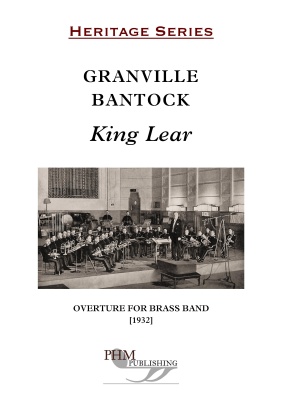
King Lear (Brass Band - Score and Parts)
Sir Granville Bantock (1868 - 1946) composed the second of his five major brass band work for Callender's Cableworks Band, completing the commission on 30 November 1932. Based in the Thames-side district of Belvedere near Erith, the band was active between 1898 and 1961. The works band of the Callender Cable & Construction Co. Ltd, it was at the peak of its popularity during the 1930s and was a frequent broadcaster on the radio. The band employed an in-house arranger and played saxophones in its lighter material. King Lear was one of the band's major commissions and was not published in Bantock's lifetime. The manuscript score and parts were thought to be lost for decades, but were found in the library of the Haydock Band (Lancashire), which had inherited part of Callender's library of manuscripts material and bespoke arrangements after it has been transferred to nearby Prescott Cables Band after Callender's Cable Works closed.King Lear is a substantial work, in essence a dramatic tone poem in the romantic Tchaikovskian manner, presenting a series of character portraits of the foolish old king and his three daughters, Goneril, Regan and Cordelia. The music is dramatic and lyrical by turns, with the most generous lyrical episode revealing perhaps the warm-hearted Cordelia. An expansive melody that flows from this is brought back towards the end as the main climax of the work.In 2001, Bantock's score was recorded by the University of Salford Brass Band, conducted by Dr. Roy Newsome. The original is serviceable, but in comparison with the orchestral version he made in 1936 (part of which was recorded on a Paxton 78 rpm) and later brass band scores, performing editions of which were prepared by others, it lacks colour and range typical of Bantock's orchestral work. Above all it lacks percussion, which can be heard on the recorded extract. With the kind permission of the Bantock Estate, I have prepared a performing edition for publication that incorporates percussion, derived from the orchestral recording and added editorially in similar manner elsewhere. I have revoiced some of the low- lying instrumental parts to present the material in more comfortable ranges. Editorial interventions more elaborate than revoicing the original text have been identified as cue notes.- Paul HindmarshDuration: 15.00
Estimated dispatch 7-14 working days
-
£40.00
King Lear (Brass Band - Score only)
Sir Granville Bantock (1868 - 1946) composed the second of his five major brass band work for Callender's Cableworks Band, completing the commission on 30 November 1932. Based in the Thames-side district of Belvedere near Erith, the band was active between 1898 and 1961. The works band of the Callender Cable & Construction Co. Ltd, it was at the peak of its popularity during the 1930s and was a frequent broadcaster on the radio. The band employed an in-house arranger and played saxophones in its lighter material. King Lear was one of the band's major commissions and was not published in Bantock's lifetime. The manuscript score and parts were thought to be lost for decades, but were found in the library of the Haydock Band (Lancashire), which had inherited part of Callender's library of manuscripts material and bespoke arrangements after it has been transferred to nearby Prescott Cables Band after Callender's Cable Works closed.King Lear is a substantial work, in essence a dramatic tone poem in the romantic Tchaikovskian manner, presenting a series of character portraits of the foolish old king and his three daughters, Goneril, Regan and Cordelia. The music is dramatic and lyrical by turns, with the most generous lyrical episode revealing perhaps the warm-hearted Cordelia. An expansive melody that flows from this is brought back towards the end as the main climax of the work.In 2001, Bantock's score was recorded by the University of Salford Brass Band, conducted by Dr. Roy Newsome. The original is serviceable, but in comparison with the orchestral version he made in 1936 (part of which was recorded on a Paxton 78 rpm) and later brass band scores, performing editions of which were prepared by others, it lacks colour and range typical of Bantock's orchestral work. Above all it lacks percussion, which can be heard on the recorded extract. With the kind permission of the Bantock Estate, I have prepared a performing edition for publication that incorporates percussion, derived from the orchestral recording and added editorially in similar manner elsewhere. I have revoiced some of the low- lying instrumental parts to present the material in more comfortable ranges. Editorial interventions more elaborate than revoicing the original text have been identified as cue notes.- Paul HindmarshDuration: 15.00
Estimated dispatch 7-14 working days
 View Music