
Results
-
 £35.00
Swan Lake, Finale from - Tchaikovsky
As a finisher, this music is as exciting as it gets! The 'fully-charged' finale to Tchaikovsky's most dramatic ballet score begins at whirlwind speed. This gives way to the famous tender love theme, which is skilfully developed by before the music builds to a thrilling and exciting conclusion. This piece won the prize for the best new arrangement at 'Spennymore' in 1996, played by the Fodens Band conducted by Phillip McCann.Recorded by Whitburn Band (Victory).
In Stock: Estimated dispatch 3-5 working days
-
 £40.00
Reflections of Tyne - Matthew Hall
Reflections of Tyne was commissioned by the NASUWT Riverside Band for their 2019 performance at Brass in Concert at The Sage in Gateshead.Reflections of Tyne combines two traditional songs from the North East of England into a rumbustious concert or contest finisher full of flair and excitement.The Waters of Tyne and The Cliffs of Old Tynemouth blend in the opening reflection of the stillness of the River Tyne before the industrial heritage of North East England is forces its way on to the landscape as the pace and intensity doubles almost instantaneously. A calmer, contemplative, solo passage precedes the final energetic climax in a vibrant musical rendition of the North East as we know it today, with the Tyne as important now as it ever has been.
Estimated dispatch 5-7 working days
-
£40.00
Dial M for Midnight - Matthew Hall
Dial M for Midnight is a jazz-based solo for aspiring and accomplished cornet players alike. Technically not particularly demanding yet quite complicated rhythmically, Dial M allows players young and old to stand up and show off their skills in a work which has it's roots in Latin America but travels through the late night smoke-filled jazz clubs along the way. Commissioned by Jim Hayes for his debut CD recording, Dial M is the title track. Nicknamed Jimmy Midnight, Jim Hayes has established himself as one of the leading cornet players in the world playing within the Scottish Co-Op Band. Dial M is a take on Jim's persona and his love of jazz, the culmination of which ends up as a witty pastiche signature track of all things James Bond to Perry Mason.
Estimated dispatch 5-7 working days
-
Kinderwalzer - Len Jenkins - Len Jenkins
The title originally began as 'kind of a waltz', but the music, in typical bier-keller fast-waltz style, progresses to be more representative of a children's nursery with fun and laughter all the way. That is, until the grotesque element appears and makes you wonder what it was that you glimpsed at the back of the wardrobe? Fortunately, all is resolved before bedtime and jollity returns. Sweet dreams!
-
Merry Christmas Polka - Sonny Burke - Len Jenkins
"Sonny" Burke was an American arranger, composer, Big Band leader and producer who during the 1940s and 1950s worked as an arranger for the Charlie Spivak and Jimmy Dorsey bands, among others. In 1955, along with Peggy Lee, he wrote the songs to Disney's Lady and the Tramp.Later he became musical director of Warner Bros. Records / Reprise Records and was responsible for many of Frank Sinatra's albums, and produced Sinatra's recording of "My Way". He was also the bandleader for recordings of leading singers such as Bing Crosby and The Andrews Sisters a highly successful close harmony singing group of the swing and boogie-woogie eras, and it was with them that Merry Christmas Polka became famous.
-
 £48.00
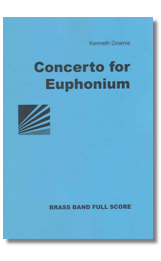
Concerto for Euphonium - Kenneth Downie
An accessible and enjoyable showpiece for soloists of all ages. The concerto's three movements are in a tuneful, melodic style and bravura passages are mixed with others designed to exploit the singing qualities of the instrument. The first movement is a vigorous allegro in which the short, pithy motifs of the opening theme contrast with the broad sweep of the second subject. A short cadenza-like passage yields to a high-spirited episode before a reprise of the opening ends the movement quietly. The second movement opens with a warm, romantic melody which is soon taken up by the soloist. A short animated section gives way to the earlier tutti theme, this time with passionate decoration from the soloist before the music gently unwinds in a tranquil coda. The finale has a bouncy, festive feel. After the first subject runs its course there is a brief journey through a more contrapuntal style, before a spirited presto moves into a compound episode before returning to the opening idea. A jubilant coda brings the work to a conclusion.
Estimated dispatch 7-9 working days
-
 £60.00
Concerto for Euphonium (Parts only) - Kenneth Downie
An accessible and enjoyable showpiece for soloists of all ages. The concerto's three movements are in a tuneful, melodic style and bravura passages are mixed with others designed to exploit the singing qualities of the instrument. The first movement is a vigorous allegro in which the short, pithy motifs of the opening theme contrast with the broad sweep of the second subject. A short cadenza-like passage yields to a high-spirited episode before a reprise of the opening ends the movement quietly. The second movement opens with a warm, romantic melody which is soon taken up by the soloist. A short animated section gives way to the earlier tutti theme, this time with passionate decoration from the soloist before the music gently unwinds in a tranquil coda. The finale has a bouncy, festive feel. After the first subject runs its course there is a brief journey through a more contrapuntal style, before a spirited presto moves into a compound episode before returning to the opening idea. A jubilant coda brings the work to a conclusion.
Estimated dispatch 7-9 working days
-
 £39.95
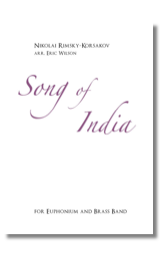
Song of India - Rimsky-Korsakov arr. Eric Wilson
'Song of India' (or more accurately the 'Song of the Hindu') from Rimsky-Korsakov's 'opera-bilina' Sadko provides a technical challenge as well as a musical one, requiring a great degree of control and accurate intonation as the subtly varied chromatic phrases weave their way over a gently undulating, almost hypnotic accompaniment. Also available with piano accompaniment (Order Code: 0317)
Estimated dispatch 7-9 working days
-
£33.00
Blockbusters! - Welch, E - Broadbent, D
The famous theme from the British television quiz show which ran from 1983 to 1993 before being revived for 4 more series, most recently in 2019.There can't be many who won't recognise this tune. A great way to get your audiences hand jiving along!
In Stock: Estimated dispatch 1-3 working days
-
£40.00
Braveheart - Horner, J - Barry, D
Positively medieval! - Braveheart is history the way it should be told, full of treachery, battle and passion and Mel Gibson in a kilt! Horner's score has a rare quality . . . it is cinematic and the themes have staying power and emotional substance (you can almost feel the cool fog rolling in from the sea and across the Scottish fields).Darrol Barry's sensitive score of the theme is stunning and anyone who has listened to this beautiful music will appreciate the depth of this arrangement.4th section +
In Stock: Estimated dispatch 1-3 working days
 View Music