
Results
-
 £76.00
Concerto for Euphonium (Parts only) - Philip Wilby
Completed on New Year's Eve 1995, Philip Wilby's concerto has already established itself as one of, if not the, greatest concerto for the instrument written so far. Its extended length seeks to explore that fine combination of sustained lyricism and explosive virtuosity which typifies the modern euphonium in the most expert hands. There are two parts which divide into four movements. Part One opens with a sonata structure movement which alternates between a melodic style and some rapid passage work. The intention of the music is a firm and cerebral development of the opening fourth-based motifs. At the tranquil conclusion of this music the second movement bursts in - Zeibekikos - a rapid and extrovert Greek Island dance complete with plate smashing! Part Two re-examines some of the opening material surrounded by cadenzas, and centred upon a short and sustained adagio. The final movement opens with a rapid fugal section which moves inexorably towards a climactic return of the music and tonality of the open
Estimated dispatch 7-9 working days
-
 £60.00
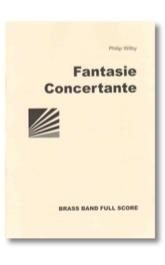
Fantasie Concertante (Score only) - Philip Wilby
This exciting new concerto is a welcome addition to the repertoire of french and tenor horn players alike. Like the 18th-Century Serenade form there are five movements, arranged symmetrically around a slow movement - Soliloquy - which separates movements entitled Burlesque (two) and Valse Caprice (three) respectively. The first and last movements share common material of a more symphonic stature, and the concerto ends with a brisk fugato. The solo horn is (in the band version) accompanied by a quintet of solo players (two cornets, euphonium, trombone, and tuba) who provide the lion's share of the counterpoint and contrast with the main body of musicians who provide musical punctuation in the more sonorous tutti sections. The first movement, Don Quixote's Dream, contains references to Cervantes' famous hero, the Spanish nature of his stories, and the ambling gait of his horseback adventures.
Estimated dispatch 7-9 working days
-
 £74.00
Fantasie Concertante (Parts only) - Philip Wilby
This exciting new concerto is a welcome addition to the repertoire of french and tenor horn players alike. Like the 18th-Century Serenade form there are five movements, arranged symmetrically around a slow movement - Soliloquy - which separates movements entitled Burlesque (two) and Valse Caprice (three) respectively. The first and last movements share common material of a more symphonic stature, and the concerto ends with a brisk fugato. The solo horn is (in the band version) accompanied by a quintet of solo players (two cornets, euphonium, trombone, and tuba) who provide the lion's share of the counterpoint and contrast with the main body of musicians who provide musical punctuation in the more sonorous tutti sections. The first movement, Don Quixote's Dream, contains references to Cervantes' famous hero, the Spanish nature of his stories, and the ambling gait of his horseback adventures.
Estimated dispatch 7-9 working days
-
 £77.00
General Series Brass Band Journal, Numbers 2230 - 2233, April 2023
2230: Prelude on 'Ascalon' (Geoffrey Nobes)This prelude was written for the Band of the Free Evangelical Church of Geisweid in Germany. The beautiful hymn tune Ascalon is heard in two complete statement, a free-flowing lyrical section followed by a contrasting section using the phrases of the melody to build to a full final working of the hymn.2231: Salt and light (Mark Feltwell)This original work follows the journey of someone who is finding their way through faith. Using inspiration from Shine, Jesus, Shine and Matthew 5:14, the journey ends with a triumphant fanfare.2232: Hymn Tune Arrangement - Esher (Dudley Bright)A two verse setting of the well know benediction, God be in my head.2233: Song Arrangement - The heart of worship (David Mills)The song The heart of worship (S.A.S.B. 635) speaks of the need to worship without any barriers or obstacles.
Estimated dispatch 7-14 working days
-
 £77.00
General Series Brass Band Journal, Numbers 2226 - 2229, December 2022
2226: March - Joyful Warrior (Steve Kellner)This march was written to celebrate the rededication and renaming of the USA National Capital & Virginia Division's music conservatory building in honour of Bandmaster James B. Anderson. It is based on two songs, Joy! joy! joy! there is joy in The Salvation Army (S.A.S.B. 963) and Joyful, joyful, we adore thee (S.A.S.B. 39).2227: Song and Dance (Ian Clarke)This music is built around two main subjects, the song Jesus put this song into our hearts (S.A.S.B. 875) and an original theme reminiscent of Slavic dance music.2228: Horn Solo - Time and talents (Stephen Bulla)A reverent tenor horn solo inspired by All there is of me, Lord (S.A.S.B. 569)2229: Promises (Sam Creamer)The well-known hymn Standing on the promises (S.A.S.B. 522) is presented in this arrangement in a driving shuffle style.
Estimated dispatch 7-14 working days
-
 £84.95
In League with Extraordinary Gentlemen (Euphonium Solo with Brass Band)
Concerto for EuphoniumIn League with Extraordinary Gentlemen combines two of composer Peter Graham's life interests - composition and 19th century popular fiction. Each of the concerto's three movements takes its musical inspiration from extraordinary characters who have transcended the original genre and have subsequently found mass audiences through film, television and comic book adaptations.The first movement follows a traditional sonata form outline with one slight modification. The order of themes in the recapitulation is reversed, mirroring a plot climax in the H.G. Wells novella The Time Machine (where the protagonist, known only as The Time Traveller, puts his machine into reverse bringing the story back full circle).The Adventure of the Final Problem is the title of a short story published in The Memoirs of Sherlock Holmes by Arthur Conan Doyle. This is an account of the great detective's final struggle with his long-time adversary Professor Moriarty at the Reichenbach Falls in Switzerland. The music takes the form of a slowed down lndler (a Swiss/Austrian folk dance) and various acoustic and electronic echo effects call to mind the alpine landscape. The final bars pose a question paralleling that of Conan Doyle in the story - have we really seen the last of Sherlock Holmes?The final movement, The Great Race, (available separately) follows Phileas Fogg on the last stage of his epic journey "Around the World in Eighty Days" (from the novel by Jules Verne). The moto perpetuo nature of the music gives full rein to the soloist's technical virtuosity. As the work draws to a conclusion, the frantic scramble by Fogg to meet his deadline at the Reform Club in Pall Mall, London, is echoed by the soloist's increasingly demanding ascending figuration, set against the background of Big Ben clock chimes.In League with Extraordinary Gentlemen was first performed in the brass band version by David Thornton and the Black Dyke Band, conductor Nicholas Childs, at the RNCM Concert Hall Manchester on January 30, 2009.
Estimated dispatch 7-14 working days
-
 £44.95
The Red Novae (Euphonium Solo with Brass Band - Score and Parts)
The title of this euphonium solo, The Red Novae, is derived from two sources; the description of a stellar explosion thought to be caused by the merger of two stars, and as a form of anagram of the dedicatee's name (Dave Thornton).The work offers the soloist an opportunity to exploit a variety of sound worlds including the use of optional electronics. (Supplied with treble and bass clef soloist parts).
Estimated dispatch 7-14 working days
-
 £95.00
A Wartime Sketchbook (Brass Band - Score and Parts)
Early in 1941 William Walton, 39, received his call-up papers. He was by then one of the most eminent of British composers and was exempted from military service on condition that he provided music for films deemed to be of 'national importance'. Scoring Lawrence Olivier's Shakespeare epic Henry V in 1943 was the most substantial of these wartime projects. His role in patriotic films from 1941 and 42 like The Foreman went to France, Next of Kin, Went the day Well and The First of the Few was to provide appropriate title music and some underscoring at key moments. Walton extracted the most substantial portions of the latter as the popular Spitfire Prelude and Fugue for orchestra. The remaining music remained unpublished until 1990, when Christopher Palmer assembled the highlights into A Wartime Sketchbook. I was intrigued to hear these examples of Walton's wartime music and having discovered that they would fit naturally and idiomatically onto the brass band, I arranged six of the numbers into a suite for Besses o' th' Barn Band, which I was conducting at the time.In 1995 the brass band suite was recorded by the famous Black Dyke Mills Band as part of an all Walton album which I produced for the ASV label (ASV CD WHL 2093). This award- winning CD also included Walton's First Shoot, in the edition by Elgar Howarth, my transcription of movements from Music for Children and two substantial brass versions by Edward Watson of the suite from Henry V (with narrator) and the March and Siegfried Music from The Battle of Britain music.Prologue: This is the stirring title music from Went the day Well, a screen play by Graham Greene about a German airborne invasion of an English village. The main theme leads toBicycle Chase: Characteristic musical high-jinks for J.B.Priestley's The Foreman went to France.Refugees: From the same film, this is a poignant accompaniment to the long march of refugees. As Ernest Irving, the film's musical director, put it, "this really makes your feet sore and your knees sag."Young Siegfrieds: This lively movement comes from the music that Walton composed for The Battle of Britain in 1968, with the assistance of Malcolm Arnold, but which the film's producer rejected. It portrays first the Berliners, cheerfully ignoring the black-out and then, in the trio, the Young Siegfrieds of the Luftwaffe, courtesy of a parody of Siegfried's horn call from Wagner's opera.Romance: A soldier and a Dutch refugee snatch a few tender moments together in Next of Kin.Epilogue: At the end of The Foreman went to France, the French look forward with hope and optimism to eventual liberation.- Paul HindmarshDuration: 14.00
Estimated dispatch 7-14 working days
-
£40.00
A Wartime Sketchbook (Brass Band - Score only)
Early in 1941 William Walton, 39, received his call-up papers. He was by then one of the most eminent of British composers and was exempted from military service on condition that he provided music for films deemed to be of 'national importance'. Scoring Lawrence Olivier's Shakespeare epic Henry V in 1943 was the most substantial of these wartime projects. His role in patriotic films from 1941 and 42 like The Foreman went to France, Next of Kin, Went the day Well and The First of the Few was to provide appropriate title music and some underscoring at key moments. Walton extracted the most substantial portions of the latter as the popular Spitfire Prelude and Fugue for orchestra. The remaining music remained unpublished until 1990, when Christopher Palmer assembled the highlights into A Wartime Sketchbook. I was intrigued to hear these examples of Walton's wartime music and having discovered that they would fit naturally and idiomatically onto the brass band, I arranged six of the numbers into a suite for Besses o' th' Barn Band, which I was conducting at the time.In 1995 the brass band suite was recorded by the famous Black Dyke Mills Band as part of an all Walton album which I produced for the ASV label (ASV CD WHL 2093). This award- winning CD also included Walton's First Shoot, in the edition by Elgar Howarth, my transcription of movements from Music for Children and two substantial brass versions by Edward Watson of the suite from Henry V (with narrator) and the March and Siegfried Music from The Battle of Britain music.Prologue: This is the stirring title music from Went the day Well, a screen play by Graham Greene about a German airborne invasion of an English village. The main theme leads toBicycle Chase: Characteristic musical high-jinks for J.B.Priestley's The Foreman went to France.Refugees: From the same film, this is a poignant accompaniment to the long march of refugees. As Ernest Irving, the film's musical director, put it, "this really makes your feet sore and your knees sag."Young Siegfrieds: This lively movement comes from the music that Walton composed for The Battle of Britain in 1968, with the assistance of Malcolm Arnold, but which the film's producer rejected. It portrays first the Berliners, cheerfully ignoring the black-out and then, in the trio, the Young Siegfrieds of the Luftwaffe, courtesy of a parody of Siegfried's horn call from Wagner's opera.Romance: A soldier and a Dutch refugee snatch a few tender moments together in Next of Kin.Epilogue: At the end of The Foreman went to France, the French look forward with hope and optimism to eventual liberation.- Paul HindmarshDuration: 14.00
Estimated dispatch 7-14 working days
-
 £29.95
Judd: Heroes of the Combat
Published two years after the end of World War Two, the title of this march projects a dual symbolism of which the composer was so fond, earlier examples being The Flag of Freedom and Victors Acclaimed. The introduction of this march is more extended and subsequent strains demonstrate a trait loved by both Coles and Marshall; the shifting between triple and duple subdivisions of the beat within attractive melodies and accompaniments.
Estimated dispatch 7-14 working days