Results
-
 £34.95
Silent Night - Christopher Bond
Silent Night and Away in a Manger; two of the most beautiful traditional Christmas carols are combined in this striking new slow jazz arrangement, to provide a subtle yet effective addition to Christmas programming. Beginning and closing with Silent Night, the arrangement features the baritone as soloist, with smaller contributions from other soloists. The central section of the work beautifully transitions into Away in a Manger, before returning to Silent Night to close. The arrangement was premiered by Tongwynlais Temperance Band in December 2015, and recorded by Cory Band in November 2016.
Estimated dispatch 10-14 working days
-
 £34.95
Aristotle's Air - Christopher Bond
The Ancient Greeks believed that there were four elements that everything was made up of: earth, water, air and fire. This theory was suggested around 450 BC, and was later supported and added to by Aristotle. The idea that these four elements - earth, water, air and fire - made up all matter was the cornerstone of philosophy, science, and medicine for two thousand years. Air was considered a 'pure' element, but in fact the air that's all around us is made up of a variety of gasses. Of course, in music, air has a different meaning; a beautiful song-like melody or tune and Aristotle's Air is just that. The work was commissioned by and written for The Cory Band as part of their winning 2015 Brass in Concert programme 'The Four Elements of the Universe', being premiered at the contest at The Sage, Gateshead, on 15th November 2015. The work was awarded the Cyril Beere Memorial Trophy for the Best New Composition or Arrangement.
Estimated dispatch 10-14 working days
-
 £79.95
Neverland - Christopher Bond
"All children, except one, grow up" wrote J.M. Barrie about Peter Pan in 1911; the first line and an expression of beautiful melancholy and fantasy, coming to represent one of the best-loved children's stories of the twentieth century. 'Peter & Wendy', as the book was first released, has subsequently been transformed into adaptations for film and stage, with subsequent books based on this iconic tale. In writing this new work for brass band, the composer has taken three of the main themes from J. M. Barrie's book, and used these themes to create new musical material, forming a work in three contrasting sections. I. Journey to Neverland The opening of the work, mysterious in its style, reflects the opening chapters of the story - a leafy London street, still in the dead of night - with the music transforming quickly as it builds in texture and momentum - a Journey to Neverland through the night sky; Second Star to the Right and straight on 'til morning. "Then Peter knew that there was not a moment to lose. 'Come,' he cried imperiously, and soared out at once into the night, followed by John and Michael and Wendy. Mr & Mrs Darling and Nana rushed into the nursery too late. The birds were flown." II. The Windows that Closed The central section of the work takes its inspiration from the sense of longing throughout the book, mainly by Peter Pan, the Darling Children & The Lost Boys. Distant memories of life before Neverland, memories of the Lost Boys' mothers, and regret at what the children have missed. Peter says "Long ago, I thought like you that my mother would always keep the window open for me; so I stayed away for moons and moons and moons, and then flew back; but the window was barred, for mother had forgotten all about me, and there was another little boy sleeping in my bed." III. Aboard the Pirate Ship The final section of the work takes its inspiration from the Pirate Ship, and Peter Pan's ultimate battle with its infamous Captain Hook. "In person, he was cadaverous and blackavized, and his hair was dressed in long curls, which at a distance looked like black candles, and gave a singularly threatening expression to his handsome countenance. His eyes were the blue of the forget-me-not, and of a profound melancholy, save when he was plunging his hook into you, at which time two red spots appeared in them and lit them up horribly."
Estimated dispatch 10-14 working days
-
 £34.95
Over The Horizon - Christopher Bond
Over the Horizon (2017), whilst both harmonically and compositionally a simple endeavour, is a spine-tingling beautiful melody for soprano cornet. Based on the painting seen in the sleeve notes of Steve Stewart's album of the same name, the work takes its inspiration from the open expansiveness of the ocean, glistening in the moonlight as four people sit quietly - two parents, a boy, and a girl. A feeling of heartfelt longing throughout the work which is developed both melodically and texturally by soloist and accompaniment; perhaps reflecting the desire to know indeed what is over the horizon. The longing intensifies with a climatic section of grandeur - a feeling of longing which arguably isn't resolved until that all-important - and high - last note. Over The Horizon was written for and commissioned by Steve Stewart and Cory Band in Spring 2017.
Estimated dispatch 10-14 working days
-
£105.00
Danceries (Set II) - Kenneth Hesketh
Danceries Set II, arranged for brass band, was first commission by Keith Allen for the Birmingham Symphonic Winds. This second set of Danceries continues the format, established in the popular Danceries (Set I), of using tunes and dances from Playford's Dancing Master (17th century) to form the basis of an extended dancesuite. In this set, the melodies have become more abstracted and project only a distant echo of their original forms. As before, each movement is self-contained, colourful and direct, with its own distinct mood.The outer movements - Jennie's Bawbee and Peascod's Galliarda - share driving percussion with a military air. Tom Tinker's Toye and Heart's Ease (movements two and three) are both settings of original melodies. All movements are more extended than in the first set, with a freer use and approach to the material; melodies now occur in various keys and are supported by a greater variety of harmonic colouring. The result is a richer, even more exhilarating set of dances.
In Stock: Estimated dispatch 1-3 working days
-
 £29.95
Cafe 1719 - Jonathan Bates
DURATION: 2'30". DIFFICULTY: 1st Section+. 'Caf 1719' was composed for the Wantage Silver Band as part of their entertainment contest sets based on the music of Johann Sebastian Bach in 2019. This particular short, jazz-inspired work is composed in tribute to the great French Pianist Jacques Loussier (1934-2019) who received global acclaim for his jazz interpretations of Bach's music, along with many other classical composers. Despite being born in the same year and living in the same country, Bach and Handel never actually met, but what if they had? Cafe 1917 acts as a musical meeting point - in a fictional Jazz Cafe by the Rhine, with the tenor horn section performing a 'Loussier-esque' version of Bach's 'Prelude No.2 in C Minor' whilst on the other side of the cafe, the trombone section follow suit with their take on Handel's 'Bourree from Music for the Royal Fireworks'. Eventually the two meet, share ideas and incorporate them into each other's melodies. Amongst the 2 main featured works by Bach and Handel, the tutti interludes are constructed on music from Bach's 'Toccata and Fugue in D Minor'. .
In Stock: Estimated dispatch 1-3 working days
-
 £29.95
Ghost of Christmas Yet To Come, The - Jonathan Bates
DURATION: 3'00". DIFFICULTY: 2nd+. Composed for Strata Brass in 2020 as part of their COVID-19 induced, virtually recorded 'A Christmas Carol' (a new suite for brass bandlasting around 30 minutes in total), 'The Ghost of Christmas Yet To Come' is a jagged and virtuosic solo for Euphonium portraying what Ebenezer Scrooge sees when he is shown how his Christmases in the future will occur by the Ghost of Christmas Yet To Come. Having already been shown how is mean and uncaring ways have impacted his life this far by the previous two visions, this 3rd and final vision is enough to force Scrooge to become a changed man and embrace the Christmas spirit with all his heart. Throughout this solo, you may hear small references to Camille Saint-Saens' 'Danse Macabre'. .
In Stock: Estimated dispatch 1-3 working days
-
 £29.95
Nightfall in Harlem - Jonathan Bates
DURATION: 5'30". DIFFICULTY: 1st+. 'Nightfall in Harlem' is a Flugel Horn solo in two short sections, each depicting a scene in the New York ditrict of Harlem, situated at the north end of Central Park. There is a heavy influence of jazz and blues throughout this solo with the opening 'Central park by night'; a moody and sleazy depiction of the bright lights of the New York skyline which engulf Central Park followed by the virtuosic 'Buskers', paying homage to the many jazz musicians who line the pavings of the park throughout the year.
In Stock: Estimated dispatch 1-3 working days
-
 £32.00
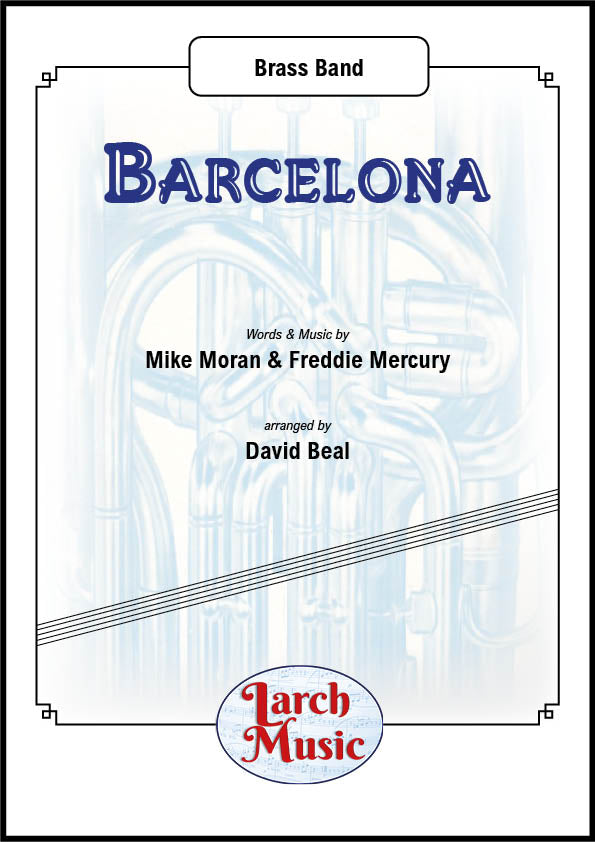
Barcelona - Vocal Duet or Cornet & Euphonium - Brass Band Sheet Music Full Score & Parts - LMAM054
COMPOSER: Mike Moran & Freddie MercuryARRANGER: David Beal"Barcelona" is a single released by Queen vocalist Freddie Mercury and operatic soprano Montserrat Caballe. A part of their collaborative album Barcelona, it also appeared on Queen's Greatest Hits III. The song reflects Mercury's love of opera with his high notes and Caballe's operatic vocals, backed by a full orchestra. Originally released in 1987, it was one of the biggest hits of Mercury's solo career, reaching number eight in the UK singles chart. After Mercury's death in 1991, it was featured at the 1992 Summer Olympics. The single was re-issued on 20 July 1992, after which the track climbed even higher, peaking at number two in the UK, the Netherlands and New Zealand. In 2004, BBC Radio 2 listed Barcelona at number 41 in its Sold On Song Top 100.Scored here for British Brass Band.
In Stock: Estimated dispatch 3-5 working days
-
 £35.00
Edward Gregson: Fanfare for a New Era (for Brass Band)
DescriptionComposer's NoteThe Fanfare has been designed to be partly antiphonal, with four separate brass 'choirs' initially playing their own music, and so some spatial separation is desirable. Soprano and solo cornets should be placed centrally, standing behind the rest of the band - or in some venues could even be placed off-stage in a side balcony, but still close to the band. If the Fanfare is played by a contesting size band, one of the solo cornets should play the 1st cornet part together with the usual player ie the number of players on the 1st, 2nd, and 3rd cornet parts should be equal. Otherwise the number of players in each of the two cornet 'choirs' is at the discretion of the conductor. The Tubular Bells accompanying the cornets 1-3 group should be placed close to that group. See inside back cover for suggested band formation.The style of playing should replicate that of symphonic brass, with a minimum of vibrato and with long notes being sustained without decaying.Programme NoteCommissioned in 2020 by Youth Brass 2000, Fanfare for a New Era was designed to be partly antiphonal - thus the separation of the band into four brass 'choirs', each with their own percussion accompaniment. First, soprano and solo cornets, rather like heraldic trumpeters, announce the main idea, majestic in character. Then horns, baritones, and euphoniums, with timpani, enter with stately figurations. Next, the heraldic trumpeters usher in trombones and tubas, to the accompaniment of tom-toms and snare drum, presenting a faster and rhythmic dance-like theme. Finally, the remaining cornets amplify the pealing of bells. All four elements then come together, surrounding the audience with a 'joyful noise' of festive brass and percussion.The original symphonic brass version of this fanfare can be purchased as part of a set of Three Fanfares HERE.For more information on Edward Gregson's music please visit the composer's website: www.edwardgregson.com
Estimated dispatch 7-14 working days