
Results
-
 £29.95
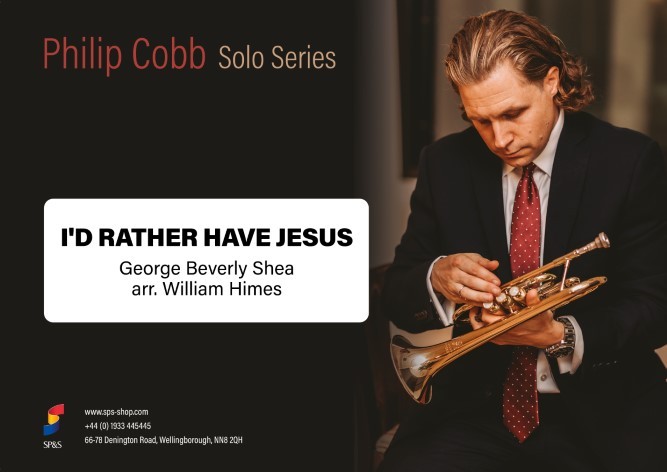
Id' Rather Have Jesus (Cornet Solo with Brass Band - Score and Parts) - Shea, George Beverly - Himes, William
The poem, I'd rather have Jesus, was written in 1922 by Rhea Miller with the tune written by George Beverly Shea. This arrangement by William Himes was originally written for William Scarlett, trumpet player with the Chicago Symphony Orchestra and former member of the Chicago Staff Band of The Salvation Army. Duration: 3.15
Estimated dispatch 7-14 working days
-
 £110.00
Diversions after Benjamin Britten (Brass Band - Score and Parts)
Suite by Lucy Pankhurst, Simon Dobson, Paul McGhee and Gavin HigginsHaving devised a collective centenary tribute for Michael Tippett at the 2006 RNCM Festival of Brass (Variations on a Theme of Michael Tippett by five eminent composers of brass band music, PHM002), I commissioned this companion piece as a Benjamin Britten tribute for the 2013 festival. In the late 1970s, while researching a book about the English composer, and Britten's first teacher, Frank Bridge (1879 - 1941), I came across a copy of the printed score of Benjamin Britten's Variations on a Theme of Frank Bridge (Op.10) for string orchestra, in which Britten had written descriptive titles for each of the variations suggesting appropriate character traits of his much loved mentor and guide. The character variations are cast in march, song and dance forms.Taking inspiration from Britten's youthful tribute, I invited four award-winning composers, who have all made significant contributions to the brass band medium, to create their own personal reflections on four aspects of Britten's character and music, designed to form a suite of Diversions after Benjamin Britten, but which can also be played separately.Lucy Pankhurst's hauntingly lyrical Prelude: His Depth refers to the emotional and symbolic subtexts that underpin Britten's operas, taking its musical cue from Britten's many arrangements of folk songs. The flugel horn takes a prominent role throughout.Simon Dobson's breathless Scherzo: His Vitality reminds us with its rapid passage work and leaping bass 'groove' that Britten loved tennis and fast cars in his younger days.Paul McGhee's evocative interpretation of the March: His Sympathy represents Benjamin Britten's pacifism, as the composer writes: 'We view the music through the eyes of a pacifist. Whilst war and violence surround us, we do not engage in it and though it continues to happen around us. With the use of muted effects in most of the band throughout the piece, the flugel horn is the lone voice of reason, standing firm against the mechanical and destructive society in which it is forced to live. As the machine of war continues around the lone voice, the voice is gradually dismissed and mocked as the war machine rumbles on into the distance.'In an extended finale, entitled Toccata: His Skill, Gavin Higgins celebrates Benjamin Britten's consummate creativity. For the RNCM Festival of Brass premiere, the four contrasting movements were framed and connected by Britten's Fanfare for St. Edmundsbury for three trumpets, with the trumpet soloists spaced round the hall. I am grateful to the Britten Estate and publishers Boosey & Hawkes for giving permission for the elements of Britten's fanfare to be incorporated in the collective work.- Paul HindmarshDuration: 19.30
Estimated dispatch 7-14 working days
-
£45.00
Diversions after Benjamin Britten (Brass Band - Score only)
Suite by Lucy Pankhurst, Simon Dobson, Paul McGhee and Gavin HigginsHaving devised a collective centenary tribute for Michael Tippett at the 2006 RNCM Festival of Brass (Variations on a Theme of Michael Tippett by five eminent composers of brass band music, PHM002), I commissioned this companion piece as a Benjamin Britten tribute for the 2013 festival. In the late 1970s, while researching a book about the English composer, and Britten's first teacher, Frank Bridge (1879 - 1941), I came across a copy of the printed score of Benjamin Britten's Variations on a Theme of Frank Bridge (Op.10) for string orchestra, in which Britten had written descriptive titles for each of the variations suggesting appropriate character traits of his much loved mentor and guide. The character variations are cast in march, song and dance forms.Taking inspiration from Britten's youthful tribute, I invited four award-winning composers, who have all made significant contributions to the brass band medium, to create their own personal reflections on four aspects of Britten's character and music, designed to form a suite of Diversions after Benjamin Britten, but which can also be played separately.Lucy Pankhurst's hauntingly lyrical Prelude: His Depth refers to the emotional and symbolic subtexts that underpin Britten's operas, taking its musical cue from Britten's many arrangements of folk songs. The flugel horn takes a prominent role throughout.Simon Dobson's breathless Scherzo: His Vitality reminds us with its rapid passage work and leaping bass 'groove' that Britten loved tennis and fast cars in his younger days.Paul McGhee's evocative interpretation of the March: His Sympathy represents Benjamin Britten's pacifism, as the composer writes: 'We view the music through the eyes of a pacifist. Whilst war and violence surround us, we do not engage in it and though it continues to happen around us. With the use of muted effects in most of the band throughout the piece, the flugel horn is the lone voice of reason, standing firm against the mechanical and destructive society in which it is forced to live. As the machine of war continues around the lone voice, the voice is gradually dismissed and mocked as the war machine rumbles on into the distance.'In an extended finale, entitled Toccata: His Skill, Gavin Higgins celebrates Benjamin Britten's consummate creativity. For the RNCM Festival of Brass premiere, the four contrasting movements were framed and connected by Britten's Fanfare for St. Edmundsbury for three trumpets, with the trumpet soloists spaced round the hall. I am grateful to the Britten Estate and publishers Boosey & Hawkes for giving permission for the elements of Britten's fanfare to be incorporated in the collective work.- Paul HindmarshDuration: 19.30
Estimated dispatch 7-14 working days
-
 £69.99
The Godfather Waltz (Brass Band - Score and Parts) - Rota, Nino - Sparke, Philip
Francis Ford Coppola's 1972 film The Godfather is seen by many to be a turning point in cinematic history. The sparse score, written by Nino Rota, is famous for its haunting main theme, played by a solo trumpet, from which The Godfather Waltz is derived. Philip Sparke has created a stunning arrangement of this theme, which appears in all three parts of the trilogy.Duration: 3:30
Estimated dispatch 7-14 working days
-
 £59.99
Tango (Brass Band - Score and Parts) - Higgins, Gavin
Tango for Trumpet or Trombone solos with Brass Band accompaniment was written for Ian Porthouse and Brett Baker in 2008. The first performance was given by the Black Dyke Band conducted by Nicholas Childs, at the Black Dyke Brass Arts Festival. Suitable for 1st Section Bands and above. Duration: 9.00
Estimated dispatch 7-14 working days
-
 £106.99
Manhattan (Cornet Solo with Brass Band - Score and Parts) - Sparke, Philip
Cornet or Trumpet Solo with Brass BandManhattan was commissioned by the United States Army Band for their solo cornet player Woodrow English and first performed by them in Carnegie Hall, New York, in November 2003. The two-movement work demonstrates both the lyrical and technical abilities of this outstanding player. The 'theme' is a weekend in New York and the opening bluesy movement, Saturday Serenade, describes the city on a Saturday night. While writing Sunday Scherzo, the composer pictured an early morning jog in Central Park. This vivaciously rhythmic second movement ends with an even quicker coda bringing the work to a brilliant close. Each movement can also be played individually when a shorter solo is required.Duration: 9:30
Estimated dispatch 7-14 working days
-
 £44.95
Tango (Por Una Cabeza) (Cornet Solo with Brass Band - Score and Parts) - Gardel, Carlos - Graham, Peter
Por una cabeza, literally translated as "by a head [of a horse]" in Spanish (meaning a horse winning a race by one head's distance), is one of the most famous and popular Argentine tangos.Composer Carlos Gardel (11 December 1890 - 24 June 1935) was a singer, songwriter and actor, and is perhaps the most prominent figure in the history of tango. The music has appeared in numerous TV and Film soundtracks, perhaps most memorably in the famous dancing scene featuring Al Pacino in Scent of a Woman. This extended arrangement for cornet (or trumpet) incorporates a cadenza and newly written interludes.
Estimated dispatch 7-14 working days
-
 £59.70
La Virgen de la Macarena (Cornet Solo with Brass Band - Score and Parts) - Freeh, Mark
La Virgen de La Macarena was the patron saint of Macarena in Seville, Spain, to whom the matadors would pray to before entering the arena. La Virgen de La Macarena is a traditional bullfighting song made famous by the great trumpet virtuoso Rafael M?ndez and now your cornet player can delight your audiences!
Estimated dispatch 7-14 working days
-
 £17.50
Concert Etude (Bb Solo with Brass Band - Score only) - Goedicke, Alexander - Broughton, William
Although firmly established in the trumpet repertoire, this exciting work has also been featured by cornet, tenor horn, trombone and even tuba players!
Estimated dispatch 7-14 working days
-
 £42.95
Evening Hymn and Sunset (Brass Band - Score and Parts) - Wiffin, Rob
The bugle call Sunset has, over the years, been combined with a number of tunes but The Day Thou Gavest, Lord, is Ended is the most usual combination with it.The words of John Ellerton's hymn are associated with the tune St Clement - generally credited to the Reverend Clement Cotteril Scholefield.The band accompaniment to Sunset is generally associated with the band arrangement by one Captain Green (1888-1974), but the arranger has taken the opportunity to give a slightly new look at the accompaniment to the trumpet call.Duration: 3.15
Estimated dispatch 7-14 working days
 View Music