
Results
-
 £77.20
The Best of Andrew Lloyd Webber - Andrew Lloyd Webber - Henk Ummels
Once again Henk Ummels has succeeded to make a rich and full arrangement using only 5 voices. This time an arrangement of highlights from the biggest musical hits from the most well known musical composer of all time. It has been arranged for beginner bands, but also very suitable for lower level bands who want something fun and entertaining. Includes music from: The Phantom of the Opera, Jesus Christ Superstar, Cats, and Joseph and the Amazing Technicolour Dreamcoat.
Estimated dispatch 5-14 working days
-
 £154.60
Kobolt - John Brakstad
"Cobalt" was commisioned by Modum Janitsjar as own choice piece for the Norwegian Wind Band Championships, third section in 2009. The Royal Cobalt Works of Modum were established in 1773 to extract cobalt ore from the local mines. The works were in operation until 1893. The cobalt was used in the production of cobalt blue pigment for the worlds porcelain and glass industry. To day it is a museum showing us how people at that time worked and lived. Most of the work was done by hand. There were also bad accidents with many fatalites. But in their free time there were dancing and drinking, and the entire piece ends with a dance-episode including a local tune.
Estimated dispatch 5-14 working days
-
 £228.70
Fanfare and Chorale - Egil Hovland - Ray Farr
This arrangement (or edition) for brass band will give the possibility for more performances of this fine work by Hovland. The composer, before his death, examined my work and made no suggestions for changes, and his approving comments were complimentary and encouraging. The work was originally written for Concert Band in 1966 as Op. 54a to St. Olaf College Band in the US. It was transcribed in 1967 for symphony orchestra as Op. 54b by the composer himself. The challenges in arranging the piece for brass band were mostly concerned with satisfactorily covering the upper register used by piccolo, flutes and clarinets, and while there are wonderful brass players around who have amazing high registers, I have aimed this edition at a level achievable by reasonably good brass band players who are willing to give time and effort into the proper preparation and delivery of the music. Having worked on this new edition with a top-class brass band, I think it sounds wonderful and interestingly different to the original. Besides the obvious differences of tone-colour and absent high notes, I have used in my scoring, the option for using a vibraphone in place of a celeste. Vaughan Williams, in his Variations for brass band writes for celeste, but because the instrument is quite rare, performances have been mostly given using a glockenspiel- but this, of course sounds two octaves higher than it was intended. I think that vibraphone and brass is an excellent combination and recommend it without hesitation in this piece. Every detail of articulation and dynamic has been considered, so in order to keep the integrity of the music, please do not change anything in the name of "interpretation". As Ravel says- "What is there to interpret?" Ray Farr
Estimated dispatch 5-14 working days
-
£76.99
Haexdonck - Guido De Ranter
This work was commissioned by the municipality of Kapelle-op-den-Bos on the occasion of the 150th anniversary of canon Jaak Muyldermans. Haexdonck is the old spelling of the present day region of "Oxdonk" where Jaak Muyldermans lived. In this three-part work the composer describes the different human aspects of canon Muyldermans' rich life. The first part, slow and dreamy, describes the writer/poet. The second dissonant part with much percussion describes his time as an army chaplain during the Great War. The third hymn-like part depicts his time as a priest. This work by Guido De Ranter, a newcomer to composition,is suitable for competitions or concerts.
Estimated dispatch 5-14 working days
-
 £60.99
Alpine March - Bertrand Moren
Bertrand Moren composed Alpine March for the Hochwaliser Musikfest in Blatten, Switzerland in 2004. The march opens in a festive 6/8 time with lots of dynamic contrast and characteristic 6/8 rhythms. The Trio-section however is written in 2/4 time and is very lyrical. With a da capo this march, written by the winner of last year's European Brass Band Composition Contest, is brought to a thrilling close.
Estimated dispatch 5-14 working days
-
£54.99
All You Need Is Love - John Lennon - Thijs Oud
The Beatles remain the biggest-selling British group of all time with their countless hits and timeless classics written by John Lennon and Paul McCartney.All You Need Is Love is one such song that recently made it into the top 40 pop songs of all time. In this arrangement Thijs Oud has utilised all the original Beatles elements whilst, at the end, integrating 'snippets' of many more of their hits.Perfect for all concert programmes this will also make an excellent finale to your events.
Estimated dispatch 5-14 working days
-
 £84.99
Christmas Brass - Richard Peaslee
Christmas Brass is a fantasy on six carols, originally commissioned by Mark Freeh for the Manhattan Brass Choir. Duration: 16:30The well-known tune, O Come, O Come Emmanuel, a hymn originally based on a plainsong melody, is here set in 5/4 meter. Modal harmonies are combined with big band style as the piece gains momentum, greatly accentuating the mood of the words, "Rejoice! Rejoice! Emmanuel." The opening 5/4 statement of the theme returns, and the piece ends quietly.In Beautiful Savior (also known by the title Fairest Lord Jesus), a hushed beginning featuring horns, euphoniums, and a muted trumpet, leads through a key change to a satisfying, chorale-likeclosing passage.In Away in a Manger, Peaslee sets two tunes, Cradle Song and Away in a Manger. Following a straightforward presentation of each melody, Peaslee plays them against one another. The music swells to a full climax followed by a hushed ending.Peaslee employs a gentle hand in It Came Upon a Midnight Clear, using flugelhorn solos and duets in a jazz-waltz style.In Silent Night, the traditional carol gets an untraditional harmonization, propelled forward by give-and-take between the two groups of brass instruments in the brass choir: trumpets and trombones versus horns, euphoniums, and tuba.Hark! The Herald Angels Sing begins with a humorous blast of discordant harmonies as multiple carols are sounded at the same time. An up-tempo 4/4 announcement of the melody in the trombone is followed by a metrical modulation in 6/8-3/4 time. An additional metrical modulation bring the music back into 4/4, but at a slower tempo and in a pronounced jazz style. Tempo I returns, and the set of six pieces closes with a big ending.Instrumentation: 4 Trumpets, 2 Horns in F, 4 Trombones, 2 Euphoniums, Tuba, Guitar, Bass, Percussion
Estimated dispatch 5-14 working days
-
 £60.99
Consolation - Jan de Haan
Wer nur den lieben Gott lasst walten was composed by Georg Neumark in about 1641 and was subtitled 'Trostlied' literally meaning consolation song. Songbooks at the time showed the popularity of this song and it is still well-known today partly due to Johann Sebastian Bach's use of the melody for one of his own chorals. In Jan de Haan's arrangement the choral is heard twice, once, alternating with the original motif from the introduction and a second time, without interruption, reflecting the composer's original intention - a song of consolation.
Estimated dispatch 5-14 working days
-
 £74.99
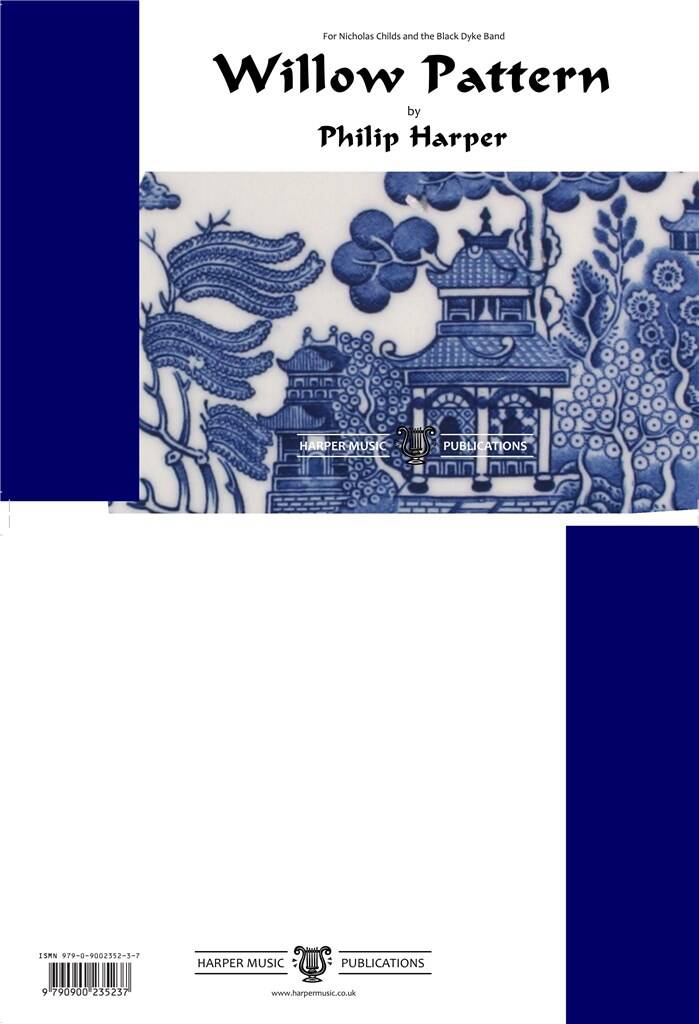
Willow Pattern - Philip Harper
Composed in 2009 for Nicholas Childs and the Black Dyke BandThis piece tells the Willow Pattern legend through music. Several leitmotifs are used both for the different characters and also for some of the important emotions in the tale. Additionally, Knoon-se's part is mainly played by the flugel horn, Changby the euphonium, the Mandarin by the Eb Bass and the Duke Ta-jin by the trombone. The Willow Pattern LegendOnce, in ancient China, there lived a wealthy and powerful Mandarin who had a beautiful daughter, Knoon-se. She had fallen in love with Chang, a humble accountant, which angered her father who imprisoned her in the Pavilion by the river with only theexotic birds for company. She learnt that the Mandarin planned to marry her to the pompous Duke Ta-jin and that the wedding would take place on the day the blossom fell from the willow tree, so she sent Chang a message: "Gather thy blossom, ere it bestolen". The Duke arrived by sea amid great fanfare when the tree was heavy with bud, and nights of magnificent banquets followed. After one such occasion when the Mandarin slept, Chang crept over the crooked fence and tiptoed into the Pavilion to rescueKnoon-se, but as they escaped the alarm was raised. They fled over the bridge with the Mandarin close on their heels brandishing his whip.They managed to escape by boat to a secluded island where they lived happily for a time. Meanwhile, the Mandarin learned of their refuge and, intent on revenge, he ordered his soldiers to kill them. As Knoon-se and Chang slept at night, the men setfire to the pagoda in which they lived and the lovers perished in the flames. However, the Gods, moved by the lovers' plight, transformed their souls into two turtle-doves which rose from the charred remains, soaring above the Earth, symbolising eternal happiness. Willow Pattern is dedicated to the memory of Jean Harper who passed away as I was completing the piece and who was a great collector of porcelain and china-ware. NOTES ON PERFORMANCEMute Requirements:Metal mutes soprano cornet, repiano cornet, 2nd cornets, 3rd cornets (6 in total) Cup mutes all cornets and trombones (10 + 3) Harmon mutes soprano cornet, solo cornets, repiano cornet (6) Percussion Requirements:There are two parts for percussion on the score. The minimum requirements are as follows: 2 players - Timpani, 2 Large tom toms, 2 Wood Blocks, Triangle, Sleigh Bells, Whip, Clash Cymbals, Suspended Cymbal, Hi-hat, Glockenspiel, Xylophone, Tam tam (or susp. cym.) For performances with extra resources, and to achieve closer authenticity, the full requirements are as follows: 3 players - Timpani, 3 Taiko Drums played with thick wooden sticks (or Large tom toms), 2 Wood Blocks, Triangle, Chinese Bells (or Sleigh Bells), Whip, Clash Cymbals, Chinese Cymbals (small clash cymbals approx 12"), Suspended Cymbal, Glockenspiel,Xylophone, Tam tam
Estimated dispatch 5-14 working days
-
 £183.99
Perihelion: Closer to the Sun - Philip Sparke
Perihelion was commissioned by the Cory Band as their own-choice piece for the 2013 European Brass Band Championships, held in Oslo, Norway. Winning the set piece section of the contest and coming second to Eikanger-Bjorsvik Musikklag with their own choice selection, Cory went on to become European Champions for the fifth time.Cory MD Philip Harper had asked for a 'Concerto for Band' to fully exploit his outstanding band of virtuosi, and composer Philip Sparke created a one-movement work with contiguous sections, first featuring horns and flugel, then trombones followed by cornets and a slower central section for percussion and baritones, euphonium andbasses.The piece is abstract in nature, without a specific programme, and the title merely reflects the fact that the piece was begun on January 2nd 2013, the day of Earth's perihelion - the point in its orbit when it is closest to the sun. It could also be argued that the piece weaves between moments of brilliant optimism and dark shadow, both of which can be the result of bright sunshine.
Estimated dispatch 5-14 working days
 View Music