
Results
-
£54.99
Studio-Pop - Kees Vlak
Studio-Pop consists of five movements. The first movement, entitled Marching on a String, is an energetic rock march in a modern rhythm. Next, the charming Dreaming of Summer has been composed in three-four time - which is quite unusual in modern pop music. The inspiration for the third movement, Chicken-Charley was a youngman selling chicken legs from a stall. His supple, dancing movements can be recognised in the music. The fourth movement, Candlelight is a modern, attractive ballad. Finally, Discoteca takes us along on a night visit to a Spanish discotheque. The typically Spanish chords and the stirring, high-spirited rhythm provide an exuberant closing to Studio-Pop.
Estimated dispatch 5-14 working days
-
 £60.99
Let's Dance - Henk Hogestein
Let's Dance takes you on an exciting night of dancing,being cool on the dance floor with your designer clothes, dancing the night away and forgetting about your daily worries. It's party time on the dance floor with this grooving new work. Brass Band goes Disco!
Estimated dispatch 5-14 working days
-
 £60.99
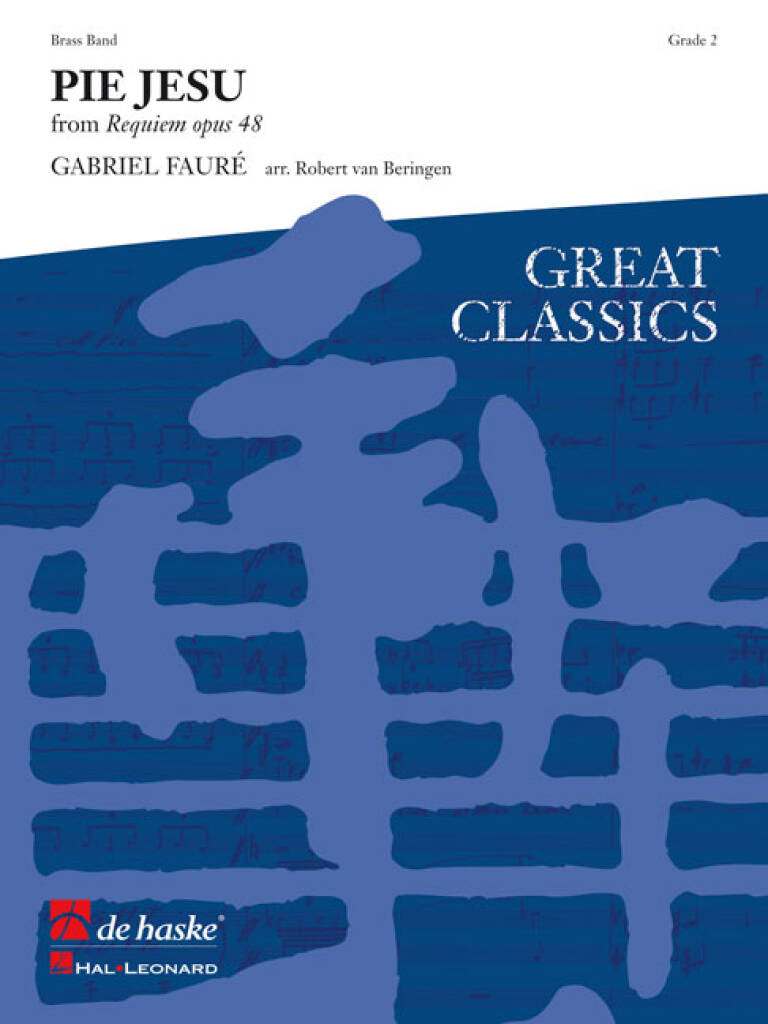
Pie Jesu - Gabriel Fauré - Robert van Beringen
Pie Jesu is the famous aria for soprano and orchestra from Gabriel Faure's Requiem, opus 48. Faure (1845- 1924) composed the work in 1887, two years after his father's death and only a short time before his mother passed away. Faure's Pie Jesu is richly atmosphere and peaceful, and Robert van Beringen perfectly captures the essence of Faure's beautiful music in this arrangement for fanfare band.
Estimated dispatch 5-14 working days
-
 £87.99
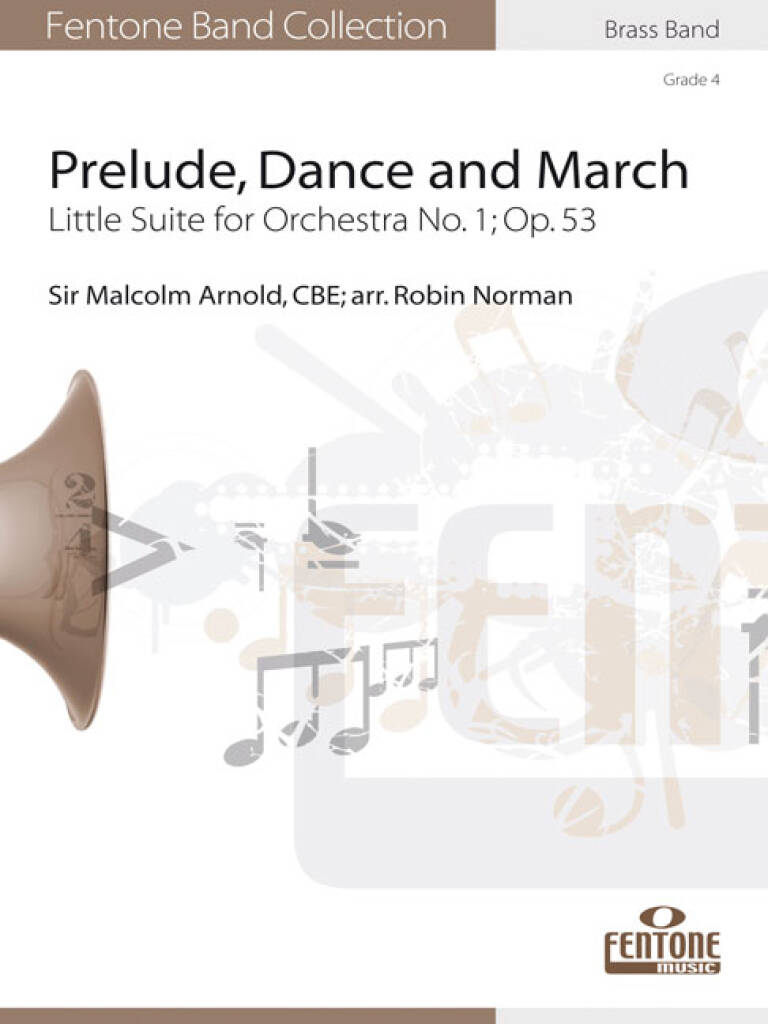
Prelude, Dance and March - Malcolm Arnold - Robin Norman
Malcolm Arnold is one Britain's best-loved composers. In 1948 he composed a very short suite for the National Youth Orchestra of Great Britain - entitled simply To Youth. Seven years later he took To Youth and made some fairly major revisions, including a complete new movement, and the Little Suite for Orchestra was born. The Little Suite for Orchestra follows a very similar pattern to the later suites for brass band, starting with a bold, strident Prelude, which strangely ends quietly before a lovely, lilting, Dance composed in 3/8 time. Finally a rollicking and militaristic March brings the suite to a conclusion. This arrangement for brass band by Robin Norman is sure tobecome a classic in the brass band repertoire.
Estimated dispatch 5-14 working days
-
 £50.00
Our Flirtations. - John Philip Sousa
The name John Philip Sousa is no stranger to any brass band aficionado. Our Flirtations has its origins in incidental music written by Sousa for a play of the same name. It was written around 1880, about the time hewas appointed Director of the U.S. Marine Band, a position he held until he formed his own civilian band in 1892. Sousa wrote over 130 marches, many of which have been transcribed for brass band.
Estimated dispatch 5-14 working days
-
 £85.00
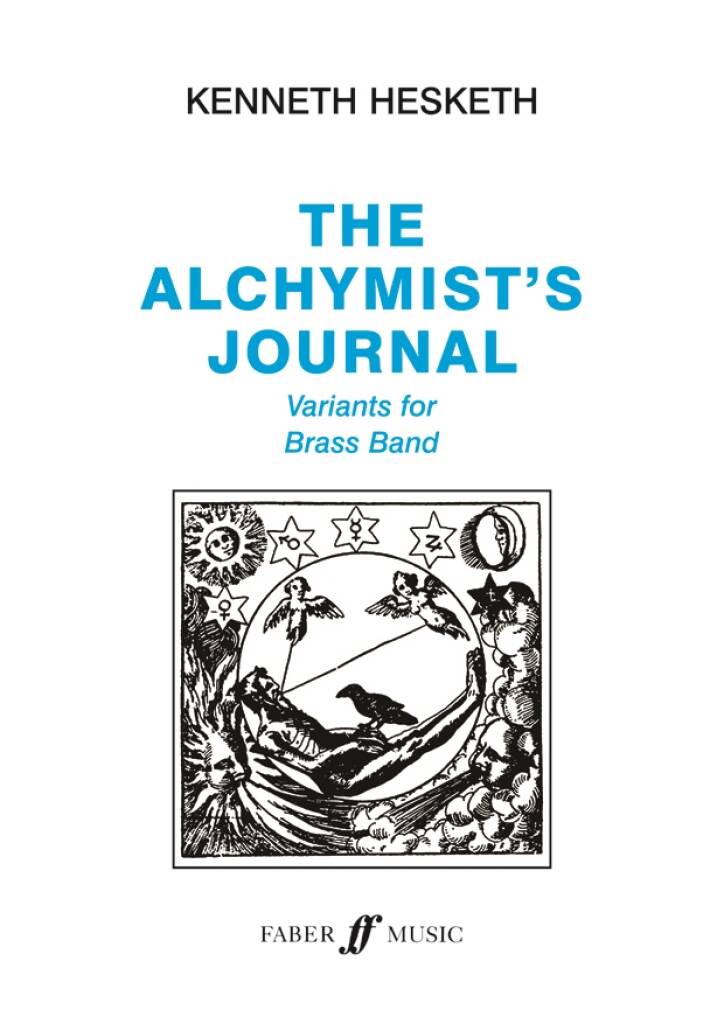
Alchymist's Journal. - Kenneth Hesketh
'The Alchymist's Journal' gets its title from the book of the same name by American author Evan S. Connell. The book fictionalises a number of famous Alchemist's writings, each one developing another's thoughts thuscontinuing one idea but changing it subtly to provide a new view point or way of thinking. This process is, in fact, alchemical as one idea transmutes into another. This idea is parallel to the processes at work within thesevariants. The whole work is constructed from 6 notes (C, A, B flat, E flat, F sharp, E) and is presented in nine different sections, each individual in mood but still based upon the original pitches. This is not a thematic setofvariations, as the themes are developed one at a time from small segments of the six notes. For example, the opening theme is the complete number of pitches, the second theme uses three notes transposed then repeated at theoriginal level, and so on. Harmonically, the six notes can be divided into two triads, A minor and E flat minor - each key beginning and ending the piece respectively. Whilst this is essentially abstract music with noprogramme there is an introduction, menacing scherzo, slow reflective section followed by a recap of the scherzo and final coda. 'The Alchymist's Journal' was commissioned by the Brass Band Heritage Trust at the suggestionof Paul Hindmarsh, to whom the work is dedicated.
Estimated dispatch 5-14 working days
-
 £69.99
Nocturne - Torstein Aagaard-Nilsen
Commissioned by Manger School Band and their conductor (at that time) Bj?rn Sagstad in 1990. He wanted a calm, slow piece of music. Nocturne means 'night music'. It does not reflect a particular dream, but the feeling you get when you?re day-dreaming: you are in the middle of beeing awake and asleep. Geschreven in opdracht van Manger School Band en hun dirigent (op dat moment) Bj?rn Sagstad in 1990. Hij wilde een rustig, langzaam stuk muziek. Nocturne betekent 'nacht muziek'. Het gaat dus niet een bepaalde droom, maar het gevoel dat je krijgt wanneer je aan het dagdromen bent: je bent in het midden van wakker zijn en slapen.
Estimated dispatch 5-14 working days
-
 £109.99
Nordic Moods - Tom Brevik
The composer:1st movement: Reflections by the Fjord.Overlooking one of the mighty fjords of Norway, my mind and thoughts are with an old religious Norwegian folk-tune, with words by the famous parson Peter Dass.The majestic fanfare-likeopening reflects the power of God our Father, the choral itself heard for the first time on flugelhorn. The choral is repeated a few times, separated only by some short variations. The movement ends in thriumph, with fanfares and the choral broughttogether.2nd movement: Reflections in the Old Church.In this movement my associations of a summer day, finding myself alone in an old deserted stone church. From the old walls I hear folk songs, perhaps like the ones sung in the church bypoor fishermen and farmers in days gone by. Suddenly the light from the sun breakes through the small circular window above the altar, and a lovely melody is heard, before the original figures take us to the end of the movement.3rd movement:Festive Reflections.Any festive occasion can be reflected in this movement. from the bonfire at midsummer-night to the children celebrating the return of the sun in the northern part of Norway. from the traditional sleigh-riding at Christmas tothe Celebrations of the National Day on the 17th of May each year.
Estimated dispatch 5-14 working days
-
£76.99
Durkle Bandrydge Suite - Bruce Fraser
Durkle Bandrydge is the name of the composers imaginary world, but it could very well be anyones invisible dream world with a different name. In this very versatile suite by Bruce Fraser, 8 characters are featured, each with its ownpeculiarities, making Durkle Bandrydge such a colourful place. Do these characters differ that much from us? That is for you to find out! In the last part, all characters come together in a special way.Durkle Bandrydge exists at the end ofyour street. It is invisible to humans, but Durkle Bandrygators can watch us with great interest. The music will introduce you to some of the characters who live in this unusual place. The parts: Somnanbulyss, who is a giant trollguarding the entrance to Durkle Bandryde. At least, he is supposed to, but he tends to sleep most of the time. His music is therefore very slow moving and sleepy. Long Gwysteen is a tall, mysterious, and somehow sophisticated character,who walls around with a shell on his back. His music glides along rather gracefully. Squelfitch is a rather unpleasant and smelly character who lives in a bog, which is why his music sounds rather slimy and a bit like trying to walkthrough quicksand. Perfydlia is a meddling old woman, who gossips about everybody and squeals with sudden delight at the small exciting bits of tittletattle about others in the village. In the music you can hear her sudden little squealsof delight. Maryann Lovely is a beautiful young lady, graceful, gorgeous, absolutely devine, and her music is obviously just the same. Thistledoo Nicely is a lively character who spends and spends and spends with her credit card,buying the latest fashion and never worries about having to pay the bills. Her music reflects her excitement when shopping and het 'happy go lucky' approach to life. Marsyn Edginton is the Lord of the manor, the richest man in town, the'big cheese', the man with all the power and, of course, the biggest house. He is very grand and his music like he could be a king. Jimmy McScotsmyn is a red haired scotsman wearing tartan cap. He misses his home country terribly and eatslots of shortbread, oatcakes, scotch eggs, porridge and drinks an enormous amount of Scotch Wisky, which helps him to have fond memories of the kind of music he would like to dance to when he was a younger man. His favourite dance is a Jig andthis is the music he remembers. Grand March of the Durkle Bandrydgators. We hope that you have enjoyed meeting these characters from Drukle Bandrydge and would invite you to listen to all the villagers now march along in a grand parade -it is a pity that you can not see them, what is a wonderful sight. If you listen carefully, you will hear the melodies which belong to the characters as they march past. Oh what a grand spectacle!
Estimated dispatch 5-14 working days
-
 £104.99
Like a Child - Andreas Ludwig Schulte
The young have the future. This is the statement made at the beginning of 'Like a Child' by Andreas Ludwig Schulte. The opening radiates strength and ambition, but one is also made to wonder which direction will be chosen, which choices will have to be made.After the introduction the first steps on the path of life are taken, still somewhat unsteadily (the 3/4th time used illustrates this uncertainty). However, the child has now set off and will meet the future with an open mind, unafraid, even though experience will teach it how easily it can be hurt.Fortunately, it is sometimes allowed to be vulnerable and it discovers there will always be someone to offer shelter,support and love. (Adagio) The last part breathes a far greater independence. Youth is able to face the future, it can even take on the whole world!
Estimated dispatch 5-14 working days
 View Music