
Results
-
 £44.95
Contest Music (Brass Band - Score only) - Heaton, Wilfred
Butlins 2018 Championship Section. One of the three choices of set works. The others were Year of the Dragon (Sparke) and Concerto for Brass Band No.1 (Venables).
Estimated dispatch 7-14 working days
-
£94.95
Contest Music (Brass Band - Score and Parts) - Heaton, Wilfred
Butlins 2018 Champsionship Section. One of the three choices of set works. The others were Year of the Dragon (Sparke) and Concerto for Brass Band No.1 (Venables).
Estimated dispatch 7-14 working days
-
 £49.99
A Phantom Menace Suite (Brass Band - Score and Parts) - Williams, John - Duncan, Andrew
Andrew Duncan has brought together three key themes from the first tow of the Star Wars prequels, 'Star Wars: The Phantom Menace' and 'Star Wars: Attack of the Clones', providing an exciting addition to any concert.Suitable for Advanced Youth/3rd Section Bands and aboveDuration: 6.00
Estimated dispatch 7-14 working days
-
 £74.95
A Portrait of Paris (Cornet and Euphonium Duet with Brass Band - Score and Parts) - Graham, Peter
A Portrait of Paris was written for Alexis Demailly and Bastien Baumet of the Paris Brass Band. The three movements, Promenade (aux Champs-?lys?es), Sur La Seine and Tour de France, are the composer's musical impressions of some of the city's landmarks and events (with occasional references to a famous Parisian composer thrown in for good measure...)
Estimated dispatch 7-14 working days
-
 £60.99
Bandstand Boogie (Brass Band - Score and Parts) - Albertine, Charles - Wain, Peter
Charles Albertine played tenor saxophone with the Sammy Kaye band in the late 1940s, and was the lead arranger for the new Las Elgart band. He arranged most of the Three Suns later music. Most of his later career was spent in television.Bandstand Boogie was adopted by Dick Clark as the theme song for his long-running series, American Bandstand.Duration: 3.15
Estimated dispatch 7-14 working days
-
 £74.95
Between the Moon and Mexico (Brass Band - Score and Parts) - Sparke, Philip
Between the Moon and Mexico was composed for the 1998 Finals of the National Brass Band Championships of Great Britain. The first performance took place at the Royal Albert Hall, London, on the 17th of October.The title has no hidden meaning and was chosen preciesly because it would not predetermine the style or form of the work. The composer wanted to see what sort of piece would emerge if the only influence was what had already been written. The result is a sort of musical collage in which various musical collage in which various musical elements, ranging from two or three notes to complete melodies, assume importance by virtue of their context. In a way, the piece grew out of itself.Duration: 16.30
Estimated dispatch 7-14 working days
-
£37.95
Between the Moon and Mexico (Brass Band - Score only) - Sparke, Philip
Between the Moon and Mexico was composed for the 1998 Finals of the National Brass Band Championships of Great Britain. The first performance took place at the Royal Albert Hall, London, on the 17th of October.The title has no hidden meaning and was chosen preciesly because it would not predetermine the style or form of the work. The composer wanted to see what sort of piece would emerge if the only influence was what had already been written. The result is a sort of musical collage in which various musical collage in which various musical elements, ranging from two or three notes to complete melodies, assume importance by virtue of their context. In a way, the piece grew out of itself.Duration: 16.30
Estimated dispatch 7-14 working days
-
£154.99
Bulgarian Dances (Part II) (Brass Band - Score and Parts)
Bulgarian folk music has a long tradition and numerous typical characteristics, such as particular dissonances and complex, irregular rhythms. In Bulgarian Dances (Part II) (which can be performed together with the previously published title Bulgarian Dances) Franco Cesarini has preserved the original spirit of Bulgarian folk music, yet has imbued it with a symphonic character and brought it into the concert hall. The three different movements give us a meditative, moving folksong and a lively dance, before a distinctly symphonic part leads to a glittering finale.
Estimated dispatch 7-14 working days
-
 £45.00
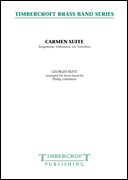
Carmen Suite (Brass Band - Score and Parts) - Bizet, Georges - Littlemore, Phillip
Incredible as it seems today, Bizet's opera?Carmen?was met with a lukewarm reception at its premiere at the Paris Opera-Comique in 1875; critics condemned its subject matter as lurid and its music overly Wagnerian, and it ran for a mere 37 performances. Bizet died with a few days of it opening at the tragically early age of just thirty-six. Now hailed as the composer's supreme achievement, this colourful, passionate work continues to delight listeners around the world with its emotional, atmospheric music and the originality of its conception. Two orchestral suites were created in the latter part of the 19th Century each containing six pieces. This brass band arrangement brings together three of these pieces, the?Aragonaise, the Habanera?and?Les Toreadors. Duration: 7:00
Estimated dispatch 7-14 working days
-
 £48.95
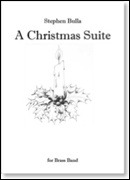
CHRISTMAS SUITE, A (Brass Band) - Bulla, Stephen
First published in 1984, this has always been a popular work for brass bands all over the world. This new edition is now available with a full score. Lasting about eight minutes, the three movement suite includes settings of Wassail Song, Lo, how a rose e're blooming, and to finish a 'Pot-pourri' bursting with tunes and energy.
Estimated dispatch 7-14 working days
 View Music