
Results
-
 £30.00
The Water is Wide - Traditional
Alternatively known as O Waley Waley, Andrew Duncan has created this stunning arrangement for brass band, presenting the hauntingly beautiful, traditional song as a feature for the solo cornet section of the band.Look and Listen (performance courtesy of Bon Accord Silver Band 2018):
In Stock: Estimated dispatch 3-5 working days
-
 £35.00
The Witches' Sabbath - Berlioz
An effective arrangement of the exciting finale from Berlioz's greatest masterpiece 'Symphonie Fantastique'.This new 'finisher' is all about an opium induced fantasy Berlioz had about rescuing a woman he was madly in love with from a group of evil witches and other assorted ghouls.After many brilliant musical descriptions of the eerie scenes, Berlioz triumphantly rescues his beloved narrowly saving her from being sacrificed by the witches!First performed by Whitburn Band at Spennymoor 24 and recorded by them on the 'Live from Spennymoor 24' CD.
In Stock: Estimated dispatch 3-5 working days
-
 £89.99
Ross Roy - Jacob de Haan
In this composition, Jacob de Haan sees the "Ross Roy" as a metaphor for the years spent at school (a monument in time), where one's personality is formed. So, the opening theme the artist calls the Ross Roy theme initially has monumental characteristics.The rhythmic motion, which strides along in the lower register and percussion at the beginning of the next section is typical of "Tempo di Marcia". This movement, accompanied by repetitions of sound, is a metaphor for the structure and discipline in school. This is the introduction to a march theme, symbolic of "passing through" the classes up to the final examinations.Then, the Ross Roy theme is dealt with again, now in aplayful, humorous variation. As if the composer is saying there should also be time for a smile in school. The same theme can be heard in major key and a slower tempo in the following section, expressing pride and self-confidence. This is also the introduction to the expressive middle section that represents love, friendship and understanding.We then return to the march theme in a slightly altered construction. The oriental sounds, constituting the modulation to the final theme, are symbols of the diversity of cultures in the school. The characteristic final theme first sounds solemn, but turns into a festive apotheosis. It is no coincidence that the final cadence is reminiscent of the close to a traditional overture, for the school years can be considered the "overture" to the rest of one's life.
Estimated dispatch 5-14 working days
-
 £64.30
Zourfaroka - Marc Jeanbourquin
One morning everything went wrong in Zourfaroka. In this forest where thousands of magical beings live, everything sparkles and shines and is full of life. But not this morning, because the terrible troll Potugor has returned. This is the opening text for the musical fairy tale written by Lise Jeanbourquin and set to music by her husband Marc Jeanbourquin. The first part is a warlike setting, showing the preparations of Kirielo and the inhabitants of Zourfaroka for the battle with Potugor. On the way they meet the fairy Xeriole, and this meeting is put to music in the second part. The soloist's role in the first few bars is left to the choice of the conductor. And as in many fairy tales, with fairies, gnomes, and amazing magical creatures, the piece ends in the third part with everyone coming together in song and dance.
Estimated dispatch 5-14 working days
-
£89.99
Festive Impressions - Oliver Waespi
This brilliant opening work with the sub-heading Cinematographic Overture" is guaranteed to make a great impression on your audience. The piece starts with solemn brass-band motifs, followed by melodic movements in the quiet middle part that leads to a rich climax. At the end of this refreshing work, there is a reprise of the brass bands which reflects the spirit of this music very well. After all, this is the intention of this work which was written specially for the Musikverein Henggart" to celebrate their 75th anniversary.
Estimated dispatch 5-14 working days
-
 £105.20
Jul i Svingen - Odd Nordstoga - Idar Torskangerpoll
This is a piece of music is the title track from the Norwegian Broadcaster NRK's advent calendar TV-series "Christmas at Svingen". This is the main title from Norwegian advent calender TV-series for children produced in 2006 by The Norwegian Broadcasting Corporation (NRK). The music won Spellemannsprisen (the Norwegian Grammy award) in the Music for Children category in 2006. The series are shot at the rural parts of Norway, and the lyrics for this song describes christmas preparations as children perceive it.
Estimated dispatch 5-14 working days
-
 £94.99
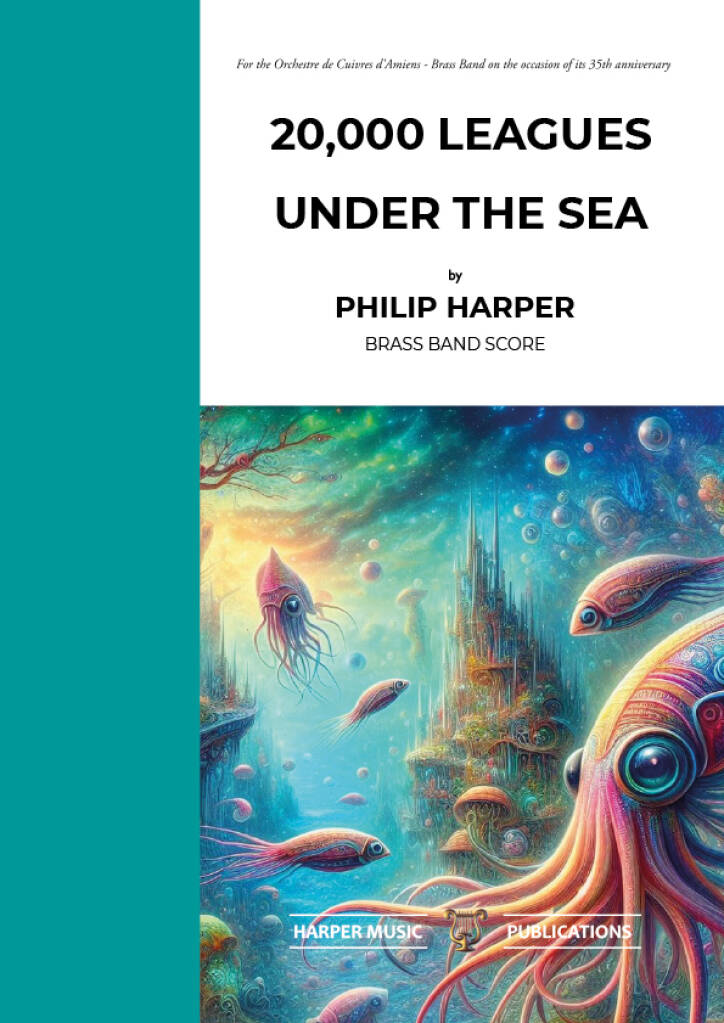
20,000 Leagues under the Sea - Philip Harper
Frenchman Jules Verne was a pioneer in science fiction during the late 19th Century, penning some classic stories such as Journey to the Centre of the Earth and Around the World in 80 Days - both of which have already been the subject of brass band test-pieces. It was therefore natural for me to choose Verne's 1869 watery magnum opus as the subject for this piece to which there are five sections, as well as an introduction and a finale.I. THE NAUTILUS. After a mysterious introduction we are introduced to The Nautilus - a fantastical submarine.II. THE CORAL KINGDOM. We visit awe-inspiring underwater coral formations.III. SQUID ATTACK. The Nautilus is attacked by a school of giant squid, or 'devilfish'.IV. CAPTAIN NEMO. Captain Nemo is a loner and an eccentric. Some say he is a madman. Soloists of the band help to uncover the character of this enigmatic but powerful figure.V. MAELSTROM. The Nautilus is dragged into the ocean's deadliest whirlpool but Captain Nemo lives to fight another day.
Estimated dispatch 5-14 working days
-
 £103.90
Moondance - Van Morrison - Idar Torskangerpoll
This is the title-track of the third studio-album by the Northern-Ireland singer and saxophonist Van Morrison. Both the song alone and the record album are among the artists biggest successes.The album is covering many musical genres.Moondance is representing the jazz-side of these. The style is a mid-temo, swing-feel typical for numerous jazz-tunes.This arrangement have solo options for solo cornet and/or first trombone.
Estimated dispatch 5-14 working days
-
 £69.99
Down by the Salley Gardens - Patrick Millstone
A thoroughly gripping melody of Irish descent constitutes the basis on which this exceedingly beautiful little piece of music rests. Down by the Salley Gardens is a guaranteed heartbreaker on your next concert. Since the lyrics of this Irish traditional are also supplied with the set, a combination of band with solo voice or even choir is a definite possibility. The Arranger: Leafing through a song-book containing traditionals etc., I was immediately struck by this song and its exceptionally beautiful and atmospheric melody. I simply had to do something with it. Een meeslepende traditional van Ierse komaf staat aan de basis van dit wonderschone werkje. Down bythe Salley Gardens belooft een hartenbreker te worden op uw eerstvolgende concert. De tekst van deze Ierse traditional wordt meegeleverd en daarmee is een combinatie met zang ook zeer goed mogelijk. De arrangeur: Bladerend door een liedboek met traditionals, enz., was ik meteen getroffen door dit nummer en zijn uitzonderlijk mooie en sfeervolle melodie. Ik moest gewoon iets mee doen.
Estimated dispatch 5-14 working days
-
 £102.99
The African Connection - Carl Wittrock
Carl Wittrock's wide interest in global folk-music resulted in this concert-piece based on original African rhythms. Obviously, the percussion section has a conspicious role to play, but the band too may indulge itself in moments of thoroughly delightful excitement. The introduction depicts the awakening of nature, and develops into a dance. The (main) motif of this dance is from a dance entitled Apollo and comes from Gambia. Its accompaniment consists of an ostinato pattern by balaphon-master Maudo Susa. The quiet middle movement is based on the rhythm of the 'gigbo' : a traditional dance from Ghana. In the final movement -which also bears a slight resemblanceto a theme from 'The Lion King'- the so-called 'Kono' rhythm is used. The work is played most advantageously using djembes. Challenge and please your percussion section with 'The African Connection'.
Estimated dispatch 5-14 working days
 View Music