
Results
-
 £49.95
Malcolm Arnold Variations (Score Only)
MALCOLM ARNOLD VARIATIONS was commissioned by Philip Biggs and Richard Franklin for the 20th All England Masters International Brass Band Championship held in the Corn Exchange, Cambridge on 25 May 2008. The work is dedicated to Anthony Day, long time carer of Sir Malcolm Arnold in his final years. I first met Malcolm and Anthony in 1990 and remained in constant touch until Malcolm's passing in 2006. Anthony, of course, remains a friend and plays his own role subliminally in this piece. The work is not based on any of Malcolm Arnold's own themes, rather it is a portrait of him (and by association Anthony Day) through my eyes and as a result of my friendship with both parties over some 18 years. If there is any theme as such it is the personalities of the players, the protagonist and his carer placed together by my own efforts coloured and influenced by aspects of Arnold's style and technique without recourse to direct quotation but through allusion and parody. It is of course designed as a brass band test piece but in my eyes is first and foremost a musical challenge. The pyrotechnical elements are there but always secondary to the musical thrust of the work's structure. I have long beforehand submerged myself in Malcolm Arnold's music and ultimately delivered this tribute. Music Directors will be advised to acquaint themselves with the composer's personal music, particularly the film scores, symphonies, concertos and ballets: the solutions towards a successful interpretation of my piece are all in there - and YES, I want, and sanction, this piece to be interpreted, and therein lies the challenge for those of you 'up front'! The challenge for players is that of virtuosity, ensemble and careful attention to where they are individually in relation to their colleagues - a question of balance, taste and insight. With regard to tempi, as is my usual custom, I have indicated all metronome marks with the prefix circa. I would suggest that the fast music is played at these tempos but that the more rubato moments can be allowed some freedom in expression and fluidity of line. With regard to the type of mutes to be employed - this decision I leave to the discretion of players and conductors. Structurally the work is cast as an Introduction, 20 Variations and a Finale. Some variations are self contained, others run into each other as sequences in the same tempo. In other variations, segments are repeated and developed. I could describe the overall concept as a miniature ballet or a condensed film score - there is much drama and character and the repeated elements assist this in driving the action forward. I have deliberately avoided the more extremely dark qualities of Malcolm's own music in this, my celebration of this master-composer, as I have always viewed (and evidenced by my previous Masters scores Tristan Encounters and Chivalry) that the Cambridge contest is a 'sunshine- affair' and firmly believe that Malcolm Arnold would have had it no other way too!
Estimated dispatch 7-14 working days
-
£132.00
Abstractions - Torstein Aagaard-Nilsen
Verket ble bestilt av Norges Musikkorpsforbund som pliktnummer til NM for Brass Band 2. divisjon (na 1. divisjon) 1990.Satstitlene er abstraksjoner der synsopplevelser er tenkt gjenskapt som musikk, altsa en abstrakt fremstilling av et motiv, likt et abstrakt bilde der man ikke umiddelbart kan se likheten.1. Aurora Borealis (Lento espressivo) Inspirert av Nordlyset som kan vaere svaert intenst vinterstid.Det er aldri i ro og antar nye fasonger og farger hele tiden mens det farer over nattehimmelen.The first movement is inspired by the northern lights. It constantly changes in colour and shape.2. Rocks (Moderato ben ritmico)I denne satsen er tittelen et ordspill. Ordet "rock" er velkjent i musikken, men er ogsa en enorm stein eller del av et fjell.The title of the second movement is a play with the word "rock" is a well-known word describing a musical genre. But it is also a giant stone or a part of a mountain.3. Seascape (Allegro)I denne satsen forsoker jeg a fange ulike aspekter ved havet, samtidig som satsen samler opp musikalske ideer fra de to foregaende satsene. Denne satsen videreforer, oppsummerer og avslutter verket.The third movement is inspired by different aspects of the sea. It also sums up different ideas that occurs in the two previous movements to round off the whole piece.Tredje utgave - 2015Third Edition - 2015
Estimated dispatch 7-14 working days
-
 £79.95
Neverland - Christopher Bond
"All children, except one, grow up" wrote J.M. Barrie about Peter Pan in 1911; the first line and an expression of beautiful melancholy and fantasy, coming to represent one of the best-loved children's stories of the twentieth century. 'Peter & Wendy', as the book was first released, has subsequently been transformed into adaptations for film and stage, with subsequent books based on this iconic tale. In writing this new work for brass band, the composer has taken three of the main themes from J. M. Barrie's book, and used these themes to create new musical material, forming a work in three contrasting sections. I. Journey to Neverland The opening of the work, mysterious in its style, reflects the opening chapters of the story - a leafy London street, still in the dead of night - with the music transforming quickly as it builds in texture and momentum - a Journey to Neverland through the night sky; Second Star to the Right and straight on 'til morning. "Then Peter knew that there was not a moment to lose. 'Come,' he cried imperiously, and soared out at once into the night, followed by John and Michael and Wendy. Mr & Mrs Darling and Nana rushed into the nursery too late. The birds were flown." II. The Windows that Closed The central section of the work takes its inspiration from the sense of longing throughout the book, mainly by Peter Pan, the Darling Children & The Lost Boys. Distant memories of life before Neverland, memories of the Lost Boys' mothers, and regret at what the children have missed. Peter says "Long ago, I thought like you that my mother would always keep the window open for me; so I stayed away for moons and moons and moons, and then flew back; but the window was barred, for mother had forgotten all about me, and there was another little boy sleeping in my bed." III. Aboard the Pirate Ship The final section of the work takes its inspiration from the Pirate Ship, and Peter Pan's ultimate battle with its infamous Captain Hook. "In person, he was cadaverous and blackavized, and his hair was dressed in long curls, which at a distance looked like black candles, and gave a singularly threatening expression to his handsome countenance. His eyes were the blue of the forget-me-not, and of a profound melancholy, save when he was plunging his hook into you, at which time two red spots appeared in them and lit them up horribly."
Estimated dispatch 10-14 working days
-
 £59.95
Judd: Caelum Corona - Stephen Bulla
Stephen Bulla's 'Caelum Corona' ('Crown of Heaven') portrays, in sound, a Christian's walk in faith, intended metaphorically via a musical narrative reminiscent of the early church pilgrims, their struggles and triumphs. The composer initially evokes the atmosphere of Rome at the time of St. Paul and other martyrs, thus the Latin title. Bulla marks his imaginative tone poem with dark, brooding music in the first two of three parts, in each of which he has embedded an appropriate hymn or song reference as thematic material. The first of these sounds in a minor key following a symphonic exposition made up primarily of fanfare-like motives, the music at times quite harsh and abrasive. The song is Paul's statement of exuberant faith (2 Timothy 1:12) in the midst of prison and persecution: 'For I know whom I have believed, and am persuaded that he is able to keep that which I've committed unto him against that day.' More challenging, aggressive music returns until a further point of reflection on Christ's sacrifice is reached. The music graphically evokes the barren landscape of Golgatha, the horror of the crucifixion, including stark wind sounds, a loss of stability via eerie, dissonant chord clusters, and even the nails being driven into Christ's body. The Baritones and then Flugel Horn softly play 'He died of a broken heart.' Yet the Christian life, despite its perils - both at the time of Paul and now - is a victorious life, and the composer resolves the tensions of the work in a scintillating finale, a brilliant setting of the old song about spiritual warfare and the ultimate triumph of Christ the King: 'Victory for me!' (T.B. 841). The chorus of that tune proclaims: 'No retreating, hell defeating, shoulder to shoulder we stand; God look down, with glory crown our conq'ring band.' That crowning is the same one sought and claimed by St. Paul (2 Timothy 4:8): 'Now there is in store for me a crown of righteousness, which the Lord, the righteous judge, will award me on that day, but also to all who have longed for his appearing.' Believers look forward to participating in the final coronation of their Saviour - King of Kings and Lord of Lords - while humbly desiring their own 'crown of heaven.'
Estimated dispatch 7-14 working days
-
 £30.00
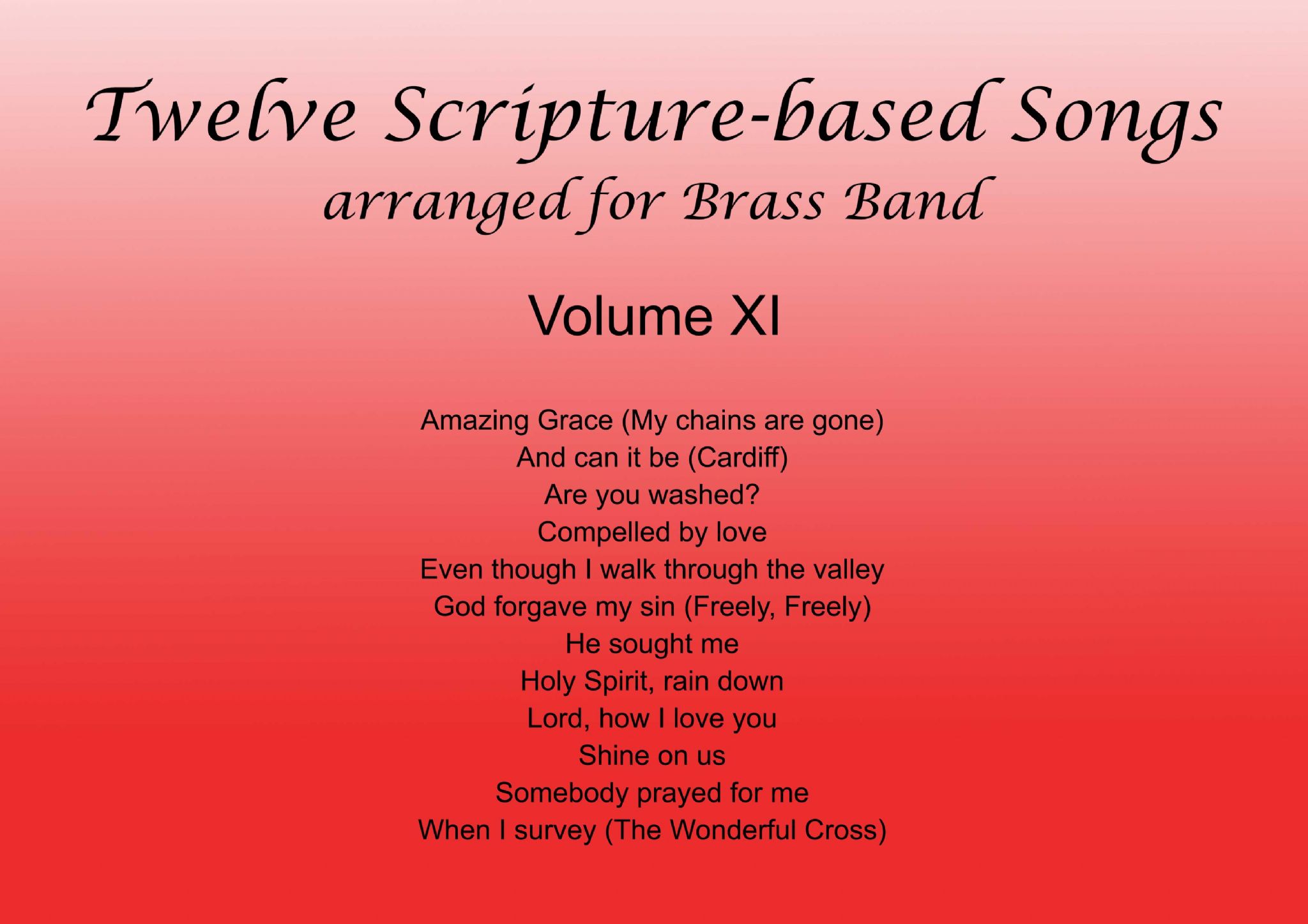
Twelve Scripture-Based Songs Volume XI
Twelve scripture-Based Songs arranged for Brass Band (Volume XI) are packaged and marketed in complete sets which include a full score and a set of master parts. It is intended that these parts be used as 'masters', for the purpose of photocopying a quantity of parts to accommodate the precise instrumentation needs of the band for which this has been purchased.Amazing Grace (My chains are gone)And can it be (Cardiff)Are you washed?Compelled by loveEven though I walk through the valleyGod forgave my sin (Freely, Freely)He sought meHoly Spirit, rain downLord, how I love youShine on usSomebody prayed for meWhen I survey (The Wonderful Cross)
Estimated dispatch 7-14 working days
-
 £30.00
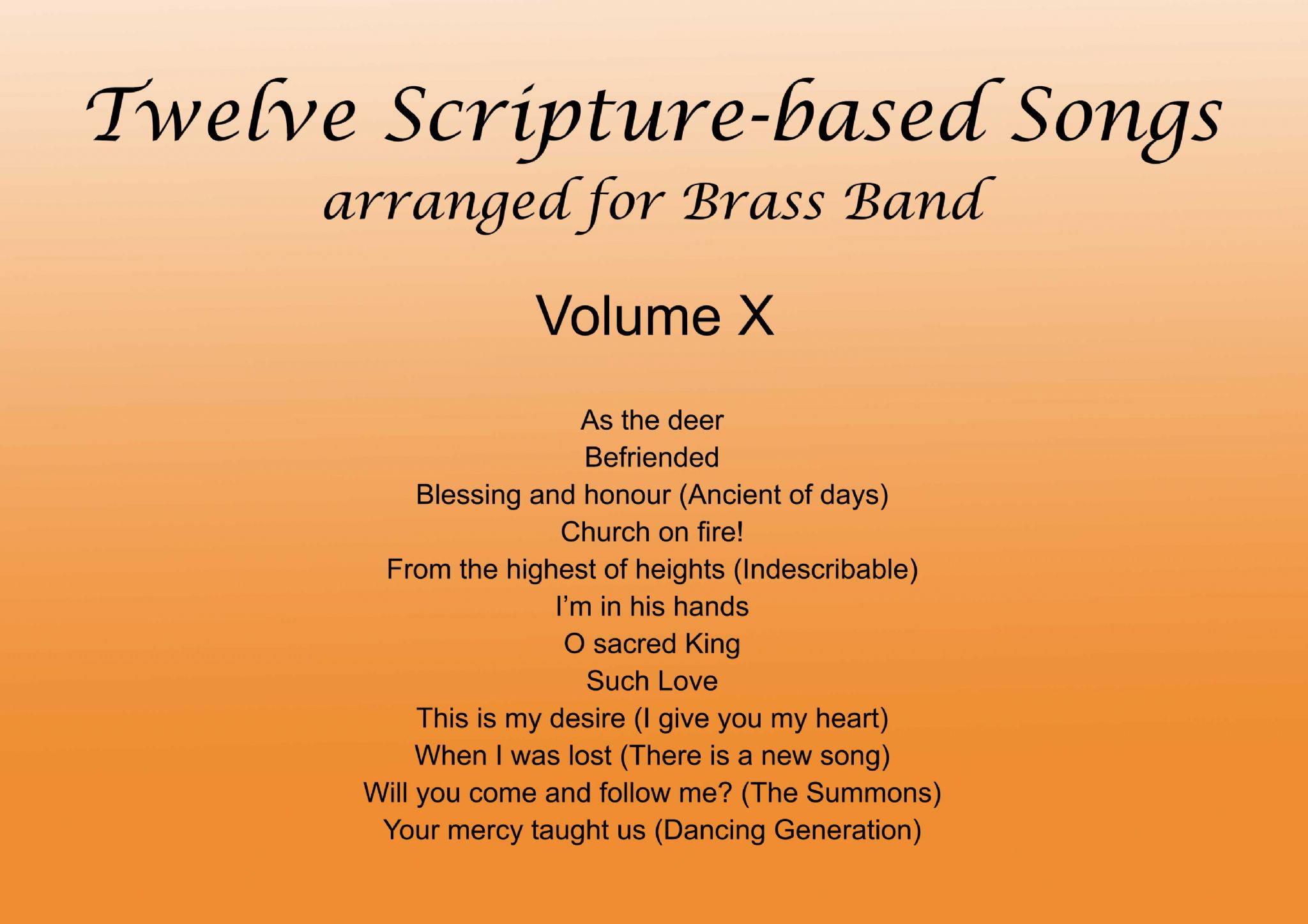
Twelve Scripture-Based Songs Volume X
Twelve scripture-Based Songs arranged for Brass Band (Volume X) are packaged and marketed in complete sets which include a full score and a set of master parts. It is intended that these parts be used as 'masters', for the purpose of photocopying a quantity of parts to accommodate the precise instrumentation needs of the band for which this has been purchased.As the deerBefriendedBlessing and honour (Ancient of days)Church on fire!From the highest of heights (Indescribable)I'm in his handsO sacred KingSuch LoveThis is my desire (I give you my heart)When I was lost (There is a new song)Will you come and follow me? (The Summons)Your mercy taught us (Dancing Generation)
Estimated dispatch 7-14 working days
-
 £30.00
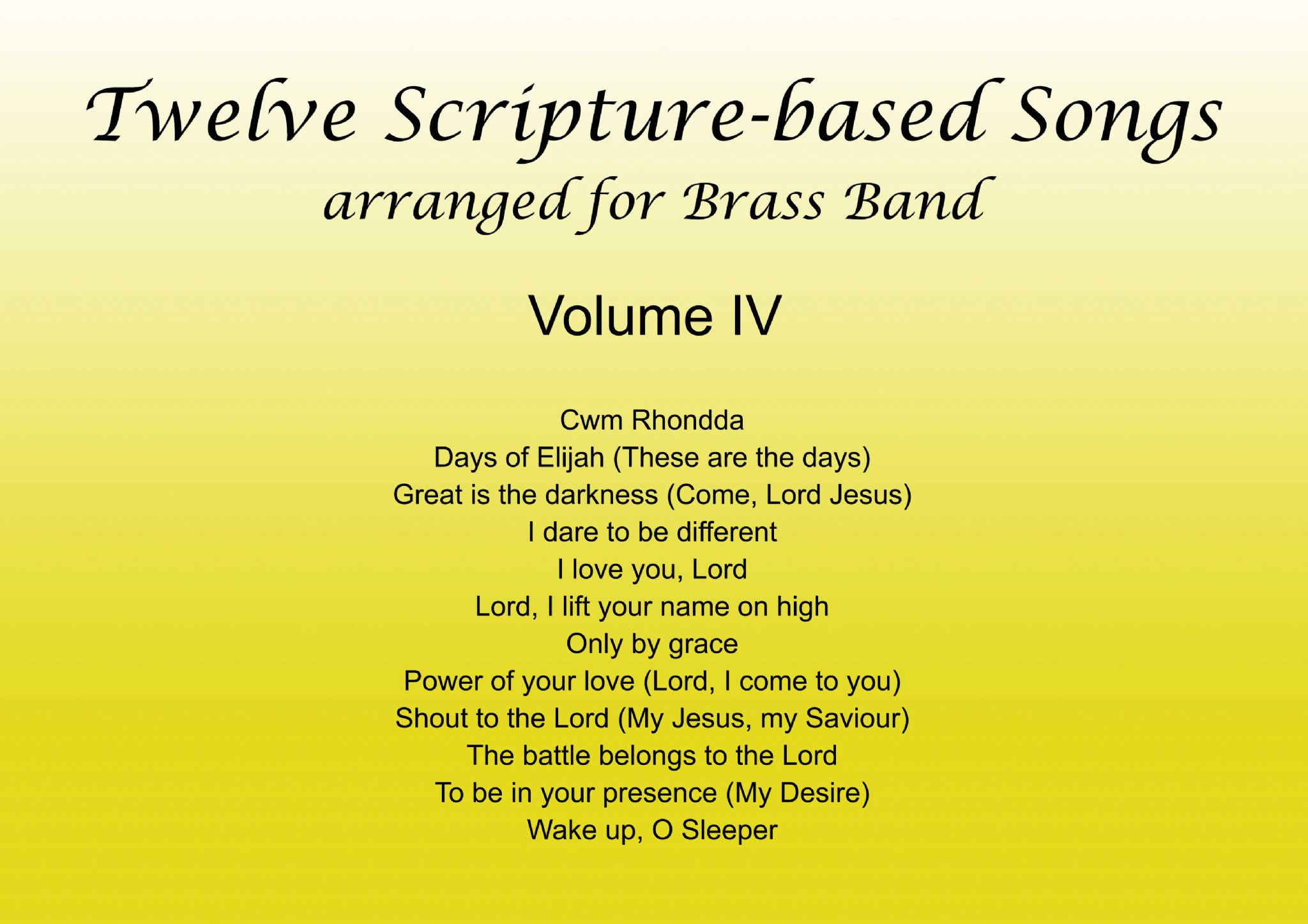
Twelve Scripture-Based Songs Volume IV
Twelve scripture-Based Songs arranged for Brass Band (Volume IV) are packaged and marketed in complete sets which include a full score and a set of master parts. It is intended that these parts be used as 'masters', for the purpose of photocopying a quantity of parts to accommodate the precise instrumentation needs of the band for which this has been purchased.Cwm RhonddaDays of Elijah (These are the days)Great is the darkness (Come, Lord Jesus)I dare to be differentI love you, LordLord, I lift your name on highOnly by gracePower of your love (Lord, I come to you)Shout to the Lord (My Jesus, my Saviour)The battle belongs to the LordTo be in your presence (My Desire)Wake up, O Sleeper
Estimated dispatch 7-14 working days
-
 £40.00
Sunset
ABOUT THIS PIECE: Cantatio are pleased to release this arrangement of Sunset by Paul Mottram from his album Symphonic Minimalism. Originally recorded by the Royal Philharmonic Orchestra at Abbey Road, this piece is often heard on TV and radio, most recently on Ken Bruce's show on BBC Radio 2 following the death of Queen Elizabeth II. Paul says of this piece: "I very loosely modelled the track on some of the compositions of John Barry - a simple lyrical melodic style with an almost regal feel and beautiful orchestral sound. I was indeed imagining a sunset when I wrote it and had some sense of the piece having an ultimate warm, resigned, quiet finality about it". You can read more about the piece here. ENSEMBLE: Standard British Brass Band WHEN YOU BUY THIS PRODUCT, YOU GET: High-quality printed score and parts LEVEL: 1 LISTEN: DURATION: 3-minutesEXAMPLE SCORE: Click here LEVEL GUIDE: Level 1- Accessible to all Level 2 - c. UK third section and higher Level 3 - c. UK second section and higher Level 4 - c. UK first section and higher Level 5 - c. UK championship section level
Estimated dispatch 5-7 working days
-
 £30.00
Flanfayre - Stephen Deazley
I was asked by Music for Youth to write a flexibly scored fanfare for the school proms at the Royal Albert Hall and at their National Festival in Birmingham in 2013. At its first performance at the National Festival, over 200 young brass players performed Flanfayre in Birmingham Town Hall, directed by Roger Argente, members of Superbrass and myself. The score is a progressive romp through some increasingly dance-like grooves, borrowing some of its swing from South America, from marches and big band, moving from a really quite straight opening to a "let-go" moment at the end. It is more like a flan full of different flavours, than a fanfare, hence the title. I set myself a challenge to write 100 bars but ended up with 102, which, after the introduction, can be broken down into 10 easily discernible sections each with their own mini-musical narrative. If you have time feel free to teach the audience the clapping groove. I also modelled the slow moving melody of the final section on the following words; "nothing beats a nice big cheesy, nothing beats a nice big cheesy, nothing beats a nice big cheesy, nothing beats a cheesy flan". Feel free to incorporate these too, and perform only under the strict instruction that you have fun ! - Programme Note copyright of Stephen Deazley
-
 £9.95
First Quartet (Brass Quartet - Score and Parts)
My first Brass Quartet was written in 1968, immediately after I finished my studies at the Royal Academy of Music, and was in response to a request from my then publisher, R Smith & Co, to write some chamber music for brass band instruments. It is scored for two cornets, horn and euphonium. In the same year I also wrote another quartet (No. 2) which is scored for the more unusual combination of two horns, baritone, and tuba. The First Quartet is really a miniature in terms of length, lasting less than six minutes. However, it packs a lot of punch in its two connected movements, a Prelude and a Capriccio. The Prelude is lyrical in style and opens with a rising figure (covering a major seventh) on euphonium answered by muted cornets. These ideas form the material for the movement which is arch shape in structure. The opening returns, immediately followed by a transition passage which leads directly into the turbulent Capriccio. This is rather Bartokian in style (I was very influenced by Bartok in my student days and had closely studied his six string quartets), in the manner of a Hungarian dance in 5/8 time. The constantly changing metric patterns give the music a rather disruptive quality, but also an opportunity for the players to show their virtuoso abilities. - Edward Gregson
Estimated dispatch 7-14 working days