
Results
-
 £35.00
A Suffolk Prelude - Andrew Duncan
Written for the Ipswich & Norwich Co-Op Band, A Suffolk Prelude is based around five traditional tunes from Suffolk:'Nutting Time','Blackberry Fold','Cupid's Garden','A Seaman's Life''The Bold Richard'The piece begins on the percussion and timpani alone leading through a crescendo into the first statement of the fanfare which is derived from a motif from the tune 'Nutting Time'. This leads into a playing of the 'Nutting Time' tune which is then developed as the tune is passed around the band.'Nutting Time' is a jolly lighthearted tune about a 'fair maid' who meets a handsome young farmer called 'Johnny' when out gathering nuts in the wood. After a pause on the tubular bells the slow tune 'Blackberry Fold' is presented as a solo for Flugel Horn, then as a full band version.'Blackberry Fold' is a touching song about a Suffolk squire who gets married well below his station to a beautiful milkmaid, simply because he loves her! They live happily ever after.The next tune to be heard is the juanty 'Cupid's Garden' played firstly as a solo on the Euphonium, and again this is about the subject of love. This song is sung from a sailors prospective and he tells how he met a lovely maiden and has promised to marry her when he returns from duty at sea.The trombones then play the noble tune 'A Seaman's Life'. This tune seems to serve as a warning to young girls about the fickle nature and the total unsuitability of marrying a sailor! 'Oh a seaman's life is a merry merry life, they'll rob young girls of their heart's delight, they will leave them behind for to sail one morn, but they never know when they'll return'. Despite this it is a fine tune!The last tune featured is 'The Bold Richard' which is played by all the bass instruments in the band. This is a song telling how the Royal Navy friggate 'The Bold Richard' went to battle against a French friggate destroying her and taking her crew as prisoners.Suffolk Prelude goes on to feature a slow version of the tune 'A Seaman's Life' played alongside a fast version of the tune 'Cupid's Garden'. The opening fanfare then returns leading into a final coda section.
In Stock: Estimated dispatch 3-5 working days
-
 £25.00
Cowboy Carol - Cecil Broadhurst
This well known carol has been flexibly arranged by Tim Paton to offer a variety of combinations in its performance - a full band piece; a band piece with vocal soloist or choir; or even a means to utilise the vocal talents of the band members themselves, to create an in-house musical combo!Every band part has a songsheet included and between 10-14 of the players are directed to sing before the full band joins in with a final verse and chorus of this fabulous Cecil Broadhurst song to make for a big ending to any festive concert.The options are numerous and the stunning music and scoring makes for just as much a successful outcome whether voices are included or not - the choice is yours!
In Stock: Estimated dispatch 3-5 working days
-
 £35.00
Divertimento (previously Spring's Awakening) - Andrew Duncan
This original solo for Eb Tenor Horn and brass band, composed by Andrew Duncan, has proved to be a welcome addition the solo repertoire.Written to demonstrate both the technical and lyrical sides of the Horn, the piece begins with a fast, bright (slightly Latin) section. This gives way to an expressive legato tune which, first played by the Soloist, is then taken up by the whole band. The central section, Andante, allows the soloist to really sing out and, following a short cadenza, the opening material returns to lead into an exciting Coda section.Also available for Eb Tenor Horn with piano accompaniment and F Horn with piano accompaniment.Difficulty Guide:Suitable for intermediate to advanced Tenor Horn players. Range: Low F# to high Db. (optional Bb).NB: The previous working title of Spring's Awakening has now been re-edited into this final title of Divertimento.
In Stock: Estimated dispatch 3-5 working days
-
 £30.00
Exegesis - Tim Paton
An exciting, original composition for brass band by Tim Paton. A complex work which entwines melodic lyricism amidst contemporary harmonies and scoring. A tour de force of Tim's creativity and a rewarding challenge for the performers and audience.Tim comments: The term exegesis is applied to a study which works out the meaning of something, an interpretation of a series of events, a comparison of ideas within a given medium, for example, "Biblical exegesis". This brass band piece is a musical exegesis.Section one is made up of three main themes, and although these themes are tonal within themselves, there is a sense that they are trying to understand one another. From the very beginning of this section, there is an element of bi-tonality and dissonance.The middle section is ponderous, where we hear elements of these three themes. It could be called the 'thinking section'.Section three almost interrupts this middle section, with fanfares displaying a realisation, still containing bi-tonality, but in harmony! We are soon led in to a hymn like celebration, followed by a determined, militaristic section for the percussion. Finally, the fanfares which opened this third section, reappear, taking us to a final conclusion.
In Stock: Estimated dispatch 3-5 working days
-
 £109.99
Modern Times - Etienne Crausaz
Modern Times is a concert suite from the musical and theatrical show Le Temps de Lyre, written and directed by Nicolas Bussard. The work was commissioned for the 100th anniversary of the Lyre de La Roche, directed by Marc-Olivier Broillet, with the premiere taking place in July 2024 in front of an audience of over 2,000.This suite highlights three of the dozen tableaux in the show. After an introduction evoking a sort of journey back in time, the first tableau (bar 20) illustrates various disasters that have occurred in the village over the years. The sky darkens, the thunder rumbles, the rain lashes down, and violent gusts of wind are unleashed on this corner of the country. The storm finally calms down, giving way to great desolation.The second tableau (bar 117) describes the resilience of the villagers, who summon up all their courage to repair the damage. The music is soft, calm, and hopeful.On the strength of this new beginning, the village can embrace modernity: motor vehicles replace horses, a dam is built, and tourism develops, encouraging a society open to other cultures. The third tableau in this suite illustrates all these advances (bar 177). Musically, this final section pays tribute to George Gershwin and Leonard Bernstein, two of the 20th century's great musicians and composers, who worked during the fascinating period of modern times and well beyond.
Estimated dispatch 5-14 working days
-
 £183.20
Folklore - Kjetil Djønne
"Folklore" is a work for brass band and percussion loosely based on the story of the Norwegian woman accused of witchcraft, Anne Pedersdotter. She was sentenced to be burned at the stake in Bergen in the spring of 1590 and has since been frequently highlighted as Norway's most famous and talked-about witch.The work begins with the movement "Lyderhorn," depicting the mountain outside Bergen where witches gathered to plan magical actions against the city. Here, we hear the quietness of nature and the wind blowing through the trees before a new theme appears, which will come to life in the next movement. In the distance, the witches have started their ceremony.In the next movement, "Walpurgis Night," the witches perform their rituals to afflict the city with fire, disease, and natural disasters. The ceremony becomes more and more chaotic, violent, and compelling until the darkness of the night envelops us, concluding the section.The third movement describes the women's inner struggle against the harassment they faced when the people of Bergen suspected them of being witches. Rumors often turned into formal accusations from the legal system, and many were sentenced to death after undergoing trial. "From life to death through the fire."The fourth and final movement, "The Pyre," depicts the actual death sentence. You can hear the pyre being ignited and the flames growing and intensifying. It all culminates in a chorale as a memorial to the lives that were taken.
Estimated dispatch 5-14 working days
-
 £85.00
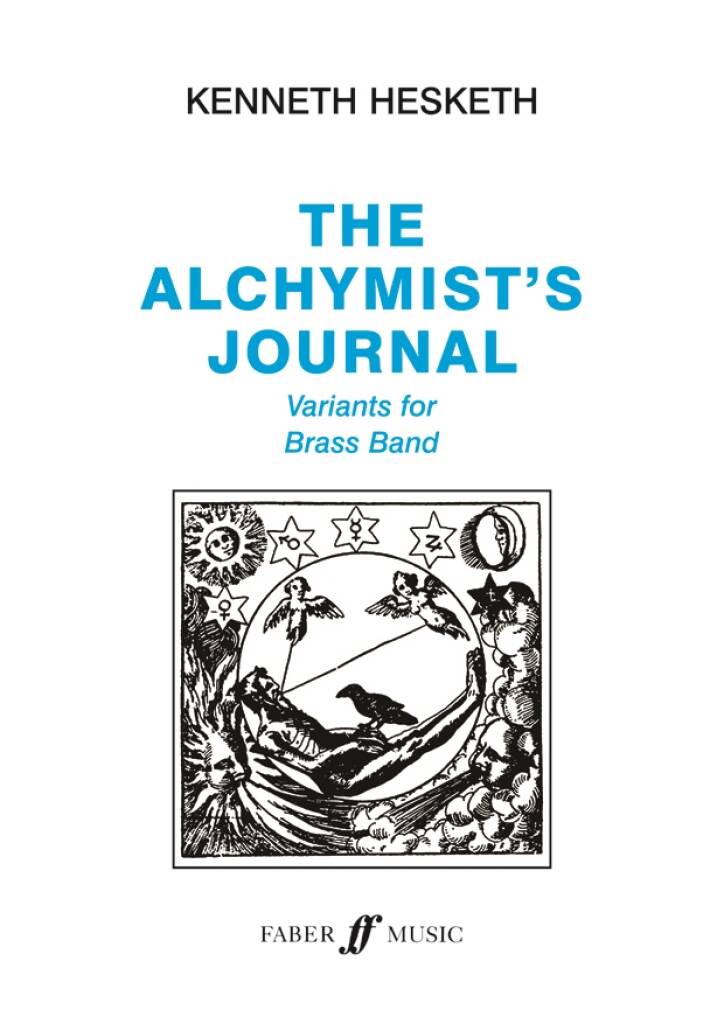
Alchymist's Journal. - Kenneth Hesketh
'The Alchymist's Journal' gets its title from the book of the same name by American author Evan S. Connell. The book fictionalises a number of famous Alchemist's writings, each one developing another's thoughts thuscontinuing one idea but changing it subtly to provide a new view point or way of thinking. This process is, in fact, alchemical as one idea transmutes into another. This idea is parallel to the processes at work within thesevariants. The whole work is constructed from 6 notes (C, A, B flat, E flat, F sharp, E) and is presented in nine different sections, each individual in mood but still based upon the original pitches. This is not a thematic setofvariations, as the themes are developed one at a time from small segments of the six notes. For example, the opening theme is the complete number of pitches, the second theme uses three notes transposed then repeated at theoriginal level, and so on. Harmonically, the six notes can be divided into two triads, A minor and E flat minor - each key beginning and ending the piece respectively. Whilst this is essentially abstract music with noprogramme there is an introduction, menacing scherzo, slow reflective section followed by a recap of the scherzo and final coda. 'The Alchymist's Journal' was commissioned by the Brass Band Heritage Trust at the suggestionof Paul Hindmarsh, to whom the work is dedicated.
Estimated dispatch 5-14 working days
-
 £94.95
Of Men and Mountains - Edward Gregson
Of Men and Mountains was commissioned by the Netherlands Brass Band Championships for their tenth anniversary contest in Drachten in December 1990. In July the previous year, Edward Gregson and his wife took the Trans Canadian Railway from Toronto to Vancouver. The journey through the Rocky Mountains was the starting point for Of Men and Mountains. Gregson writes that: 'its high peaks and shafts of sunlight breaking through the clouds, its canyons and ferocious rapids made me understand a little more about the majesty of nature and the fragility of humanity. The eternal struggle between man and nature was personified in the building of this incredible railway... hence my title (after Blake).' The work is dedicated to the memory of Eric Ball, who died shortly before the writing of the work was commenced. Of Men and Mountains is in one continuous movement with a duration of approximately 17 minutes. Its form is difficult to describe because of its motivic and accumulative nature, but it is essentially a symphonic tone poem in search of a theme, which eventually comes in its final and complete state in the majestic ending after an ever-increasing paced scherzo. Of Men and Mountains has been selected as the test pieces for the 2023 National Brass Championships of Great Britain at the Albert Hall.
Estimated dispatch 5-14 working days
-
 £54.95
Sonata - Derek Bourgeois
This work, composed in 1998, was commissioned by the American trombonist Don Lucas as a work for trombone and piano and first performed by him in Birmingham on 19th May 2000. Subsequently, I arranged the music for both solo trombone and brass band and solo trombone and wind band so that it now exists in three formats. The first movement, in B flat major, is brisk and energetic, and is cast in sonata form. The second subject is gentler and more lyrical. The second movement, a scherzo in C major, is the most complex of the four. Basically the structure is a rond. For a long time the music remains in the opening 5/8 time until a new theme introduces more broken rhythms in a more jazzy idiom. After a return of the opening theme the following episode is more tonally ambiguous. Finally, the main theme returns to round off the movement. The third movement, a lyrical adagio, is really one long extended melodic flow. The harmonies are lush and the textures simple and direct. The tonal center is A minor, but the music meanders through so many keys, that this key centre is heavily disguised. The finale is a fiery affair. G minor is really its home key, but throughout the movement the music moves about a lot and the second subject is first heard in A flat minor. The movement's underlying sonata structure is masked not only by its loose tonality but also by its frequently changing time signatures. Like the first movement the second subject is more lyrical in nature and for a while it seems that the music will end peacefully, but a final flurry heralds a triple forte unison on the home note of the first movement - B flat. Derek Bourgeois
Estimated dispatch 5-14 working days
-
 £84.99
Pacific Dreams - Jacob de Haan
Pacific Dreams describes the experience of Miguel, a traveling composer from Spain who, feeling somewhat alienated from his homeland, is wandering through an area of Sydney known as The Rocks. At a small outdoor market in a typical street of this oldcolonial neighbourhood, he discovers a print of William DeShazos painting "Pacific Dreams" Portrayed in the painting is the surf of one of the exotic islands in the Pacific. Next, with the impressive Sydney Harbour Bridge looming over the narrowstreets of The Rocks, he envisions sultry Pacific beaches. Suddenly a theme he once composed about the lakes in Japan comes to him. Is it the Asian influences present in cosmopolitan Sydney that bring this theme to mind? Or perhaps the waters aroundSydney, over which he could sail to Tahiti? He is uncertain. Could this same theme be used to create a new composition about his feelings for the metropolis Sydney? How then to work his Pacific Dreams into the mix? Miguel is certainly no fan ofHawaiian music. Mayby he could use the vocabularies of islands like Hawaii and Tahiti, their beautiful vowel combinations being sung ad libitum by a mixed choir.With these ideas and his newly purchased print of "Pacific Dreams", he boards the Metroat Circular Quay. He has a final glimpse of the harbour and the Sydney Opera House as the train races into the ground. On to the hotel! To work! He must compose!Maestoso : Miguel is impressed as he gazes upon the Sydney Harbour Bridge. And yet, hewants to go away from this city. Away, to an exotic island in the Pacific.Steady Rock : In the Rocks, musicians are playing at a square. Miguel basks in the atmosphere but at the same time he is fantasizing about Hawaii and Tahiti.Andante Lamentoso :In his hotel room, Miguel is feeling sad and lonely in this big city. He takes comfort in his "Pacific Dreams".Allegro : Miguel boards the boat that takes him from Darling Harbour to Circular Quay. In his mind he is traveling on to Hawaii. Or is ithome, where the bolero is playing? He is pulled back to reality by the skyline of Sydney.
Estimated dispatch 5-14 working days
 View Music