
Results
-
 £48.56
Finale from Symphony No.3 (Organ Symphony) (Brass Band) Saint-Saens arr. Norbury
Saint-Saens' magnificent Finale from Symphony No.3 (widely known as the 'Organ Symphony') has here been arranged for brass band with optional organ by Kevin Norbury. It was recorded by The International Staff Band on its CD Manuscripts, although this version has been revised in places. Saint-Saens decided to add the organ and piano to his 3rd symphony as a pragmatic orchestration innovation. The composition of this symphony was probably started in 1885 and a first draft was completed in Prague in 1886. Saint-Saens later recalled its eventful genesis: 'The Symphony in C was three-quarters sketched out when I found it impossible to write the finale. I did not know how to resolve this situation, until one night I suddenly woke up and, in a sort of hallucination, I heard the whole finale, which I hastily wrote down in outline, knowing that if I went back to sleep without having put anything on paper, I would have forgotten it all the next day.' The symphony was first performed under the composer's direction at Saint James's Hall in London on May 19, 1886. This arrangement by Kevin Norbury can both function as a stand-alone brass band piece, and be performed with an organ by omitting the notes found in square brackets in the parts and score. To view a rolling score video please visit www.youtube.com/watch?v=OlUd_FppBY8 PDF download includes score and parts. Additional parts (Horn in F and Baritone, Trombone, Euphonium & Tuba in Bass Clef) available here. Sheet music available from: UK - www.brassband.co.uk USA - https://satradecentral.org Difficulty Level: 1st Section + Length: 8.30 minutes Instrumentation: Soprano Cornet Eb Solo Cornet Bb Repiano Cornet Bb 2nd Cornet Bb 3rd Cornet Bb Flugel Horn Bb Solo Horn Eb 1st Horn Eb 2nd Horn Eb 1st Baritone Bb 2nd Baritone Bb 1st Trombone Bb 2nd Trombone Bb Bass Trombone Euphonium Bb Bass Eb Bass Bb Timpani Glockenspiel Percussion Organ (optional)
In Stock: Estimated dispatch 1-3 working days
-
 £33.62
Miserere mei, Deus (Brass Band) Gregorio Allegri arr. Espen Haukas
Miserere mei, Deus was composed by the Italian composer Gregorio Allegri (1582-1652) during the 1630s for use in the Sistine Chapel during matins, as part of the exclusive Tenebrae service on Wednesday and Friday of the Holy Week. The Miserere is written for two choirs, one of five and one of four voices, and is generally accepted to be one of the finest examples of Renaissance polyphony to survive to the present day. Tutti choirs sing a simple version of the original Miserere chant; one voice then, spatially separated, sings an ornamented "commentary" on this. The comment-part is left out in this arrangement due to its meaning with text, though monotonous in tune. The introduction is added by the arranger to set the right atmosphere before the original chant is played. The brass choirs are meant to be placed opposite each other in a church or large hall. To view a video of Norges Nasjonale Brassband performing the piece please visit www.youtube.com/watch?v=YrJU3lwYD9U PDF download includes score and parts. Sheet music available from: UK - www.brassband.co.uk USA - www.solidbrassmusic.com Difficulty Level: 4th Section + Instrumentation: Brass Choir 1: Solo Cornets (incl. Repiano) Horn in Eb Tenor Trombones in Bb Euphoniums Basses in Bb Timpani Brass Choir 2: Soprano Cornet in Eb 2nd Cornets in Bb 3rd Cornets in Bb Flugelhorn Horns in Eb Baritones Bass Trombone Basses in Eb
In Stock: Estimated dispatch 1-3 working days
-
 £29.95
Trevithick - Christopher Bond
Trevithick (2013) is a march for brass band, written on the occasion of Camborne's 30th Trevithick Day celebration which saw six Cornish brass bands parade through the streets one after the other, performing the work. Structured as any traditional march is with the bass solo forming the central section, the work is formed from both existing Cornish tunes such as Trelawny and Camborne Hill, as well as original material.
Estimated dispatch 10-14 working days
-
 £40.00
Losgaintir. For solo Baritone/Euphonium and brass band
Recommended - Championship to 2nd Section Written for Katrina Marzella and the Black Dyke band, Losgaintir (or Luskentyre in English) is one of my favourite places in Scotland. Losgaintir is on the west coast of the isle of Harris in the Outer Hebrides and has an outstanding beach widely regarded as one of the most beautiful in the world. Losgaintir is a wonderful place to be on warm sunny days with its long stretch of white sands, aqua marine seas, the incredible mountain backdrop of south Lewis and the uninhabited island of Taransaigh in view. The weather in Harris is notorious for changing very quickly and this piece tries to reflect this. Although idyllic on a calm, sunny days, on stormy days Losgaintir's character becomes dark and foreboding, with low dark clouds and sweeping winds from the Atlantic creating a dark, brooding atmosphere. The opening melody (written modally like a traditional Scottish Gaelic air) depicts the calm serenity of Losgaintir on a beautiful summer's day. The character of the fast section that follows portrays winter in Losgaintir during a tempestuous storm with bracing winds. Includes score & parts Also see: Losgaintir for Solo Baritone/Euphonium & Piano
-
 £34.95
Maybury Hill Lullaby - Jonathan Bates
DURATION: 4 minutes. DIFFICULTY: 2nd+. 'Maybury Hill Lullaby' was composed for the City of Bradford Brass Band as part of a programme of music based around both the original H.G Wells novel and 1978 adaption by Jeff Wayne of The War of the Worlds. . During the previous day, the first of the missiles from Mars had crashed into Earth and the creature within had gone about invoking chaos and destruction upon all human life nearby. 'The Narrator' (an unnamed character throughout) escapes the scene to his home on Maybury Hill, Woking and falls into a deep, haunted sleep, recalling the horrors he had witnessed before his eyes.
In Stock: Estimated dispatch 1-3 working days
-
 £34.95
On Ilkley Moor Baht'at - Jonathan Bates
DURATION: 4'00". DIFFICULTY: 3rd+. 'On Ikley Moor Baht'at' was arranged specially to celebrate Yorkshire Day on Saturday 1st August, 2020. The original work was performed and recorded virtually by a band from each of the 4 ridings of Yorkshirewith the arrangement being made with this 'distance banding' idea in mind. Each of the verses is painted in a unique way to each other, telling the story and character behind the lyrics - which are sung in the traditional Yorkshire dialect. .
In Stock: Estimated dispatch 1-3 working days
-
 £56.00
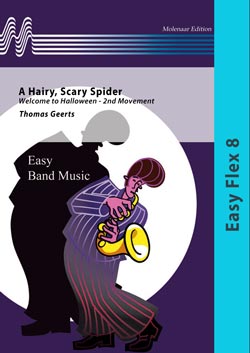
A Hairy, Scary Spider - Thomas Geerts
A Hairy Scary Spider is the second part of the musical theatre piece Welcome to Halloween. This piece can be ordered separately or as part of the complete set. The piece describes a day in the life of a hairy, scary spider. In the beginning you aren't really sure what you are looking at. Is it a ball of wool or a big shadow? It turns out to be a spider sitting happily in his web. At a certain point while the whole band is watching him carefully, he jumps which leads to an inevitable scream.
Estimated dispatch 10-14 working days
-
 £35.00
Arromanches - Albert E. Kelly/Gosling Mol
Kelly wrote this march for the 1948 Kneller Hall March Contest. With the 4/7th Dragoon Guards Kelly took part into the landing in Normandy on D Day, june the 6th 1944; actually he was injured himself at the end of july. 'ARROMANCHES' is a suiting tribute to the heroes of the Allied landings at Arromanches.
Estimated dispatch 10-14 working days
-
£90.00
Kobolt - John Brakstad
"Cobalt" was commisioned by Modum Janitsjar as own choice piece for the Norwegian Wind Band Championships, third section in 2009.The Royal Cobalt Works of Modum were established in 1773 to extract cobalt ore from the local mines. The works were in operation until 1893.The cobalt was used in the production of cobalt blue pigment for the worlds porcelain and glass industry.To day it is a museum showing us how people at that time worked and lived.Most of the work was done by hand. There were also bad accidents with many fatalites.But in their free time there were dancing and drinking, and the entire piece ends with a dance-episode including a local tune.
Estimated dispatch 7-14 working days
-
£58.00
Marsjkonkurransen - Bo-Carlsen - Haakon Esplo
"Gurines March" is a very well-known song in Norway. Lalla Carlsen made great success performing it in the Chat Noir Revue "Det er servert" ("It's Served") in 1932 and in the movie "Opp med hodet" the same year. The song is the same melody that was used for the "The Man Who Broke the Bank at Monte Carlo".Norwegian singer/banjo player Kari Svendsen is one of many performers who have made recordings of the tune from then on to this day. "Gurines March" is great for parade, where it certainly will bring a smile or two among the audience.
Estimated dispatch 7-14 working days
 View Music